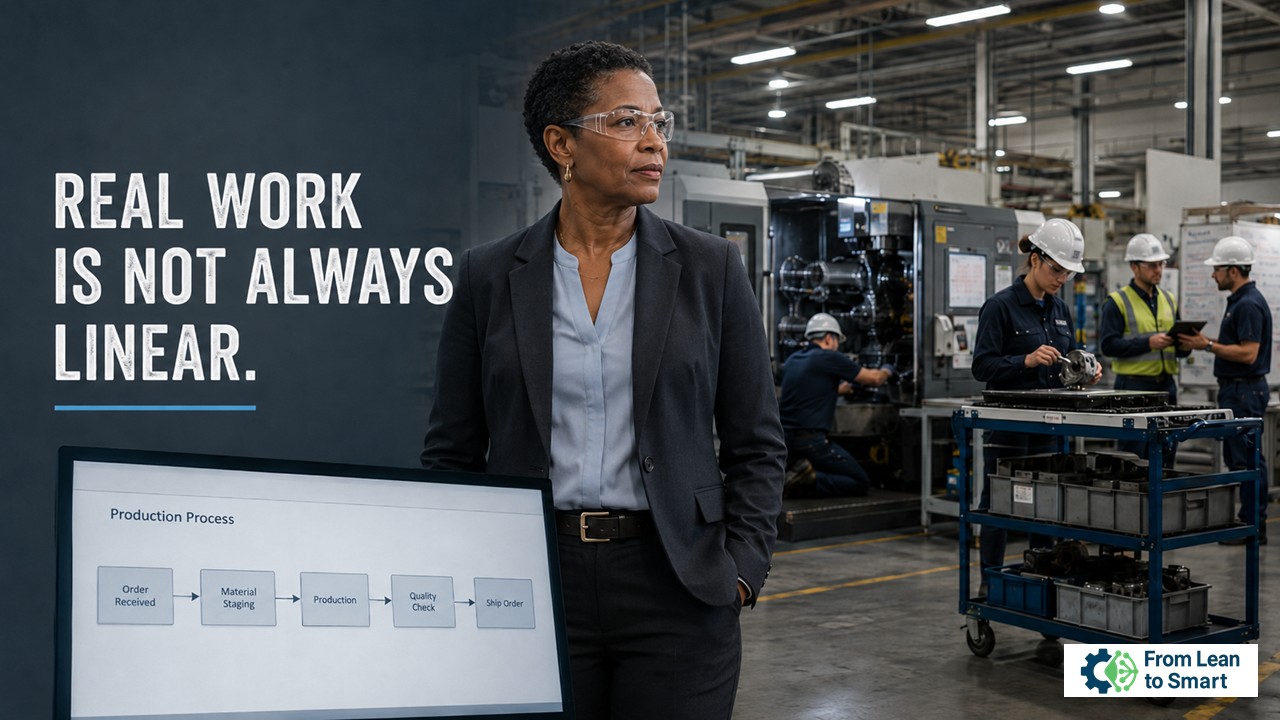
Many operational processes appear linear when they are presented in a meeting.
A request is created. A responsible person evaluates it. A decision is made. The work is executed. The result is recorded. The process is closed.
On a screen, the sequence looks logical, controlled and measurable.
On the shop floor, however, the same process may involve an urgent production order, an unavailable technician, an uncertain diagnosis, a missing spare part, a temporary quality containment, contradictory system information and a supervisor deciding whether the line can continue operating safely.
The official workflow may still exist, but it no longer explains how the work is actually being managed.
This is where conventional process thinking begins to struggle. Complex industrial work cannot always be governed solely as a predefined sequence of tasks. It must often be managed as an operational case in which the route may vary, while decision rights, evidence requirements, risk controls and closure criteria remain explicit.
The Process Does Not Disappear When the Sequence Changes
Industrial organizations frequently assume that process discipline requires every case to follow the same predefined path.
That assumption is reasonable for repetitive, stable and low-variability transactions. It becomes much less reliable when the work depends on evolving operational conditions.
Consider a recurring equipment problem.
The documented process may require production to report the issue, maintenance to diagnose it, planning to schedule the intervention, procurement to provide the required material and maintenance to close the work order.
In practice, the appropriate sequence depends on the context:
- Is the asset critical to the current production plan?
- Does the failure affect safety, quality, availability or only production speed?
- Can the equipment continue operating under a temporary restriction?
- Is a qualified technician available?
- Is the spare part physically available, regardless of what the system indicates?
- Has the same failure mode occurred before?
- Is the observed symptom caused by the asset itself or by another process condition?
- What is the operational consequence of delaying the intervention?
These questions are not secondary details. They determine what the organization should do next.
The work cannot always be managed by moving a task mechanically from one predefined box to another. The people involved must interpret the operating condition, evaluate risk and determine the appropriate response.
That does not mean that the process has become uncontrolled.
It means that the process is contextual rather than purely sequential.
Linear Workflows Coordinate Tasks. Contextual Work Coordinates Decisions.
A linear workflow is designed primarily around sequence:
First perform this activity. Then obtain this approval. Send the result to the next role. Close the task when the required fields have been completed.
Contextual work is organized around a different question:
Given what is currently known, what should happen next?
The distinction is fundamental.
In complex operational environments, the next action may depend on asset condition, production status, quality exposure, safety consequences, technical uncertainty, available resources, historical evidence and the cost of delaying the decision.
The process therefore becomes less like a fixed route and more like a governed operational case.
Mandatory controls, approved procedures, escalation rules and standard activities still apply. However, the route through them may change according to the circumstances.
This pattern is common in:
- maintenance troubleshooting;
- quality incidents and containment;
- supplier deviations;
- engineering changes;
- customer complaints;
- production recovery;
- industrial launches;
- recurring equipment instability;
- cross-functional root-cause investigations.
Forcing these situations into an excessively rigid workflow usually produces one of two outcomes.
Either the workflow obstructs legitimate operational action, or employees create workarounds outside the official system.
The first outcome reduces responsiveness. The second reduces visibility, traceability and organizational learning.
Context Is an Operational Variable
The term context should not be interpreted as a vague appeal to experience or intuition.
In industrial operations, context consists of identifiable conditions that influence the decision, such as:
- asset criticality;
- current production demand;
- safety and quality exposure;
- failure history;
- available skills and resources;
- physical material availability;
- system data quality;
- temporary operating restrictions;
- customer impact;
- residual technical risk;
- the reversibility of the proposed action.
A mature process does not ignore these variables. It makes them visible and incorporates them into decision-making.
This is particularly important where several systems contain different parts of the operational reality. ERP may contain the planned material position. MES may contain the active production order and current recipe. CMMS or EAM may contain equipment history. QMS may contain the containment status. None of these systems, in isolation, necessarily represents the complete case.
The organization must therefore coordinate not only tasks, but also the interpretation of distributed operational information.
Standardization and Adaptability Are Not Opposites
When organizations recognize the need for flexibility, they sometimes move too far in the opposite direction.
They conclude that complex work cannot be standardized and must therefore depend entirely on experience, personal judgment and informal coordination.
That conclusion is equally dangerous.
Contextual work still requires structure. In many cases, it requires stronger governance than routine work because the consequences of a poor decision may be significant.
The objective is not to eliminate standards. It is to standardize the elements that must remain stable while preserving controlled discretion where professional judgment is necessary.
For example, a quality deviation process may standardize:
- the minimum information required to open the case;
- containment and traceability requirements;
- authorized decision roles;
- risk-assessment criteria;
- evidence required before product release;
- escalation conditions;
- maximum response times;
- final documentation;
- the criteria for operational closure;
- the post-resolution learning review.
What cannot always be standardized is the exact route between detection and resolution.
One deviation may require laboratory analysis. Another may require supplier involvement. A third may be traced to an incorrect MES recipe. A fourth may result from equipment deterioration and require maintenance intervention. A fifth may involve a measurement-system problem rather than a product defect.
The route may differ, but the governance should remain consistent.
This is a more mature form of process management than assuming that every operational situation will follow the same flowchart.
At the same time, contextuality must not become a justification for undocumented decisions, weak discipline or excessive dependence on individual experience. Adaptability is valuable only when it remains visible, authorized and accountable.
The Hidden Cost of Designing Around the Happy Path
Most process maps are designed around expected behaviour.
They represent how work should proceed when information is available, systems are aligned, resources are accessible and no significant exception occurs.
Industrial operations, however, are often defined by what happens when one of those assumptions fails.
A planner releases an order, but the ERP material status does not reflect the physical stock.
A maintenance work order is technically complete, but the equipment remains unstable during production.
A quality alert is closed in the workflow, but containment continues informally because confidence in the process has not been restored.
A production deviation is approved, but the decision is not reflected in the MES logic used by operators.
A spare part is shown as available, but it cannot be located physically.
A corrective action is marked as complete, but the underlying failure mechanism has not been removed.
In each case, the process may appear complete from a system perspective while remaining unresolved operationally.
This is not merely a software-integration problem. It reflects a deeper design weakness: the organization has modelled task completion, but not operational resolution.
The distinction matters.
A task is complete when the assigned activity has been executed or its required fields have been populated.
An operational issue is resolved only when the relevant risk has been removed, controlled, transferred or explicitly accepted by the authorized decision owner.
When performance is measured primarily through workflow status, employees may learn how to close activities without necessarily closing the underlying operational exposure.
BPM Must Govern the Case, Not Only the Route
A stronger BPM approach begins by recognizing that some operational processes have a stable objective but a variable path.
The objective may be to:
- restore equipment reliability;
- protect the customer;
- authorize or reject a deviation;
- recover production safely;
- resolve a supplier problem;
- stabilize a process;
- determine and eliminate a root cause.
BPM should establish the control environment around that objective.
This includes:
- clear case ownership;
- explicit decision rights;
- required evidence;
- visible process state;
- obligations and deadlines;
- escalation logic;
- approved alternative actions;
- cross-system information;
- traceable deviations;
- risk acceptance;
- closure criteria;
- learning after resolution.
This changes the role of process technology.
The system is no longer merely a workflow engine that pushes tasks between departments. It becomes an operational coordination layer that allows participants to understand:
- the current state of the case;
- the decisions already made;
- the evidence supporting those decisions;
- the unresolved risks;
- the obligations still open;
- the next actions that are permitted;
- the person accountable for the final outcome.
MES, CMMS/EAM, QMS, ERP and BPM platforms may each contain part of the required context. The central challenge is not simply to connect these systems technically. It is to ensure that their information supports a coherent operational decision.
Without that coherence, employees must reconstruct the case through telephone calls, spreadsheets, email chains, messaging applications and personal memory.
The work may continue, but the organization loses repeatability, traceability and institutional knowledge.
Process Mining Can Reveal Variability, but It Cannot Interpret It Alone
Process mining can make contextual work visible by identifying loops, delays, repeated activities, skipped steps, rework and alternative routes.
This visibility is valuable, but it can also be misinterpreted.
A deviation from the dominant process path is not automatically evidence of waste or noncompliance.
It may represent poor discipline. It may also represent a necessary response to an operational condition that the official process model failed to anticipate.
Event logs alone cannot reliably determine the difference.
Operational interpretation is essential.
Process variation can be divided into at least three categories:
Uncontrolled variation results from weak process discipline, incomplete training, system avoidance, unclear ownership or informal workarounds.
Legitimate variation results from a real operating condition that requires a different response.
Designed variation occurs when the process explicitly recognizes alternative paths and governs the conditions under which each path may be used.
Before redesigning a process around its most common route, leaders should understand why the other routes exist.
Some should be eliminated. Some should be formalized. Some should remain exceptional but governed. Others may reveal that the official process does not reflect shop-floor reality.
The objective is not to make every process trace identical. It is to distinguish uncontrolled variation from justified operational adaptability.
Better Process Management Begins with Better Questions
When reviewing a complex operational process, leaders should move beyond asking whether employees followed the prescribed sequence.
They should ask:
- What information changed the direction of the work?
- Which decisions required professional judgment?
- Which contextual variables were relevant?
- Where did employees leave the official system, and why?
- Which exceptions were predictable enough to govern in advance?
- Which controls protected the operation?
- Which controls created delay without reducing risk?
- Where were decision rights unclear?
- What evidence was required to determine that the issue was genuinely resolved?
- Who was authorized to accept the remaining risk?
- Did the process close because the work was complete, or because the system required a status change?
- Was the learning from the case incorporated into standards, maintenance strategies or process design?
These questions lead to a more realistic process architecture because they begin with how operational work is actually performed.
The Objective Is Not Process Freedom, but Governed Adaptability
Factories do not need processes that allow unrestricted improvisation.
They also do not need rigid workflows that become ineffective whenever reality is more complex than the diagram.
They need operating systems that combine standards, context, evidence, accountability and professional judgment.
Linear workflows will remain valuable for stable, repetitive and predictable work. However, when uncertainty, exceptions and cross-functional decisions dominate, the organization must manage the work as a contextual case.
That shift transforms BPM from an administrative modelling exercise into a genuine operational capability.
The process is no longer defined only by the route that employees follow. It is defined by how effectively the organization understands the situation, evaluates the relevant risk, makes the next decision and preserves accountability while conditions evolve.
Process maturity is not demonstrated by making every case look identical.
It is demonstrated by ensuring that different cases remain visible, governed, evidence-based and operationally resolved.
Questions for Reflection
- Which of your operational processes appears linear in the system but behaves contextually in practice?
- Where are employees creating workarounds because the official workflow cannot respond to real operating conditions?
- Does your process governance control task completion, or does it ensure that the underlying operational issue has actually been resolved?
- Which forms of process variation in your organization are uncontrolled, legitimate or already designed?
- Are decision rights and residual-risk acceptance as clearly defined as task ownership?
#BPM #OperationalExcellence #ProcessMining #SmartFactory #MES #IndustrialMaintenance #AssetManagement #ManufacturingExcellence #ProcessGovernance #IndustrialTransformation