
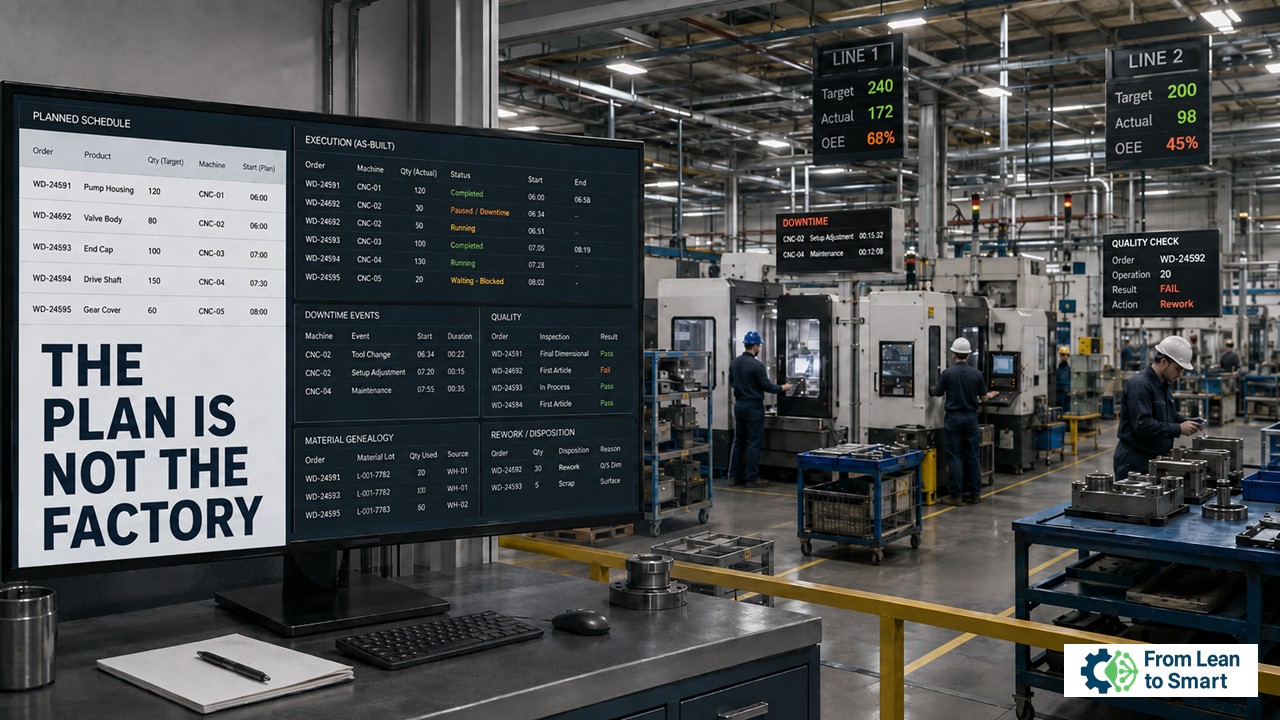
Most factories are highly capable of creating plans.
Production orders are released. Sequences are defined. Materials are allocated. Targets are established. ERP records what should happen. Planning meetings continually refine what should happen next.
Then the shift begins.
A machine loses 18 minutes to a minor stop. Material arrives late. Quality places a batch on hold. An operator change increases cycle time. Planned volume is divided between two lines. Rework becomes necessary. Maintenance intervenes between orders. A process parameter is adjusted within an approved range.
By the end of the shift, the required production volume may still be achieved.
But the path followed is no longer the path that was planned.
That distinction is fundamental to MES/MOM.
The schedule represents operational intent. Performance provides evidence of operational execution.
The difference between them is not an inconvenience to be hidden. It is one of the most valuable sources of operational knowledge available to manufacturing.
If a manufacturing system cannot reliably connect expected execution with observed execution, it may know what was planned and collect thousands of shopfloor signals, yet still fail to answer one of the most important questions in digital operations:
What actually happened, in the context of what was supposed to happen?
A production order is not proof of execution
This appears obvious, yet many industrial architectures implicitly treat transactional completion as evidence of physical execution.
ERP releases an order for 500 units.
Later, 500 units are reported as completed.
Transactionally, the order may appear complete.
Operationally, important questions remain.
Which equipment produced the units?
When did execution actually begin and end?
Was the planned routing followed?
Which material lots were physically consumed?
Were substitutions required?
Which operators or teams performed the work?
Were expected process conditions maintained?
How much scrap or rework occurred?
Which equipment events affected the order?
Were required inspections executed at the appropriate points?
Were all 500 units produced under equivalent conditions?
Did execution follow the planned sequence?
The difference is between declaring a result and preserving sufficient evidence to reconstruct how that result was achieved.
That is one of the central responsibilities of MES/MOM.
Not because manufacturing needs more data.
Because quality, traceability, maintenance, Operational Excellence, and management decisions depend on understanding the relationship between intention and execution.
Operations Schedule: intended execution
In ISA-95-oriented architectures, an Operations Schedule represents planned operational work.
For production, it provides the execution layer with the context required to perform manufacturing activities.
Depending on process type and system architecture, that context may include:
- product or process requirements;
- required quantity;
- planned timing;
- equipment or equipment-class requirements;
- personnel requirements;
- material requirements;
- relevant specifications or parameters;
- priority and sequence.
The exact implementation is less important than the underlying concept.
The schedule describes expected work.
ERP may originate demand or production orders.
Advanced Planning and Scheduling may optimise sequence and resource allocation.
MES/MOM may receive the relevant production requirements and translate them into executable operations closer to the shopfloor.
But the schedule remains an expression of intent.
It does not prove that execution occurred as planned.
Operations Performance: evidence of execution
Operations Performance represents what occurred during execution.
It moves manufacturing from expected conditions to observed results.
Depending on the required level of detail, performance information may include actual quantities, equipment used, material consumed, personnel involvement, timestamps, executed process segments, scrap, rework, quality results, downtime, deviations, and relevant process conditions.
This distinction matters because production almost never follows the plan perfectly.
That is not automatically a failure.
Industrial operations contain legitimate variation.
The management challenge is to distinguish between:
- acceptable variation;
- authorised deviation;
- recoverable loss;
- abnormality;
- non-conformance;
- process instability;
- execution failure.
That distinction becomes difficult when planned and actual information are mixed together.
A sound MES/MOM information model preserves the difference between what was expected and what was observed.
That difference is where operational learning begins.
Not all “actual” data has the same evidential value
There is an additional distinction that matters in practice.
A value can appear to be actual while still not being direct evidence of execution.
Consider equipment identification.
The planned order specifies Machine A.
If the system automatically copies Machine A into the production record and calls it “actual equipment,” the database contains an actual field—but not necessarily an observed fact.
The same problem can occur with materials, labour, routing, timestamps, and process parameters.
For trustworthy execution history, organisations should understand the provenance of important data.
Was the information:
- planned;
- copied from a standard;
- manually declared;
- automatically observed;
- inferred from system context;
- calculated from other events;
- imported from another authoritative system?
These distinctions matter.
A manually confirmed material issue and an automatically scanned lot may both be legitimate records, but they represent different evidence mechanisms.
A calculated runtime and an equipment-state history may both describe production duration, but they are not identical observations.
The objective is not to distrust anything that is not automatically captured.
It is to avoid representing assumptions as observations.
Good execution evidence requires provenance, not merely populated fields.
Why the distinction matters operationally
Operations Schedule and Operations Performance can sound like terminology for architects.
Their importance is much broader.
The plan-versus-execution relationship sits behind questions factories ask every day.
Why did this order require more time than expected?
Why was the scheduled quantity not completed?
Why did material consumption exceed standard?
Why was different equipment used?
Why did execution occur in a different sequence?
Why did the batch require rework?
Why did labour consumption differ from expectation?
Why did OEE deteriorate during an order that still achieved its final output?
Why are production costs increasing while daily volume appears stable?
These are not merely reporting questions.
They are questions about execution variance.
MES/MOM becomes valuable when it can connect intended operations with sufficient evidence to explain those differences.
Context is the essential architectural function
A useful architectural perspective is to examine the relationship between enterprise planning, manufacturing operations, and lower-level automation.
ERP and related business systems operate around demand, orders, inventory, costing, and enterprise commitments.
MES/MOM operates closer to production execution and manufacturing operations management.
Automation systems, equipment, control platforms, historians, and connected devices provide machine states, process values, counts, alarms, and other detailed operational signals.
Each contributes a different part of the picture.
A machine controller may know that a cycle occurred.
A historian may know the process temperature during that cycle.
MES/MOM should be able to associate that cycle with the relevant production context.
ERP should understand how confirmed production affects inventory, orders, and business commitments.
The important capability is not merely connectivity between layers.
It is contextual continuity.
Without it, a plant may have excellent machine connectivity and still struggle to answer:
What exactly occurred while this order, batch, or unit was being produced?
That is why MES/MOM should not be reduced to visualisation or data collection.
Its value lies partly in connecting physical execution with the operational context that gives that execution meaning.
The dangerous shortcut: turning the plan into the actual
One of the most damaging MES implementation shortcuts is to allow planned values to become substitutes for observed execution.
The production order expects Machine A, so Machine A is automatically recorded as the equipment used.
The bill of material expects Material X, so Material X is assumed to have been consumed.
The routing specifies Step 3 after Step 2, so the system assumes that sequence occurred.
The labour standard expects two operators, so the reported labour is derived from the standard.
This produces clean data.
It may also produce misleading data.
The problem becomes visible when operations change.
Machine A becomes unavailable and production moves to Machine B.
An authorised substitute material is consumed.
One process step must be repeated.
Part of the order requires rework.
A quality hold changes the sequence.
Actual labour increases because the process becomes unstable.
If the system replaces those events with expected values, the distinction between standard and variance disappears.
The database may appear controlled.
The operation becomes less observable.
This is especially damaging because downstream analytics can still operate successfully on the data.
Dashboards calculate.
Reports reconcile.
Process Mining discovers apparently orderly paths.
AI models detect patterns.
But if planned values have silently replaced actual execution, sophisticated analysis can merely produce sophisticated conclusions from weak evidence.
As-built evidence does not mean capturing everything
The opposite mistake is equally common.
Some MES programmes respond to traceability and operational visibility requirements by attempting to capture every possible shopfloor event.
Every signal.
Every screen action.
Every parameter.
Every timestamp.
Every micro-state.
The result can be enormous data volume with limited operational meaning.
The objective should not be maximum capture.
It should be sufficient evidence to reconstruct and explain execution at the level required by operational, quality, regulatory, and improvement needs.
For one production process, that may require:
- planned versus confirmed quantity;
- actual start and completion;
- equipment used;
- material genealogy;
- relevant process parameters;
- actual routing or process path;
- quality status;
- significant downtime;
- scrap and rework.
Another process may require considerably more or less.
A regulated process may require detailed electronic production records.
A traceability-critical component may require serial-level genealogy.
A high-volume continuous or batch process may require a different relationship between aggregated records and detailed event history.
There is therefore no universal requirement to capture everything at the finest possible granularity.
MES/MOM design requires judgement.
Evidence should be designed around risk and decision requirements, not around the technical ability to collect data.
A practical factory example
Consider a production schedule requiring 1,200 units on Line 2 during the morning shift.
The plan appears straightforward.
MES receives the order, product, target quantity, expected routing, and relevant process requirements.
Production begins.
After 280 units, a feeder problem creates intermittent stops.
Maintenance intervenes but does not fully replace the component because no suitable planned window exists.
Production continues.
Later, a quality check identifies variation approaching a specification limit. Inspection frequency is increased and one process parameter is adjusted within its authorised range.
At 760 units, the line stops again.
Production transfers the remaining volume to Line 3, where a compatible configuration is available.
The shift ends with 1,180 good units and 20 units requiring rework.
Now compare two information environments.
The first ultimately reports:
Planned quantity: 1,200
Completed quantity: 1,200
That may eventually be sufficient for some inventory transactions.
Operationally, however, most of the production story has disappeared.
A stronger MES/MOM environment could preserve evidence that:
- 760 units were produced on Line 2;
- 420 units were produced on Line 3;
- actual production start and stop times differed from plan;
- feeder-related downtime occurred;
- maintenance intervened during execution;
- quality inspection frequency was increased;
- an authorised parameter adjustment occurred;
- defined units or batches were affected;
- 20 units entered rework;
- actual material and equipment genealogy differed from the original plan;
- final good quantity was confirmed after rework.
Now the organisation has more than a completion transaction.
It has an execution history.
That evidence can support quality investigation, reliability analysis, OEE interpretation, traceability, cost analysis, process improvement, and future planning.
The value is not that MES captured more data. The value is that the organisation can reconstruct the operational truth with sufficient confidence.
Schedule versus performance is also an Operational Excellence question
Lean management depends heavily on understanding the difference between expected and actual conditions.
Standard work establishes a baseline.
Abnormality becomes visible when reality departs from that baseline.
A similar principle applies to digital execution management.
The schedule defines expected execution.
Operations Performance records observed execution.
The difference deserves management attention.
Not every variance represents waste.
Not every schedule deviation represents poor discipline.
But repeated differences contain information.
Perhaps setup standards are unrealistic.
Perhaps a bottleneck is protected by hidden buffers.
Perhaps quality containment repeatedly changes routing.
Perhaps planned cycle time no longer reflects the actual product mix.
Perhaps certain material conditions systematically extend processing time.
Perhaps maintenance-related micro-stops are absorbed operationally without becoming visible in conventional production reporting.
When schedule and execution evidence are connected, MES/MOM can make these patterns visible systematically.
That creates a practical bridge between manufacturing systems and Operational Excellence.
OEE becomes more useful when losses retain production context
OEE can be calculated correctly and still interpreted poorly.
One reason is loss of operational context.
A speed loss during one product may have a different explanation from the same apparent loss during another.
A changeover may distort availability if operating states are poorly classified.
A reduced production rate may be expected for one variant and abnormal for another.
Scrap may be concentrated after a material change rather than distributed uniformly across the order.
An aggregated OEE value can identify that performance deteriorated.
It does not necessarily explain why.
Connecting performance losses with orders, products, equipment states, materials, process conditions, and production sequence creates more useful questions.
Instead of asking:
Why was OEE 67%?
the factory can ask:
Which production conditions and execution events generated the losses represented by that 67%?
The second question is much closer to actionable problem-solving.
The same evidence improves cost analysis
Manufacturing cost models depend heavily on standards.
Standard cycle time.
Standard labour.
Standard material consumption.
Standard routing.
Those standards are essential for planning, commercial decisions, and cost control.
Improvement, however, requires visibility into where actual execution differs from those assumptions.
If a product consistently consumes more equipment time than the standard assumes, the explanation may involve operations, engineering, maintenance, product design, or commercial assumptions.
If rework is systematically under-recorded, apparent cost performance becomes misleading.
If production regularly uses alternate equipment with different productivity, the standard routing may no longer represent the normal operating model.
MES/MOM should not replace enterprise costing.
It can, however, provide execution evidence that helps explain why actual operational economics diverge from expectations.
That is a much stronger role than simply feeding another production report.
Variance must become part of a management system
Another common anti-pattern is to capture schedule and performance successfully and then stop at dashboards.
Plan versus actual quantity.
Planned versus actual runtime.
Target versus output.
These indicators are useful.
They are not sufficient.
The more important question is what happens after a relevant deviation is detected.
Who owns the investigation?
Which variance thresholds matter?
Can supervisors see the execution context behind the difference?
Can maintenance associate production loss with equipment history?
Can quality identify affected material or units?
Can planning determine whether an assumed rate is unrealistic?
Can Industrial Engineering revise a standard when repeated evidence justifies it?
Can Process Mining identify recurring execution variants?
Can lessons from actual performance influence the next schedule?
MES/MOM creates more value when variance becomes part of a closed management loop:
plan → execute → observe → explain → learn → adjust
Without the final steps, plan-versus-actual remains reporting.
With them, it becomes operational learning.
Visibility creates value only when it improves the next decision or the next standard.
Before implementing this capability, check whether…
- the organisation clearly distinguishes planned information from execution evidence;
- production orders contain enough context for MES/MOM to orchestrate execution without simply reproducing ERP structures;
- equipment, material, personnel, and process master data are governed;
- actual equipment and material usage can be recorded rather than automatically inferred from the plan;
- the provenance of important execution data is understood;
- downtime, scrap, rework, and quality deviations can be associated with the relevant production context;
- the required genealogy level is explicitly defined: order, batch, lot, serial, or another appropriate level;
- timestamps and event definitions are sufficiently consistent to reconstruct execution;
- relevant plan-versus-performance variance has an accountable owner;
- ERP, MES/MOM, quality, maintenance, and automation systems share sufficiently consistent information semantics;
- the organisation knows which execution evidence is genuinely required for compliance, traceability, reliability, improvement, and decision-making.
If those foundations are weak, additional interfaces will not create trustworthy execution history.
They will simply move ambiguous information faster.
From reporting completion to understanding execution
The distinction between Operations Schedule and Operations Performance may initially appear technical.
Operationally, it represents one of the most important principles in manufacturing digitalisation:
the plan is not the factory.
The production order is not proof of the process.
The routing does not prove that the routing was followed.
Standard material consumption is not actual consumption.
Planned equipment is not necessarily the equipment that produced the part.
A completion transaction is not necessarily sufficient evidence to explain execution.
MES/MOM earns its place in the industrial architecture when it helps preserve these distinctions.
It receives operational intent.
It supports execution.
It records relevant evidence.
It preserves context and provenance.
It exposes meaningful variance.
And it returns trustworthy performance information to the wider manufacturing and enterprise environment.
The objective is not to move from “we think this happened” to a larger database.
It is to move towards:
“This is the evidence of how production was actually executed, and this is how it differed from what we intended.”
For traceability, quality, maintenance, Operational Excellence, costing, and continuous improvement, that distinction is fundamental.
Three questions are therefore worth asking:
Can your factory reconstruct how an order was actually executed, or can it only confirm that the order was completed?
Where are planned, standard, or inferred values still being presented as though they were observed shopfloor facts?
When schedule and performance diverge, does the organisation merely report the variance—or does it use the evidence to improve the next operational decision?
#MES #MOM #SmartFactory #OperationalExcellence #ISA95 #ManufacturingExcellence #ProcessMining #IndustrialData #Traceability #LeanManufacturing