Process mining can reveal that a process is not behaving the way management believes it is.
That capability is already valuable.
It can expose repeated loops, unexpected sequences, waiting, rework, bypassed activities, bottlenecks, and process variants that remain invisible in the official workflow.
But discovering the real process creates a more difficult question:
What should the organisation do about it?
That is where the discussion moves beyond process visibility towards operational intelligence.
A factory does not improve because an algorithm discovers 47 process variants.
A maintenance organisation does not become more reliable because conformance analysis reveals repeated deviations.
Quality does not improve because a dashboard highlights rework loops.
And AI does not create operational value simply because it can describe those patterns in natural language.
Value appears when the organisation can connect observed behaviour with operational context, consequence, decision rights, action, and subsequent outcomes.
Process mining helps reconstruct how work was recorded as having happened. Operational intelligence helps the organisation understand what that behaviour means and what decision should follow. AI can support that reasoning.
That is a considerably more demanding ambition.
Process mining is a mirror, not an operating system
One of process mining’s greatest strengths is its ability to challenge the designed process.
Most organisations have process models.
They describe how purchasing should work, how a maintenance notification should become a work order, how a non-conformance should be contained, how production deviations should be escalated, or how engineering changes should be approved.
Operational reality is usually more complex.
Cases move backwards.
Activities are repeated.
Approvals happen late.
People bypass steps.
Systems disagree about status.
Work continues physically while the transactional process appears to be waiting.
Exceptions gradually become normal practice.
Process mining can make those behaviours visible from event data.
But visibility should not be confused with judgement.
A deviation is not automatically waste.
A loop is not automatically failure.
A longer path is not automatically inferior.
Sometimes the process is poorly disciplined.
Sometimes the designed model is unrealistic.
Sometimes an exception represents exactly the adaptation that operational circumstances required.
And sometimes an apparently harmless transactional deviation represents serious risk on the shopfloor.
An event log can show the behaviour represented by the recorded events. It cannot determine, by itself, whether that behaviour was operationally appropriate.
Interpretation still requires context.
The digital footprint is not the entire operation
This limitation becomes particularly important in industrial environments.
Consider a maintenance process.
Process mining may show that some work orders repeatedly move from diagnosis to execution, back to diagnosis, and then into another execution activity before closure.
A purely transactional interpretation might classify that pattern as rework.
Perhaps it is.
But several operational realities could produce the same process trace.
The first repair may have been ineffective.
The initial diagnosis may have been wrong.
The technician may have discovered a second failure mode during intervention.
Production may have required a temporary restoration because the asset could not be released for the complete repair.
A required spare may have been unavailable.
Or the CMMS may force technicians to close and reopen transactions because it cannot represent evolving troubleshooting appropriately.
These situations can look similar in an event log.
Operationally, they are fundamentally different.
This is why process behaviour becomes more meaningful when it is connected to case context such as:
- asset criticality;
- equipment condition and machine state;
- production schedule and constraint status;
- downtime consequence;
- spare-parts availability;
- maintenance history;
- condition-monitoring evidence;
- technician findings;
- temporary operating controls;
- decisions made under production pressure.
The process path matters.
But the context determines what that path means.
Process mining should produce better questions
The most valuable process-mining initiatives should not finish with a spaghetti diagram.
They should create better operational questions.
Why do apparently similar quality cases close in four hours in one situation and remain open for three days in another?
Why are certain maintenance orders repeatedly reopened?
Why does one site bypass a particular approval more frequently than another?
Why does rework increase after specific combinations of process activities?
Why do some production abnormalities escalate immediately while others remain unresolved across shifts?
Why does one material flow consistently require more steps than the designed process predicts?
Those questions move the organisation from process discovery towards diagnosis.
Once they become specific, additional operational information becomes relevant.
MES/MOM can provide execution context.
CMMS/EAM can provide asset and maintenance history.
QMS can provide non-conformance, inspection, and disposition data.
ERP can provide material, production, and business context.
Historians can provide actual process conditions.
Master data can connect products, assets, recipes, process segments, materials, and organisational structures.
The organisation is no longer merely mining a process.
It is reconstructing the operational situation behind the process behaviour.
That is the foundation required if AI is expected to support decisions rather than simply summarise dashboards.
The next step is not simply “add AI”
There is an understandable temptation to treat AI as the natural next technology layer.
Process mining detects the pattern.
AI explains the pattern.
AI recommends the action.
The problem appears solved.
Industrial operations require considerably more caution.
Suppose process mining identifies that quality incidents involving one operation enter rework loops more frequently than expected.
An AI system could help relate those cases to machine parameters, material batches, maintenance events, process versions, and previous corrective actions.
Useful.
It might identify plausible interventions such as:
inspection of tooling condition;
temporary adjustment of sampling;
review of a material lot;
or maintenance intervention.
Also potentially useful.
But before any recommendation becomes operational, several questions remain.
Is the proposed action permitted by the approved process?
What evidence supports the recommendation?
How strong is that evidence?
Which production is currently exposed?
Who owns the decision?
Can production continue safely and within quality requirements?
Could the action affect regulatory or customer obligations?
What happens if production, quality, maintenance, and engineering disagree?
How is the final decision recorded?
How will the organisation determine later whether the action improved the situation?
Without those mechanisms, AI remains an analytical assistant.
It has not yet become part of an operational-intelligence capability.
Operational intelligence requires decision models
Industrial organisations often invest heavily in process models.
They invest much less effort in explicitly modelling decisions.
Consider a production abnormality.
The formal workflow might state:
detect issue → notify supervisor → involve quality → investigate → correct → verify → close.
But the operational difficulty usually exists between those activities.
Should production stop?
Should containment expand?
Should maintenance intervene immediately?
Can the current order continue?
Should material be blocked?
Does engineering need to approve a parameter change?
How much evidence is required before restart?
Who can accept temporary operating risk?
Those are decision questions.
And they are often more important than the activity sequence itself.
A mature operational-intelligence capability should therefore make several elements explicit:
- the decision to be made;
- the accountable decision owner;
- relevant evidence requirements;
- applicable standards and constraints;
- authorised alternatives;
- escalation criteria;
- risk-acceptance authority;
- conditions for review or reversal;
- expected evidence of outcome.
AI can contribute by assembling the information required around these decision points.
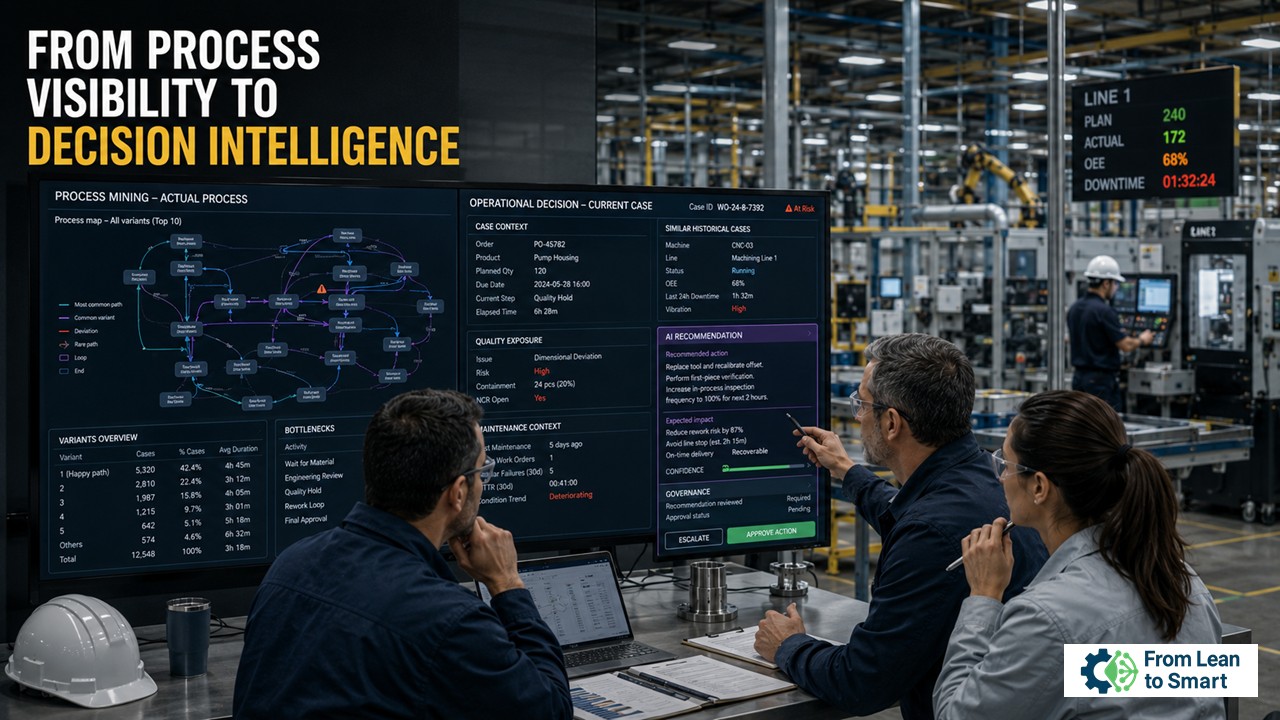
A useful decision-support environment might present:
the current process and equipment state;
similar historical cases;
known failure patterns;
maintenance history;
quality exposure;
material genealogy;
production priorities;
applicable procedures;
previous interventions and outcomes;
and alternative actions with their constraints.
The accountable professional then makes or approves the decision.
The important evolution is from:
“Here is an anomaly.”
to:
“Here is the operational situation, the relevant evidence, the available options, the constraints, and the reasoning behind the proposed action.”
That is a stronger and more credible role for Industrial AI.
A practical manufacturing example
Consider a recurring dimensional defect on an automated production line.
The defect is intermittent.
Quality contains affected parts.
Production makes adjustments within the approved operating range and restarts.
Maintenance inspects the equipment.
The condition disappears.
Two weeks later, it returns.
Traditional reporting may present these events as several independent quality incidents.
Process mining provides a different perspective.
Across historical cases, it identifies a recurring pattern:
quality alert;
containment;
parameter adjustment;
temporary recovery;
maintenance inspection;
case closure;
followed by another similar incident later.
The repeated process loop is significant.
But it still does not explain the physical mechanism behind the problem.
Additional context is then introduced.
MES/MOM links the events to product variants and equipment configuration.
Genealogy connects affected production with material batches.
The historian provides relevant process conditions before each defect.
CMMS/EAM provides component history and previous interventions.
Quality records provide inspection results and previous dispositions.
Now the process pattern becomes operationally richer.
Several cases may share a combination of:
a particular product family;
progressive tooling degradation;
parameter correction after initial defect detection;
and a maintenance intervention that restores the condition temporarily without replacing the degrading component.
AI can now assist with evidence synthesis.
It can retrieve similar historical events.
It can highlight that parameter correction repeatedly restored output but did not prevent recurrence.
It can identify the relevant maintenance history and governed troubleshooting procedures.
It may propose evaluating tooling replacement during the next feasible intervention opportunity rather than repeating the same temporary correction.
That recommendation may be valuable.
But it is still not the final operational decision.
Production may be executing an important order.
Quality may require wider containment.
Maintenance may not have the replacement component immediately available.
Planning may have alternative capacity.
Equipment condition may be deteriorating.
The recommendation therefore enters a governed decision process.
That is the transition from identifying process patterns to improving operational decisions.
Frequency is not the same as operational priority
AI and process analytics create another potential trap.
They are highly effective at identifying what occurs frequently.
Operations may care more about what matters consequentially.
The most common deviation is not necessarily the most important deviation.
A frequent administrative loop may consume considerable processing time but create limited operational exposure.
A rare deviation in a quality-release process may create customer risk.
A rare maintenance escalation may involve a high-consequence asset.
A low-frequency process variant may affect the production constraint during a critical demand period.
Operational intelligence therefore requires more than process frequency or statistical prominence.
It needs consequence.
Relevant dimensions may include:
- safety;
- product quality;
- asset criticality;
- delivery exposure;
- cost;
- customer impact;
- production constraints;
- regulatory significance;
- recoverability.
AI can help prioritise patterns only when the organisation has made these priorities explicit.
Otherwise, analytical systems tend to optimise whatever is easiest to measure.
AI can scale poor interpretations
There is also a subtler risk.
Process mining can produce technically valid observations that are interpreted incorrectly.
AI can scale that misinterpretation.
Suppose one process variant has longer throughput time than the standard path.
The obvious optimisation objective might be to eliminate it.
But the variant may represent a necessary escalation route for high-risk quality cases.
Reducing its duration indiscriminately could weaken an important control.
Or process mining may show that certain maintenance cases contain more diagnostic steps than average.
AI might classify those cases as inefficient.
In reality, they may involve complex equipment where deeper diagnosis reduces the probability of repeated failure.
This is why operational optimisation objectives must themselves be governed.
Faster is not always better.
The standard path is not always the correct path.
Rare does not mean irrelevant.
Conformance does not necessarily mean effectiveness.
Domain knowledge is therefore not an optional final validation layer.
It is part of the intelligence system.
Lean remains essential
Advanced analytics does not eliminate traditional problem-solving.
Lean contributes something fundamental: the discipline of distinguishing expected condition from abnormality, going to the Gemba, testing assumptions, identifying causes, and learning through countermeasures.
Process mining can show that the digital process differs from the designed process.
AI can identify patterns across large case populations.
Neither automatically explains why.
The strongest combination is complementary.
Lean provides problem-solving discipline.
Process mining provides evidence of recorded process behaviour.
MES/MOM and operational systems provide execution context.
AI helps retrieve, connect, and interpret complex evidence.
Technical experts provide domain judgement.
Governance preserves accountability.
This is not AI replacing Lean.
It is a more evidence-rich improvement system.
BPM also evolves
Traditional BPM often starts with the designed process.
Process mining challenged that logic by exposing what transactional behaviour actually looks like.
AI creates another possibility.
Not every operational situation needs to be represented by a fully prescribed sequence.
For predictable work, workflow automation remains highly effective.
For complex cases, systems may need to govern work through boundaries, evidence requirements, decision rights, and escalation rather than attempting to prescribe every possible step.
This is particularly relevant to:
complex maintenance troubleshooting;
quality escapes;
production recovery;
supplier incidents;
engineering deviations;
and cross-functional operational cases.
These environments still require discipline.
They simply do not always require identical sequencing.
AI can support adaptive work only if the boundaries remain explicit:
mandatory controls;
authorised actions;
escalation thresholds;
process ownership;
evidence requirements;
decision authority;
and human accountability.
Flexibility without governance becomes uncontrolled variation.
Automation without sufficient flexibility can become operational bureaucracy.
A mature BPM capability must manage the boundary between both.
Architecture determines whether AI has usable context
AI-supported operational intelligence cannot exist as a disconnected chatbot.
Industrial context is distributed.
ERP contains business requirements and enterprise commitments.
MES/MOM contains production execution context.
CMMS/EAM contains asset work and maintenance history.
QMS contains inspections, non-conformance, and quality decisions.
Historians contain process behaviour.
Process-mining platforms reconstruct transactional paths.
Master-data structures provide identity, hierarchy, and relationships.
AI can help reason across those sources.
But the architecture must answer difficult questions.
Which system is authoritative for each information domain?
How current must the information be?
How are assets, products, orders, batches, and cases linked?
Can the recommendation be traced back to its evidence?
Was the evidence directly observed, manually declared, inferred, calculated, or inherited from a standard?
Which information is permitted for AI use?
How is role-based access enforced?
Where is the recommendation recorded?
How are human overrides captured?
How does learning occur without silently modifying governed process rules?
These are not secondary implementation details.
They determine whether AI-supported decisions can be trusted, explained, and governed.
Human-in-the-loop may be the target architecture
“AI-driven operations” is often interpreted as a progression towards reducing human involvement.
For many industrial decisions, that assumption deserves challenge.
AI is well suited to activities humans find difficult to perform quickly at scale:
scanning large numbers of historical cases;
retrieving relevant evidence;
connecting information across applications;
identifying recurring patterns;
comparing alternatives;
summarising complex operational situations.
Humans remain particularly important where judgement depends on unusual context, incomplete evidence, conflicting objectives, or explicit acceptance of operational risk.
They can challenge questionable assumptions.
Recognise when the data is weak.
Balance quality, production, maintenance, and customer consequences.
Decide when a supposedly similar historical case is actually different.
Accept accountability for the result.
Human-in-the-loop should therefore not always be treated as a temporary compromise until AI becomes more capable.
For decisions involving safety, product quality, significant asset exposure, or customer consequence, it may be the appropriate governance model.
Decision traceability must extend beyond the recommendation
If AI begins influencing operational decisions, traceability cannot stop at recording the final action.
The organisation should be able to reconstruct:
What situation triggered the analysis?
Which information was used?
What was the provenance of that information?
Which historical cases were retrieved?
Which constraints or standards applied?
Which alternatives were considered?
What recommendation was presented?
Who reviewed it?
Was it accepted, modified, or rejected?
Why?
What action followed?
And what happened afterward?
The final question is essential.
Without outcome feedback, the organisation cannot determine whether AI-supported decisions actually improved operations.
This creates a potentially powerful learning loop:
process behaviour → interpretation → recommendation → human decision → action → outcome → new process evidence
Process mining can then examine whether behaviour changed.
The organisation can compare recommendation, action, and result.
Repeated outcomes can influence future standards, escalation rules, decision models, and improvement priorities.
At that point, the system is doing more than analysing the past.
It is contributing to an organisational learning capability.
The near-term opportunity is reducing decision ambiguity
The most credible near-term value of Industrial AI may not be autonomous execution.
It may be reducing unnecessary ambiguity around recurring operational decisions.
A maintenance planner with hundreds of open work orders needs better prioritisation.
A quality engineer investigating recurring defects needs faster access to connected evidence.
A supervisor managing a production disruption needs relevant historical cases and current constraints.
A reliability engineer needs to distinguish chronic patterns from isolated events.
An operations leader needs to know which process deviations deserve management attention.
AI can support all of these roles.
But the objective should remain explicit:
better decisions, not merely more automation.
That principle helps prevent technology-first implementations.
A more credible maturity sequence
Organisations sometimes attempt to move directly from process mining towards AI agents.
A more robust progression is:
See the process.
Build trustworthy event data and understand actual process variants.
Interpret the process.
Use operational expertise to distinguish waste, necessary complexity, poor discipline, and weaknesses in the designed process.
Add context.
Connect process events with relevant asset, product, material, quality, production, and maintenance information.
Define the decisions.
Identify where people repeatedly need to choose, prioritise, escalate, authorise, or accept risk.
Support the decisions.
Use analytics and AI to retrieve evidence, identify patterns, compare alternatives, and structure recommendations.
Govern the decisions.
Define accountability, boundaries, authorisation, traceability, and escalation.
Learn from outcomes.
Measure what happened after the decision and feed the evidence back into process improvement.
This progression is less dramatic than announcing an autonomous factory.
It is also considerably more likely to survive contact with industrial reality.
The future is not the end of process management
AI will not make processes irrelevant.
It will make process understanding more important.
An AI agent cannot operate responsibly if nobody knows which process it belongs to.
A recommendation cannot be governed if no one owns the decision.
An automated action cannot be audited when operational context is missing.
A process-mining model cannot explain physical reality when its event data is disconnected from the shopfloor.
Future industrial systems will therefore require stronger connections between:
process;
data;
systems;
AI;
people;
and governance.
Not because factories should avoid autonomy.
Because autonomy without operational context, decision boundaries, and accountability is not maturity.
It is unmanaged risk.
From discovering behaviour to improving decisions
Process mining gave organisations an important capability:
the ability to challenge how they believe work happens with evidence of how recorded work actually behaves.
The next step should not be to automate every deviation it discovers.
The next step is to understand:
which deviations matter;
what operational context explains them;
which decisions they influence;
which consequences are at stake;
and where AI can improve those decisions responsibly.
That is the transition from process visibility to operational intelligence.
And it changes the objective substantially.
The advantage will not come simply from owning a process-mining platform.
It will not come from deploying AI agents.
It will not come from collecting more operational data.
It will come from building an organisation capable of combining process evidence, industrial context, technical judgement, and governed AI support to make better decisions—and then learning systematically from the results.
Three questions are worth asking:
When process mining exposes a deviation, can your organisation distinguish waste, necessary adaptation, and weak process design before attempting to optimise it?
Which recurring operational decisions would materially improve if AI could assemble the relevant process, asset, production, maintenance, and quality evidence at the moment of decision?
If AI influenced a critical shopfloor decision tomorrow, could you reconstruct the evidence, recommendation, human judgement, action, and eventual outcome afterward?
#ProcessMining #IndustrialAI #OperationalExcellence #BPM #SmartFactory #MES #IndustrialMaintenance #ManufacturingExcellence #ProcessIntelligence #DigitalTransformation