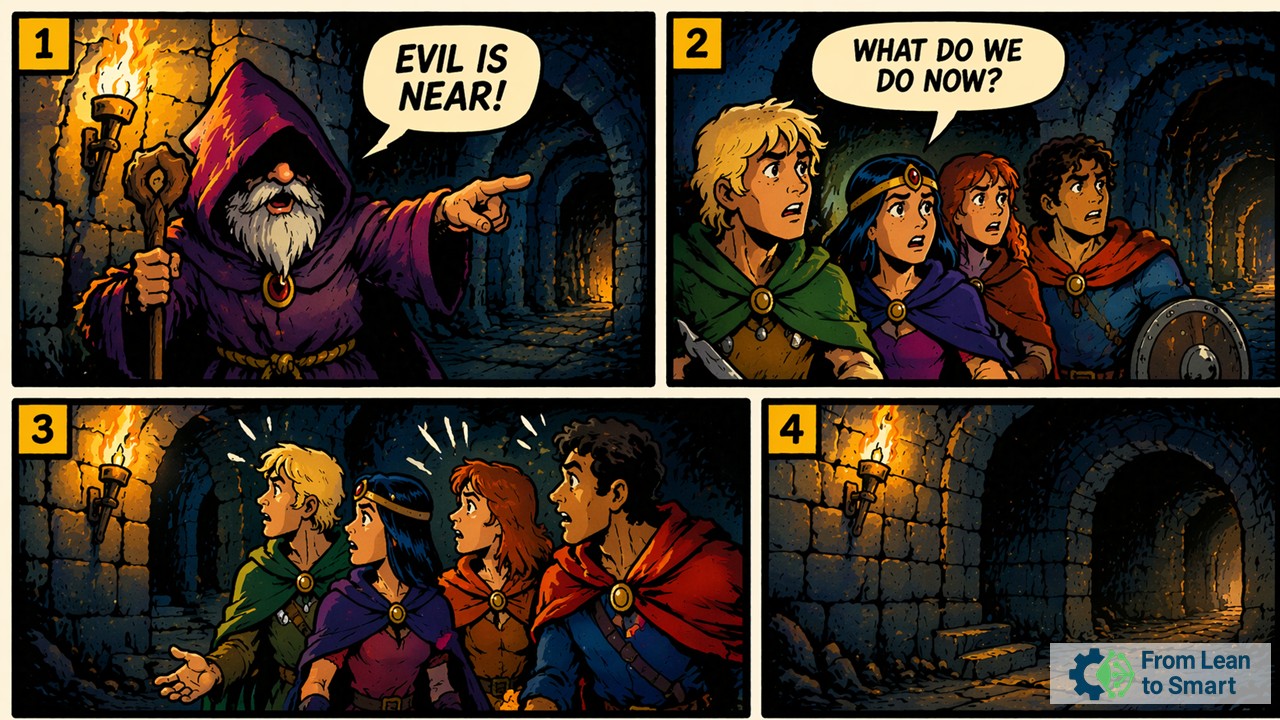
Many predictive maintenance systems remind me of the Dungeon Master from Dungeons & Dragons.
They show up, tell you that something is happening, give you a clue… and when it is time to decide what to do, they are gone.
The problem is that, in industry, there is nothing funny about that. Detecting an anomaly is useful, but it is not enough. The hard part is not receiving the alert. The hard part is deciding whether to stop, wait, inspect, or accept the risk.
That is why I have become increasingly convinced that the real value does not lie only in predicting better, but in helping people make better decisions.
For a long time, we have talked about predictive maintenance as if everything depended on one thing only: getting the prediction right.
Detect earlier. Fine-tune the algorithm. Reduce false positives. Find the ultimate model.
And yes, all of that matters.
But after working closely with predictive maintenance SaaS solutions and seeing how they are actually used in real industrial environments, I have come to a different conclusion:
the real problem does not begin before the alert, but after it.
Because an alert, no matter how good it is, does not decide whether it makes sense to intervene today, wait 48 hours, or keep observing. It does not put the cost of stopping into context against the risk of doing nothing. It does not turn a technical signal into a reasonable operational action on its own.
That is where the real difficulty begins.
In theory, the goal seems obvious: build a model that is more powerful, more precise, and more autonomous, capable of anticipating any failure.
In real industrial settings, things look different. Every asset behaves differently. Every site has its own peculiarities. And every organization prioritizes risk, cost, service continuity, and performance in its own way.
That is why the idea that one single algorithm will solve everything in a universal way is not just ambitious. In many cases, it is also expensive, slow to scale, and difficult to sustain.
And this leads to a reflection that feels increasingly important to me:
perhaps the greatest value does not lie in predicting better, but in deciding better based on the prediction.
Because between the signal and the action there is a huge gap. A space full of context, criticality, priorities, intervention windows, uncertainty, and trade-offs. And that space is not always handled well by a dashboard, a curve, or a score.
Very often, it is better handled by an intelligent combination of technology, expert judgment, and operational support.
That is why I believe that, in many cases, an approach based only on “here is the platform, now you figure out what to do with the alerts” falls short.
When there is a layer of service, supervision, or expert support, the value changes. It is no longer only about detecting signals, but about filtering noise, interpreting context, prioritizing correctly, and turning a prediction into a useful recommendation.
That distinction is critical.
Because the customer is not really buying a detected anomaly. They are buying peace of mind. They are buying judgment. They are buying responsiveness. They are buying better decisions.
And it is no coincidence that frameworks such as ISO 55000 and the Institute of Asset Management (IAM) place such a strong emphasis on value. In the end, managing assets is not just about knowing what is happening, but about making decisions that balance risk, cost, performance, and business objectives.
That is why I believe the future of predictive maintenance is not just about chasing the perfect algorithm.
It is about designing what happens after the alert much better.
And this is where generative AI may open a very interesting path forward: not as a magical substitute for experts, but as an orchestration layer capable of connecting signals, context, history, criticality, procedures, and alternative courses of action in order to structure decisions more effectively.
Not to decide on its own. But to help people decide better.
Because in the end, an alert is not a decision. And a good prediction only starts creating value when someone knows how to turn it into the right action.
Are we overinvesting in prediction and underinvesting in decision support?