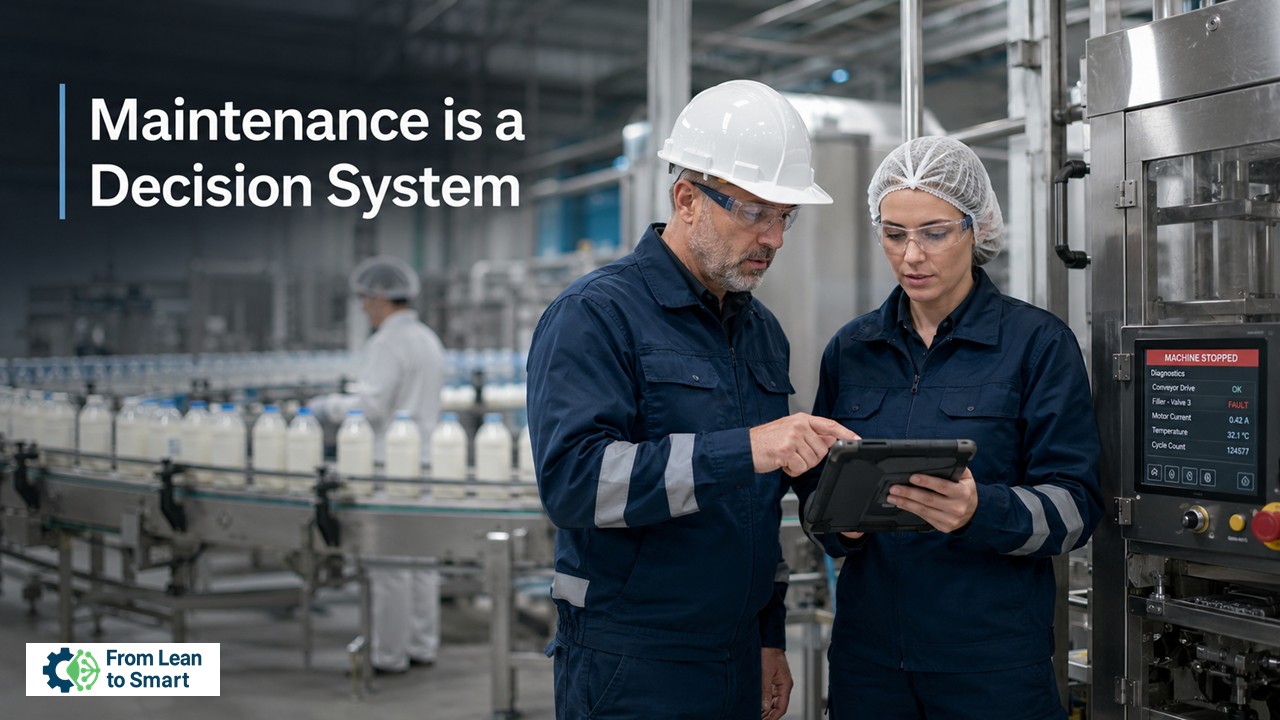
The real value of maintenance is not only in repairing equipment. It is in helping the factory make better operational decisions before failure becomes expensive.
For many years, maintenance has been managed, discussed and judged mainly as a cost center.
Labor cost.
Spare parts cost.
Contractor cost.
Downtime cost.
Budget deviation.
All of that matters. No plant can ignore cost discipline. Maintenance must manage resources carefully, control waste and justify investment.
But when maintenance is reduced only to cost, something essential disappears from the conversation.
Maintenance is not only a department that spends money.
It is one of the most important operational decision systems inside a factory.
Every day, maintenance teams make decisions under pressure, with incomplete information, limited resources and direct consequences for safety, quality, delivery, productivity and production stability.
The real question is not:
“How much does maintenance cost?”
The stronger question is:
“What kind of operational decisions does maintenance enable — or fail to enable?”
Maintenance Is a Daily Decision Environment
In a real factory, maintenance is rarely a clean sequence of planned activities.
It is a constant negotiation between:
What should be done.
What can be done.
What production pressure allows to be done.
A bearing shows abnormal vibration, but the line is already behind schedule.
A recurring sensor fault stops the machine for a few minutes every shift, but nobody wants to stop long enough to investigate the root cause.
A preventive task is due, but the technician is pulled into an urgent breakdown.
A critical spare part is recommended for replacement, but procurement lead time is uncertain and the current part is still “working.”
These are not just technical situations.
They are decisions.
And most of them are made under uncertainty.
A vibration alarm, for example, is not only a technical signal. It becomes a decision when the team must choose whether to continue running, reduce speed, prepare parts, schedule an intervention, accept risk until the next window or stop the asset immediately.
That is where maintenance creates value.
Not only by repairing the machine, but by helping the organization make the right trade-off at the right time.
The Risk of Managing Maintenance Only by Cost
Treating maintenance only as a cost center can be dangerous.
When the dominant question is:
“How do we reduce maintenance cost?”
the organization may start optimizing the wrong thing.
It may reduce preventive maintenance without understanding risk.
It may delay component replacement without understanding failure consequences.
It may celebrate lower spare parts inventory while increasing exposure to long downtime.
It may push technicians to close work orders faster while losing valuable failure knowledge.
It may measure maintenance efficiency while ignoring operational fragility.
On paper, cost improves.
In reality, the factory becomes more vulnerable.
The issue is not whether maintenance cost matters.
The issue is whether cost is managed without understanding the operational risk being transferred.
A decision to defer maintenance can become a delivery problem.
A decision to run an unstable asset can become a quality problem.
A decision to reduce spare parts can become a recovery problem.
A decision to ignore recurring failures can become a morale problem.
A decision to normalize firefighting can become a culture problem.
Maintenance cost is visible in the budget.
Poor maintenance decisions are often visible later, in downtime, scrap, overtime, missed deliveries, unstable output and loss of trust between maintenance and production.
Failures Rarely Start When the Machine Stops
Factories do not suffer only from breakdowns.
They suffer from poor decisions before the breakdown.
The inspection that was postponed.
The weak signal that was ignored.
The temporary fix that became permanent.
The repeated microstop that was normalized.
The work order that was closed without useful failure information.
The maintenance window that was negotiated away because production needed “just one more shift.”
By the time the machine stops, the failure may look sudden.
But often, the decision path was visible long before the breakdown.
This does not mean maintenance should always win the argument.
That would be too simplistic.
Production pressure is real. Customer demand is real. Changeovers, delivery dates, labor constraints, OEE targets and capacity limitations are real.
A good maintenance organization does not exist to stop production at every sign of risk.
It exists to make risk visible, understandable and manageable.
That is a very different role.
From Technical Support to Risk-Informed Decision-Making
Maintenance should help the operation answer questions such as:
- What happens if we continue running?
- How much risk are we accepting?
- What is the earliest safe intervention window?
- Is the failure mode isolated, recurring or systemic?
- What spare parts exposure do we have?
- Can the asset run at reduced speed?
- Are we solving the problem, or only resetting the symptom?
- Who owns the decision if we defer the intervention?
These are decision questions, not only maintenance questions.
The best maintenance leaders understand this.
A technician diagnosing a recurring fault is not just fixing a machine.
They are interpreting signals.
A planner coordinating a shutdown is not just scheduling tasks.
They are balancing risk, access, capacity, resources and production impact.
A reliability engineer analyzing failure history is not just producing charts.
They are helping the plant decide where attention should go first.
A maintenance manager challenging repeated emergency work is not just asking for discipline.
They are protecting the factory from becoming addicted to firefighting.
Firefighting Is Not Only a Maintenance Problem
Firefighting is not only a maintenance behavior.
It is an organizational decision pattern.
At first, firefighting feels productive.
People react fast. Teams show commitment. Machines come back online. Production continues.
But over time, firefighting creates its own culture.
Urgency becomes normal.
Planning becomes optional.
Temporary fixes become accepted.
Technicians become heroes for restoring production, but rarely get the time to eliminate the cause.
The organization becomes very good at reacting and very weak at preventing.
This is where maintenance cost discussions often become misleading.
Because firefighting can look efficient in the short term.
Until the hidden costs appear:
unstable output, overtime, quality losses, spare parts emergencies, missed improvement opportunities, technician fatigue and weak trust between maintenance and production.
A reactive organization does not only lose time.
It loses decision quality.
The Maturity Question Needs to Change
If maintenance is understood as a decision system, the maturity question changes.
It is not only:
How many preventive tasks were completed?
How many work orders were closed?
How much did maintenance spend?
How fast did the team respond?
Those questions matter, but they are incomplete.
The stronger questions are:
Did we make the right intervention at the right time?
Did we prioritize based on risk or based on noise?
Did we understand the consequence of deferral?
Did we learn from the failure or only restore the asset?
Did our maintenance data improve future decisions?
Did production and maintenance share the same view of operational risk?
This is where maintenance becomes strategic.
Not because it uses more advanced terminology.
But because it directly influences the factory’s ability to decide well under pressure.
Digitalization Does Not Automatically Improve Maintenance
The same logic applies to digitalization.
Many plants invest in dashboards, CMMS improvements, condition monitoring, predictive tools, sensors, AI models and Smart Factory initiatives.
These can all be valuable.
But technology does not automatically improve maintenance maturity.
A dashboard that only shows more alarms can create more confusion.
A predictive model that identifies risk but does not help prioritize action may remain unused.
A CMMS full of work orders but poor failure context does not create intelligence.
A sensor strategy disconnected from planning, spare parts, decision rights and production constraints may generate data without impact.
The issue is not lack of data.
Many factories already have more data than they can operationally absorb.
The issue is whether data is converted into better decisions.
This is especially important in maintenance because not every decision can be automated.
A machine may show degradation, but the right action depends on context.
Is the line critical this week?
Is there a planned stop in two days?
Is the spare part available?
Is the failure mode safety-critical?
Can the asset run under controlled conditions?
Is this the first occurrence or the fifth?
Does production understand the risk?
Who decides, who approves and who owns the consequence?
These contextual factors determine the decision.
That is why maintenance intelligence cannot be reduced to prediction alone.
Prediction is useful.
But prediction without prioritization, coordination and accountability does not change the operation.
A risk signal without clear ownership becomes just another alarm.
Designing Maintenance as a Decision Capability
A mature maintenance function must be designed as a decision capability.
That means moving beyond activity control and building the mechanisms that help the organization decide better.
Some of those mechanisms are very practical:
Clear asset criticality criteria.
Not every asset, component or failure mode deserves the same level of attention. Prioritization must be based on operational consequence, not only on who shouts the loudest.
Formal governance for deferred maintenance.
If an intervention is postponed, the risk should be visible, documented and owned. Deferral is sometimes necessary, but it should not become invisible.
Better failure coding and work order quality.
A closed work order without useful failure context may restore the asset, but it does not improve future decisions.
Maintenance-production routines based on risk.
The conversation should not be only about urgent jobs and available windows. It should include asset health, recurring issues, exposure, constraints and upcoming risks.
Connection between CMMS/EAM data and operational action.
Data should not live only in systems. It should influence planning, prioritization, spare parts, interventions and management decisions.
Structured learning from repeated failures.
If the same issue appears again and again, the organization should not only ask how fast it was fixed. It should ask why the decision system allowed recurrence to continue.
These are not theoretical improvements.
They are the practical foundations of reliability, asset management and operational excellence.
Maintenance Decisions Are Business Decisions
Maintenance decisions are business decisions.
Not in a slogan sense.
In a very practical sense.
A decision to delay an inspection can affect customer delivery.
A decision to keep running an unstable asset can affect quality.
A decision to reduce inventory can affect recovery time.
A decision to ignore weak signals can affect safety.
A decision to overload technicians with emergencies can affect morale and retention.
A decision to accept firefighting as normal can affect the entire culture of the plant.
This does not make maintenance more important than production.
It makes maintenance inseparable from production performance.
The factory does not run because machines exist.
The factory runs because people make thousands of small operational decisions every week that keep assets, processes, materials, schedules and resources aligned.
Maintenance is at the center of many of those decisions.
The Real Shift
The future of maintenance will not be defined only by more sensors, more dashboards or more algorithms.
It will be defined by the ability to connect technical reality with operational decision-making.
To move from reaction to anticipation.
From isolated work orders to shared operational context.
From cost control to risk-informed decisions.
From firefighting culture to disciplined adaptability.
That is the real shift.
Maintenance should absolutely manage cost.
But it should not be defined by cost.
Because when maintenance is seen only as a cost center, the organization asks:
“How do we spend less?”
When maintenance is understood as a decision system, the organization asks something far more powerful:
“How do we make better operational decisions before the factory pays the price?”
And that may be one of the clearest signs of maintenance maturity.
Not how fast the plant reacts to failure, but how consistently it makes better decisions before failure becomes inevitable.
#Maintenance #ReliabilityEngineering #AssetManagement #TPM #LeanMaintenance #OperationalExcellence #SmartFactory #IndustrialAI #PredictiveMaintenance #ManufacturingLeadership #IndustrialMaintenance #OperationalDecisionMaking