Why future-state process design must survive operational reality
Every transformation program has one.
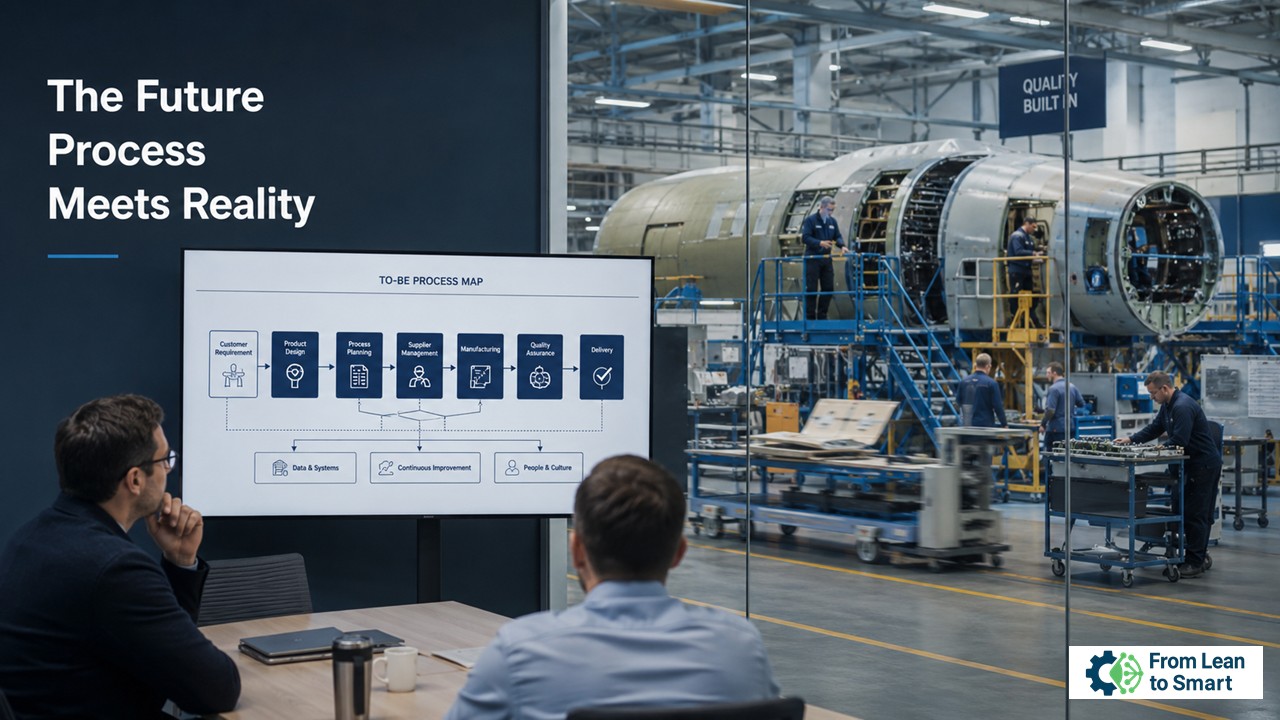
The perfect “to-be” process.
It appears after workshops, interviews, value stream discussions and alignment meetings. It looks clean. Logical. Attractive. Every step has a purpose. Every role is clear. Every approval seems justified. Every system interaction appears reasonable.
On the screen, it works.
Then the organization tries to run it.
And the process starts to suffer.
Not because people are resistant. Not because the design team was incompetent. Not because the business does not understand process discipline.
The problem is deeper.
Many to-be processes are designed as if the future will be more stable than the present.
But operations rarely become stable just because we draw them that way.
In industrial environments, the future process must operate in the same reality as the current one: machine failures, supplier instability, urgent customer changes, quality deviations, maintenance backlogs, missing data, system limitations and human decisions made under pressure.
A perfect process that cannot absorb imperfection is not a future state.
It is a fantasy.
The happy path is not the process
Most transformation initiatives begin with good intentions.
The current process is fragmented, slow, inconsistent and full of manual work. People want clarity. Leaders want standardization. IT needs requirements. Operations wants less firefighting. Everyone agrees that the current state is painful.
So the project team designs a better process.
The new model removes unnecessary steps, clarifies responsibilities, eliminates duplicated checks, simplifies approvals and introduces digital workflows.
That is progress.
But often, only partially.
The issue is not that the to-be process is wrong. The issue is that it is often too idealized. It describes how work should flow when the right information is available, the right people act on time, the system behaves correctly and the case follows the expected path.
In other words, it describes the happy path.
But the happy path is not the process.
It is only one version of the process.
In a factory, the real process includes everything that happens when the happy path breaks.
And it will break.
A maintenance request is created, but the asset code is wrong. A production order is released, but material is blocked. A supplier deviation needs approval, but purchasing, quality and production disagree on the risk. A corrective action is assigned, but the root cause is still unclear. A machine is technically available, but the operator knows it will fail again in two hours.
The process does not stop because the model is incomplete.
People continue.
They call someone. They escalate informally. They create a workaround. They update an Excel file. They ask for permission outside the system. They make a decision and document it later, if there is time.
This is where the gap begins.
The official process says one thing. The operational process does another. The system captures only part of the story.
Then leaders ask why adoption is low.
The answer is uncomfortable: because the designed process did not respect the operational conditions in which it had to survive.
A strong to-be process is not the cleanest version of reality
A strong to-be process is not the cleanest version of reality.
It is the most useful version of reality.
That means it must define more than the standard flow. It must also define what happens when the standard flow is no longer enough.
A realistic future-state process should clarify three things:
1. The standard flow How the process should work under normal conditions.
2. The exception logic What happens when information is missing, priorities conflict, risk increases or the system cannot support the real situation.
3. The feedback mechanism How deviations, workarounds, rework and operational friction become visible for learning and improvement.
This is where many BPM and digital transformation initiatives remain too optimistic.
They assume that better design will remove ambiguity. Sometimes it does. But in operations, many ambiguities are structural. They come from competing priorities, technical uncertainty, physical constraints and time pressure.
No process model can eliminate all of that.
The goal is not to ignore complexity.
The goal is to make the right complexity visible, manageable and actionable.
The real weakness is often not the sequence of activities
Consider a recurring downtime issue on a critical production line.
The ideal process might say:
Detect failure. Create notification. Assign technician. Diagnose. Repair. Confirm root cause. Close work order. Update preventive plan.
It sounds correct.
But real life is different.
The technician may restore the line without fully identifying the root cause because production is losing volume. The supervisor may accept a temporary fix because the customer shipment is at risk. Engineering may request deeper analysis, but the machine cannot be stopped again this week. Maintenance may know the component should be replaced, but the spare part is not available. Quality may demand additional checks before restart.
Who decides?
The process map rarely answers this with enough precision.
And that is the point.
The weakness of many to-be processes is not in the sequence of activities.
It is in the decision logic around exceptions.
A process is not mature because it has fewer boxes.
A process is mature when it helps the organization make better decisions under real constraints.
That requires asking different questions:
Where will this process fail? Which decisions will create conflict? What information will be missing? Which exceptions are predictable? Who has the authority to accept risk? What must be visible for learning? What should never be bypassed?
These questions may make the process less beautiful.
But they make it more operational.
Oversimplification does not remove complexity
In transformation work, there is often pressure to simplify.
And simplification is valuable.
But oversimplification is dangerous.
A process that ignores complexity does not remove complexity. It transfers it to people.
Usually to supervisors, planners, maintenance coordinators, quality engineers and team leaders.
They become the hidden integration layer of the organization.
They compensate for weak process design. They connect systems that do not talk to each other. They interpret priorities. They manage exceptions. They absorb ambiguity. They protect output.
And then we call the process standardized.
It is not standardized.
It is stabilized by people.
This distinction matters.
Because when the hidden work of coordination, judgment and exception management is not designed into the process, it remains invisible. And what remains invisible cannot be governed, improved or scaled.
Automation can industrialize bad assumptions
This problem becomes even more serious when companies move from process documentation to workflow automation.
An unrealistic process map is annoying.
An unrealistic automated workflow is operationally dangerous.
Once a flawed to-be process is embedded into a system, the organization loses flexibility in the wrong places. People are forced to follow steps that do not match reality, enter data that does not support decisions, request approvals that delay action or bypass the system to get the work done.
Then the digital process becomes theatre.
The system says everything is controlled.
Operations knows it is not.
That is why MES, MOM, BPM platforms, workflow tools and automation projects must be grounded in operational truth.
Technology can reinforce discipline.
But it can also scale bad assumptions.
A poor process on paper is a problem. A poor process automated at scale is a bigger problem.
The goal is not to design imperfect processes intentionally.
The goal is to design processes that are honest about imperfection.
The future state is a hypothesis, not a final truth
A future-state process should not be treated as a static picture.
It should be treated as a hypothesis.
A disciplined hypothesis, but still a hypothesis.
Once deployed, it must be observed, measured, challenged and adjusted.
This is where Process Mining, operational analytics and structured feedback loops can create real value. Not because they magically fix the process, but because they reveal how the process behaves when exposed to real work.
Variants matter. Rework matters. Waiting times matter. Manual corrections matter. Unauthorized paths matter. Escalation loops matter.
They are not embarrassing deviations from the perfect design.
They are signals.
Some deviations will show poor compliance. Others will show training gaps. Others will reveal system friction. But some will expose a more important truth:
The to-be process was never realistic enough.
That is not failure.
That is learning — if the organization is mature enough to see it.
From process design to operational capability
For industrial companies, this shift is essential.
Factories do not need beautiful process architecture disconnected from daily pressure.
They need process discipline that supports performance, safety, quality, reliability and accountability.
They need systems that help people act consistently without denying operational judgment.
A strong to-be process should clarify the standard path, but also define how exceptions are managed. It should reduce unnecessary variation, but not suppress necessary adaptation. It should improve control, but not create bureaucracy. It should support automation, but not automate ignorance.
The future of BPM in operations will not be built on perfect diagrams.
It will be built on processes that can live with uncertainty.
That is a more demanding ambition.
It requires humility from designers, honesty from operations, discipline from leaders and feedback from execution systems.
Because the real future process does not exist in the workshop.
It emerges when the model meets production pressure, system constraints, human judgment and operational trade-offs.
The future-state process is not validated when it is approved in a workshop.
It is validated when it survives operational reality.
That is where the fantasy ends.
And real process transformation begins.
#BPM #OperationalExcellence #ProcessMining #SmartFactory #DigitalTransformation #ManufacturingOperations