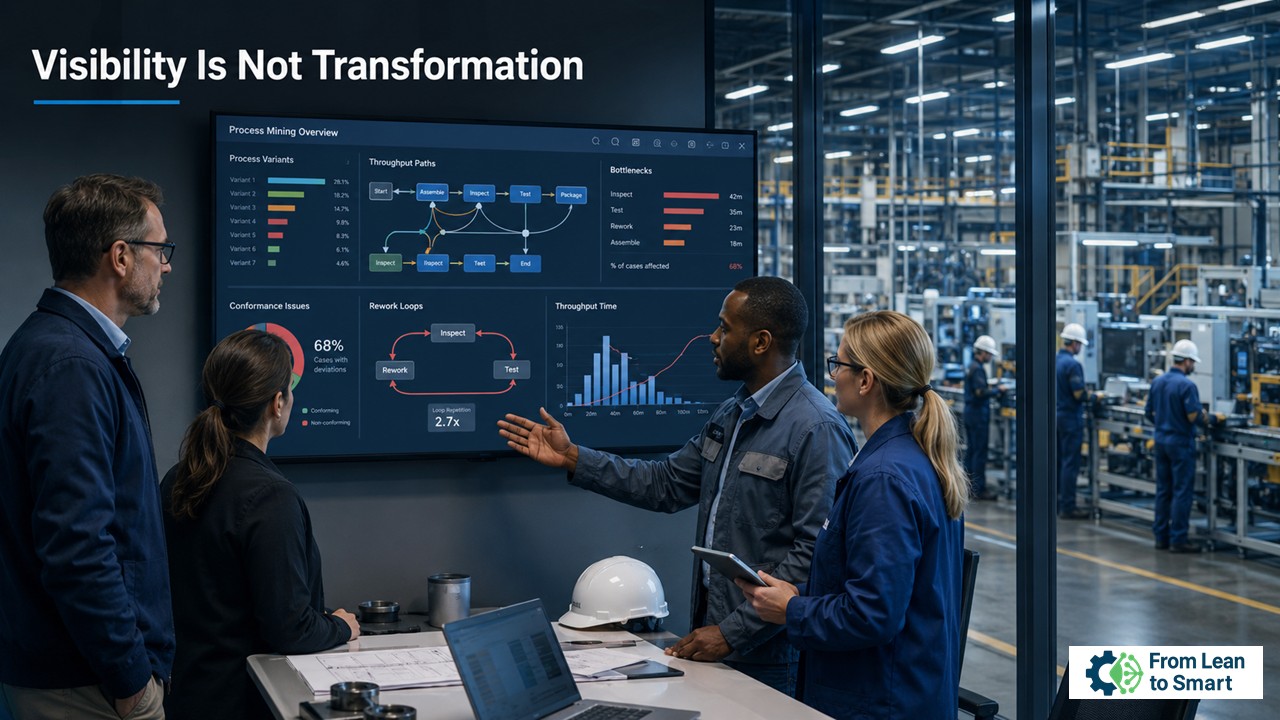
Visibility is powerful. But visibility is not transformation.
Process Mining has changed the conversation.
For years, many organizations believed they understood their processes because they had procedures, workshops, documentation and system workflows.
Then Process Mining showed something uncomfortable.
The process people thought they had was not always the process actually being executed.
Variants appeared everywhere.
Approvals took longer than expected.
Rework loops were more frequent than admitted.
Manual corrections were hidden in plain sight.
Cases moved backward, forward, sideways and sometimes outside the official path entirely.
For many leaders, this was a wake-up call.
And rightly so.
Process Mining brings a level of transparency that traditional BPM often lacked.
It helps organizations move from opinions to evidence. It reveals execution patterns, bottlenecks, deviations, waiting times and behavioral realities that were previously buried inside ERP, MES, CRM, workflow, ticketing or CMMS systems.
That is valuable.
But there is a risk.
Some organizations start to believe that once they can see the process, they can fix the process.
That is not always true.
Process Mining can reveal broken processes.
It cannot, by itself, repair the management system that produced them.
That distinction matters.
A dashboard can show what happened. It does not always explain why.
A Process Mining dashboard may show that purchase orders are frequently changed after release.
It may show that maintenance work orders are closed late.
It may show that production orders are rescheduled several times.
It may show that quality deviations remain open for weeks.
It may show that approvals are bypassed, repeated or delayed.
But the dashboard does not always explain the full operational reason behind those behaviors.
It shows what happened.
It does not always explain why people acted that way.
And in operations, the why is usually where the real problem lives.
A process variant may look like non-compliance.
But it may actually be a workaround for missing master data.
A delay may look like poor discipline.
But it may be caused by conflicting priorities between production and maintenance.
A repeated approval may look like bureaucracy.
But it may reflect unclear risk ownership.
A manual correction may look like bad behavior.
But it may be the only way to compensate for a system that does not match the physical flow.
A blocked case may look like inactivity.
But it may be waiting for a decision no one feels authorized to make.
This is why Process Mining must be interpreted with operational maturity.
Data shows traces.
People understand context.
Management must connect both.
Without that connection, Process Mining can become another layer of digital frustration.
The organization sees more problems.
But it does not build the capability to solve them.
Visibility without accountability does not transform operations
This pattern is common.
A company deploys Process Mining with high expectations. The first analysis creates excitement. The team discovers variants, bottlenecks, rework and automation opportunities. Dashboards are presented. Improvement ideas are listed. Leadership asks for action.
Then the hard part begins.
Who owns the process?
Who owns the exception?
Who has the authority to change the rule?
Who can challenge the KPI conflict?
Who decides whether a workaround is bad practice or necessary adaptation?
Who funds the system change?
Who follows up after the workshop?
If those questions are not answered, Process Mining becomes visibility without accountability.
And visibility without accountability does not transform operations.
It only makes dysfunction more visible.
This is especially important in industrial environments.
Manufacturing processes are not just administrative workflows. They are connected to physical reality: machines, materials, operators, quality gates, maintenance constraints, engineering changes, supplier issues, safety requirements and production pressure.
The system log never captures everything.
It may record that a production order was delayed.
It may not capture that the line was running with a temporary maintenance fix.
It may record that a quality inspection took longer than expected.
It may not capture that the right specialist was supporting another critical issue.
It may record that a maintenance order was closed after the target date.
It may not capture that production refused the downtime window three times.
The event log tells part of the story.
The shopfloor tells the rest.
That does not weaken Process Mining.
It defines how it should be used.
Process Mining should provoke better questions
Process Mining is not a replacement for operational understanding.
It is a powerful instrument to focus operational understanding where it matters most.
The best use of Process Mining is not to produce beautiful dashboards.
It is to provoke better questions.
Why does this variant exist?
Why does this approval loop repeat?
Why do teams bypass this step?
Why does this delay happen only in certain plants, lines, shifts, suppliers or product families?
Why does the official process work in some cases and collapse in others?
These questions move the conversation from process compliance to operational learning.
That is where real value begins.
But this requires discipline.
It is tempting to treat every deviation as waste. In Lean terms, many deviations are indeed signals of instability, waiting, rework, overprocessing or unclear flow.
But not all deviations have the same meaning.
Some deviations are harmful and must be eliminated.
Some deviations are protective and must be understood.
Some deviations reveal poor system design.
Some deviations expose conflicting objectives.
Some deviations are informal best practices that should be standardized.
Some deviations are risk acceptance decisions that should never remain invisible.
A mature organization does not simply remove variation.
It separates necessary variation from unnecessary variation.
That difference is critical.
In operations, excessive rigidity can be as dangerous as excessive freedom.
If a process is too loose, performance becomes inconsistent.
If it is too rigid, people are forced to bypass it when reality becomes complex.
Process Mining can help find that balance, but only if the organization is willing to confront the management issues behind the patterns.
The maintenance example: when the process is not the real problem
Imagine a plant analyzing maintenance execution.
The Process Mining view shows that preventive maintenance orders are frequently delayed, rescheduled or closed without full execution.
The initial conclusion may be simple:
Maintenance discipline is weak.
But after discussion with supervisors, planners and technicians, the picture changes.
Production frequently cancels planned downtime to recover volume.
Spare parts are not always available.
Some preventive tasks are not adapted to actual asset condition.
Technicians are pulled into urgent breakdowns.
The CMMS workflow requires closure information that adds little value.
Maintenance KPIs push compliance, while production KPIs push availability.
Now the issue is no longer just process compliance.
It is operational governance.
The process is broken because the management system is misaligned.
No dashboard can fix that alone.
The same logic applies to quality, logistics, engineering changes, procurement, production planning and customer order fulfillment.
Process Mining can reveal friction.
But the root causes often sit between functions.
That is why cross-functional accountability is essential.
Many broken processes survive because each function optimizes its own part.
Purchasing optimizes cost.
Production optimizes output.
Maintenance protects reliability.
Quality protects conformity.
Planning protects schedule adherence.
Finance protects control.
All of that is legitimate.
But when no one owns the end-to-end operational outcome, the process becomes a negotiation space.
And the system records the consequences.
Process Mining makes those consequences visible.
It does not automatically resolve the trade-offs.
BPM and Process Mining need each other
This is where BPM and Process Mining must work together.
BPM provides process ownership, governance, standards, roles, escalation logic and improvement discipline.
Process Mining provides execution evidence, variation analysis, bottleneck detection and behavioral transparency.
One without the other is incomplete.
BPM without execution data can become theoretical.
Process Mining without governance can become diagnostic theatre.
The real opportunity is to connect both with operational management.
That means using Process Mining not only to detect inefficiency, but to redesign how decisions are made.
It means reviewing exceptions, not only averages.
It means connecting variants with root causes.
It means involving the people who live the process, not only the people who analyze the data.
It also means building a clear improvement loop:
1. Evidence
What is really happening in the process?
2. Context
Why is it happening under real operational conditions?
3. Ownership
Who has the authority to change the rule, system, KPI or behavior?
4. Action
What will be changed, tested, standardized or escalated?
Without that loop, Process Mining remains analytical.
With that loop, it becomes part of the operating system.
Be careful with automation
There is another common mistake.
A frequent pattern is detected.
The organization immediately asks:
Can we automate it?
Sometimes the answer is yes.
But sometimes the better question is:
Should this process be automated in its current form?
If the pattern exists because the process is broken, automation may only accelerate dysfunction.
Automating a bad approval logic does not create agility.
Automating poor master data handling does not create control.
Automating exception routing without decision ownership does not create accountability.
It creates faster confusion.
Before automating, organizations should ask whether the process deserves to be automated.
Sometimes the answer is no.
Sometimes the process must first be simplified, clarified, governed or redesigned.
Sometimes roles must change.
Sometimes policies must be challenged.
Sometimes KPIs must be aligned.
Sometimes the system must reflect the real operational flow instead of forcing people into artificial steps.
Process Mining can guide that work.
But it cannot replace it.
The real gap is often management, not technology
This is the uncomfortable truth.
Many organizations do not suffer from lack of process visibility.
They suffer from lack of process ownership.
They can see the delays.
They can see the variants.
They can see the rework.
They can see the bottlenecks.
But they cannot decide what to do because accountability is fragmented.
That is not a technology gap.
It is a management gap.
For Process Mining to create real impact, leaders must treat it as part of the operating system, not as a reporting tool.
It should feed daily management, performance reviews, process governance, Lean improvement, system design and cross-functional decision-making.
The purpose is not to admire the map of dysfunction.
The purpose is to change the conditions that create it.
In the end, Process Mining will not save broken processes.
But it can make them much harder to ignore.
And that is already powerful.
The next level is not simply seeing the process more clearly.
It is building the discipline to act on what we see.
Because visibility is not transformation.
Transformation begins when the organization has the ownership, courage and operational maturity to change the process behind the data.
#ProcessMining #BPM #OperationalExcellence #SmartFactory #DigitalTransformation #ManufacturingOperations #IndustrialTransformation