Many organizations are investing in Process Mining, Task Mining, BPM, data science and AI to understand how work really happens.
That is a positive evolution.
For years, companies have managed processes through procedures, workshops, interviews, assumptions and static process maps. Process Mining changes the conversation because it allows organizations to see process reality through data: variants, bottlenecks, rework loops, waiting times, deviations and execution patterns that are often invisible in traditional reporting.
But in industrial environments, there is an important point that deserves more attention:
Process visibility is not the same as operational impact.
A process map can show where the flow is delayed.
A dashboard can show where performance is weak.
An algorithm can detect patterns and anomalies.
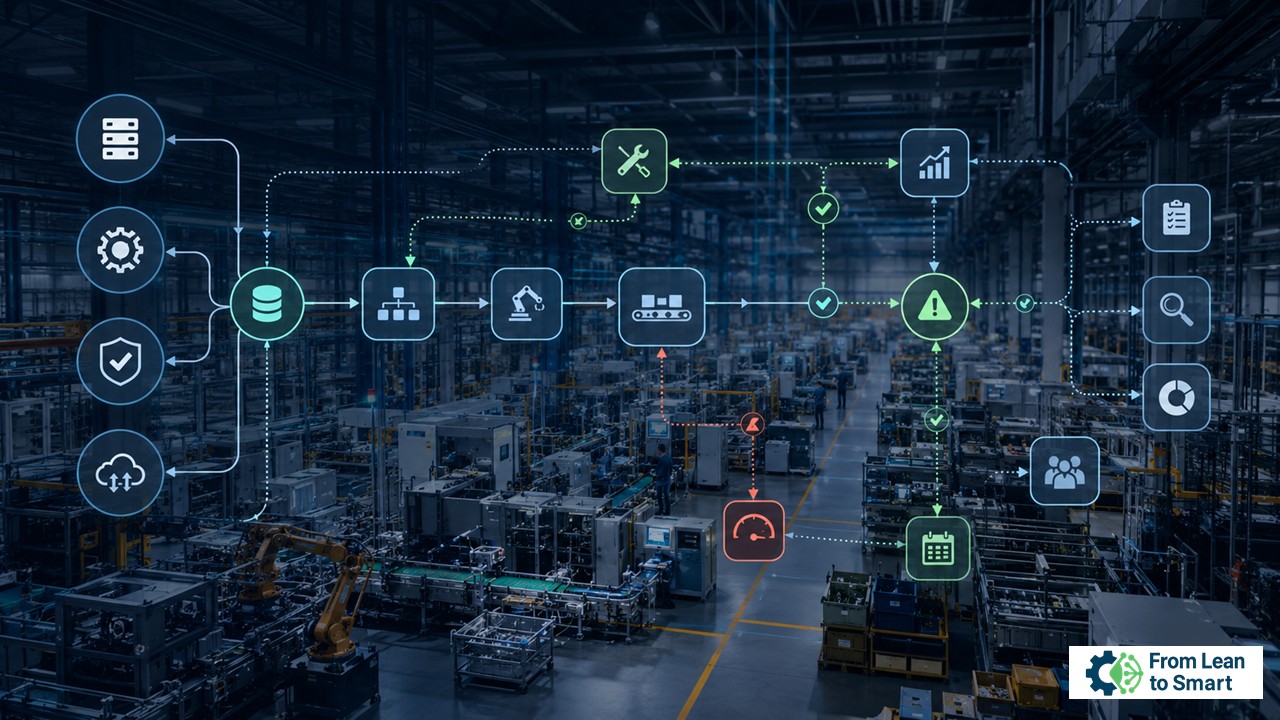
But industrial value appears only when those insights are connected to the reality of the shopfloor: assets, people, materials, quality, maintenance, planning, constraints, routines and decisions.
In other words, Process Mining needs the shopfloor if it wants to create real industrial value.
The gap between process visibility and operational reality
Industrial companies already have a lot of data.
ERP systems contain orders, materials, inventories, purchasing and planning data. MES platforms capture production execution, batches, scrap, downtime and quality checks. CMMS or EAM systems store maintenance work orders, asset history, preventive maintenance plans and spare parts information. QMS platforms manage deviations, non-conformities, audits and corrective actions.
On paper, the data is there.
In practice, the real process is rarely contained in one system.
The actual flow of work usually lives across ERP, MES, CMMS, QMS, Excel files, shift reports, local trackers, whiteboards, emails, informal decisions and conversations at the Gemba.
That is why applying Process Mining in industrial operations requires more than technical extraction of event logs. It requires operational interpretation.
The system shows the transaction.
The shopfloor explains the constraint.
Without that connection, there is a risk of creating beautiful process visualizations that do not change how the factory actually works.
Use case 1: Maintenance and Reliability Workflows
Maintenance is one of the strongest areas where Process Mining can create industrial value.
Many plants have thousands of work orders in their CMMS or EAM system. They can report backlog, preventive maintenance compliance, corrective work, emergency work, MTTR and spare parts consumption.
But many still operate in firefighting mode.
The real question is not only:
How many work orders do we have?
The better question is:
Why does maintenance execution break down, and how does that affect asset performance?
Process Mining can reconstruct the flow of a maintenance work order:
Notification → Work order creation → Priority assignment → Planning → Spare parts reservation → Scheduling → Execution → Technical completion → Closure
This can reveal where work is delayed, where rework appears, where approvals slow down execution, or where certain types of orders follow abnormal paths.
But the real value comes from interpreting those patterns with maintenance and reliability logic.
A closed work order is not always a solved problem.
High preventive maintenance compliance does not always mean effective preventive maintenance.
Backlog is not one problem; it can be caused by missing spare parts, poor planning, weak scheduling discipline, wrong priorities, lack of capacity, unclear asset criticality or poor coordination with production.
This is where Process Mining must connect with concepts such as asset criticality, failure modes, PM optimization, backlog quality, spare parts availability, schedule compliance, MTTR, MTBF and field execution.
Otherwise, the analysis may show that a work order was delayed, but not explain why that delay matters for reliability.
The industrial value is not only seeing the maintenance process.
The value is improving maintenance decisions.
Use case 2: Quality, Non-Conformance and CAPA Flows
Quality is another area where Process Mining can move beyond administrative workflow analysis.
Most industrial companies have a QMS. They register deviations, non-conformities, customer complaints, audit findings and CAPAs. They track closure dates, responsible owners and action status.
But many organizations still face recurring defects.
That means the key question is not only:
How long does it take to close a CAPA?
The stronger question is:
Is the organization actually learning from quality issues, or just closing them in the system?
Process Mining can reconstruct the flow of a quality issue:
Detection → Registration → Containment → Risk assessment → Root cause analysis → Corrective action definition → Approval → Implementation → Effectiveness check → Closure → Recurrence
This can show where investigations get stuck, where ownership is unclear, where loops appear between quality, production, engineering or suppliers, and where corrective actions take too long.
But again, speed is not the only measure of quality.
A closed CAPA is not always a solved problem.
A fast closure is not always an effective closure.
A completed action does not necessarily mean the process has changed.
The real value comes when Process Mining is connected with quality and operational improvement logic: recurrence, root cause quality, containment versus corrective action, FMEA, control plans, process stability, supplier issues, audit findings and Gemba validation.
In many companies, quality data is coded for compliance, not for learning. The QMS can show that the process was followed, but it does not automatically prove that the organization understood and eliminated the cause.
This is where Lean Six Sigma, structured problem solving and Process Mining can work together.
The goal is not only faster CAPA closure.
The goal is fewer recurring problems.
Use case 3: Production Planning to Shopfloor Execution
The third area is the gap between production planning and real shopfloor execution.
Many factories have ERP, MES, planning tools, Power BI dashboards and daily production meetings. Yet they still struggle with constant plan changes, material issues, quality blocks, changeover variability, unplanned downtime, capacity gaps and firefighting.
The plan may look stable in the system.
The shopfloor often lives a different reality.
Process Mining can help reconstruct the flow from demand and planning to execution:
Demand → Production planning → Material availability check → Production order release → Scheduling → Setup → Production start → Quality checks → Downtime events → Rework or scrap → Completion → Delivery
This can reveal where the plan starts to deviate from reality.
But the important question is not only:
Did we follow the plan?
The important question is:
Why did the plan break?
Schedule adherence is not only a planning KPI. It can be affected by material availability, asset reliability, quality releases, changeovers, labor constraints, capacity assumptions, maintenance interventions or last-minute commercial priorities.
OEE is useful, but it does not always explain the full flow. A line may lose availability because of maintenance issues, performance because of unstable materials, quality because of process variation, or time because of poor sequencing and changeovers.
This is why Process Mining in production environments must be connected with operational knowledge: Lean, flow, bottlenecks, SMED, standard work, material flow, daily management, Gemba routines and cross-functional problem solving.
The ERP route is not always the real process.
The MES captures execution, but not always the reason behind the exception.
The dashboard shows the loss, but the Gemba explains the mechanism.
The industrial value is created when process visibility helps improve schedule adherence, material flow, changeover reliability, OEE losses, cross-functional coordination and daily decision-making.
What many digital initiatives underestimate
Many digital transformation projects underestimate the difficulty of moving from insight to execution.
They assume that if the organization can see the problem, it will act on the problem.
But industrial operations do not change because a dashboard exists.
They change when insights are embedded into:
- process ownership
- decision rights
- daily management routines
- standard work
- escalation mechanisms
- Gemba validation
- leadership behavior
- continuous improvement discipline
That is why Process Intelligence should not be treated only as an analytics capability. In industrial environments, it must become part of the operating system.
A maintenance insight must change planning, scheduling or reliability decisions.
A quality insight must improve root cause analysis, standards or controls.
A production insight must change sequencing, material flow, changeover routines or daily priorities.
Otherwise, Process Mining risks becoming another layer of reporting.
Useful, but not transformative.
From process maps to industrial decisions
The future of Process Mining in industry is not only better visualization or more advanced algorithms.
The future is the ability to connect process data with operational knowledge.
That means understanding how work really happens across systems, functions and frontline routines. It means connecting ERP, MES, CMMS, QMS and shopfloor reality. It means validating insights with people who understand the process from the inside. It means moving from event logs to decisions.
Process Mining can reveal the process.
But industrial value appears when people use that visibility to change how the organization plans, executes, maintains, improves and learns.
That is why Process Mining needs the shopfloor.
Because the shopfloor is where process intelligence becomes operational impact.
#ProcessMining #OperationalExcellence #SmartFactory #Manufacturing #IndustrialTransformation