Many factories say they practise 5S.
They clean the area before audits. They paint lines on the floor. They label tools, cabinets, storage locations, and shadow boards. They take “before and after” pictures. Sometimes they even celebrate the transformation with a slide showing a cleaner workplace.
But after a few weeks, the same problems return.
Tools are missing again. Temporary materials appear near the line. Scrap containers overflow. Maintenance panels remain blocked. Operators create informal storage points because the official ones do not support the real work. Cleaning becomes an event rather than a routine. The audit score looks acceptable, but the process remains unstable.
That is the moment when 5S stops being Lean and becomes decoration.
Cleanliness matters. But cleanliness alone is not the purpose of 5S.
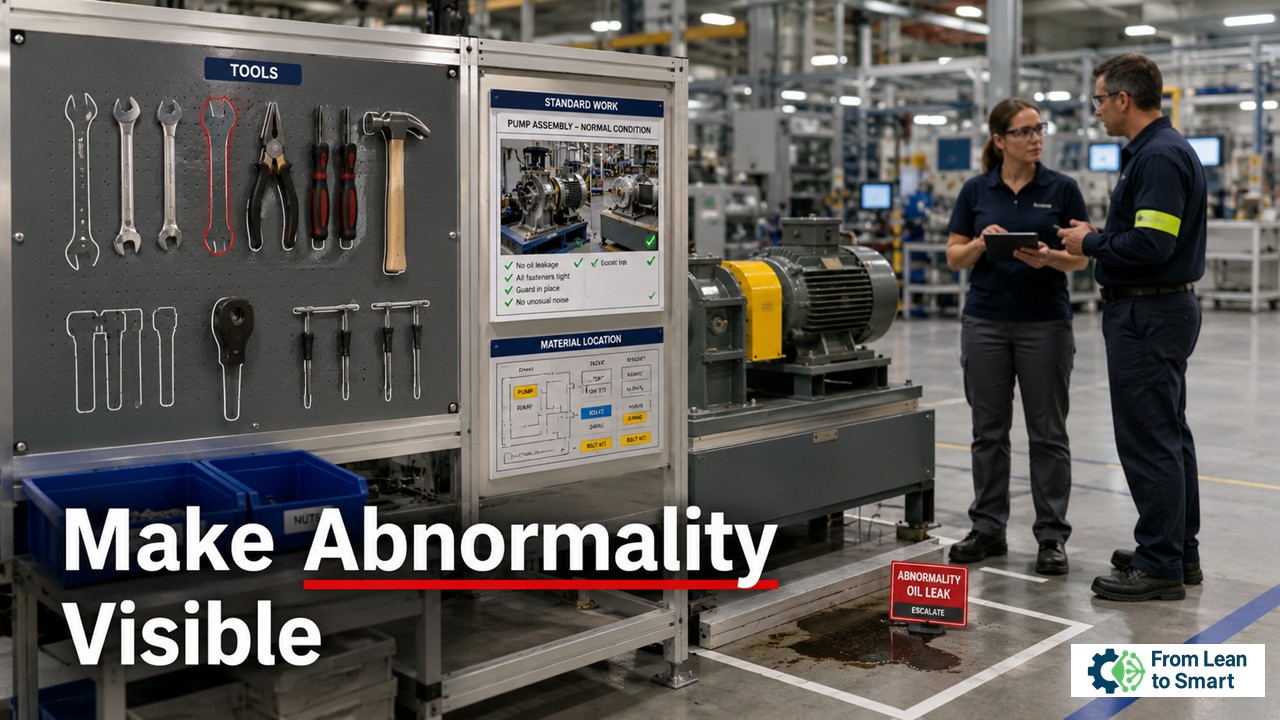
The real purpose of 5S is to make the normal condition clear enough that abnormality becomes visible.
That difference changes everything.
If a wrench is missing, the team should see it immediately.
If material is outside the defined location, the deviation should be obvious.
If oil appears under a machine, it should not become part of the landscape.
If WIP exceeds the agreed limit, the process should tell us that flow is under stress.
If a temporary workaround is still there after three weeks, the area should expose that management has not removed the root cause.
This is the mature meaning of 5S: not housekeeping, but operational truth.
5S Is a Test of Process Discipline
In real factories, disorder rarely appears randomly. It usually tells a story.
A messy tool area may indicate weak maintenance planning. Excess material near the line may reveal unstable replenishment or poor pull discipline. Unclear storage locations may show that workplace design was implemented without sufficient gemba validation. Repeated cleaning problems may indicate equipment deterioration that has not been escalated. Labels that nobody respects may suggest that the standard was designed for the audit, not for the work.
When 5S is practised seriously, it becomes a diagnostic system. It exposes the friction between the designed process and the real process.
When it is practised superficially, it becomes a weekly cleaning campaign.
The difference is critical. A mature 5S system helps the organisation see problems earlier. A weak 5S system teaches people to hide problems before someone important arrives.
When the Audit Score Becomes the Enemy
Many 5S systems fail because the audit becomes the objective.
The team prepares the area before the visit. Supervisors ask people to “make it look right.” The checklist rewards visual compliance, not operational learning. The discussion focuses on points lost, not on causes discovered.
This creates a dangerous behaviour: the factory cleans the symptom before it understands the process.
A good 5S audit should not only ask whether the floor is marked. It should ask whether the marking supports safety, flow, ergonomics, and problem detection.
It should not only ask whether tools are labelled. It should ask whether tools are available at the point of use, in the right quantity, with clear ownership and replenishment logic.
It should not only ask whether the area is clean. It should ask what abnormal conditions cleaning has revealed: leaks, wear, contamination, loose components, blocked access, unsafe improvisations, or recurring sources of dirt.
An audit that does not generate better questions is only administration.
The Real Power of 5S Is Abnormality Management
5S becomes powerful when it connects with daily management.
A missing item should trigger a response. An overflowing location should trigger a decision. A recurring contamination point should trigger maintenance or engineering action. A blocked access zone should trigger leadership intervention. A repeated deviation should trigger problem-solving, not another reminder.
This is where many implementations break down.
The abnormality is visible, but nothing happens.
People stop caring because the system has taught them that visibility does not lead to action. Operators report issues, but the same issues return the next day. Supervisors raise concerns, but nobody removes the constraint. Maintenance sees deterioration, but production pressure postpones the intervention. Logistics sees instability, but the material flow remains unchanged.
Visual management without response damages credibility.
The message becomes clear: “We want standards, but we do not protect them.”
A Practical Example from the Line
Imagine a production line where operators frequently leave extra components near the workstation.
From a cosmetic 5S perspective, the answer is simple: remove the excess material, repaint the location, and remind the team to respect the standard.
From a Lean perspective, the question is different:
Why does the operator need extra material?
Maybe the replenishment cycle is unreliable. Maybe the container size is wrong. Maybe the supermarket location is too far from the point of use. Maybe line stoppages are so frequent that operators create buffers to protect themselves. Maybe planning changes the sequence too often. Maybe the standard work was defined under ideal conditions that do not exist during normal production.
The extra material is not only a 5S deviation. It is a signal.
If management only removes the material, the problem will return. If management studies the signal, 5S becomes an entry point into flow, stability, workplace design, and problem-solving.
Standards Must Support the Work
One reason 5S fails is that standards are imposed without understanding the work.
A label is created, but the location is inconvenient. A tool board is installed, but the tool is used in three different places. A cleaning checklist is defined, but no time is protected for cleaning. A storage rule is created, but material variation makes it unrealistic. A red zone is painted, but nobody owns the escalation when it is violated.
Then leaders are surprised that people do not follow the standard.
But the problem may not be discipline alone. Sometimes the standard is not good enough.
Respect for people includes making standards practical, visible, and improvable. It also includes taking deviations seriously instead of blaming operators for adapting to a system that does not support the work.
The purpose of 5S is not to force obedience to a weak design. The purpose is to expose whether the design actually works.
Leadership Behaviour Decides Whether 5S Survives
5S is often delegated to Lean teams, supervisors, or audit coordinators. But its sustainability depends on leadership behaviour.
When managers walk through the shopfloor, what do they react to?
Do they ignore small abnormalities because production is running?
Do they accept temporary storage because the customer order is urgent?
Do they walk past blocked maintenance access without asking why?
Do they congratulate clean areas without asking what problems were found?
Do they demand audit scores but fail to remove recurring constraints?
People learn from what leaders tolerate.
If leaders treat 5S as appearance, the organisation will optimise appearance. If leaders treat 5S as a system for revealing problems, people will start using it to surface reality.
That is a very different culture.
Digital 5S Will Not Fix Weak Discipline
Some factories now digitalise 5S audits with mobile applications, dashboards, pictures, action trackers, and automated scoring. These tools can help with traceability and follow-up.
But digitalisation does not solve the underlying management problem.
A digital audit that tracks cosmetic findings only creates faster cosmetic reporting. A dashboard of open 5S actions is not improvement if actions are closed administratively without removing the cause. A photo database does not create discipline if leaders do not respond to recurring abnormalities.
Technology can support 5S. It cannot replace the management discipline behind it.
Before digitalising 5S, the factory should be clear about what it wants to learn from abnormalities, who owns the response, how recurring issues are escalated, and how learning is incorporated into standards.
Otherwise, digital tools simply automate the ritual.
5S Is Not Basic. It Is Revealing.
Many organisations treat 5S as the beginner level of Lean: something simple, visual, and easy to implement before moving on to “real” improvement.
That view underestimates its importance.
A factory that cannot sustain basic workplace standards will struggle with pull systems, SMED, TPM, built-in quality, MES discipline, or Industrial AI. If normal conditions are not clear, deviations are invisible. If deviations are invisible, problem-solving starts late. If problem-solving starts late, the organisation becomes reactive.
5S is not the whole Lean system. But it is a mirror.
It shows whether the organisation can define normality, detect abnormality, respond with discipline, and learn from recurring deviations.
It also shows something even more important: what leaders notice, what they ignore, what they escalate, and what they allow to become normal.
That is not housekeeping.
That is operational maturity.
#LeanManufacturing #OperationalExcellence #5S #Gemba #VisualManagement #ContinuousImprovement #ShopfloorManagement #StandardWork #Kaizen #ProblemSolving #LeanLeadership #DailyManagement #FactoryOperations #ProcessDiscipline