Generative AI has entered manufacturing through a familiar sequence.
First came curiosity. Then came demonstrations. Then came internal pilots: maintenance assistants, quality knowledge bots, document search tools, troubleshooting support, operator guidance, engineering copilots, automatic report generation, and AI-generated summaries of production issues.
Some of these use cases are genuinely useful.
Some are superficial.
Some are risky when introduced without operational discipline.
The central question is not whether generative AI can create value in manufacturing. It can. The more important question is whether the factory is mature enough to govern how generative AI influences operational decisions.
In industry, a fluent answer is not necessarily a valid answer. A confident response is not necessarily a safe one.
Manufacturing Is Not a Generic Knowledge Environment
A factory is not an office process with machines in the background. It is a live operational system where decisions affect safety, quality, delivery, cost, reliability, and customer trust.
When a maintenance technician asks an AI assistant for troubleshooting support, the answer may influence how an asset is diagnosed, whether a line is stopped, whether a temporary fix is accepted, whether a spare part is consumed, or whether the issue is escalated.
When a quality engineer asks for probable causes of a defect, the response may influence containment, rework, release decisions, process adjustments, or customer risk.
When a production supervisor requests a shift summary, they do not need elegant language. They need operational truth: what happened, what changed, what remains open, who owns the next action, and which risks require escalation.
This is why generic enthusiasm about AI is insufficient in manufacturing. The issue is not only the model’s ability to generate text. The issue is whether its output is grounded in validated sources, constrained by approved procedures, aligned with decision rights, and embedded in accountable routines.
Where Generative AI Can Be Genuinely Useful
Generative AI can create value when it reduces friction between people and operational knowledge.
Many factories already possess a significant amount of knowledge, but that knowledge is often fragmented. It lives in maintenance histories, PDF manuals, engineering notes, quality alerts, Excel files, shift logs, lessons learned, email threads, CMMS work orders, MES events, PLC alarms, supplier documents, and the experience of people who are not always available when problems occur.
In that environment, a governed AI assistant can be useful.
It can retrieve relevant historical cases. It can summarize long troubleshooting records. It can compare current symptoms with previous failures. It can help write structured incident reports. It can guide users toward approved procedures. It can translate complex technical information into clearer operational language. It can help teams prepare better problem-solving discussions.
This is not a futuristic vision. It is a practical extension of industrial knowledge management.
However, the value does not come from the model “being smart” in isolation. The value comes from connecting the model to reliable industrial context and using it inside a disciplined decision process.
An assistant that helps a technician find the right procedure faster may be valuable. An assistant that invents a plausible action without knowing the plant’s safety rules is a risk.
The Danger: Fluent Answers Without Operational Responsibility
Generative AI becomes dangerous when people confuse fluency with validity.
A model can produce a convincing explanation while missing a critical constraint. It can suggest a technically plausible action that is not allowed in that plant. It can summarize incomplete data as if it were complete. It can ignore asset criticality, safety rules, quality containment, maintenance windows, spare parts availability, customer risk, or escalation criteria.
In a factory, that matters.
A wrong answer in a meeting may create confusion. A wrong answer near the line may create operational risk.
This does not mean generative AI should be rejected. It means it must be bounded.
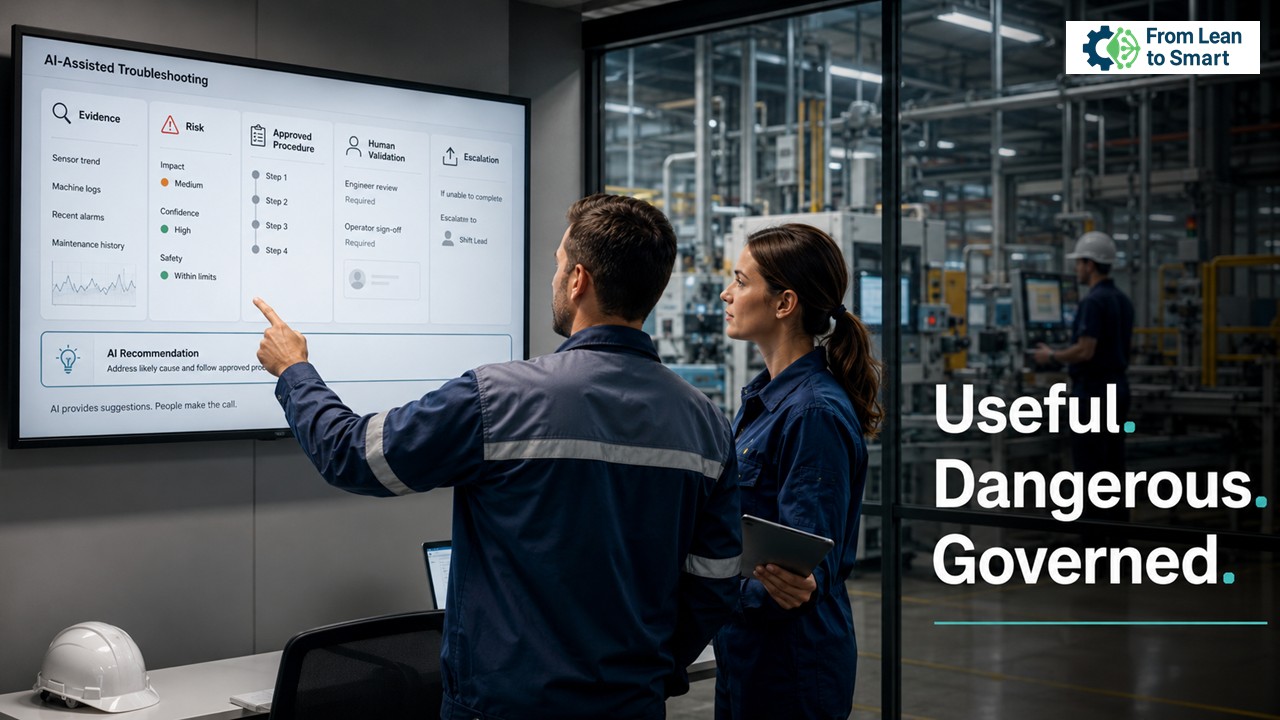
A serious industrial AI assistant should have clear limits. It should know what it is allowed to answer, what it must not answer, when it must cite approved sources, when it must ask for missing information, and when it must escalate to a responsible expert.
Sometimes the most valuable answer an AI assistant can give is:
“I do not have enough validated context to recommend an action.”
That sentence may be more useful than a confident but unsafe recommendation.
The Misunderstanding: Treating Generative AI as a Chatbot
One of the most common mistakes is treating generative AI as a conversational layer placed on top of weak processes.
A chatbot connected to poor documentation is not operational intelligence.
A chatbot without ownership is not governance.
A chatbot retrieving obsolete procedures is a risk.
A chatbot making recommendations without escalation logic is not ready for the shopfloor.
The opportunity is not simply to “chat with the factory.” The opportunity is to build governed operational assistance.
That requires more than a language model. It requires controlled knowledge sources, source validation, version management, decision boundaries, auditability, escalation rules, and integration with existing operating routines.
Generative AI should not bypass MES, MOM, CMMS, QMS, ERP, or established workflows. It should help people use those systems better, interpret context faster, and make decisions with better traceability.
If AI becomes another informal workaround, it will add complexity rather than capability.
And manufacturing already has enough workarounds.
A Maintenance Example: From Answer Machine to Decision Support
Consider a critical asset generating repeated vibration alarms. Maintenance reviews the CMMS history. Production is under pressure to maintain output. A spare part is available, but replacement requires stopping the line. An AI assistant retrieves similar historical cases and identifies possible causes: bearing degradation, lubrication issues, or misalignment.
That may be useful, but it is not enough.
The actual decision depends on additional context: asset criticality, current vibration trend, safety risk, production plan, maintenance window, lubrication records, operator observations, previous interventions, spare parts quality, and escalation thresholds.
If the assistant simply says, “Replace the bearing,” it has reduced a complex operational decision to an unsupported recommendation.
A better assistant would support the decision process:
“Similar historical cases suggest bearing degradation, lubrication issues, or misalignment as possible causes. Before deciding on intervention, validate the vibration trend, inspect lubrication records, review recent maintenance activity, confirm operating conditions, and escalate if the defined risk threshold is exceeded.”
That is the difference between AI as an answer machine and AI as industrial decision support.
The first produces an instruction.
The second improves the quality of judgment.
A Quality Example: Supporting Investigation Without Closing It Prematurely
Now consider a quality engineer investigating a recurring defect after a process change. A generative AI assistant can summarize recent nonconformities, retrieve past 8D reports, compare symptoms with previous customer complaints, and suggest possible investigation paths.
That can save time.
But the assistant must not replace accountability. It must not decide whether product should be released. It must not invent causal certainty. It must not ignore material batches, recipe versions, process parameters, operator conditions, inspection method changes, or containment rules.
In quality management, language is not cosmetic. It defines responsibility.
A possible cause is not a root cause.
A correlation is not evidence.
A similar case is not the same condition.
A summary is not an approved disposition decision.
A governed AI assistant should help the team ask better questions, structure the investigation, and retrieve relevant evidence. It should not close the investigation prematurely or create false confidence.
The Missing Layer: Operational Governance
Generative AI in manufacturing needs governance before scale.
Not governance as paperwork. Governance as operating discipline.
The essential questions are practical:
Who owns the knowledge base?
Who validates procedures and technical content?
Which sources are approved for AI retrieval?
How are obsolete documents removed?
What can the assistant summarize, suggest, or recommend?
Which outputs require human approval?
How are prompts, answers, and resulting decisions logged?
How are unsafe or low-quality responses reported?
Who audits the system’s behavior over time?
These questions may seem less exciting than AI demonstrations, but they are what separate a promising pilot from a reliable industrial capability.
Without governance, generative AI becomes another uncontrolled layer between people and the process. It may accelerate access to information, but it may also accelerate the spread of poor information.
The model is only one part of the system. The surrounding industrial discipline is what determines whether the output can be trusted.
Human-in-the-Loop Is Not a Weakness
Some discussions present human-in-the-loop as a temporary limitation, as if the final objective were to remove people from industrial decision-making.
That view misunderstands factory reality.
In manufacturing, human accountability is not an obstacle to automation. It is part of safe and responsible operations.
The role of generative AI should be to reduce cognitive load, surface relevant knowledge, structure options, detect patterns, and improve the quality of operational conversations. It should not silently transfer responsibility from supervisors, technicians, engineers, and managers to a statistical system.
A person must still understand the decision, challenge the recommendation, and own the consequence.
The future factory does not need blind AI confidence. It needs better collaboration between human judgment, process discipline, system context, and governed AI support.
The Real Maturity Test
Almost any organization can launch a generative AI pilot. The harder question is whether it can sustain a governed capability that people trust and use responsibly.
That requires strong foundations: clear standards, reliable master data, validated knowledge, process ownership, disciplined workflows, escalation rules, system integration, and leadership behavior that values operational truth over speed.
Generative AI will expose the maturity of the industrial system around it.
If a factory has weak documentation, unclear ownership, poor data discipline, and informal decision-making, AI will amplify those weaknesses. If a factory has strong routines, validated procedures, reliable records, and clear accountability, AI can become a serious operational support capability.
The technology is powerful, but it is not self-governing.
The decisive question is not whether generative AI can answer. The question is whether the factory has created the conditions under which an answer can be trusted, challenged, traced, and responsibly used.
That is what will determine whether generative AI in manufacturing becomes useful, dangerous, or simply misunderstood.
#IndustrialAI #GenerativeAI #AIinManufacturing #SmartFactory #MES #MOM #CMMS #QualityManagement #OperationalExcellence #IndustrialMaintenance #Reliability #AIGovernance #DataGovernance #ManufacturingExcellence