Industrial AI is often presented as if it could sit above the factory and make operations smarter by itself.
Connect the data. Train the model. Generate insights. Automate recommendations. Improve performance.
The narrative is attractive, but it is incomplete.
Anyone who has worked close to production, maintenance, quality, planning, or industrial systems knows that the factory is not a clean dataset waiting to be optimized. It is a living operating system shaped by constraints, priorities, standards, exceptions, workarounds, tribal knowledge, incomplete master data, shifting production requirements, and decisions made under pressure.
This does not make AI irrelevant.
It makes AI dependent on something many organizations still underestimate: operational context.
That is why industrial AI needs MES, BPM, and Lean more than is often acknowledged.
Not because every AI initiative requires a large transformation program around it. Not because these disciplines are fashionable. But because AI only creates sustainable value when it can influence real operational decisions in a way that is contextual, governed, traceable, and credible to the people who must act.
AI Without Context Becomes Operational Noise
A model can predict that a machine has an increasing probability of failure.
However, the real decision is not simply whether to stop the machine. The decision depends on asset criticality, the production plan, spare parts availability, safety exposure, maintenance windows, current WIP, customer priority, quality impact, historical failure behaviour, and the confidence that production and maintenance teams have in the alert.
A quality model can detect a pattern that suggests a potential defect.
However, the operational response depends on recipe version, material batch, process parameters, inspection rules, containment procedures, traceability requirements, customer risk, and whether the process team understands the likely cause.
An AI assistant can suggest a troubleshooting action.
However, the relevant question is whether that action is safe, approved, aligned with standards, traceable, and within the competence level of the person expected to execute it.
This is where many industrial AI pilots become impressive in demonstration but weak in operation. They can predict, classify, summarize, or recommend, but they do not always understand the operating system they are trying to influence.
The issue is not whether the model is intelligent.
The issue is whether the recommendation can become responsible action.
MES Provides Execution Reality
MES and MOM systems matter because they provide the execution backbone of the factory.
They connect production orders, equipment status, materials, personnel, process parameters, quality checks, genealogy, downtime, scrap, rework, recipes, and execution evidence. In practical terms, MES helps AI understand what was actually happening when an event occurred.
Without this context, AI may detect signals but miss their operational meaning.
A temperature deviation is not just a numerical anomaly. It may be related to a product variant, a recipe, a material lot, a shift, a changeover, a maintenance intervention, or a specific process segment.
Downtime is not merely the difference between running and stopped. It needs to be connected to reason codes, operating conditions, sequence of events, actions taken, and ownership.
Quality is not simply pass or fail. It is linked to process conditions, material history, inspection logic, operator actions, rework decisions, and product genealogy.
AI needs this execution context to avoid becoming statistically interesting but operationally disconnected.
MES does not make AI valuable by itself. Poorly governed MES data can also create confusion. But without reliable execution context, AI has a much harder time producing recommendations that operators, supervisors, engineers, and maintenance teams can trust and act upon.
BPM Provides Ownership and Decision Logic
BPM is often reduced to process mapping. In industrial operations, that is too limited.
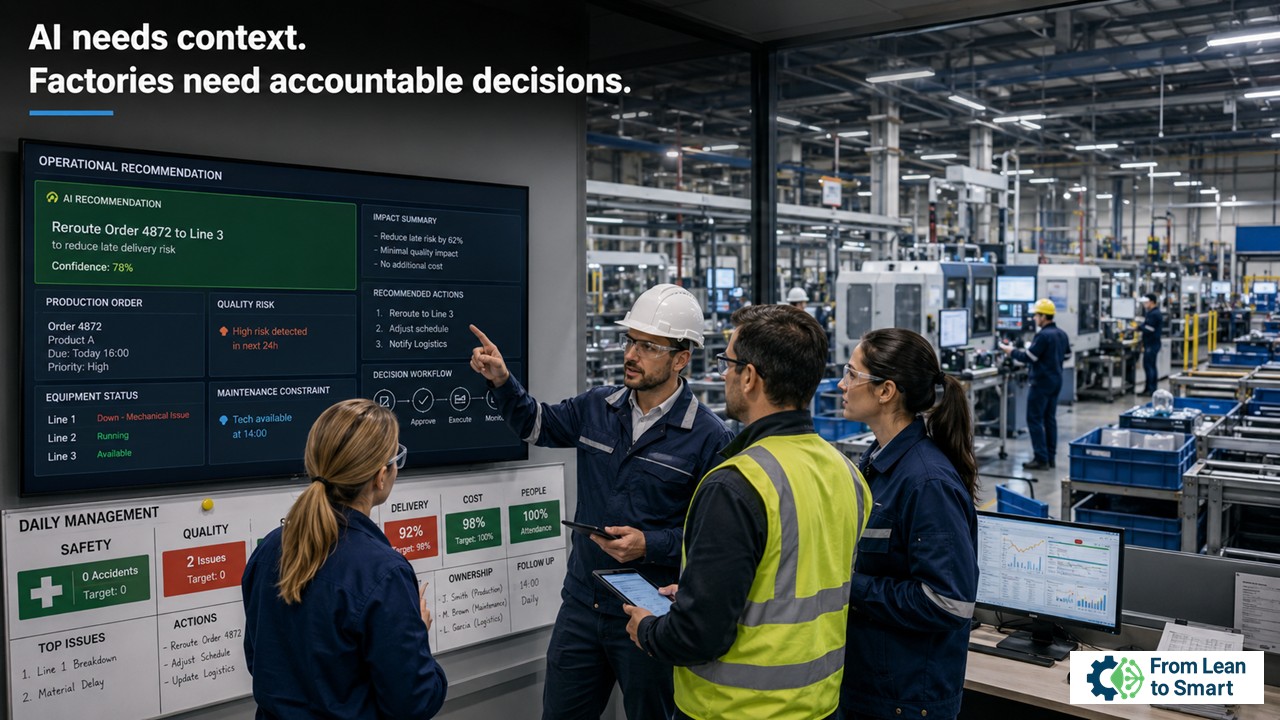
At its best, BPM defines how work, exceptions, responsibilities, escalations, and decisions actually move through the organization. This is essential for AI because a recommendation without ownership is not a decision. It is only another signal.
If an AI system recommends an intervention, several questions immediately matter:
Who owns the decision?
Production, maintenance, quality, planning, process engineering, the supervisor, or the shift manager?
What happens if the recommendation conflicts with delivery pressure?
Who can override it?
What evidence must be documented?
When should the case be escalated?
How will the decision be reviewed after execution?
These are not technical details. They are governance questions.
AI without process ownership creates operational ambiguity. It produces recommendations that everyone can see, but nobody clearly owns. In that situation, the factory does not become more intelligent; it becomes more exposed to unclear accountability.
A factory does not need more alerts without decision rights. It needs clearer decision processes.
BPM helps define how AI recommendations enter real operational workflows: how they are evaluated, who acts, what evidence is required, when exceptions are allowed, how overrides are controlled, and how learning is captured after the event.
That is the difference between AI as an isolated tool and AI as part of an accountable operating system.
Lean Provides Problem Clarity and Operational Discipline
Lean gives AI something equally important: a disciplined way to understand operational problems.
Before asking AI to optimize a process, the organization should understand whether the process is stable enough to learn from.
Before using AI to explain losses, the factory should know whether losses are classified consistently.
Before automating recommendations, teams should understand the standard condition, the abnormal condition, and the expected response.
Before adding predictive intelligence, leaders should ask whether daily management routines already act on visible problems.
Lean is not the opposite of AI. In industrial environments, Lean is one of the foundations that makes AI useful.
Lean clarifies flow, standards, waste, abnormalities, root causes, and problem-solving routines. It forces the organization to confront operational reality before scaling analytical complexity.
This matters because AI can amplify weak thinking.
If downtime reason codes are unreliable, AI will learn from poor classification.
If standards are unstable, AI will struggle to distinguish normal variation from abnormal performance.
If daily meetings do not close actions, AI insights will become another topic for discussion rather than a trigger for improvement.
If leadership tolerates recurring abnormalities, AI will not create accountability by itself.
Lean helps AI remain grounded in operational truth.
The Dangerous Fantasy: AI Above the System
One of the riskiest assumptions in industrial transformation is that AI can compensate for weak operational systems.
It cannot do so by itself.
AI will not replace process ownership.
It will not correct poor master data through enthusiasm.
It will not create trust where teams have already experienced too many unreliable alerts.
It will not remove cross-functional conflict when production, maintenance, quality, and planning operate with disconnected priorities.
It will not convert dashboards into decisions if routines, standards, and accountability are weak.
AI can be powerful, but it is not above the system. It is inside the system.
If the system is unclear, AI will inherit that lack of clarity.
If the process is unstable, AI will learn from instability.
If ownership is ambiguous, AI recommendations will circulate without disciplined action.
This is why industrial AI maturity should not be measured only by model sophistication. It should also be measured by the organization’s ability to turn recommendations into governed decisions.
A Realistic Maintenance Scenario
Consider a predictive model that detects abnormal vibration on a critical asset.
The model produces a risk score. The dashboard changes status. A notification is sent.
At that point, the real operational work begins.
Is the asset critical for the next production window?
Is there a spare part available?
Has this failure mode occurred before?
Is the maintenance team already overloaded?
Can the asset be stopped without creating a customer delivery issue?
Is the risk related to safety, quality, availability, or cost?
What does the CMMS history indicate?
Does production trust the alert?
Who has the authority to make the final decision?
In this scenario, AI contributes the early signal and supports the decision.
MES contributes production context, equipment status, order priority, material flow, and execution history.
BPM contributes escalation logic, ownership, approval rules, override discipline, and decision traceability.
Lean contributes the standard for abnormality response, root cause discipline, structured problem solving, and learning after the intervention.
The value does not come from the model alone. It comes from integrating the model into an operating system capable of acting responsibly.
From Prediction to Governed Recommendation
Many factories do not fail because they lack predictions. They fail because predictions do not become governed action.
This is the maturity shift industrial AI requires.
The question is not only:
“The model says something may happen.”
The more important question is:
“The system recommends an action, explains the context, identifies the owner, shows the constraints, supports escalation, records the decision, and enables learning afterwards.”
That shift requires more than data science. It requires MES or MOM context, BPM governance, and Lean discipline.
The future of industrial AI is not only better models. It is better operational decision systems.
These systems will connect recommendations to standards, workflows, roles, evidence, exceptions, and learning. They will keep humans accountable while giving them better context for decisions made under uncertainty. They will not bypass operations; they will help operations reason more effectively.
The Practical Question Before Scaling AI
Before scaling an industrial AI use case, leaders should ask several hard questions.
Which operational decision are we trying to improve?
Do we have the execution context required to interpret the signal?
Is there a defined process for acting on the recommendation?
Do people trust the data?
Are standards clear enough to distinguish normal from abnormal?
Who owns the decision when AI suggests action?
What happens when the recommendation conflicts with production pressure?
How will we know whether the recommendation improved safety, quality, delivery, cost, or asset reliability?
These questions are less fashionable than discussing algorithms, copilots, or autonomous agents. But they are closer to value.
The competitive advantage will not come from simply having AI in the factory. It will come from governing how AI influences operational decisions.
For that, AI needs more than data.
It needs MES to understand execution reality.
It needs BPM to structure ownership and decision logic.
It needs Lean to clarify problems, standards, abnormalities, and learning.
AI may be the new capability, but operational discipline remains the foundation.
The factories that benefit most from AI will not be the ones that treat it as a layer above operations. They will be the ones that embed it inside a disciplined operating system where context is reliable, decisions are owned, actions are traceable, and learning is continuous.
#IndustrialAI #MES #MOM #BPM #LeanManufacturing #OperationalExcellence #SmartFactory #IndustrialMaintenance #AssetManagement #Reliability #DataGovernance #ManufacturingExcellence