The idea of the autonomous factory is attractive because it simplifies the story.
Machines detect anomalies. Algorithms assign priorities. AI agents coordinate production, maintenance, quality, and logistics. The plant adjusts itself in real time. Managers supervise from a distance. Operators intervene only when the system requests human attention.
It is a clean narrative.
Real factories are not clean.
They operate under production pressure, demand volatility, incomplete data, ageing assets, quality risks, shift-to-shift variation, maintenance constraints, supplier issues, safety requirements, informal workarounds, and decisions that are rarely as simple as a dashboard suggests.
For this reason, the most important question is not whether AI can make the factory more autonomous.
The more serious question is whether AI can make the factory more accountable.
Autonomy Is Not the Same as Industrial Maturity
Many digital transformation discussions confuse autonomy with progress.
If a system can recommend an action, trigger an alert, adjust a parameter, generate a work order, or propose a schedule change, it is often assumed that the factory is becoming smarter. Sometimes this is true. In other cases, the organization is simply accelerating a weak decision process.
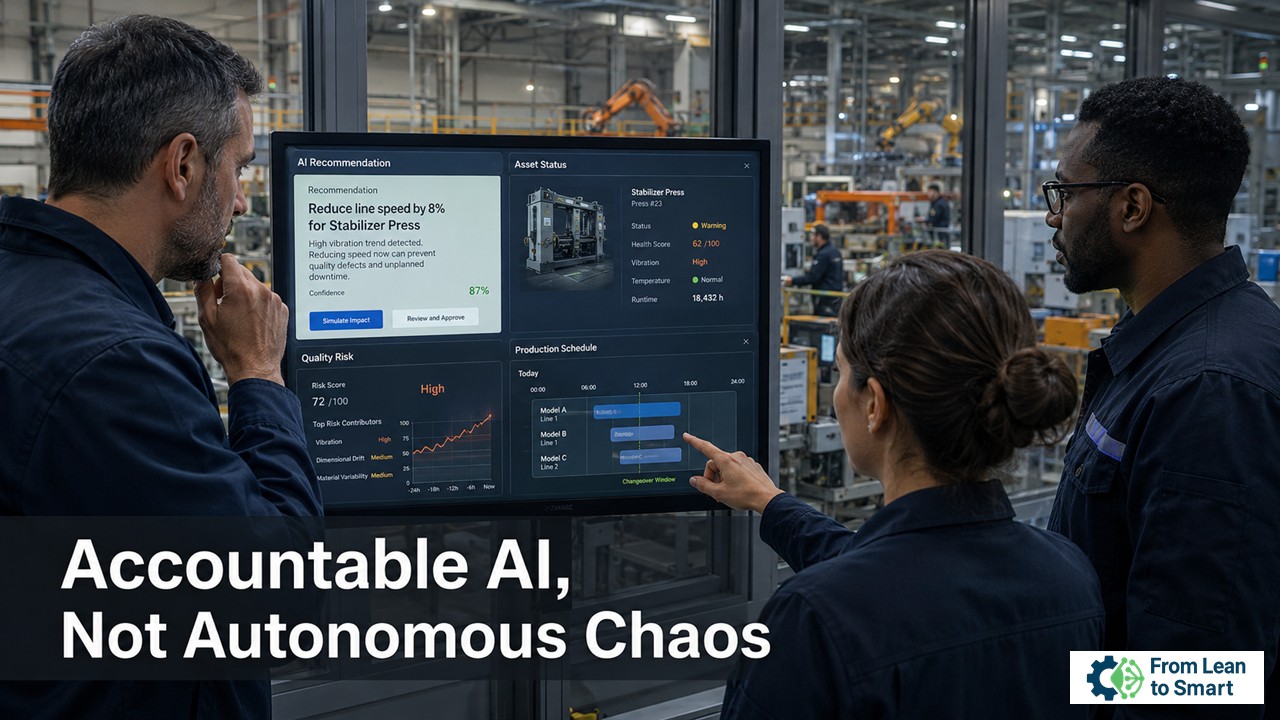
A predictive maintenance model may detect a risk of bearing failure. But the operational decision depends on asset criticality, spare parts availability, production commitments, maintenance windows, safety exposure, previous failure history, and the cost of stopping now versus later.
An AI-based quality model may detect a defect pattern. But value appears only when the organization can connect that signal to process parameters, material batches, recipes, inspection rules, operator actions, and corrective action discipline.
An AI scheduling agent may propose a sequence change. But someone still has to own the trade-off between delivery performance, overtime, changeover losses, inventory exposure, and quality risk.
In the factory, the difficult part is rarely the recommendation itself.
The difficult part is knowing who is accountable for accepting it, challenging it, escalating it, overriding it, or learning from it.
The Risk of Autonomous Confusion
AI can scale intelligence. It can also scale confusion.
If process ownership is weak, AI recommendations will move across departments without clear accountability. If master data is poor, the output may appear precise while resting on fragile operational context. If escalation rules are unclear, people will either follow the system blindly or ignore it quietly. If daily management routines do not absorb the new signals, AI becomes another layer of operational noise.
This is not only a technology problem. It is an operating model problem.
A factory with weak standards, unclear decision rights, poor loss understanding, and inconsistent follow-up does not become mature because it adds AI. It may simply become faster at making poorly governed decisions.
The same principle applies to dashboards. A dashboard does not improve performance because it displays information. It improves performance only when it changes the quality of a decision, the speed of a response, or the discipline of follow-up.
AI is no different.
An AI system that predicts, classifies, optimizes, or generates without changing operational accountability is not yet an industrial capability. It is a technical feature waiting for an owner.
Accountable AI Starts with Decision Clarity
Before asking what AI can automate, industrial leaders should ask what decision they are trying to improve.
Is the decision about stopping a line? Releasing a batch? Prioritizing a maintenance intervention? Adjusting a process parameter? Escalating a supplier issue? Replanning a production sequence? Opening a quality containment? Changing a standard?
Each decision has context.
Each decision has consequences.
Each decision needs ownership.
Accountable AI requires the organization to answer practical questions before the model is placed into the operating environment:
Who owns the decision?
What data, rules, and standards should the AI use?
What is the approved action space?
When must a human review the recommendation?
What level of confidence is sufficient for action?
Which risks require escalation?
How is the final decision recorded?
How does the system learn from the result?
These questions are less attractive than slogans about autonomous agents, but they are much closer to the real work of industrial transformation.
The issue is not whether AI can generate a recommendation. The issue is whether the organization has a governed decision architecture capable of using that recommendation responsibly.
Human-in-the-Loop Is Not a Sign of Immaturity
Human-in-the-loop is sometimes presented as a temporary limitation, as if the final objective were to remove people from operational decision-making altogether.
In industrial environments, this view is often naïve.
Human accountability is not present because AI is weak. It is present because factories deal with safety, quality, people, assets, customers, and long-term consequences.
A maintenance technician may know that a vibration alert is technically relevant but operationally secondary because the spare part is unavailable and the next planned stop has already been agreed. A production supervisor may know that an apparently optimal sequence creates a hidden quality risk because the team has seen instability after a specific changeover. A quality engineer may challenge an AI recommendation because the system cannot yet see a recent material deviation that has not been reflected in structured data.
This does not mean human judgment is always correct.
It means industrial decisions require a governed relationship between data, models, standards, experience, and responsibility.
The objective is not to protect old habits from AI. The objective is to prevent AI from bypassing the accountability that keeps operations safe, reliable, and disciplined.
The Factory Needs a Decision System, Not Isolated Intelligence
The next maturity step is not simply adding more AI use cases.
It is building stronger operational decision systems.
This means connecting AI with MES/MOM context, ERP constraints, CMMS/EAM data, quality rules, process standards, asset hierarchy, genealogy, production schedules, maintenance plans, escalation routines, and daily management practices.
AI should not live beside the operating system of the factory. It must be embedded into it.
For example, an AI recommendation in maintenance should not only state that an asset may fail. It should help frame the decision:
What is the criticality of the asset?
Which production orders are exposed?
Is the spare part available?
Is there an approved maintenance procedure?
Have similar failures occurred before?
What is the risk of postponement?
Who must approve the intervention?
This is a different level of maturity.
It moves the conversation from prediction to decision support. From alert to action. From model output to governed operational reasoning.
Accountable AI Requires Leadership Discipline
The uncomfortable truth is that accountable AI will expose management weaknesses.
It will reveal unclear ownership.
It will expose poor master data.
It will challenge informal workarounds.
It will make escalation gaps visible.
It will show whether daily management is a real decision rhythm or merely a meeting around numbers.
That is why AI governance cannot be delegated only to IT, data science, or automation teams.
Industrial AI governance must involve operations, maintenance, quality, engineering, safety, finance, and leadership. Not as occasional stakeholders, but as owners of the decisions AI will influence.
A factory does not need every AI recommendation to be perfect. It needs every recommendation to be traceable, challengeable, sufficiently explainable for its risk level, and connected to a clear decision process.
That is what builds trust.
Not slogans about autonomy.
Before the Next AI Pilot
Before launching the next AI pilot, industrial leaders should ask three questions.
First, which operational decision will this AI capability improve, and who owns that decision today?
This question forces the organization to move from broad ambition to operational specificity. “AI for maintenance” is too vague. “Prioritizing corrective intervention on critical assets under production constraints” is much closer to the real decision.
Second, what should happen when the AI recommendation conflicts with operator experience, maintenance constraints, or quality risk?
This is where trust is won or lost. Escalation rules, override logic, and learning routines should be defined before deployment. The purpose is not to prove that either the model or the human is always right. The purpose is to make disagreement visible, traceable, and useful for improving the system.
Third, are we building an AI feature, or are we strengthening the decision system of the factory?
Many AI pilots remain isolated because they are designed around model performance rather than operational adoption. A stronger approach connects AI outputs with standards, MES/MOM context, CMMS/EAM data, daily management, accountability, and follow-up discipline.
That is where AI becomes operational.
The Future Factory Will Be Governed Before It Is Autonomous
There will be more automation. More AI agents. More real-time optimization. More intelligent assistants. More closed-loop control in specific domains where the process is stable, the risk is understood, and the boundaries are clear.
But the credible future factory will not be a place where humans disappear from accountability.
It will be a governed socio-technical system in which people, processes, systems, and AI collaborate with discipline.
Some decisions will be automated.
Some will be recommended.
Some will be escalated.
Some will remain human because the context is too complex, the risk too high, or the trade-off too strategic.
The competitive advantage will not come from having AI in the factory. It will come from governing how AI influences operational decisions.
Because the factory does not need autonomous AI for the sake of autonomy.
It needs accountable AI that helps people make better decisions under real industrial pressure.
#IndustrialAI #AccountableAI #SmartFactory #MES #MOM #OperationalExcellence #IndustrialMaintenance #AssetManagement #Reliability #DataGovernance #ProcessGovernance #ManufacturingExcellence