
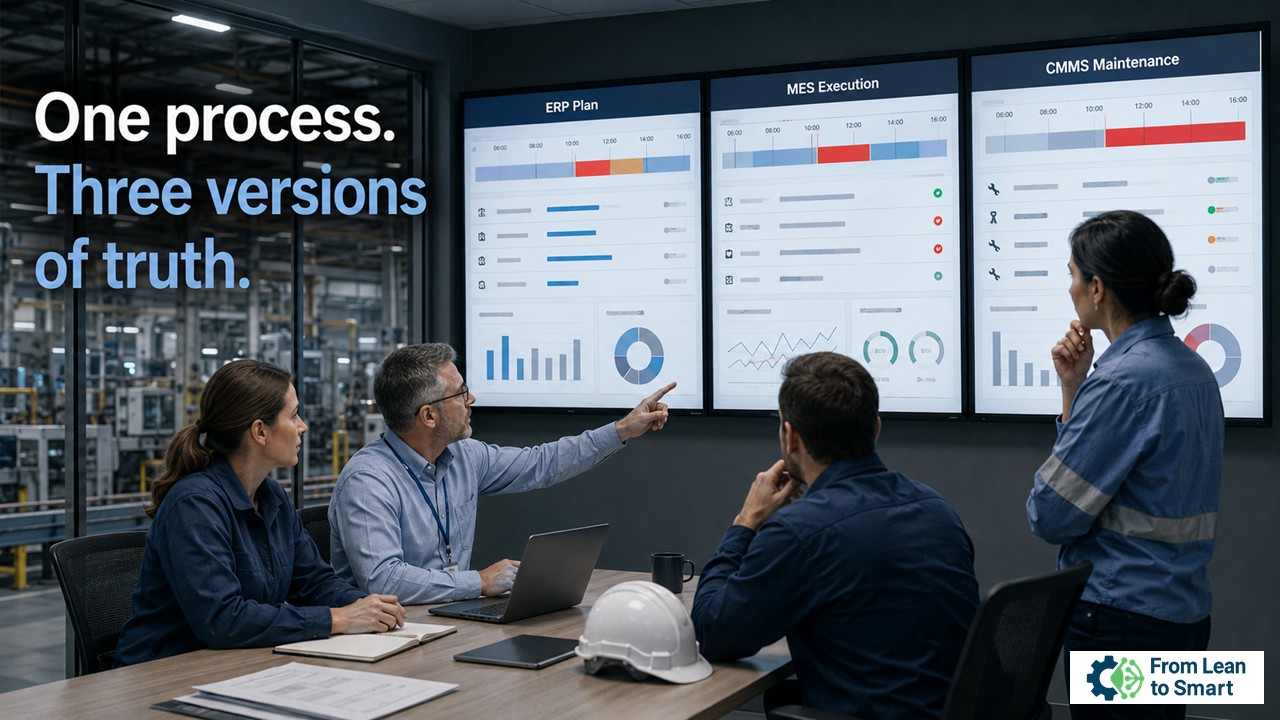
In many factories, the process appears clear on paper.
The ERP defines what should be produced. The MES records what was executed. The CMMS captures what stopped, failed, was inspected, or repaired. Quality systems add another layer of evidence. Spreadsheets, shift logs, and supervisor notes often complete the picture — or complicate it further.
Individually, each system may be doing its job. Collectively, they may describe different versions of the same operational event.
This is where many BPM initiatives begin to lose contact with the factory.
Not because the process map is necessarily wrong. Not because the systems are useless. Not because people are careless.
The deeper issue is that the organization has not defined how operational truth is constructed across systems, roles, timestamps, decisions, and exceptions.
A factory does not run on isolated data records. It runs on interpreted events.
The Process Is Not Contained in One System
A production order may be released in ERP with a planned quantity, route, and date. On the shopfloor, the MES may capture partial confirmations, downtime, scrap, rework, deviations, manual adjustments, and shift-level decisions. The CMMS may register a maintenance intervention against an asset that explains part of the downtime, but not always with the same timing, failure classification, or production context.
From an IT perspective, this may look like an integration issue.
From an operational perspective, it is usually a process ownership issue.
Who owns the end-to-end interpretation of what happened?
Who decides which timestamp is relevant?
Who validates the reason code?
Who connects a machine stoppage with a work order, a production loss, a quality risk, and a maintenance action?
Who ensures that the process model reflects what people actually do under production pressure?
If the answer is “the system should do that,” the organization is already in difficulty.
Systems can capture, structure, and transfer information. They do not automatically create operational meaning.
Three Systems, Three Operational Narratives
Consider a familiar situation.
A production line loses two hours during the night shift. In the MES, the stoppage is recorded as “mechanical failure.” In the CMMS, the work order states “sensor replaced.” In the ERP, the production order is confirmed with lower output and a variance. In the daily meeting, the discussion becomes a negotiation of interpretations.
Production argues that maintenance response was slow.
Maintenance argues that the initial failure description was poor.
Planning sees a delayed order.
Quality asks whether the unstable restart affected product conformity.
Finance sees a cost variance but not the operational chain behind it.
Everyone has data. Nobody has a shared version of the process.
This is one of the most important blind spots in industrial BPM. The process is not only the designed flow. It is also the way exceptions are detected, classified, escalated, corrected, and learned from.
When ERP, MES, and CMMS disagree, the issue is not merely data inconsistency. It is often decision inconsistency.
BPM Must Move from Documentation to Operational Reconciliation
Traditional BPM often assumes that once the process is modeled, roles are assigned, and systems are aligned, execution will follow.
Factories rarely behave with that level of simplicity.
Industrial operations contain variation: urgent orders, material shortages, changeovers, quality holds, asset degradation, missing spare parts, engineering deviations, cleaning constraints, temporary workarounds, and production pressure. These realities do not always fit into a linear process diagram.
This does not make BPM irrelevant. It means BPM must mature.
In an industrial environment, BPM should help answer practical questions:
What is the official process when execution follows the expected path?
What happens when the process deviates?
Which system records which part of the event?
Who validates the operational interpretation?
Which data triggers action, escalation, or learning?
How are recurring disagreements prevented from appearing again in the next shift meeting?
At this level, BPM is no longer a documentation exercise. It becomes an operating discipline.
Integration Without Accountability Creates Digital Confusion
Many companies invest heavily in connecting ERP, MES, CMMS, QMS, WMS, historians, and analytics platforms. The intention is understandable. Disconnected systems create blind spots, manual reconciliation, and delays.
But integration alone does not remove ambiguity.
If downtime reason codes are poorly governed, integration distributes poor classification faster.
If asset hierarchies are inconsistent, maintenance history becomes difficult to connect with production losses.
If production orders, equipment names, cost centers, and material references are not aligned, reporting becomes an exercise in reconciliation.
If supervisors classify causes differently by shift, dashboards become negotiation tools instead of decision tools.
The factory may become more digital and still remain operationally confused.
This point is uncomfortable but essential: digital integration can amplify weak process discipline.
A connected system landscape only creates value when the organization has defined ownership, data meaning, exception logic, master data rules, and decision rights.
The Hidden BPM Work Nobody Wants to Own
The hard work is rarely glamorous.
It includes agreeing on master data.
It includes defining how downtime should be classified.
It includes clarifying when a maintenance notification becomes a work order.
It includes deciding who can modify a reason code after the shift.
It includes aligning production, maintenance, quality, planning, IT, and operational excellence around the same operational event.
It includes verifying whether the designed process still reflects the real process.
This work is not usually celebrated in transformation presentations. But it is where industrial BPM becomes real.
A process cannot be managed seriously when every function owns only its fragment and nobody owns the operational thread.
In real factories, the value of BPM appears when it helps functions stop defending their local truth and start building a shared one.
Process Mining Still Requires Operational Interpretation
Process mining can expose variants, loops, delays, rework, and deviations that were previously invisible. That visibility can be valuable.
But process mining does not automatically explain why the process behaves as it does.
A deviation may be waste.
It may be a workaround.
It may be a risk.
It may be a necessary adaptation to an unstable reality.
It may even be informal operational intelligence that the official process failed to capture.
Without shopfloor interpretation, process mining can produce elegant but incorrect conclusions.
If ERP data suggests that a maintenance process took too long, the real constraint may have been the absence of a production window. If MES data shows frequent manual adjustments, the cause may be poor routing, unstable material quality, unrealistic standards, or inadequate master data. If CMMS history shows repeated interventions, the root issue may sit in operating conditions, cleaning standards, lubrication discipline, setup practices, component design, or supplier quality.
The event log shows the trace. The organization still needs to understand the work.
MES/MOM as Industrial BPM
This is why MES/MOM can play an important role when it is understood correctly.
Not merely as an operator interface.
Not merely as an OEE dashboard.
Not merely as a reporting layer.
MES/MOM can become a form of industrial BPM when it connects execution, resources, standards, equipment, quality, material flow, deviations, and operational decisions.
But this only happens when the process logic is designed with the shopfloor, not imposed from a conference room.
A strong MES/MOM layer should help make the operational event understandable:
What was planned?
What actually happened?
Where did it happen?
Which asset was involved?
Which material was affected?
Who made the decision?
Which deviation occurred?
What action followed?
Was the issue escalated, corrected, or simply absorbed by the next shift?
That is not just data collection. It is process accountability.
What Leaders Should Examine
When ERP, MES, and CMMS tell different versions of the same process, leaders should resist the immediate temptation to ask for another interface, dashboard, or data lake.
They should begin with more fundamental questions.
Where does operational truth break down?
Which system is authoritative for which decision?
Where do people compensate with spreadsheets, informal routines, or verbal agreements?
Which exceptions are repeatedly debated in daily meetings?
Which data fields are completed because they are useful, and which are completed only because the system requires them?
Who has the authority to align departments around one version of operational reality?
These questions expose whether BPM is being treated as a documentation activity or as a management capability.
The most frequent disagreements are rarely random. They usually appear around downtime, scrap, rework, maintenance interventions, production confirmations, quality holds, and schedule deviations — precisely because these events cross functional boundaries.
A useful starting point is not to ask, “Which system is right?”
A better question is: Which decision is affected by this inconsistency, and who owns that decision in daily operations?
The Objective Is Not Perfect Data
The goal is not to make ERP, MES, and CMMS identical. They serve different purposes.
ERP manages business planning, order fulfilment, and financial consequences.
MES/MOM manages execution, operational context, and shopfloor control.
CMMS/EAM manages maintenance work, asset history, and reliability actions.
They should not all do the same thing.
The real objective is to define how their different truths connect into one operational narrative that people can trust, challenge, and act upon.
That is the foundation for better decisions, better problem-solving, better process mining, better automation, and eventually more credible industrial AI.
Because if humans cannot agree on what happened, AI will not magically solve the process. It will only learn from fragmented reality.
The maturity of industrial BPM is not measured by the elegance of the process map. It is measured by the organization’s ability to govern execution, interpret exceptions, assign accountability, and build a shared understanding of operational reality.
#OperationalExcellence #IndustrialMaintenance #SmartFactory #MES #BPM #ProcessMining #ManufacturingExcellence #AssetManagement #Reliability #IndustrialAI #DigitalTransformation