
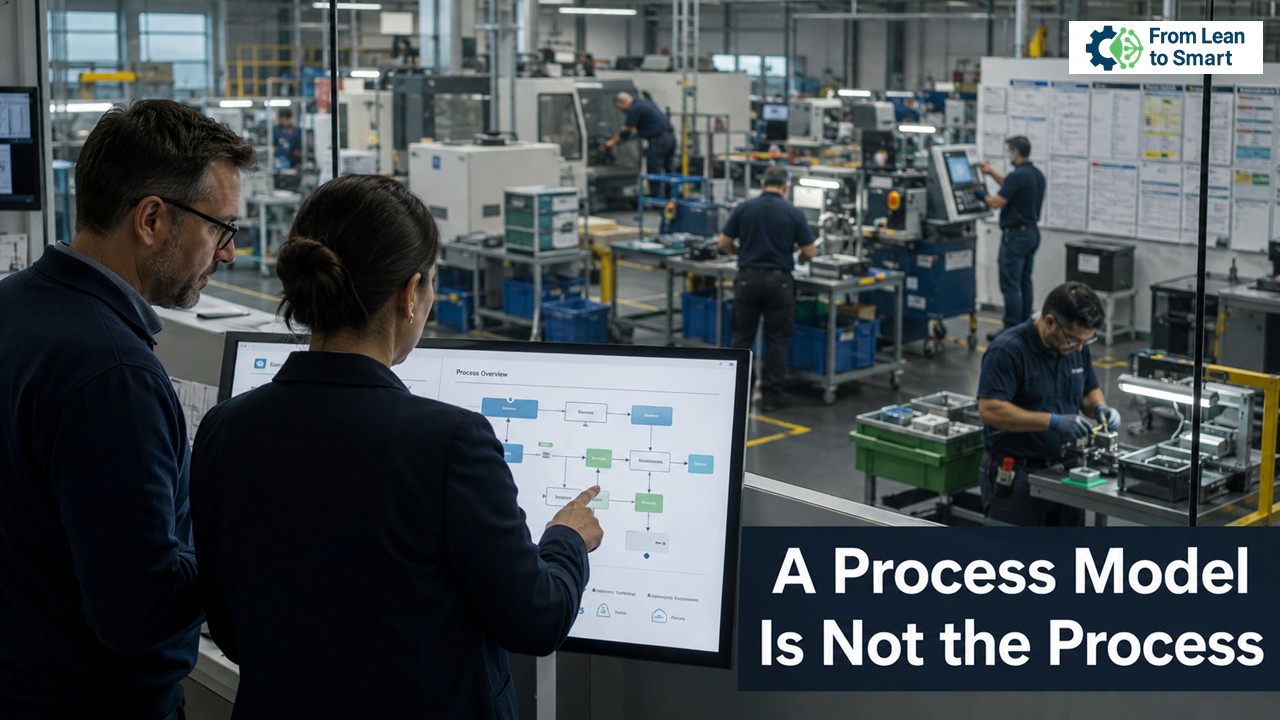
A process model can be useful.
It can clarify sequence, responsibilities, inputs, outputs, systems, controls, and handovers. It can help teams align their language, identify gaps, standardise work, and design better ways of operating.
But a process model is not the process.
The real process appears when production is behind plan, a machine alarm is active, a material batch is delayed, a quality doubt has not yet been resolved, the ERP order status does not match the MES execution status, maintenance has no spare part available, and the supervisor has only a few minutes to decide what to do next.
That is where the process becomes real.
Not in the diagram.
Not in the workshop.
Not in the approved procedure.
The real process is the interaction between work, decisions, exceptions, systems, constraints, habits, and accountability under operational pressure. This is also why many BPM initiatives remain administratively correct but operationally weak: they document the intended flow without sufficiently confronting how work actually behaves on the shopfloor.
A process model should therefore be treated as a hypothesis about operations, not as proof that the process is understood.
The Map Is Useful, but It Is Not the Territory
A process map usually shows the intended flow. Operations reveal the actual flow.
The difference between both is where much of the learning lives.
In a meeting room, a process may look clean: request, approve, execute, confirm, close. On the shopfloor, that same process may include missing information, informal calls, urgent escalations, duplicated entries, waiting for approvals, manual corrections, temporary decisions, and undocumented workarounds.
The model may state that maintenance receives a work order, plans the task, executes it, and closes it. The real process may include a production supervisor requesting immediate support, a technician diagnosing the failure without complete history, a spare part that exists in the system but is not physically available in the store, a temporary fix accepted to protect output, and a work order closed later with incomplete information because the line had to restart.
The model may state that quality containment follows a defined workflow. The real process may include uncertainty about the affected batch, incomplete genealogy, pressure from customer delivery, manual checks, conversations between quality and production, and a decision that depends on both data and operational experience.
None of this means that the process model is useless. It means that the model is incomplete unless it is tested against operational reality.
Processes Are Made of Decisions, Not Only Activities
Traditional BPM often places too much emphasis on activity sequence: who does what, after whom, and through which system.
That matters. But in industrial operations, the critical part of the process is often not the sequence itself. It is the decision logic that governs the sequence when reality does not follow the model.
When do we stop the line?
When do we continue under deviation?
When do we escalate?
Who has the authority to accept temporary risk?
What information is sufficient to act?
Which system is the source of truth?
Which exception requires management involvement?
What cannot be decided locally?
These questions rarely appear clearly in a basic process diagram. Yet they determine how the factory actually behaves.
A process model that describes activities but ignores decisions can create a false sense of control. It shows movement, but not judgement. It shows handovers, but not priorities. It shows roles, but not accountability under pressure.
Real operational processes are decision systems. If BPM does not make decisions visible, it remains administrative rather than operational.
The Hidden Process Lives in Exceptions
Many organisations design processes around the normal flow. But factories spend a significant part of their management energy dealing with exceptions.
A material does not arrive.
A machine does not perform as expected.
A quality check fails.
A supplier deviation appears.
A production order changes priority.
A preventive maintenance task is postponed.
A process parameter drifts.
A customer request changes the sequence.
The formal process often treats these situations as deviations. In real operations, however, exceptions are not occasional noise. They are where the maturity of the process becomes visible.
A strong process does not mean that nothing goes wrong. It means the organisation knows how to detect, decide, escalate, contain, learn, and return to stability.
A weak process may look adequate in the diagram and still collapse when conditions change. This is why BPM must go beyond the perfect “to-be” flow. It must define how the organisation handles abnormality.
Otherwise, the real process will be governed by informal experience, personal networks, and local improvisation. Sometimes that saves the day. But it does not build a scalable operating system.
Systems Often Disagree with the Process
Another reason process models fail is that they underestimate the systems landscape.
The process may look unified, while the information is fragmented across ERP, MES, CMMS, QMS, WMS, spreadsheets, emails, dashboards, and local databases. Each system may represent a different version of operational reality.
ERP says the order is released.
MES says execution is blocked.
CMMS says the asset is available.
The technician knows the equipment is running with a temporary condition.
Quality has a containment note in a separate file.
Logistics has adjusted the material sequence manually.
Which version represents the process?
The answer is not always obvious.
A process model that does not address data ownership, system roles, master data discipline, and operational truth is not enough. It may show the intended flow while the factory continues to operate through reconciliation work.
People then become the integration layer. They call, check, copy, validate, compare, and correct. This human coordination is often invisible in the model, but it consumes time, creates risk, and hides process weakness.
Good BPM must make this visible.
Workarounds Are Signals
Workarounds are often treated as discipline problems. Sometimes they are. But often they are signals.
A workaround may reveal that the official process is too slow. It may show that system data is not trusted. It may indicate that decision authority is unclear. It may expose a missing escalation route. It may prove that the process was designed for the normal case, not for real operational variability.
The point is not to romanticise workarounds. The point is to study them.
If a workaround appears once, it may be local improvisation. If it appears across shifts, departments, or plants, it is probably telling the organisation something important.
The real process is often hidden in what people do to make the formal process work.
A mature BPM approach does not only ask, “Are people following the process?” It also asks, “What does the workaround reveal about the process we designed?”
That second question is often where improvement begins.
Process Ownership Is Where the Model Becomes Real
A process model without ownership is only a drawing.
Someone must own the process outcome, not merely a functional activity. That ownership must include standards, exceptions, data, handovers, system behaviour, escalation routines, and improvement priorities.
In many factories, ownership is fragmented. Production owns output. Maintenance owns equipment. Quality owns conformity. Logistics owns material flow. Engineering owns process design. IT owns systems. Finance owns cost.
But real operational problems do not respect those boundaries.
When downtime, quality risk, material constraints, and delivery pressure collide, who owns the end-to-end decision? Who decides what trade-off is acceptable? Who ensures that the decision is recorded, reviewed, and translated into learning?
If the answer is unclear, the process will be governed by urgency, hierarchy, or personal influence.
That is not BPM. That is survival.
Process ownership must be operational, not decorative. It must reach daily management, performance reviews, problem-solving routines, escalation meetings, and improvement portfolios. It must be visible when exceptions occur, not only when procedures are approved.
Process Mining Does Not Replace Operational Interpretation
Process mining can be powerful because it reveals how processes flow through system transactions. It can show loops, delays, rework, skipped steps, and unusual paths that are difficult to see through interviews alone.
But process mining does not automatically explain why the process behaves that way.
A loop may be waste. It may also be a necessary quality control.
A delay may indicate poor execution. It may also reflect waiting for safe equipment access.
A skipped step may be non-compliance. It may also be a system transaction that does not represent the physical process accurately.
The data shows traces. The gemba explains meaning.
This is where BPM, Lean, process mining, and operational leadership must work together. The objective is not to produce more elegant diagrams or more impressive dashboards. The objective is to understand how work really happens and to improve the system that shapes that work.
Without operational interpretation, process mining can become another form of abstraction. With operational interpretation, it can become a disciplined way to expose reality.
The Value of BPM Is Operational Truth
BPM creates value when it helps the organisation see reality more clearly and act with greater discipline.
It should help answer practical questions:
Where does the process really break?
Where are decisions unclear?
Where do systems disagree?
Where do people compensate for weak design?
Where do exceptions become normal work?
Where does ownership disappear?
Where does data fail to support action?
That is a very different ambition from documenting processes for compliance.
A process model should not be treated as a final answer. It should be treated as a hypothesis to be tested against real operations.
Go to the shopfloor. Follow the work. Compare the model with the decisions people actually make. Look at the system transactions. Watch the handovers. Study the exceptions. Ask where people need to call someone to make the process move. Ask what happens when the normal flow fails.
That is where the process lives.
A process model is not the process. But used correctly, it can become the starting point for understanding reality, challenging assumptions, clarifying accountability, and building a more reliable operating system.
The maturity of BPM is not measured by the quality of the diagram. It is measured by whether the organisation can make better decisions, with better information, under real operational conditions.
#BPM #ProcessManagement #OperationalExcellence #ProcessOwnership #ManufacturingExcellence #ShopfloorManagement #LeanManufacturing #SmartFactory #MES #ProcessMining #IndustrialOperations #ContinuousImprovement #DigitalTransformation