In manufacturing, the fastest reaction is not always the best solution.
Factories are very good at reacting.
A machine stops. People move.
A quality issue appears. Containment starts.
A customer escalation arrives. Meetings multiply.
A KPI turns red. Actions are requested.
And in serious manufacturing environments, this is necessary. Urgency cannot be ignored.
But there is a big difference between reacting fast and solving well.
Many problems remain alive in factories not because people lack effort, experience or technical knowledge, but because the organization moves too quickly from symptom to action.
The pressure to do something often wins over the discipline to understand what is really happening.
That is where A3 thinking becomes valuable.
Not as a template.
Not as a document.
Not as a Lean ritual.
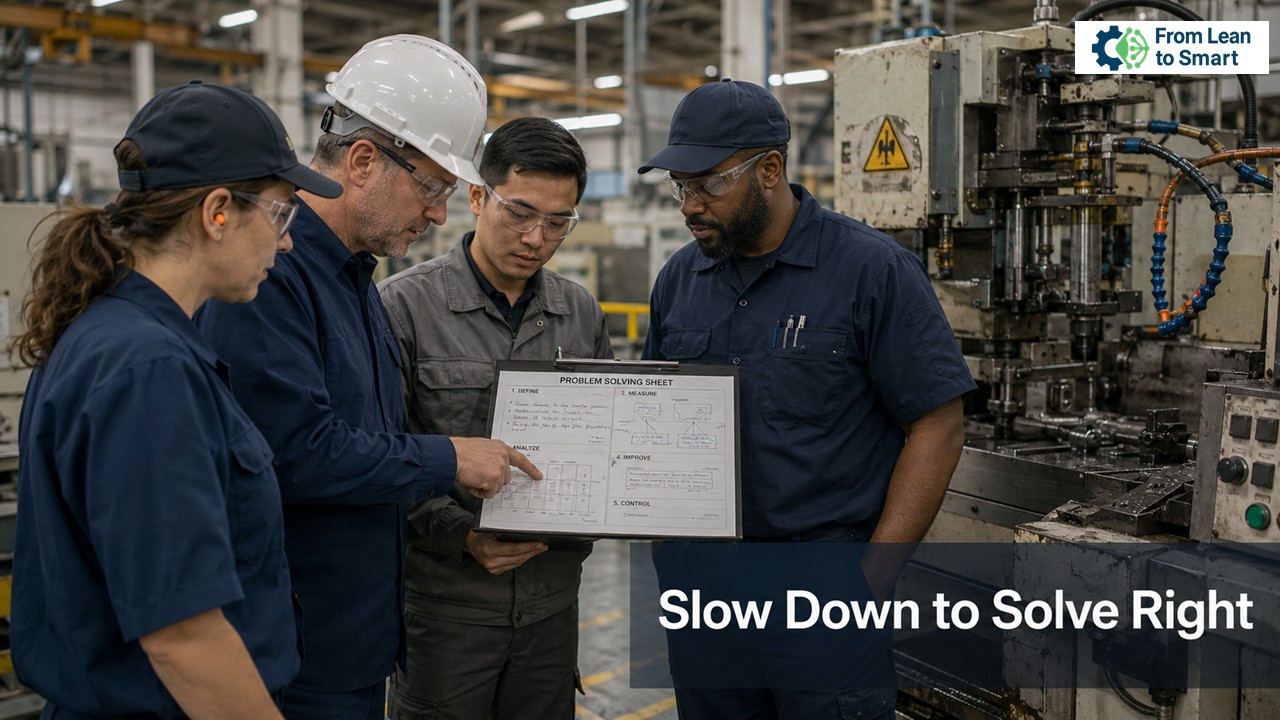
But as a disciplined way to slow down enough to solve the right problem.
The Problem Is Rarely the First Thing We See
In real operations, the visible problem is often only the surface.
A line misses output, but the deeper issue may be unstable material supply, repeated microstops, poor changeover preparation or an unrealistic staffing assumption.
OEE drops, but the real losses may be hidden behind weak reason codes, merged downtime categories or operators choosing the “least wrong” option in the system.
A quality defect appears, but the cause may sit across process parameters, tooling condition, training, maintenance history, material batch variation or a standard that no longer reflects reality.
Maintenance is blamed for availability, but the deeper issue may be production pressure delaying planned work until failures become unavoidable.
When the organization jumps directly to countermeasures, it may solve the visible symptom while leaving the system untouched.
That is not improvement.
That is operational recycling.
The same problems return with different names, new meetings and another action list.
A3 Is Not Paperwork. It Is Thinking Made Visible
A good A3 forces a team to make its reasoning explicit.
It asks simple but uncomfortable questions:
What is the current condition?
What is the gap?
Why does it matter?
What facts do we actually have?
What assumptions are we making?
Where is the process behaving differently from the standard?
What causes have been verified at the Gemba?
Which countermeasures address the cause, not only the effect?
This is uncomfortable because it exposes weak thinking.
It shows when the problem statement is vague.
It shows when opinion is being used instead of evidence.
It shows when the action was selected before the cause was understood.
It shows when the organization is trying to close an issue rather than learn from it.
And that is precisely the value.
A3 thinking creates a shared space where operational reasoning can be challenged before resources are spent, habits are reinforced and ineffective actions are repeated.
The Best A3s Are Built Close to the Work
The strongest A3s are built close to the process.
Not because Gemba is a fashionable word, but because the process does not exist in a conference room.
It exists in cycle times, walking paths, machine states, material presentation, operator decisions, tooling conditions, maintenance constraints, quality checks and real production pressure.
When teams build an A3 far from the work, they often describe the organization’s interpretation of the problem.
Not the problem itself.
That difference matters.
A supervisor may say that the operator is not following the standard.
At the Gemba, the team may discover that the standard cannot be followed because parts arrive mixed, tooling is not available at the point of use, the machine requires an undocumented adjustment or the cycle time assumption is no longer valid.
A production manager may see low performance.
At the Gemba, the team may find repeated minor stops that never appear as meaningful losses because downtime classification is too crude.
A quality engineer may see an isolated defect.
At the Gemba, the pattern may reveal a process condition that changes after changeover, during material replenishment or when a specific material batch is used.
A3 thinking protects the organization from solving the wrong version of the problem.
Root Cause Is Not a Slogan
Many factories say they do root cause analysis.
Fewer consistently verify causes.
A cause is not root because it appears at the bottom of a diagram.
A cause is not root because the team asked “why” five times.
A cause is not root because it sounds plausible under pressure.
A cause becomes useful when it is connected to evidence and when removing it changes the condition.
This distinction is critical.
Without it, A3s become storytelling documents. They explain the problem in a way that makes the action feel reasonable, but they do not prove that the action will change the system.
A3 thinking should force teams to test causality:
If this cause is true, what should we observe?
Can we reproduce or confirm the condition?
Does the data support what we saw at the Gemba?
Are we confusing correlation with cause?
Are we blaming behavior when the process makes the right behavior difficult?
This discipline is what separates problem-solving from action management.
Countermeasures Are Not Action Lists
One of the most common mistakes is turning the A3 into a list of tasks.
Retrain operators.
Update the work instruction.
Add an audit.
Create a checklist.
Review the standard.
Add a meeting.
Escalate to maintenance.
Improve communication.
Sometimes these actions are necessary.
But too often, they are generic responses to a poorly understood problem.
A countermeasure should change the condition that allows the problem to occur.
If the real issue is unstable material supply, a training action will not solve it.
If the real issue is a weak changeover standard, another audit will not stabilize it.
If the real issue is poor machine basic condition, a dashboard will not recover reliability.
If the real issue is unclear ownership between production and maintenance, a new KPI will not create alignment.
The question is not whether the action sounds reasonable.
The question is whether the action directly addresses the verified cause.
That is where many improvement systems become weak.
They manage activity.
But they do not always change the process.
A3 Thinking Develops People, Not Only Processes
A3 is often described as a problem-solving method.
That is true, but incomplete.
A3 thinking is also a leadership development mechanism.
It teaches people to observe better, define problems more precisely, separate facts from assumptions, involve the right functions, think in systems and evaluate countermeasures based on learning.
It also changes the leader’s role.
The leader should not use the A3 to demand a perfect document.
The leader should use it to coach the thinking.
What makes you believe this is the problem?
Where did you observe it?
What does the standard say?
What evidence contradicts your hypothesis?
Who needs to be involved?
What did we learn after the countermeasure?
What changed in the process?
When leaders ask these questions consistently, A3 becomes part of the management system.
When leaders only ask when the action will be closed, A3 becomes another administrative burden.
The maturity of A3 thinking is often visible in the quality of leadership questions.
The Real Value Is Better Operational Judgment
The value of A3 thinking is not the paper size.
It is not the layout.
It is not whether every box is filled correctly.
The value is better operational judgment.
A good A3 helps the organization avoid three common failures:
1. Solving symptoms instead of causes.
2. Implementing actions without understanding the process.
3. Closing problems without creating learning.
In factories under pressure, this discipline is difficult.
People want quick answers.
Managers want visible progress.
Teams want to move on.
But unresolved problems have a way of returning, often with higher cost, greater frustration and less trust.
A3 thinking does not make problems easy.
It makes the thinking harder to hide.
And that is why it matters.
Because the strongest factories are not the ones that react the fastest to every issue.
They are the ones that learn how to understand problems deeply enough to prevent them from coming back.
Questions for Reflection
Are we using A3s to improve thinking, or mainly to document actions after decisions have already been made?
How often do we verify causes at the Gemba before selecting countermeasures?
Do our leaders coach problem-solving logic, or do they mainly push for action closure?
#A3Thinking #LeanManufacturing #OperationalExcellence #ProblemSolving #ContinuousImprovement #Gemba #RootCauseAnalysis #Manufacturing #IndustrialLeadership #ProcessImprovement #ShopfloorManagement #LeanLeadership #IndustrialExcellence