AI agents are entering the industrial conversation with a familiar promise: more autonomy, faster decisions, less manual coordination, and fewer people trapped between disconnected systems.
A production agent could monitor output and recommend schedule adjustments.
A maintenance agent could prioritize interventions based on risk.
A quality agent could detect deviations and propose containment actions.
A planning agent could balance demand, capacity, inventory, and operational constraints.
On paper, this sounds powerful.
On the shopfloor, it becomes more difficult.
A factory is not a collection of isolated tasks waiting to be automated. It is a network of decisions, constraints, responsibilities, exceptions, escalation routines, informal workarounds, and cross-functional trade-offs. What looks like a simple recommendation in a system often becomes a complex operational decision in reality.
This is where many AI-agent initiatives will struggle.
Not because the technology is necessarily weak.
Not because models cannot generate useful recommendations.
Not because operators are inherently resistant to change.
They will struggle because the organization has not clarified who owns the process, who owns the decision, who owns the data, and who is accountable when recommendations collide with operational reality.
AI agents do not remove the need for process ownership. They make the absence of ownership visible.
The Factory Does Not Need Automated Confusion
Many factories already operate with fragmented ownership.
Production owns output. Maintenance owns asset condition. Quality owns conformity. Logistics owns material availability. Engineering owns process design. Planning owns the schedule. IT owns applications. OT owns connectivity. Continuous improvement owns methodology. Finance owns cost visibility.
Each function is necessary. But operational problems rarely respect functional boundaries.
When a machine runs below target, the root cause may involve production discipline, maintenance reliability, material feeding, process parameters, operator capability, planning pressure, or equipment design.
When a quality deviation appears after a changeover, the cause may involve recipe management, tooling condition, material batch variation, inspection method, setup standards, machine drift, or the pressure to restart production quickly.
When a maintenance alert indicates increased risk on a critical asset, the decision is not only technical. Should the line stop now, wait for the next maintenance window, reduce speed, prepare spares, increase monitoring, or escalate to production planning?
These are not merely technical questions. They are process-ownership questions.
If ownership is unclear before AI, an agent will not solve the ambiguity. It may simply accelerate it.
AI Agents Need Decision Boundaries
One of the most dangerous assumptions in industrial AI is that an agent is useful simply because it can recommend or act.
In industrial operations, action without boundaries is risk.
A maintenance agent recommending an intervention must understand more than vibration patterns or failure probabilities. It needs asset criticality, spare-parts availability, production demand, safety constraints, maintenance windows, failure history, work-order backlog, escalation rules, and the operational cost of stopping or not stopping.
A quality agent supporting containment decisions must understand control plans, inspection evidence, genealogy, deviation approvals, customer risk, rework rules, release authority, and the conditions under which product can continue to move.
A production agent supporting execution must understand takt, bottlenecks, labor constraints, standard work, changeover rules, WIP limits, material shortages, and the difference between a temporary recovery action and a new operating condition.
Without these boundaries, an AI agent becomes another voice in an already noisy system.
It may be fast.
It may be impressive.
It may even be technically correct within a narrow analytical frame.
But factories do not run on narrow correctness. They run on governed decisions under constraints.
Process Ownership Is Not a Name in a RACI Matrix
Process ownership is often reduced to a name in a procedure, a swimlane in a workflow, or a box in a RACI matrix.
That is not enough.
Real process ownership means that someone is accountable for how the process performs, how exceptions are handled, how standards evolve, how data is interpreted, how decisions are escalated, and how cross-functional conflicts are resolved.
It also means understanding the process as it actually operates, not only as it was designed.
A serious process owner knows where the process breaks under pressure. They know which data is trusted and which data is disputed. They know where informal workarounds have replaced formal standards. They know which decisions are routine, which require escalation, and which should never be delegated without human review.
That level of ownership is essential before AI agents are allowed to influence operational decisions.
Otherwise, the agent will operate inside ambiguity.
And ambiguity does not disappear because it has been digitalized.
The Hidden Problem: Agents Will Disagree
A factory with multiple AI agents will not automatically become more intelligent.
It may become more conflicted.
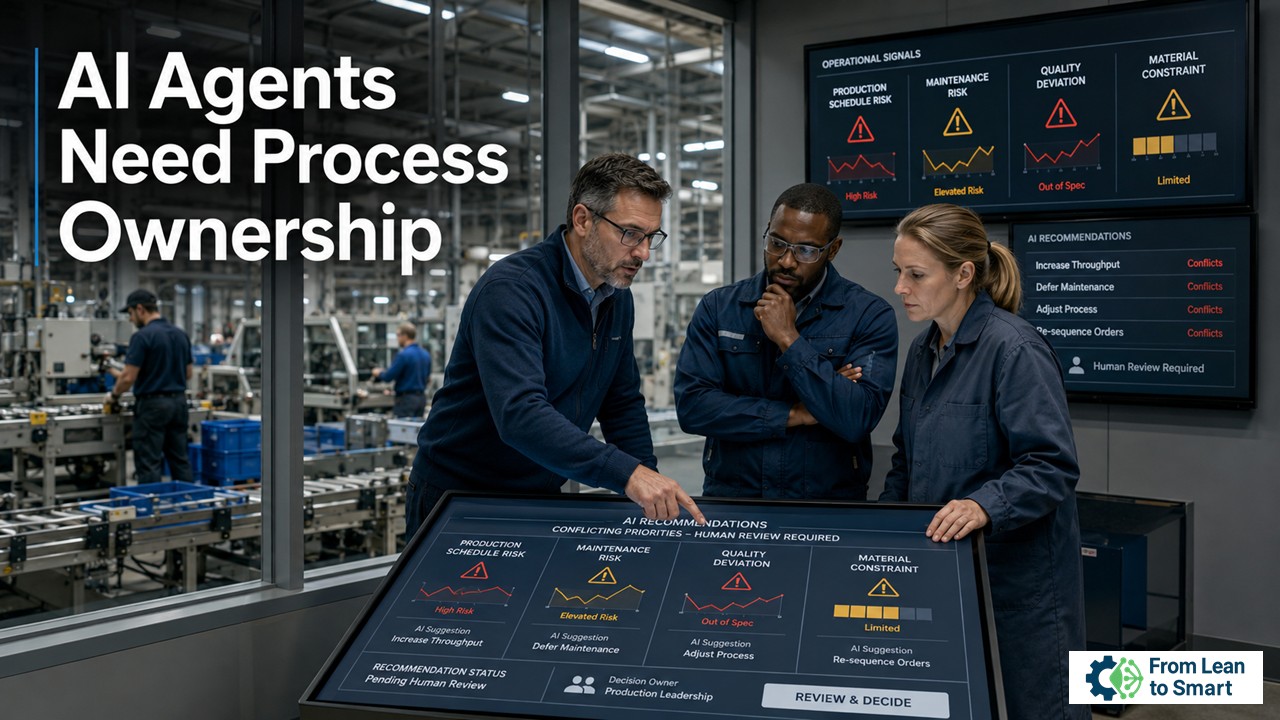
Imagine a maintenance agent recommending a controlled stop within four hours because the risk pattern on a critical asset is increasing.
At the same time, a production agent recommends continuing the run to recover schedule adherence.
A quality agent detects a small but rising process deviation and recommends additional containment checks.
A logistics agent warns that the alternative line cannot run because a component delivery is delayed.
Which recommendation wins?
The answer cannot be left to the most confident algorithm, the most visible dashboard, or the manager who happens to be available at that moment.
This is where decision governance becomes critical.
The factory needs clear rules for prioritization, escalation, evidence, authority, auditability, and accountability. Safety and quality constraints must be explicit and non-negotiable. Production recovery must be evaluated against reliability risk. Maintenance recommendations must be connected to asset criticality and customer impact. AI outputs must be traceable, challengeable, and reviewed against actual outcomes.
Without process ownership, AI agents will not create orchestration.
They will create automated disagreement.
Process Discipline Before Agent Autonomy
There is a maturity sequence that many organizations will be tempted to skip.
First, understand the process.
Then define ownership.
Then stabilize standards and data.
Then clarify decision logic.
Then introduce AI support.
Then consider controlled automation.
Jumping directly to autonomous agents is attractive because it sounds advanced. But in many factories, the practical value comes much earlier: helping people see risks, retrieve relevant context, compare options, and make better decisions faster.
An AI agent does not need full autonomy to create value.
A maintenance agent that summarizes failure history, links similar past cases, checks spare availability, and proposes risk-based options can be valuable.
A quality agent that connects defect patterns with process parameters, material batches, recipes, inspection results, and containment rules can be valuable.
A production agent that highlights schedule risks, bottleneck behavior, abnormal deviations from standard, and recovery options can be valuable.
But each of these use cases still requires ownership.
Someone must define what the agent is allowed to recommend.
Someone must validate the operational context.
Someone must decide when a recommendation becomes an action.
Someone must review outcomes and improve the decision logic.
AI can support the operating system of the factory. It should not become a substitute for it.
MES, BPM, Lean, and the Need for Process Meaning
AI agents in factories need operational context. That context is usually distributed across MES/MOM, ERP, SCADA, CMMS/EAM, QMS, WMS, historians, planning systems, engineering standards, and daily management routines.
But systems alone are not enough.
MES can provide execution context.
BPM can clarify process flow, ownership, exceptions, and governance.
Lean can expose waste, variation, standard-work gaps, flow problems, and real gemba conditions.
Together, these disciplines help create the foundation for AI agents that are connected to operational reality.
Without that foundation, agents operate on fragmented signals. They may see downtime without understanding the quality of reason codes. They may see quality deviations without understanding containment logic. They may see maintenance alerts without understanding production constraints. They may see schedule risk without understanding the real bottleneck.
Industrial AI needs more than data.
It needs process meaning.
The Leadership Question
The question for leaders is not simply:
“Where can we deploy AI agents?”
The better question is:
“Which operational decisions are important enough, frequent enough, and structured enough to be supported by AI?”
That question leads to harder, more useful ones.
Who owns this decision today?
What information is required to make it well?
Where does that information come from?
Which data is trusted, and which data is contested?
What exceptions occur?
Who has authority to approve action?
What risks must be controlled?
What must be auditable?
How do we learn when the recommendation was wrong, incomplete, or applied in the wrong context?
These questions may feel less exciting than discussing autonomous factories. But they determine whether AI creates operational value or simply adds another layer of digital complexity.
The future factory will not be defined by the number of agents deployed.
It will be defined by the quality of the decisions that humans, systems, processes, and AI are able to make together.
AI agents can be powerful. But without process ownership, they will not transform the factory.
They will reveal that nobody truly owned the process in the first place.
Questions Worth Taking to the Shopfloor
Which operational decisions would we trust an AI agent to support today, and which are still too ambiguous?
Do we have real process owners, or only functional owners protecting their part of the system?
When AI recommendations conflict across production, maintenance, quality, logistics, and planning, who decides what happens next?
#IndustrialAI #SmartFactory #OperationalExcellence #ProcessOwnership #MES #MOM #BPM #LeanManufacturing #IndustrialMaintenance #DataGovernance #ManufacturingExcellence #DecisionIntelligence