Why industrial AI needs process discipline before automation ambition
Many factories are preparing for artificial intelligence.
Fewer are preparing their processes for artificial intelligence.
That difference matters.
Because AI does not operate in a vacuum. It learns from data, detects patterns, supports decisions, automates recommendations and, in some cases, triggers actions.
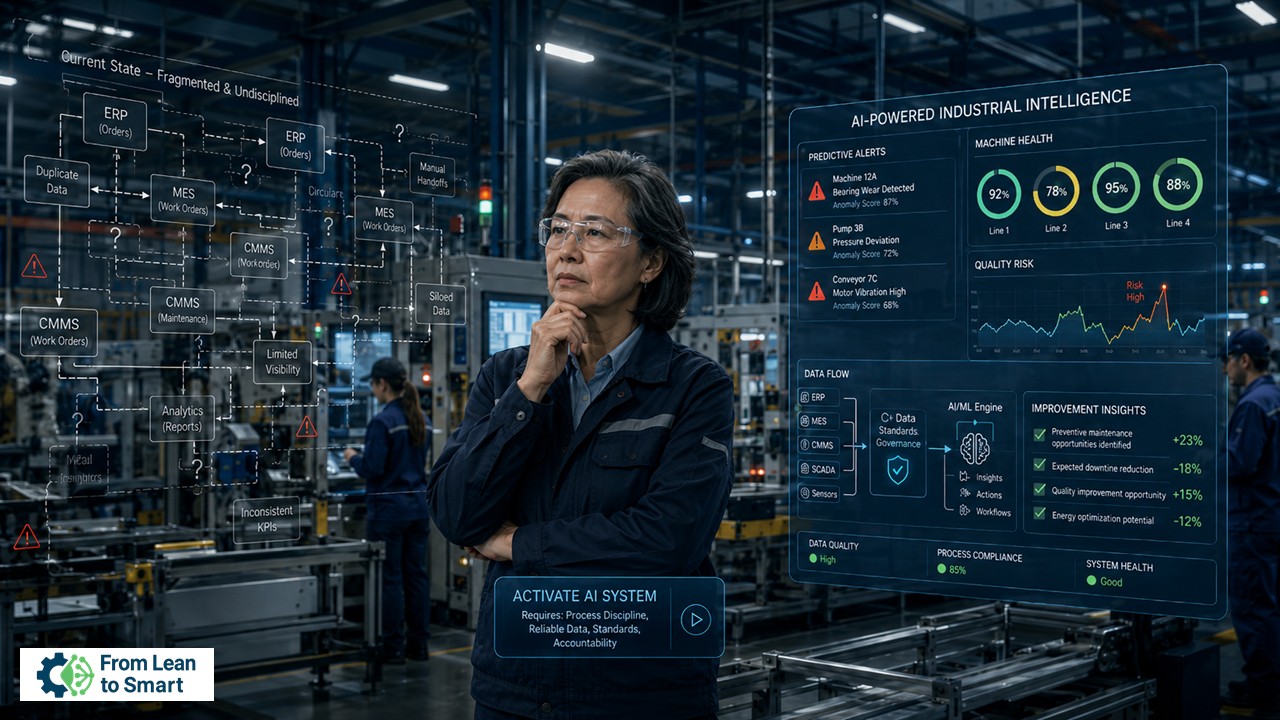
But if the process behind the data is unstable, undocumented, misunderstood or owned by nobody, AI will not create operational excellence.
It will simply make confusion faster.
A factory that does not understand its own processes should not expect AI to understand them better.
This is an uncomfortable point, because industrial AI is now surrounded by strong expectations.
Predictive quality.
Predictive maintenance.
AI assistants.
Autonomous planning.
Vision systems.
Digital twins.
Process mining.
Generative AI for troubleshooting.
AI agents for operations.
Closed-loop control.
The ambition is legitimate.
The problem is not ambition.
The problem is believing that AI can compensate for weak operational discipline.
When AI becomes the shortcut
In many industrial organizations, the AI conversation starts too late in the logic and too early in the technology.
A use case is defined.
A model is selected.
Data scientists are involved.
A pilot is launched.
A dashboard appears.
A proof of concept produces promising charts.
Then reality arrives.
The production line has several ways of recording the same event.
Maintenance interventions are classified differently depending on the shift, area or technician.
Quality defects have local names that do not match the official taxonomy.
Machine states are not consistently defined.
Cycle time losses are hidden under generic categories.
Process parameters are stored, but nobody agrees which ones are truly critical.
The standard work exists, but the real work has evolved around constraints that were never formally reviewed.
In that context, the AI model is not the first problem.
The process language is.
Industrial AI needs data.
But more importantly, it needs meaning.
It needs to know what an event represents, where it belongs in the process, who owns the decision, what standard defines normality and what action is expected when a deviation appears.
Without that foundation, AI becomes a sophisticated layer over operational ambiguity.
AI does not remove the need for standards
There is a common misunderstanding in digital transformation.
Standards are often seen as something old, slow or administrative.
AI is seen as modern, fast and strategic.
But in industrial environments, the opposite is often true.
AI without standards is fragile.
A standard is not only a document.
In a factory, a good standard is a shared operational agreement.
It defines how work should happen, how deviations are recognized, how information is captured, how responsibilities are assigned and how learning is incorporated back into the process.
This is why frameworks such as ISA-95 remain relevant in Smart Factory discussions.
Not because factories need more terminology.
But because integration needs structure.
AI needs to understand whether a signal belongs to equipment behavior, process execution, material flow, maintenance history, quality inspection, planning constraints or business demand.
Without that context, the organization may have more data, but not necessarily better decisions.
The same applies to Asset Management.
Predictive maintenance does not create value because a model predicts a failure.
It creates value when the organization can connect that prediction with:
Asset criticality.
Failure modes.
Spare parts.
Maintenance windows.
Production priorities.
Safety exposure.
Cost impact.
Decision accountability.
Prediction alone is not management.
A good prediction only becomes valuable when the factory knows what decision it must trigger.
The hidden weakness: unreliable operational data
Factories generate enormous amounts of data.
But volume is not the same as reliability.
A sensor can be accurate and still be useless if the process state is unclear.
A maintenance record can exist and still be misleading if the failure mode was poorly coded.
A quality database can be complete and still be weak if defect criteria changed informally over time.
Industrial data becomes valuable when it is connected to decisions.
That requires discipline in areas that rarely receive the same attention as AI pilots:
Master data ownership.
Process definitions.
Event taxonomies.
Equipment hierarchy.
Product and process parameters.
Quality defect classification.
Maintenance failure modes.
Data lineage between OT, MES, ERP, CMMS/EAM and analytics.
Clear rules for who validates, changes and governs data.
These topics are not glamorous.
But they decide whether AI becomes useful or decorative.
A predictive quality model, for example, may detect correlations between process parameters and defects.
But if defect classification is inconsistent, the model learns noise.
If rework is recorded differently between shifts, the model may learn behavior instead of process physics.
If process changes are not logged, the model may interpret a new standard as an anomaly.
The same happens in maintenance.
A model may detect abnormal vibration, temperature or energy consumption.
But if the asset hierarchy is weak, failure history is incomplete and maintenance actions are not standardized, the recommendation may be technically interesting and operationally difficult to trust.
Bad data does not only reduce AI accuracy.
It reduces organizational confidence.
And once operators, engineers, maintenance teams or supervisors stop trusting the system, the model becomes another dashboard nobody uses.
Accountability cannot be automated away
One of the most dangerous assumptions in industrial AI is the belief that automation can replace accountability.
It cannot.
AI can recommend.
AI can prioritize.
AI can detect patterns faster than humans.
AI can help capture expert knowledge.
AI can assist a technician during troubleshooting.
AI can suggest probable causes of recurring quality issues.
But the factory still needs to know who owns the decision.
Who validates the recommendation?
Who decides whether the line continues or stops?
Who updates the standard after the lesson learned?
Who reviews false positives and false negatives?
Who checks whether the model is still valid after a product change, supplier variation, process modification or equipment intervention?
This is where AI governance becomes operational, not theoretical.
In an industrial environment, trustworthy AI is not only about model performance.
It is about safety, explainability, traceability, cybersecurity, human oversight and responsibility.
AI governance should not be a committee created after deployment.
It should be part of the operating model from the beginning.
Because when an AI recommendation affects production, quality, maintenance, safety or delivery, the real question is not only:
Is the model correct?
The real question is:
How does the organization decide, act, learn and improve based on that recommendation?
From automation-first to process-first AI
A more mature approach starts with a different question.
Not:
Where can we apply AI?
But:
Which operational decision needs to become faster, better, more reliable or more consistent?
That question changes everything.
If the challenge is scrap reduction, the work starts by understanding the defect generation process, detection points, reaction plans, measurement systems and data capture logic.
If the challenge is maintenance reliability, the work starts with asset criticality, failure modes, operating context, maintenance standards, spare parts strategy and lifecycle risk.
If the challenge is production flow, the work starts with bottlenecks, constraints, planning rules, changeover standards, WIP behavior, material availability and escalation routines.
AI then becomes part of a broader Digital Operational Excellence system.
Lean clarifies the process.
Six Sigma strengthens variation thinking.
BPM defines ownership and governance.
MES/MOM provides execution structure.
Process Mining can reveal how the process really behaves.
Asset Management connects decisions to lifecycle value.
AI increases visibility, prediction and decision support.
None of these disciplines should compete.
Together, they help prevent one of the most common digital transformation failures:
Automating fragments of a process that nobody governs end to end.
What leaders should review before scaling industrial AI
Before scaling industrial AI, leadership teams should challenge the operational foundation.
Not to slow innovation down.
But to prevent scaling confusion.
The questions are simple, but not always comfortable:
Are our critical processes clearly defined, or only informally understood?
Do we have common taxonomies for losses, defects, failures, stops, causes and actions?
Is the MES/MOM logic aligned with how the factory really works?
Are master data owners clearly assigned?
Do our teams trust the data they use in daily management?
Can we explain why an AI recommendation was generated?
Is there a defined human decision owner?
Do we have a mechanism to learn from model errors?
Are standards updated when AI reveals a better way of working?
Can we connect AI outputs with real operating routines?
Do we know which decisions should be automated, assisted or kept human?
These questions are less exciting than a demo.
They are also more important.
A pilot can look impressive in a presentation.
Scaling requires something deeper:
Process discipline.
Reliable data.
Clear ownership.
Governed systems.
Operational trust.
Decision accountability.
Without these elements, AI may create visibility, but not necessarily value.
The real future of industrial AI
The future of industrial AI will not be defined only by model performance.
It will be defined by the ability of factories to connect models with process discipline, trustworthy data, governed systems and accountable people.
The best factories will not be those that automate the fastest.
They will be those that understand deeply enough:
What should be automated.
What should be assisted.
What should remain human.
What must first be standardized.
What decision the technology is expected to improve.
This distinction matters.
Because AI is not a substitute for operational maturity.
It is an amplifier.
If the process is stable, owned and understood, AI can accelerate learning, improve decisions and reveal patterns that humans may miss.
If the process is fragmented, ambiguous and poorly governed, AI will amplify that weakness.
It may produce more alerts.
More dashboards.
More recommendations.
More apparent sophistication.
But not necessarily better operations.
Industrial AI creates value when it becomes part of the way the factory makes decisions.
Not when it sits above the operation as a disconnected digital layer.
Not when it produces insights that nobody owns.
Not when it automates recommendations that frontline teams do not trust.
Not when it predicts events that the organization is not ready to act on.
AI can help a factory see more.
But only process discipline helps the factory understand what it is looking at.
And that is where real industrial intelligence begins.
#IndustrialAI #ArtificialIntelligence #SmartFactory #Industry40 #OperationalExcellence #DigitalTransformation #ProcessMining #BPM #LeanManufacturing #SixSigma #AssetManagement #PredictiveMaintenance #ManufacturingOperations #DataGovernance #MES #CMMS #ReliabilityEngineering #ContinuousImprovement