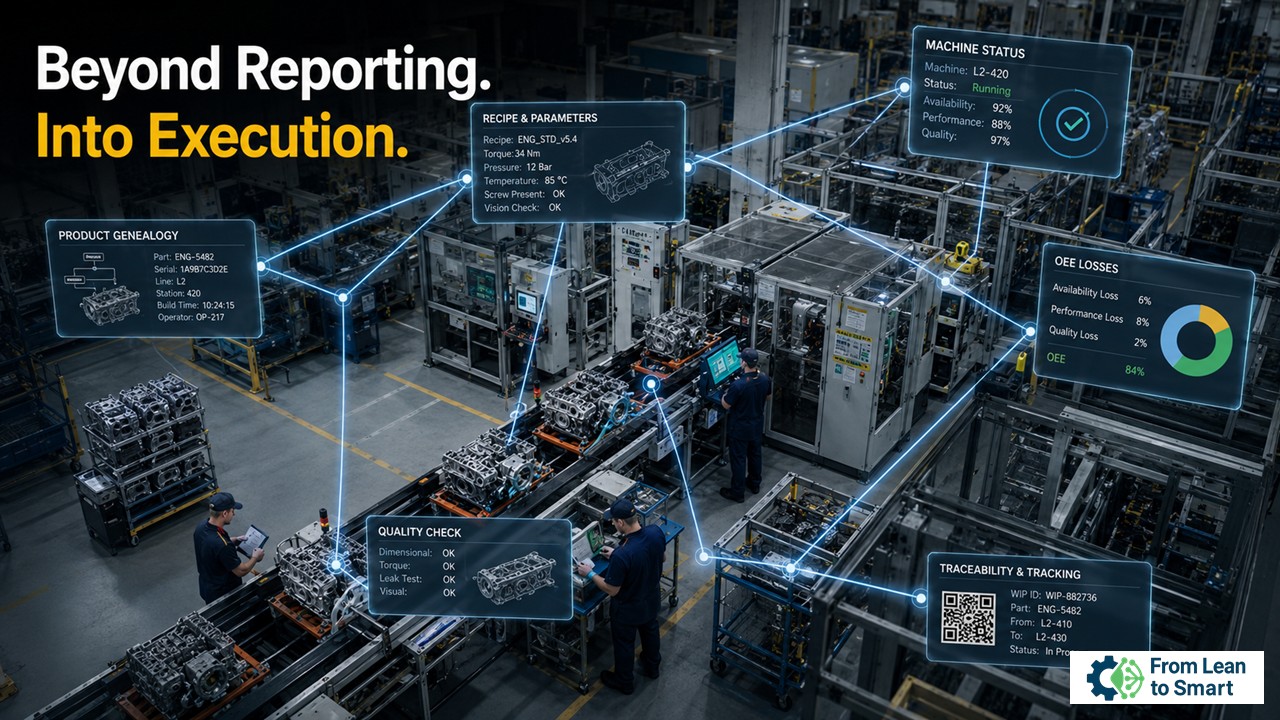
Many factories still describe MES as a system for production reporting.
That definition is too narrow.
A traditional MES can collect production quantities, downtime events, scrap reasons, operator declarations, and basic order confirmations. These functions are useful, but they are not sufficient for modern manufacturing environments where variability, quality risk, product complexity, and operational accountability are increasing.
The real value of MES/MOM does not emerge when the factory produces more dashboards. It emerges when the system helps connect what was planned, what was executed, what actually happened, and why the result changed.
At that point, MES stops being only a reporting layer and becomes part of the factory’s execution discipline.
The question is no longer only:
Did we produce?
The better question is:
Did we produce the right product, with the right material, under the right conditions, following the approved method, using the right equipment, and with evidence that can be trusted?
That is a very different level of operational maturity.
Traceability Is Not Only for Audits
Traceability is often treated as a compliance requirement. It is associated with customer claims, audits, regulatory pressure, recalls, and quality documentation.
That view is correct, but incomplete.
In real operations, traceability is also a learning capability. When a defect appears, the value is not only knowing which batch, serial number, pallet, or customer shipment may be affected. The deeper value is understanding the operational context behind the defect.
That context may include the material lot, machine, tooling, recipe version, operator, shift, process parameters, quality checks, rework history, deviations, holds, releases, and maintenance conditions.
Without this context, the organization only has fragments of data. Quality has one version of the event. Production has another. Maintenance has another. Engineering may have a fourth. The investigation then depends on meetings, memory, spreadsheets, and local explanations.
With strong MES/MOM traceability, the factory can move faster from containment to cause analysis.
A weak traceability system answers:
Where did this product go?
A stronger MES/MOM capability also helps answer:
What happened to this product while it was being made?
That distinction matters. The first answer supports compliance. The second supports operational learning.
Recipes Reduce Variability Before It Becomes Scrap
Recipe management is often underestimated because it is seen as a technical configuration issue.
In practice, it is much more than that.
In many factories, recipe changes still depend on manual adjustments, local files, operator experience, engineering instructions, or machine-level settings that are not fully connected to production execution. The result is predictable: inconsistent setups, wrong parameters, small deviations, avoidable scrap, unstable start-ups, and difficult investigations after quality problems appear.
MES/MOM does not eliminate the need for engineering discipline. It cannot compensate for poor process design or unclear ownership. But it can enforce the connection between product, process, machine, approved parameters, and execution conditions.
This is especially important in environments with frequent changeovers, multiple product variants, tight tolerances, regulated processes, or high cost of non-quality.
A recipe is not just a set of parameters. It is a controlled agreement between engineering, quality, production, and maintenance about how a product should be made.
That agreement needs ownership. It needs version control. It needs approval logic. It needs clear rules for release, change, deviation, and rollback.
When that governance is weak, the shopfloor absorbs the ambiguity. Operators compensate manually. Supervisors create local workarounds. Maintenance adjusts equipment based on experience. Quality investigates after the damage has already occurred.
A mature MES/MOM approach reduces that ambiguity by making the approved method executable, visible, and auditable.
Machine Connection Is Not the Same as Execution Control
Connecting machines is easier than controlling execution.
A factory may have PLCs, SCADA, historians, gateways, OPC UA, MQTT, edge devices, and dashboards, and still lack real operational control. Signals may be flowing, but decisions may not be improving.
This is a common misunderstanding in industrial digitalization. More connectivity does not automatically create better execution.
A stop signal is not automatically a downtime reason.
A temperature value is not automatically a quality risk.
A cycle count is not automatically reliable production evidence.
A parameter deviation is not automatically a decision.
For machine data to become useful, someone must define the rule, the context, the escalation path, and the expected response.
This is where architecture and governance matter.
MES/MOM should not replace PLCs, SCADA, or machine control systems. Those layers have their own purpose. PLCs control equipment behavior. SCADA supports supervision. Historians store process data. MES/MOM provides the execution context that gives operational meaning to events.
That context includes the order, product, operation, material, personnel, equipment state, quality requirement, recipe version, and production history.
When machine data is connected to this context, the factory can move from raw signals to operational intelligence. It can distinguish between a normal stop, an abnormal stop, a quality-relevant deviation, a setup condition, a process instability, and a loss that requires structured problem-solving.
This is not only a technical integration challenge. It is a decision-rights challenge.
Who owns the machine-state model?
Who validates downtime reason codes?
Who defines when a parameter deviation must stop production?
Who approves recipe changes?
Who decides whether an event is informational, quality-critical, or escalation-worthy?
Without these answers, machine connectivity becomes another source of noise.
OEE Becomes Misleading When It Is Disconnected from Execution
OEE is one of the most common MES use cases. It is also one of the most frequently misunderstood.
The problem is not OEE itself. The problem is when OEE becomes a number without operational truth.
If downtime reasons are unreliable, performance losses are hidden, micro-stops are ignored, scrap is declared late, and planned stops are manipulated, OEE becomes a negotiation tool instead of an improvement tool.
The dashboard may look professional, but the factory is not learning.
A stronger MES/MOM approach connects OEE with traceability, machine states, reason codes, recipes, quality events, operator workflows, and maintenance context. This allows teams to understand not only how much efficiency was lost, but where the loss originated and what operational decision should change.
OEE should not be treated as a religion. It should be treated as a disciplined model for exposing losses.
Its value depends on the quality of the underlying evidence and the maturity of the routines around it. If OEE does not trigger problem-solving, standard work improvement, maintenance action, quality review, or process correction, then it is only a reporting metric.
In that case, the organization may be measuring losses without truly managing them.
A Practical Example: Defects After Changeover
Consider a production line with recurring quality defects after changeovers.
The OEE dashboard shows availability losses and a moderate increase in scrap. Maintenance suspects mechanical instability. Production says the machine is difficult to restart. Quality sees defects concentrated in the first pieces after setup. Engineering believes the approved process parameters are correct.
Each function has part of the truth.
Without integrated MES/MOM capability, the investigation may remain fragmented. Teams review downtime comments, quality reports, maintenance notes, operator explanations, and engineering assumptions. The discussion becomes functional: production discipline, machine reliability, operator training, or parameter control.
With stronger execution context, the factory can see a more specific pattern.
The defects occur when a specific product variant uses a specific recipe version after a tooling change, during the first production window, with a recurring parameter deviation that operators manually correct after several cycles.
That changes the conversation.
The issue is no longer described in generic terms such as “poor discipline” or “machine instability.” It becomes a defined execution pattern that can be addressed through recipe governance, setup validation, machine interlock logic, first-piece inspection, standard work, and escalation rules.
That is the difference between data collection and operational learning.
Data collection shows that a problem occurred.
Operational learning explains why the pattern repeats and what must change in the process.
Where This Fits in the Industrial Architecture
Traditional MES implementations often begin with production declarations, downtime capture, scrap reporting, and basic performance dashboards.
Those capabilities are useful foundations. But a more mature MOM architecture connects several operational mechanisms:
Track and trace provides product and process genealogy.
Recipe management governs approved execution parameters and version control.
Machine integration connects real equipment behavior with production context.
OEE structures loss visibility and improvement priorities.
Quality integration connects inspections, deviations, nonconformities, holds, releases, and rework.
ERP integration aligns orders, materials, inventory movements, and confirmations.
SCADA, PLC, and historian layers provide machine and process data.
Analytics and BI consume contextualized information that the organization can trust.
The value does not come from connecting everything. The value comes from connecting the right things, with clear ownership, reliable master data, and defined decision logic.
A factory does not become more mature because it has more data flows. It becomes more mature when those data flows support better control of execution.
Readiness Questions Before Expanding MES/MOM
Before extending MES/MOM beyond reporting, several questions should be answered with discipline.
Are product genealogy requirements clearly defined by quality, customer, regulatory, and operational needs?
Is recipe ownership clear between engineering, quality, production, and maintenance?
Do machine states and downtime reason codes reflect real shopfloor behavior?
Are OEE losses used to trigger structured problem-solving, or only to report performance?
Do operators and supervisors understand what decisions the system is supposed to support?
Is master data strong enough to connect materials, equipment, operations, products, routes, resources, and process parameters?
Are escalation rules defined when deviations occur?
Are manual overrides visible, justified, and reviewed?
Do teams trust the operational evidence generated by the system, or do they still depend on parallel spreadsheets and informal explanations?
These questions are not secondary. They determine whether MES/MOM becomes an execution capability or just another reporting platform.
The Key Takeaway
MES/MOM becomes valuable when it stops being only a system of record and starts becoming a system of execution discipline.
Track and trace, recipes, machine integration, execution control, and OEE are not isolated digital features. They are connected mechanisms for controlling variability, understanding losses, protecting quality, and improving operational decisions.
The factory does not need more isolated data.
It needs evidence that can be trusted, context that can be interpreted, and routines that convert information into action.
The real test of MES/MOM maturity is not the sophistication of the dashboard. It is whether the system changes how work is prepared, executed, validated, corrected, and improved.
That is where reporting ends and operational discipline begins.
#OperationalExcellence #MES #SmartFactory #ManufacturingExcellence #IndustrialMaintenance #AssetManagement #Reliability #LeanManufacturing #ProcessMining #BPM #IndustrialAI #DigitalTransformation