Factories have never suffered from a lack of data.
They have suffered from a more difficult problem: the inability to convert operational reality into timely, contextualised and accountable decisions.
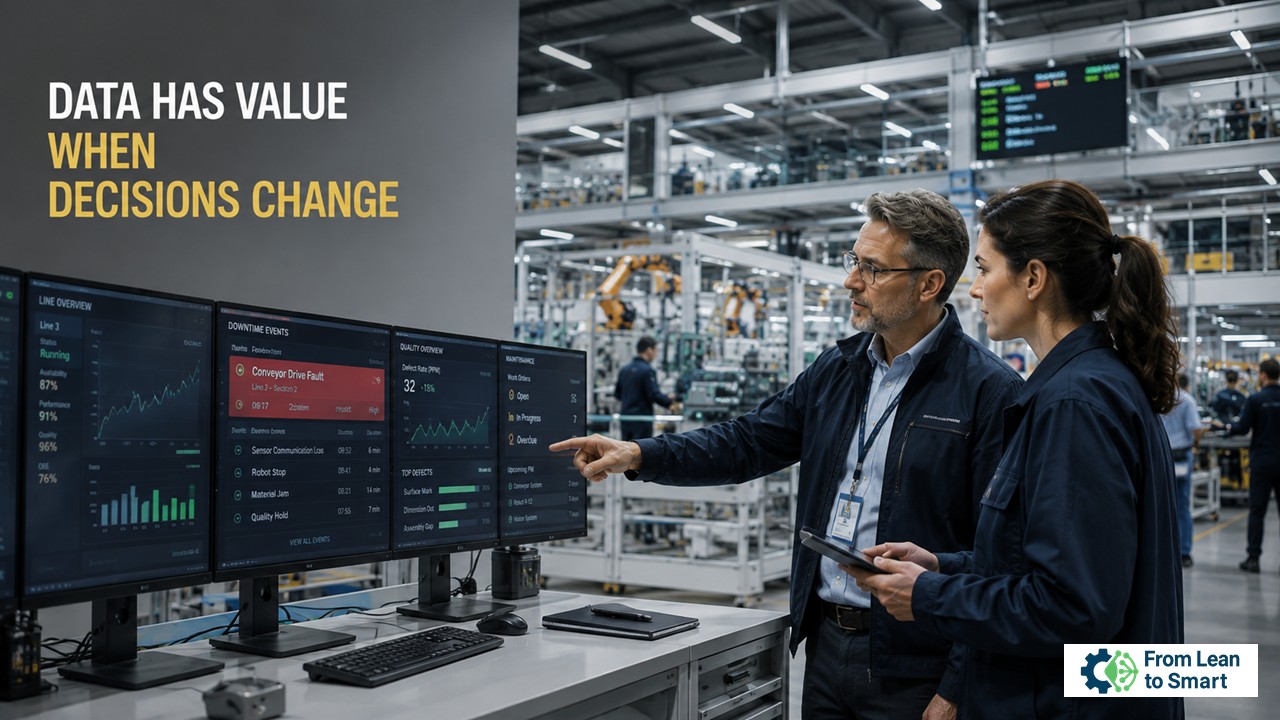
A modern manufacturing plant may collect thousands of machine signals, production counts, quality measurements, maintenance events, energy values, alarms, OEE losses and process parameters. It may operate dashboards in the control room, BI reports for management, MES screens on the shopfloor and analytics platforms in the cloud.
Yet when performance begins to deteriorate, the same questions frequently emerge:
What is actually happening?
Why is it happening?
Who has the authority to act?
What should be done now?
And how will we determine whether the action was effective?
This gap remains one of the most underestimated problems in Smart Factory transformation.
Data is not operational value. Its value emerges when it improves a decision, enables effective action and contributes to a measurable operational outcome.
This distinction matters because many digital initiatives are still designed primarily around data availability, connectivity and visualisation rather than around decision effectiveness. The result can be a technologically connected factory that remains operationally fragmented.
Visibility Is Necessary, but It Is Not Sufficient
Consider a production line where a dashboard indicates that OEE has fallen below the expected level.
The information may be entirely accurate.
But accuracy alone does not determine what happens next.
If the production supervisor sees the loss but cannot distinguish whether it originates from micro-stops, material shortages, quality holds, unstable changeovers or progressive equipment deterioration, the dashboard has created visibility without sufficient operational context.
If maintenance receives ten alarms but cannot determine which condition presents the greatest risk to the production plan, the system has generated information without prioritisation.
If quality identifies an adverse process trend but cannot relate it to the material batch, recipe, machine condition, operator intervention or previous corrective actions, analytics may have detected a pattern without enabling a robust response.
The problem is therefore not that dashboards are inherently ineffective. The problem arises when visibility is disconnected from a defined operating mechanism for response.
A useful digital system must do more than expose abnormalities. It should support a governed sequence through which abnormalities become decisions and decisions become verified actions.
A practical representation is:
Abnormality → Context → Decision → Action → Verification → Learning
That sequence is the real operational loop that Smart Factory architectures should support.
The Real Unit of Value Is the Decision
When evaluating a digital capability, a more useful starting point is not:
What data can we collect?
It is:
What recurring operational decision are we trying to improve?
That question changes the architecture of the solution.
Suppose a vibration-monitoring system identifies a developing abnormality in a critical asset.
The technical signal is only the beginning. The appropriate operational response may also depend on:
- asset criticality;
- current production demand;
- failure consequences;
- maintenance backlog;
- spare-part availability;
- safety implications;
- planned shutdown windows;
- redundancy within the process;
- historical failure modes;
- potential quality consequences;
- and confidence in the diagnostic signal.
The decision is therefore not simply:
Is vibration increasing?
It is closer to:
Given the technical condition of the asset and the current production context, should we intervene now, continue operating under defined controls, modify the production sequence, or prepare a planned maintenance intervention?
This is fundamentally different from detecting an anomaly.
It requires data, but also maintenance strategy, process knowledge, decision rights, operational standards, business rules and human judgement.
The same equipment condition can legitimately produce different decisions depending on criticality, redundancy, production exposure and the consequences of failure.
For this reason, Smart Factory architecture cannot be reduced to sensors, connectivity and dashboards.
From Fragmented Signals to Operational Context
Industrial data usually originates in fragmented systems.
A PLC knows machine state.
A SCADA system knows alarms and process variables.
MES/MOM may know the production order, product, operation, genealogy, downtime reason and execution status.
ERP knows demand, inventory and production requirements.
CMMS/EAM knows maintenance history, work orders, asset structure and backlog.
QMS may know deviations, inspections and quality dispositions.
Each system represents a legitimate part of operational reality.
The decision, however, often requires several of those realities simultaneously.
This is where integration becomes strategically relevant—not because system connectivity is valuable in itself, but because operational decisions cross application boundaries.
A machine fault becomes a maintenance issue.
The maintenance intervention affects the production plan.
The production delay changes logistics priorities.
A temporary process adjustment may introduce a quality risk.
A quality hold may subsequently affect customer delivery.
Operational reality is interconnected even when information systems are not.
The objective of industrial integration should therefore extend beyond moving data between databases. It should progressively create usable operational context for specific decisions.
This distinction is important. Integration without a decision model can simply create a larger volume of accessible information. Integration designed around operational decisions can reduce ambiguity at the moment action is required.
A Dashboard Can Show the Problem and Still Leave the Organisation Unable to Respond
One of the most common digital anti-patterns in manufacturing is the proliferation of dashboards without an equivalent redesign of management routines.
Production has one dashboard.
Maintenance has another.
Quality has another.
Logistics has another.
Management receives an aggregated version.
Each may be technically correct, yet cross-functional coordination can remain weak.
The underlying question is not whether the KPI is visible. It is whether the organisation has defined what should happen when the KPI becomes abnormal.
Imagine a red indicator appearing during the morning production meeting.
If the discussion consists primarily of explaining yesterday’s result and promising further investigation, reporting has improved, but the management process may not have.
A more mature operating system would connect the abnormality with:
- the relevant operational context;
- the applicable standard or threshold;
- a clearly identified owner;
- defined decision rights;
- an escalation rule;
- the expected response;
- the decision and action taken;
- and evidence that the countermeasure produced the expected result.
This is a closed operational loop.
Without that loop, digitalisation may improve observation while leaving execution essentially unchanged.
Smart Factory Must Connect Data With Operating Routines
Technology rarely changes manufacturing performance in isolation.
Performance changes when technology alters how the organisation recognises abnormalities, interprets them, prioritises work, coordinates functions, executes countermeasures and learns from outcomes.
This is why daily management remains fundamental in a digital factory.
A sophisticated analytics platform cannot compensate for unclear ownership.
A predictive model creates little operational value if the organisation has no capacity or agreed process to act on the prediction.
Low-latency information is of limited use if escalation takes several hours.
An AI recommendation cannot reliably improve operations if nobody knows who is authorised to accept, reject, modify or challenge it.
The objective should therefore not be real-time information for its own sake. Information should arrive within the decision window relevant to the operational problem.
For a safety interlock, that window may be measured in milliseconds.
For an unstable production condition, it may be minutes.
For maintenance planning, it may be hours or days.
For asset lifecycle decisions, it may be considerably longer.
The relevant question is not simply how quickly data can move, but whether it reaches the appropriate decision-maker with sufficient context before the opportunity to act has passed.
Digital Operational Excellence therefore requires something less visible than another technology layer: standards, governance and operational discipline.
The connection must extend from signal to decision, from decision to execution, and from execution to verified outcome.
Design Decision Loops, Not Only Technology Stacks
A useful Smart Factory discussion should begin with a specific operational loop rather than with a catalogue of technologies.
Consider a quality example.
A manufacturing process begins drifting towards an unacceptable condition.
A conventional digital approach may focus primarily on identifying and displaying the deviation earlier.
That is useful, but incomplete.
A decision-oriented approach asks:
Which product, order and batch are exposed?
What process conditions preceded the deviation?
Have similar patterns occurred before?
Is there a defined operator reaction standard?
Should the line continue, slow down or stop?
Who has authority to change the process parameters?
What limits apply to that adjustment?
Does maintenance need to inspect the equipment?
Should quality quarantine material already produced?
Who has authority to release it?
Is the decision recorded?
Is the effectiveness of the countermeasure verified?
Can what was learned be incorporated into the reaction standard for the next occurrence?
The problem is no longer one of simply visualising data.
It becomes the design of a governed operational decision loop.
That is much closer to the real purpose of a Smart Factory.
Industrial AI Makes Governance More Important, Not Less
Industrial AI increases the importance of this distinction.
AI can detect patterns, consolidate information, estimate risks, generate predictions and recommend actions. None of these capabilities is equivalent to operational authority.
A useful distinction is therefore:
Prediction → Recommendation → Decision → Execution
An AI model may predict that a quality deviation is becoming more likely.
A decision-support system may recommend reducing speed or adjusting a process parameter.
But the organisation must still determine whether such an intervention is permissible, under what conditions it may occur, who retains authority and what evidence must be recorded.
The relevant questions extend well beyond model accuracy:
What action is permitted?
Under which operating conditions?
Who validates or overrides the recommendation?
What safety, quality and production constraints must be respected?
Which recommendations may be executed automatically?
Which require explicit human approval?
How is the decision recorded for traceability?
How can the recommendation be challenged?
What happens when production, quality, maintenance and delivery priorities conflict?
These are questions of governance and decision rights, not merely artificial intelligence.
As digital systems become more capable, factories will need to define deliberately which decisions should be automated, which should be machine-supported and which must remain under explicit human accountability.
Industrial AI does not remove the need for an operating model. It makes a well-designed operating model more important.
Start With Operational Questions, Not Available Technology
When evaluating a Smart Factory initiative, I would begin with questions such as:
What recurring operational decision are we trying to improve?
What abnormality or event triggers that decision?
What information is currently missing when the decision is made?
Where does that information exist?
How trustworthy is it?
How quickly must the decision be made?
Who owns the decision?
Who has authority to execute it?
What standards and constraints govern the response?
When should the issue be escalated?
How will the decision and action be recorded?
How will we verify whether the action produced the intended result?
What should the organisation learn from the outcome?
These questions expose whether a digital initiative addresses an actual operating requirement or merely adds another layer of technology.
They also reveal why Smart Factory transformation inevitably crosses traditional organisational boundaries.
Production, maintenance, quality, logistics, engineering, IT and OT may each control part of the information, authority or execution capacity required for one operational decision.
Smart Factory transformation is therefore not only an integration challenge.
It is also a challenge of operating-model design.
The Maturity Shift
A digitally immature factory asks:
How much data can we capture?
A more mature factory asks:
How can we make the data reliable, contextualised and accessible?
A still more mature factory asks:
Which operational decisions should this information improve?
The next level asks:
How should those decisions be governed, executed and verified?
And perhaps the most important question is:
How do we build an operating system in which people, processes, standards, information systems and AI continuously improve the quality and speed of operational decisions without weakening accountability?
This is where Digital Operational Excellence begins to separate itself from digitalisation for its own sake.
The factory does not improve because it possesses more data.
It improves when abnormalities are detected early enough, interpreted in the correct context, assigned to people with clear decision rights, translated into disciplined action and followed through until the result is verified.
The value of industrial data is ultimately determined by what the operating system enables the organisation to decide and execute differently because that data exists.
That is a more demanding standard than connectivity.
It is also a much more meaningful measure of Smart Factory maturity.
Questions Worth Reflecting On
- How much of the data generated in your factory actually changes an operational decision?
- When a digital system identifies an abnormality, are ownership, decision rights and the expected response immediately clear?
- Are your Smart Factory initiatives designed around technology capabilities, or around the operational decision loops that determine performance?
#OperationalExcellence #SmartFactory #IndustrialAI #MES #IndustrialMaintenance #AssetManagement #ManufacturingExcellence #Reliability #DigitalTransformation