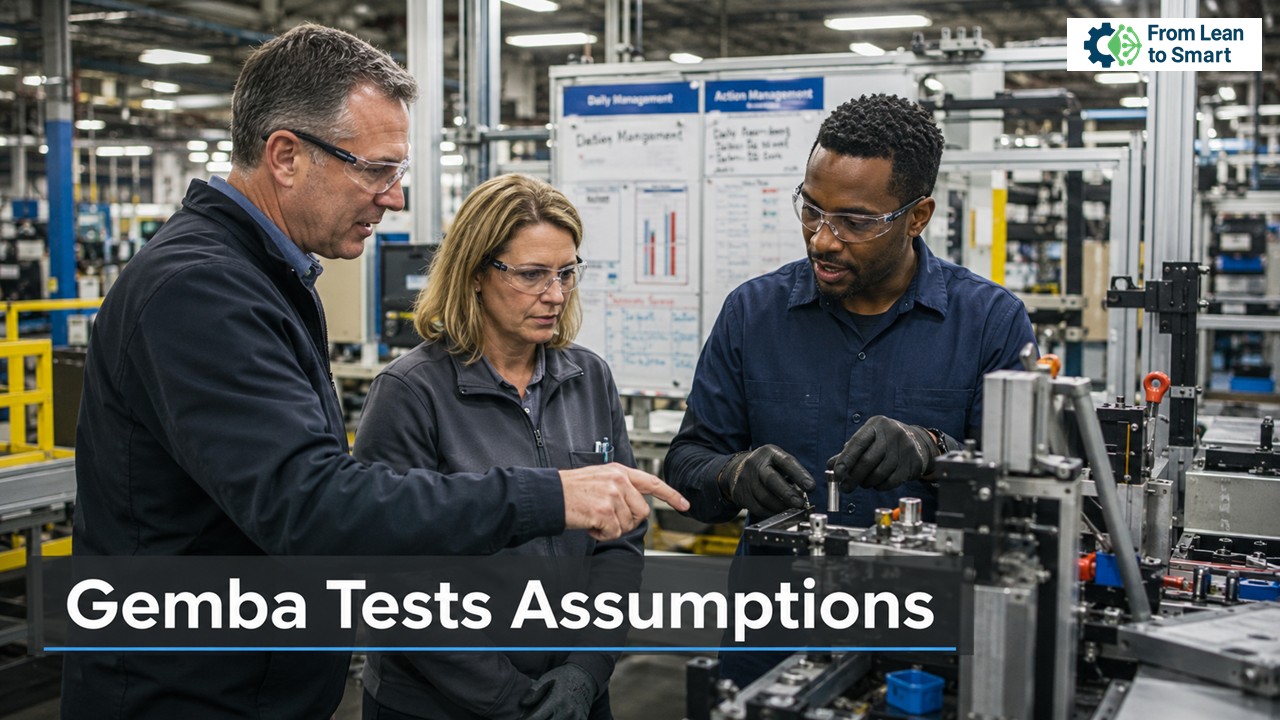
Many organizations say they “go to the gemba.”
They schedule walks. They define routes. They visit production lines, cells, warehouses, maintenance areas and quality walls. Managers ask questions. Supervisors explain the situation. Operators describe the latest problems. Sometimes photos are taken. Sometimes actions are written down.
And yet, after many gemba walks, very little changes.
The reason is uncomfortable: in many organizations, gemba has become a ritual rather than a learning discipline.
A ritual confirms that leaders were present.
A discipline tests whether leaders understood reality.
Those two things are not the same.
In a real factory, reality is rarely clean. A production board may show target versus actual, but not the causes behind the gap. An OEE figure may look acceptable while micro-stoppages have become normalized. A 5S audit may be passed while tools are still missing during changeovers. A standard may exist in the system while actual work has quietly adapted to compensate for unstable conditions.
This is why gemba matters.
Not because leaders should be visible.
Not because Lean requires a walk.
Not because it looks good on a transformation roadmap.
Gemba matters because it is where operational assumptions meet evidence.
The Factory Does Not Care About Meeting-Room Logic
From a meeting room, many problems look simpler than they are.
A recurring quality defect may appear to be an operator training issue. At the line, the situation may reveal something different: a fixture that allows variation, an inspection point located too late in the process, a work instruction that is difficult to follow under takt pressure, and a maintenance team that has been applying temporary corrections for weeks.
A downtime Pareto may suggest that one machine is the main problem. At the gemba, the discussion may show that the machine is only where the symptom appears. The real causes may involve poor material presentation, an unstable changeover sequence, weak escalation, missing spare parts, delayed maintenance planning or a production schedule that repeatedly creates instability.
A visual board may show red indicators. The serious question is whether those indicators triggered decisions, support and learning — or whether they simply decorated the wall.
This is the difference between looking at the factory and learning from the factory.
Gemba is not a tour. It is not industrial sightseeing. It is not a leadership ceremony. It is a mechanism for testing the gap between what the organization believes is happening and what is actually happening.
Good Gemba Starts Before the Walk
A useful gemba walk does not start with movement. It starts with a question.
What assumption are we testing?
Are we testing whether the standard is executable?
Are we testing whether the escalation process works?
Are we testing whether operators have the materials, tools and information required to perform the work safely and correctly?
Are we testing whether abnormal conditions trigger the expected management response?
Are we testing whether yesterday’s corrective action actually changed the process?
Without a question, gemba becomes observation without purpose.
When observation has no purpose, leaders often default to what is easiest to see: housekeeping, labels, boards, discipline and visible compliance. These elements may matter, but they are not always the real constraint.
The more mature question is not:
“Is the area in order?”
It is:
What is the process telling us that our reports are not?
That question changes the nature of the walk. It shifts attention from appearances to process behavior, from compliance to capability, and from isolated observations to systemic learning.
The Risk of Performative Gemba
In some factories, people prepare for the gemba walk as if they were preparing for an audit. Boards are updated. Areas are cleaned. Explanations are aligned. Problems are softened. The visit becomes a performance.
That is dangerous because it teaches the organization to manage impressions instead of problems.
When people believe that gemba is about being judged, they hide uncertainty. They present the official version. They explain away abnormalities. They protect themselves.
Lean requires the opposite.
Lean requires operational truth. It requires seeing friction early, making abnormalities visible and creating conditions where problems can be discussed without blame and without theatre.
Respect for people does not mean avoiding difficult conversations. It means creating a system in which problems can be surfaced, understood and solved without turning every abnormality into a personal failure.
A leader who goes to the gemba only to ask why the numbers are bad will usually receive defensive answers.
A leader who goes to understand what prevents the process from performing will usually discover the system.
Good Gemba Conversations Are Specific
Generic questions produce generic answers.
“How is it going?”
“Any problems?”
“Are we on track?”
“Do you need anything?”
These questions may be polite, but they rarely reveal process reality.
Better questions are grounded in the work:
“Where did the last abnormality occur?”
“What happened when the line stopped?”
“What did the standard require?”
“What did you actually have to do?”
“What support arrived, and how long did it take?”
“What problem keeps returning?”
“What decision was needed but delayed?”
“What condition would make this process easier to run correctly?”
These questions shift the conversation from opinion to evidence.
They also reveal something many organizations prefer not to see: many shopfloor problems are not caused by lack of effort. They are caused by unstable processes, unclear priorities, weak escalation, poor standards, missing ownership, disconnected systems or management decisions that create overload.
Gemba, when done properly, makes management visible to itself.
Standards Are Tested at the Gemba
Standard work is often misunderstood as a document to be followed.
In reality, a standard is also a hypothesis.
It says: under these conditions, this is the best known way to perform the work safely, with quality, within the required time.
But conditions change. Materials vary. Equipment ages. Product mix shifts. New operators join. Maintenance interventions modify small details. Engineering changes introduce friction. Digital systems add transactions, confirmations and screens that may not have existed when the standard was written.
This is why standards must be tested where the work happens.
When a standard is not followed, the first question should not be:
“Who failed?”
The better question is:
Why did the standard not survive contact with reality?
Maybe the standard is unclear. Maybe the process is unstable. Maybe takt time is unrealistic. Maybe the layout creates unnecessary motion. Maybe the required tool is unavailable. Maybe the MES transaction is too slow. Maybe the standard was written by someone who never performed the work under real production pressure.
A mature gemba walk does not protect standards blindly.
It protects the discipline of learning from standards.
Gemba Must Change Decisions
The value of gemba is not in what leaders see. It is in what changes after seeing it.
If gemba does not affect prioritization, resource allocation, escalation, standards, maintenance planning, problem-solving or leadership behavior, it becomes symbolic.
A useful gemba walk should improve decisions.
A recurring breakdown may move from complaint to structured root cause analysis.
A quality concern may be escalated before it becomes a customer issue.
A visual board may be redesigned because it displayed data but did not trigger action.
A supervisor’s overload may become visible, forcing a discussion about priorities and decision rights.
An automation project may be paused because the real process is not stable enough to digitalize.
This last point is increasingly important.
In many Smart Factory initiatives, leaders want real-time dashboards, AI recommendations, digital work instructions and automated alerts. But when they go to the gemba, they often discover that reason codes are inconsistent, standards are not followed, manual workarounds dominate, and accountability for action is unclear.
Digitalization can make problems more visible. It cannot automatically make the organization more disciplined.
A dashboard does not create ownership.
An alert does not create escalation.
A workflow does not create decision quality.
An AI recommendation does not compensate for poor data integrity.
Gemba helps prevent one of the most common industrial errors: automating assumptions.
What Leaders Should Take Back from the Gemba
A serious gemba walk should leave leaders with more than impressions. It should produce learning about the operating system.
Where does flow break?
Where do people work around the system?
Where are abnormalities normalized?
Where are standards weak or unrealistic?
Where does data hide the real problem?
Where do decisions arrive too late?
Where is the organization asking people to compensate for process defects?
These are not minor questions. They connect Lean with leadership, maintenance, quality, logistics, MES/MOM, digitalization and operational excellence.
The gemba is where strategy becomes concrete.
If the strategy says quality first, the gemba shows whether people are truly allowed to stop, escalate and protect the customer.
If the strategy says flow, the gemba shows whether planning, maintenance and logistics are aligned to protect stability.
If the strategy says digital transformation, the gemba shows whether data reflects operational reality.
If the strategy says respect for people, the gemba shows whether people are supported by the system or merely pressured by it.
From Presence to Understanding
Being present on the shopfloor is necessary, but not sufficient.
The real question is not whether leaders go to the gemba. The real question is whether they are willing to be corrected by what they find there.
That correction can be uncomfortable.
It may reveal that the KPI review is too superficial. It may show that an improvement project solved the visible symptom but not the cause. It may expose that the organization celebrates kaizen events while supervisors remain trapped in daily firefighting. It may show that digital tools are producing more information than decisions.
That discomfort is valuable.
It is the beginning of operational truth.
Lean does not ask leaders to have all the answers. It asks them to build a system where reality can be seen, problems can be understood, and learning can become action.
Gemba is not a ritual.
It is where assumptions are tested, where respect becomes practical, and where leadership discovers whether the operating system it designed actually works under real conditions.
Questions worth taking to the shopfloor:
When we go to the gemba, are we looking for confirmation or testing assumptions?
What problems have become so normal in our operation that we no longer recognize them as abnormalities?
After a gemba walk, what decisions actually change?
#LeanManufacturing #OperationalExcellence #Gemba #ContinuousImprovement #LeanLeadership #ShopfloorManagement #ProblemSolving #StandardWork #VisualManagement #DailyManagement #ManufacturingExcellence #ProcessDiscipline #SmartFactory #IndustrialTransformation