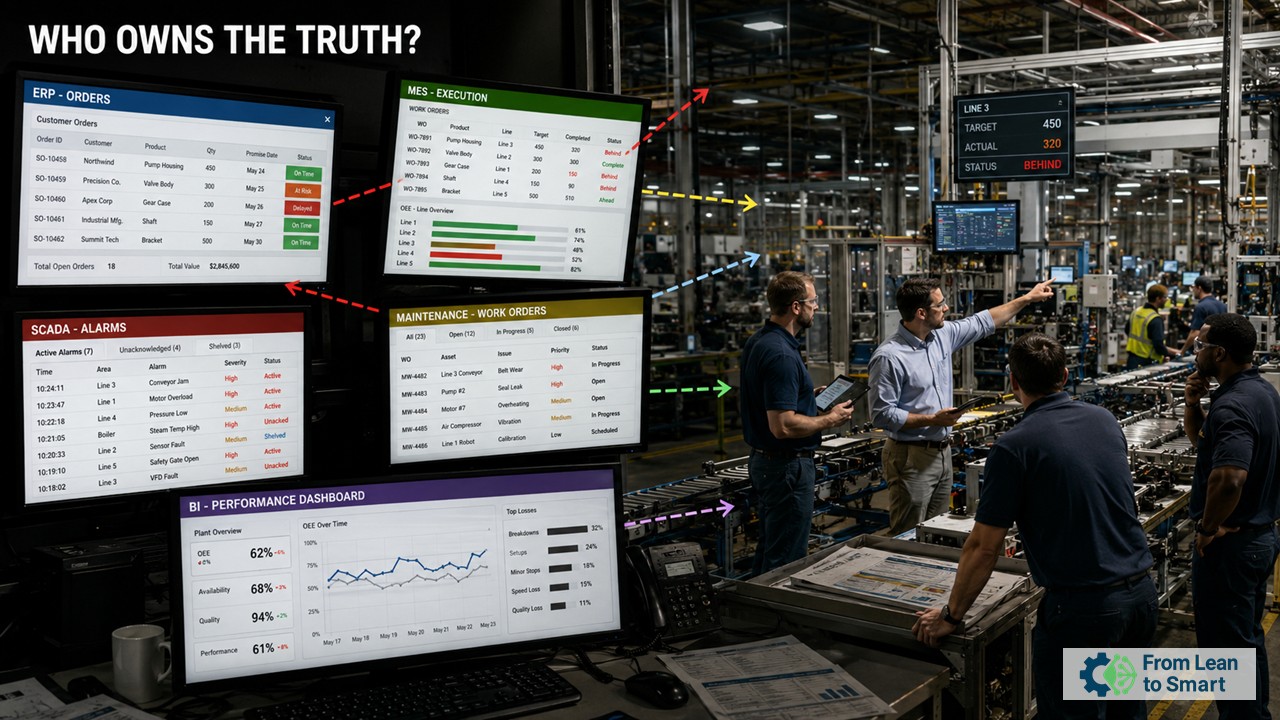
Many factories do not suffer because they have too few systems.
They suffer because nobody is fully clear about what each system is supposed to do.
ERP tries to manage production minute by minute. SCADA screens become production reporting tools. Excel becomes the real planning system. Operators enter the same information in three places. Quality, maintenance and logistics each keep their own version of the truth.
Then, when performance is poor, the conclusion is often:
“We need more integration.”
Sometimes that is true.
But more integration without clearer responsibilities usually creates a faster version of the same confusion.
The first real question is not:
“Which system should we buy?”
It is:
“What should each system be responsible for in the industrial operating model?”
That is where the distinction between MES, MOM and the wider industrial systems landscape becomes important.
The core idea
MES and MOM are often discussed as if they were just software categories.
In practice, they are part of a much larger question:
How does a factory translate business intent into controlled, measured and improved execution?
A manufacturing company usually has many systems involved in operations:
ERP for business planning and financial control.
MES for production execution and shopfloor information.
MOM for broader operations management across production, quality, maintenance, inventory and performance.
SCADA and HMI for process supervision.
PLC and automation systems for real-time machine control.
Historians for time-series process data.
CMMS or EAM for maintenance management.
QMS or LIMS for quality and laboratory processes.
WMS for warehouse execution.
BI and analytics for management reporting and decision support.
The problem is not that these systems exist.
The problem appears when their roles overlap without discipline.
When ERP wants to behave like MES, it becomes too detailed and slow.
When MES wants to behave like ERP, it becomes overloaded with commercial and financial logic.
When SCADA becomes the production system of record, it usually lacks material, order, quality and operator context.
When BI dashboards are built directly on weak operational data, they produce attractive charts and questionable decisions.
A good industrial systems landscape is not defined by how many applications are installed.
It is defined by whether each system has a clear operational responsibility and whether the handovers between them are reliable.
The concept explained in plain English
A simple way to explain the landscape is this:
ERP decides what the business needs.
MES helps the factory execute what is actually happening.
MOM manages the operational capability around execution.
Automation controls the physical process.
Analytics helps people understand performance and make better decisions.
These boundaries are not always perfect, but they are useful.
ERP typically manages customer demand, sales orders, procurement, costing, inventory valuation, finance, high-level production planning and business master data. It is the system of record for the enterprise.
MES focuses closer to the shopfloor. It connects production orders, work instructions, confirmations, material consumption, labor, quality checks, downtime, genealogy and production performance.
It should answer questions like:
What order is running now?
Which material was consumed?
Which operator performed the activity?
Which equipment was used?
What was produced, scrapped or reworked?
What happened during the shift?
Was the process executed according to the defined standard?
MOM is broader than MES. It is less a single screen and more an operational management layer. It may include production operations, quality operations, maintenance operations, inventory operations and performance management.
MOM connects execution with operational governance.
SCADA, HMI and PLC systems are closer to machine and process control. They are essential, but they usually do not understand the full business meaning of production.
A PLC can know that a valve opened, a motor stopped or a cycle completed.
But it does not usually know whether that event belongs to:
a customer order,
a batch genealogy,
a quality deviation,
an OEE loss category,
or a maintenance escalation.
That is why MES/MOM matters.
Not because it replaces other systems, but because it creates operational context between business planning and physical execution.
Where it fits in the MES/MOM architecture
In a practical industrial architecture, each layer should have a purpose.
At the enterprise level, ERP manages the business view: demand, supply, costing, procurement, inventory valuation and financial consequences.
At the operations management level, MES/MOM manages the factory view: production execution, work order status, material flow, quality evidence, operator activities, equipment usage, downtime, performance and traceability.
At the control level, SCADA, HMI, PLCs and automation systems manage the physical process: machine signals, alarms, recipes at equipment level, interlocks, cycle states and real-time control.
Around these layers, other systems play important roles.
CMMS or EAM manages assets, preventive maintenance, corrective work, spare parts and reliability history.
QMS or LIMS manages quality processes, laboratory results, non-conformities, inspections and approvals.
WMS manages warehouse movements, storage, picking and logistics execution.
Historian stores high-frequency process data that may be critical for analysis, troubleshooting and regulatory evidence.
BI and analytics platforms consolidate information for reporting, performance reviews and business decisions.
The role of MES/MOM is not to absorb all of these systems.
That would simply create another monolith.
Its role is to connect the operational flow.
For example, a production order may originate in ERP. MES translates that order into executable work on the shopfloor. The operator follows instructions, consumes material, records production, captures downtime and performs quality checks. Automation provides real-time signals. The historian stores process values. The QMS handles deviations. The CMMS receives maintenance notifications. ERP receives confirmations, consumption and inventory updates.
The value is not in the interface itself.
The value is in the quality of the operational handover.
Why it matters for Operational Excellence
Operational Excellence depends on disciplined execution and reliable learning.
If the systems landscape is unclear, continuous improvement becomes slow and political. Every meeting starts with a data debate.
Production says the downtime number is wrong.
Maintenance says the failure code was not specific enough.
Quality says the batch record is incomplete.
Planning says the order was confirmed too late.
Finance says the cost per unit does not match the operational reality.
This is not only an IT issue.
It is an operating model issue.
A clear MES/MOM landscape helps Operational Excellence because it creates better evidence for action.
OEE becomes more useful when downtime, speed losses and quality losses are connected to real equipment, orders, materials and reason codes.
Scrap analysis improves when defects are connected to process conditions, operators, shifts, batches and machines.
Traceability becomes stronger when genealogy is captured during execution, not reconstructed afterwards.
Maintenance becomes more proactive when equipment events, downtime and work orders are connected.
Standard work becomes more real when instructions, checks and confirmations are part of the execution flow.
Cost per unit becomes more meaningful when operational losses are visible and connected to business impact.
But there is an important warning.
MES/MOM does not automatically create discipline.
It can only support discipline that the organization is willing to define, follow and improve.
A bad downtime model digitized in MES is still a bad downtime model.
Unclear ownership of master data remains unclear after integration.
A dashboard built on poor confirmations only makes poor confirmations more visible.
The system landscape matters because it defines where operational truth is created.
Typical mistakes and anti-patterns
One common mistake is treating MES as a dashboard project.
Visibility is useful, but visibility alone does not control execution. A dashboard may show that the line is underperforming, but it does not define the standard, capture the reason, guide the operator, confirm the material or trigger the right escalation.
Another mistake is forcing ERP too deep into the shopfloor.
ERP is powerful, but it is usually not designed to manage second-by-second execution, machine states, operator interactions, process alarms or detailed downtime classification.
When companies try to solve every shopfloor need in ERP, they often create complex transactions that operators avoid or complete at the end of the shift.
The opposite mistake is allowing MES to become a disconnected island.
If MES captures production but does not connect properly with ERP, quality, maintenance or warehouse processes, it becomes another local database.
People may trust it for some operational details but still rely on Excel or manual reconciliation for the full picture.
A third anti-pattern is confusing automation data with operational intelligence.
A machine signal is not automatically a business event.
A stop signal is not automatically a downtime reason.
A temperature value is not automatically quality evidence.
A cycle count is not automatically good production.
Signals need context.
Another mistake is copying enterprise master data into MES without validating it at the gemba.
ERP master data may describe the product and business process correctly at a planning level, but the shopfloor may need more detail:
work centers, equipment groups, routing steps, inspection points, changeover logic, operator qualifications, packaging variants, cleaning steps or line-specific constraints.
Finally, many companies connect systems before agreeing who owns the data.
Integration without ownership creates automated disagreement.
Practical industrial example
Consider a packaging area in a food manufacturing plant.
ERP creates the production order for a finished product. It defines the item, quantity, due date, bill of materials and planned line.
MES receives the order and makes it executable. It checks whether the correct packaging material is available, shows the operator the right work instructions, confirms the product variant, records the start of production and captures output by shift.
The PLC controls the filler, capper, labeler and case packer. It detects machine states, counts cycles, records stops and manages interlocks.
SCADA allows operators and technicians to supervise the process, see alarms and interact with equipment parameters.
The historian stores key process values such as temperature, pressure, speed, weight trends or critical equipment states.
The QMS manages quality checks, sampling plans, deviations and release decisions.
The CMMS manages maintenance work when a recurring capper fault causes repeated short stops.
The WMS confirms the movement of packaging materials and finished goods.
BI later combines production, quality, downtime and cost information for performance review.
If each system does its job, the plant can understand what happened.
The order was planned in ERP.
Execution was controlled through MES.
Machine behavior was captured by automation and historian.
Quality evidence was managed through QMS.
Maintenance action was triggered through CMMS.
Inventory was updated through WMS and ERP.
Performance was reviewed through analytics.
But if responsibilities are unclear, the same plant may end up with five versions of production output, three versions of downtime, manual quality checks on paper, delayed ERP confirmations and a morning meeting where nobody agrees on what really happened.
That is the real cost of a weak systems landscape.
Implementation checklist
Before implementing this capability, check whether:
Your team can explain what ERP, MES, MOM, SCADA, Historian, CMMS, QMS, WMS and BI are responsible for in your environment.
There is a clear system of record for production orders, confirmations, material consumption, quality results, downtime, inventory movements and maintenance events.
Operators are not expected to enter the same data into multiple systems.
Shopfloor events are connected to operational context such as order, material, equipment, shift and reason code.
Master data has been validated against real shopfloor execution, not only against office process maps.
Interfaces have process owners, not only technical owners.
Dashboards are built from trusted operational events, not from disconnected signals or late manual entries.
The organization has agreed what decisions each system should support.
Key takeaway
MES/MOM does not create value by replacing every other system; it creates value when each system knows its role and operational truth can move reliably from the shopfloor to the business.
Reflection questions
1. In your factory, which system is currently being asked to do a job it was never designed to do?
2. Do your dashboards reflect operational truth, or do they simply visualize data collected from unclear processes?
3. Where is the most important handover in your industrial systems landscape: ERP to MES, MES to automation, MES to quality, MES to maintenance, or somewhere else?
#MES #MOM #Manufacturing #OperationalExcellence #SmartManufacturing #Industry40 #DigitalTransformation #IndustrialAutomation #ITOT #DataDrivenManufacturing #ProcessImprovement #ManufacturingExecution #ManufacturingOperations #Shopfloor #Traceability