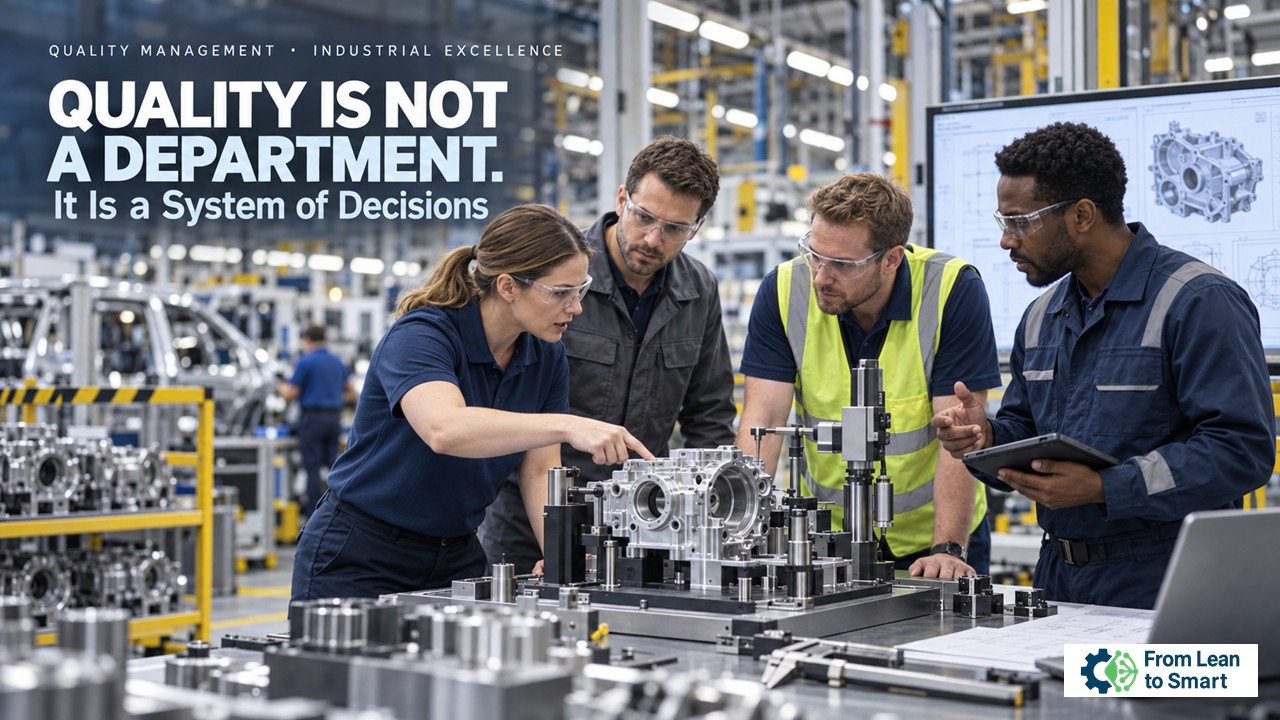
In many industrial organizations, quality has a dedicated department, a manager, defined procedures, and an extensive collection of performance indicators.
There are audits, inspections, nonconformity reports, corrective actions, supplier evaluations, and quality gates.
Yet when a serious quality problem occurs, the same question often emerges:
How did this happen when the organization already has so many quality controls?
The explanation is not always insufficient inspection or inadequate procedures.
Sometimes the organization has developed a sophisticated system for detecting and documenting nonconformities without establishing an equally effective system for controlling the decisions that create or prevent them.
Production makes decisions about output, sequencing, and execution.
Engineering makes decisions about product design and technical specifications.
Purchasing makes decisions about supplier selection and sourcing.
Maintenance makes decisions about equipment interventions and asset condition.
Planning establishes priorities and capacity commitments.
Quality is then expected to verify that the combined consequences of these decisions satisfy the applicable requirements.
This arrangement exposes a fundamental organizational problem.
If quality depends on decisions made throughout the value chain, why is accountability for its outcomes so often concentrated in one department?
The Quality function remains essential. Its technical expertise, independent assurance, and defined approval authority cannot simply be redistributed.
However, quality cannot be created exclusively through the activities of that function.
It is the result of requirements, risks, controls, and decisions managed throughout the industrial organization.
That distinction changes how quality management should be understood.
The Factory Does Not Produce Quality at the Inspection Station
Consider a manufacturing line producing components with critical dimensional requirements.
Engineering has established the product specifications.
Industrialization has designed and validated the manufacturing process.
Purchasing has selected the suppliers.
Production is responsible for executing the approved process.
Maintenance must preserve the required equipment conditions.
Quality performs the applicable verification and assurance activities.
During inspection, a dimensional nonconformity is detected.
The affected product is identified and contained, a nonconformity is recorded, and an investigation begins.
The immediate response may be entirely appropriate.
But where did the quality problem originate?
The manufacturing process may lack sufficient capability under normal operating variation.
The measurement system may have inadequate resolution, repeatability, or reproducibility for the characteristic being evaluated.
Equipment deterioration may have progressively influenced dimensional stability.
An engineering change may have been introduced without fully reassessing its manufacturing implications.
Production may have continued after an abnormal process signal because the escalation criteria were insufficiently defined.
Several of these factors may also have interacted.
Each hypothesis requires evidence.
Inspection detected the nonconforming result.
It did not necessarily create the conditions responsible for it, nor could it independently prevent every contributing factor.
The investigation must therefore distinguish the observed defect from the process mechanism that generated it and the controls that failed to prevent or detect the condition earlier.
Quality cannot be built into a product solely by inspecting the consequences of decisions already made elsewhere.
The quality management system begins much earlier.
It begins when customer requirements are interpreted, product designs are evaluated, suppliers are selected, manufacturing capability is established, and operational controls are defined.
The Difference Between Quality Responsibility and Quality Accountability
Industrial organizations frequently promote the principle that quality is everyone’s responsibility.
The principle is valid, but it can become ambiguous when responsibilities are not explicitly allocated.
Quality professionals have specialized responsibilities.
They develop assurance methods, support risk assessments, establish verification approaches, conduct audits, evaluate nonconformities, and provide technical judgment regarding product and process conformity.
They may also hold defined authority for product disposition, release, or approval under applicable procedures, customer requirements, and regulatory obligations.
These responsibilities are essential.
However, accountability for the conditions that determine quality extends beyond the Quality function.
Engineering must ensure that product designs address applicable requirements and technical risks.
Industrialization must establish manufacturing processes capable of meeting those requirements.
Purchasing and Supplier Quality must evaluate sourcing decisions against supplier capability, compliance, and supply-related risks.
Production must execute approved operations, maintain required process conditions, and respond appropriately to abnormalities.
Maintenance must preserve the equipment conditions necessary for controlled manufacturing.
Management must resolve conflicts involving delivery, cost, capacity, and conformity without compromising mandatory requirements.
The precise responsibilities depend on the organization’s governance model, but their boundaries must be explicit.
When these responsibilities are unclear, Quality can become the function expected to compensate for weaknesses throughout the operating system.
It may be held accountable for product outcomes while having insufficient influence over the engineering, sourcing, production, or resource-allocation decisions that shape those outcomes.
That is not sustainable governance.
A mature quality management system establishes accountability where processes and decisions are owned while preserving the necessary independence of quality assurance and formal approval functions.
Shared responsibility must strengthen accountability, not dilute it.
Quality is not improved by declaring that everyone owns it if no one has clear responsibility for the decisions and controls involved.
When Quality Becomes a Conflict Between Functions
Quality problems often expose tensions already present in the manufacturing operating model.
Consider a production line facing an important delivery commitment.
A process measurement begins showing an abnormal pattern on a statistical process control chart.
The manufactured product may still satisfy its dimensional specification, but the process is exhibiting evidence of instability.
Production wants to maintain output.
Maintenance recommends examining the equipment.
Engineering needs to understand the source of variation.
Quality requests the appropriate assessment and verification.
Each function has a legitimate concern.
However, the organization must make a coordinated decision.
Is the process still operating within its approved conditions?
Does the statistical signal require immediate investigation or containment?
Can production continue without violating the established control plan?
What evidence is needed?
Who has authority to decide?
What happens if the condition deteriorates?
An important technical distinction must be preserved.
Statistical control limits and product specification limits are not interchangeable.
Control limits are used to assess process behavior and identify signals that may indicate changes in the underlying process.
Specification limits define acceptable product or process requirements.
A process may produce measurements within specification while exhibiting statistical instability.
Conversely, a statistically stable process may still be incapable of consistently meeting product specifications.
This is why decisions cannot rely solely on whether the latest manufactured unit passed inspection.
The organization must understand process behavior, capability, the applicable control plan, and the consequences of abnormal variation.
A weak operating system leaves these questions to informal negotiation under production pressure.
A stronger system establishes response rules, escalation criteria, evidence requirements, and decision authority in advance.
The purpose is not to eliminate professional judgment.
It is to ensure that judgment is exercised within defined operational and risk boundaries.
Without that discipline, quality decisions can depend excessively on delivery urgency, individual influence, or the particular managers present during an abnormal event.
Why Inspection Cannot Compensate for Weak Process Design
Inspection remains essential in many industrial environments.
Certain products and processes require defined verification, independent acceptance, regulatory evidence, or customer-mandated inspection activities.
The problem is not inspection.
It is treating inspection as the primary mechanism for creating quality.
A manufacturing process with excessive variation does not become capable because more units are inspected.
An unreliable supplier does not become reliable through indefinitely increasing incoming inspection.
A poorly controlled engineering change does not become technically acceptable merely because additional approval signatures are introduced.
Inspection can identify nonconforming outputs and support containment.
However, sustainable quality requires control of the conditions that generate defects.
This is where methods such as Advanced Product Quality Planning (APQP), Failure Mode and Effects Analysis (FMEA), control planning, Measurement System Analysis (MSA), Statistical Process Control (SPC), and process-capability analysis become relevant.
These methods serve different purposes.
APQP provides a structured approach to quality planning during product and process development.
FMEA supports the systematic evaluation of potential failure modes, their consequences, and associated risks.
Control plans translate relevant product and process requirements into defined manufacturing controls and reaction arrangements.
MSA evaluates whether measurement systems are suitable for their intended use.
SPC helps monitor process behavior and identify signals requiring investigation.
Process-capability studies assess the relationship between process performance and specification requirements, subject to appropriate assumptions and conditions.
Their value depends on how they are connected.
A PFMEA that identifies a significant process risk but does not influence relevant controls may provide limited practical protection.
A control plan that operators cannot execute consistently is not an effective control.
An SPC chart that generates signals without a defined response mechanism becomes reporting rather than process management.
A capability study conducted only to satisfy an industrialization milestone may fail to represent actual production variability.
Quality methods create value when their findings change technical decisions, operating controls, and the way the process is managed.
Completing the documentation is not equivalent to establishing effective prevention.
Quality Starts Before Production
Quality risks are frequently introduced long before the first production unit is manufactured.
This is particularly relevant in product development and industrialization.
Customer requirements may be incomplete or open to interpretation.
Design decisions may create demanding manufacturing tolerances.
Supplier selection may introduce capability, obsolescence, or continuity risks.
Process validation may be performed under conditions that do not adequately represent normal series production.
Verification methods may be developed too late.
Engineering changes may affect manufacturing configurations that have already been approved.
These risks cannot be resolved effectively through final inspection alone.
They require early coordination among product engineering, manufacturing engineering, procurement, supplier quality, production, and the Quality function.
A disciplined development process must establish whether requirements are understood, technically feasible, verifiable, and compatible with the intended manufacturing process.
It must also determine how conformity will be demonstrated throughout production and the product lifecycle.
For complex products, configuration management becomes particularly important.
A manufactured product may meet its measured performance requirements while the organization lacks reliable evidence of which design revision, material configuration, process settings, and verification results apply to that specific unit.
This creates a different form of quality risk.
The physical product may appear acceptable, but the evidence required to establish its conformity or configuration integrity may be incomplete.
Manufacturing genealogy, approved specifications, engineering-change control, and verification records must therefore be managed as connected elements.
For products requiring formal conformity evidence, manufacturing the correct physical result and demonstrating that it meets the applicable requirements are both essential.
This is one reason quality management must operate across the product lifecycle rather than being concentrated at the end of manufacturing.
The Hidden Influence of Purchasing and Suppliers
Supplier quality provides another example of how fragmented decisions can create quality risks.
Purchasing may negotiate attractive commercial conditions.
Supplier Quality evaluates process capability and compliance.
Engineering establishes material and component specifications.
Planning prioritizes lead times and delivery requirements.
Operations manages the consequences of supply variability.
When these decisions are made independently, the organization may select a commercially attractive supplier while underestimating manufacturing, quality, or continuity risks.
The initial purchase price may appear favorable.
However, additional inspections, rework, production interruptions, supplier recovery activities, and warranty exposure can alter the overall economic outcome.
This does not imply that Quality should determine sourcing decisions independently.
Sourcing requires a coordinated assessment of commercial conditions, technical requirements, supplier capability, lifecycle risk, and operational consequences.
Supplier qualification must also extend beyond documentation.
A supplier may satisfy initial approval requirements while later experiencing process deterioration, uncontrolled changes, or capacity constraints.
The organization therefore needs appropriate mechanisms for monitoring performance, assessing significant changes, and responding to emerging risks.
Supplier capability is not a permanent condition established by one successful audit or initial sample approval.
It must remain consistent with actual manufacturing requirements.
Supplier quality is strengthened when sourcing decisions account for demonstrated capability and lifecycle risk, rather than treating conformity as a verification activity performed after commercial commitments have been made.
What TQM Really Demands from Leadership
Total Quality Management (TQM) is sometimes described primarily through cultural principles.
Everyone should care about quality.
Continuous improvement should become normal practice.
Customer requirements should guide organizational behavior.
These ideas remain relevant.
However, they become superficial when they are disconnected from operational governance.
If delivery performance consistently overrides process stability, the organization’s actual priorities are evident.
If engineering changes are introduced without adequate cross-functional evaluation, the organization is accepting risks through its development process.
If recurring nonconformities remain unresolved because corrective actions compete unsuccessfully with production targets, the problem is not simply insufficient quality awareness.
It is a management decision.
A mature TQM approach requires consistency between declared principles and the decisions made under operational pressure.
Leadership must establish accountable process ownership, protect critical controls, allocate resources to prevention, and ensure that relevant quality risks are escalated.
It must also understand how performance indicators influence behavior.
A low number of reported nonconformities may indicate good process performance.
It may also reflect inadequate detection or reluctance to report abnormalities.
A high corrective-action closure rate may demonstrate administrative discipline without establishing that the original failure mechanisms have been controlled.
A reduction in inspection cost may result from improved process capability—or from the removal of necessary verification.
These interpretations require evidence.
Quality leadership is not demonstrated by demanding perfect indicators. It is demonstrated by creating the conditions in which defects are prevented, abnormalities are visible, and risks are addressed through accountable decisions.
This includes protecting the independence of necessary quality controls while ensuring that the functions responsible for processes and products remain accountable for their outcomes.
From Quality Records to Quality Intelligence
Industrial digitalization creates opportunities to connect quality evidence across the product and manufacturing lifecycle.
ERP can provide material, order, and supplier information.
PLM can support product definitions, approved configurations, and engineering-change records.
MES/MOM can capture manufacturing execution, process results, and genealogy.
QMS applications can manage nonconformities, audits, and corrective actions.
Measurement systems and industrial historians can provide process and verification evidence.
CMMS/EAM can contribute equipment-condition information and maintenance history.
When these systems share reliable identifiers and relevant operational context, investigations can become more complete.
Consider a recurring dimensional nonconformity.
The organization may be able to examine whether affected units share a particular equipment condition, material batch, tooling configuration, process revision, or production period.
This can help identify relevant patterns and prioritize technical hypotheses.
However, the availability of connected information does not automatically establish causality.
A correlation between a dimensional deviation and a particular machine condition does not prove that the machine condition caused the defect.
An AI model may detect a recurring pattern while lacking information about a recent engineering modification.
A generative AI assistant may retrieve similar historical nonconformities but propose an action that is inappropriate for the current product or validated process configuration.
These technologies can strengthen investigation.
They cannot independently establish product conformity or replace applicable technical validation and release authority.
The quality management system must therefore distinguish data collection, analytical interpretation, causal verification, and authorized disposition.
Digital quality intelligence is valuable when it helps the organization make more reliable, traceable, and technically justified decisions.
It should not create the appearance of certainty where the evidence remains incomplete.
The Cost of Poor Quality Is Also a Decision Problem
Industrial organizations commonly measure scrap, rework, customer claims, and warranty costs.
These indicators are important.
However, they do not necessarily capture all the operational consequences of poor quality.
Recurring quality problems consume engineering resources.
They can interrupt manufacturing flow.
They may generate emergency purchasing and logistics activity.
They can delay industrialization, product release, and project milestones.
They may create configuration uncertainty, additional verification requirements, and long-term support obligations.
Some consequences are directly visible in financial records.
Others are distributed across normal operational activities and may be difficult to attribute.
The purpose of analyzing poor-quality costs should not be limited to calculating their financial impact.
The analysis should also identify the decisions and process conditions responsible for those costs.
A recurring nonconformity may justify an engineering modification rather than additional inspection.
A persistent supplier problem may require a sourcing or supplier-development decision rather than repeated containment.
An unstable process may require capability improvement instead of accepting rework as a routine operating activity.
The appropriate action must reflect the verified cause, expected benefit, implementation risk, and resources required.
The economic value of quality becomes clearer when prevention is connected to the technical and managerial decisions that determine future operational risk.
This shifts attention from the cost of detecting failures toward the conditions required to prevent them.
Building Quality into the Daily Management System
A practical quality management system must connect product requirements and process controls with daily operational decisions.
At the shopfloor level, abnormal conditions must be visible.
Operators and supervisors must understand the criteria requiring containment, escalation, or controlled continuation.
Nonconforming or potentially affected product must be managed according to applicable requirements.
Technical investigations must distinguish immediate correction from corrective action addressing the underlying cause.
Cross-functional decisions must have appropriate owners and documented authorization.
And corrective-action effectiveness must be verified.
These activities represent different stages of quality management.
Containment protects against further consequences while the situation is assessed.
Correction addresses an identified nonconforming condition.
Corrective action addresses the causes of nonconformity to prevent recurrence.
Effectiveness verification determines whether the implemented changes have achieved the intended result.
Completing one stage does not automatically demonstrate completion of the others.
At the management level, recurring quality problems should influence process design, maintenance strategies, supplier development, training, manufacturing capability, and product engineering.
At the leadership level, unresolved quality risks must be considered explicitly when decisions are made about cost, delivery, capacity, and investment.
This is not intended to slow down every operational decision.
It is intended to prevent the organization from repeatedly absorbing the consequences of risks that remain insufficiently controlled.
A useful quality management review should therefore examine more than defect counts and closure rates.
It should ask which controls failed, which assumptions proved incorrect, which risks remain active, and what decisions are required to strengthen prevention.
The Real Test of Quality Maturity
A mature quality management system should be able to answer several demanding questions.
Are responsibilities and decision rights clearly established across engineering, procurement, operations, maintenance, and quality?
Can employees contain or stop an operation when required without entering an informal negotiation about production output?
Are product requirements translated into effective manufacturing and verification controls?
Do engineering changes trigger appropriate reassessment of product and process risks?
Are control plans consistent with actual manufacturing conditions?
Do recurring nonconformities receive investigations that extend beyond the visible defect?
Are statistical process signals interpreted correctly and connected to defined response rules?
Can the organization demonstrate configuration integrity and traceability where required?
Are corrective actions verified through evidence that relevant failure mechanisms have been controlled?
And do management decisions address the risks revealed by quality information?
These questions extend well beyond the Quality department.
They examine whether the industrial operating system can consistently translate requirements into controlled execution and verified results.
That is a more meaningful interpretation of quality maturity than simply counting inspections, audits, or completed corrective-action reports.
Quality Is the Consequence of How the Organization Operates
Quality professionals remain essential.
Industrial organizations require expertise in product assurance, metrology, statistical methods, process capability, risk analysis, compliance, and customer requirements.
They also require independent assurance and formal quality authority where mandated by the management system and applicable obligations.
But this expertise must influence decisions throughout the product and manufacturing lifecycle.
It should not be used primarily to identify and manage the consequences of weaknesses created elsewhere.
A mature quality management system connects customer requirements with engineering decisions, supplier capability, validated manufacturing processes, operational controls, reliable evidence, and accountable corrective action.
It protects mandatory requirements.
It makes process abnormalities visible.
It establishes clear decision ownership.
And it ensures that recurring quality problems lead to verified improvements rather than repeated containment.
Quality is not created by assigning responsibility for defects to one department. It is created through the decisions and controls that determine whether products and processes consistently meet their requirements.
The Quality function provides essential expertise and independent assurance.
The industrial organization as a whole must create the conditions for conformity.
That is why quality cannot be understood merely as a department.
It is a system of decisions—supported by technical evidence, governed through clear accountability, and verified through operational results.
Questions for Further Reflection
- Are we managing quality through the decisions that shape product design, supplier capability, and manufacturing execution, or relying primarily on the Quality department to detect their consequences?
- When quality problems recur, can we identify the accountable process owners and decision authorities, or does responsibility become fragmented across functions?
- Do our quality management methods demonstrate effective prevention and controlled risk, or primarily document the activities performed after a nonconformity occurs?
#QualityManagement #TQM #OperationalExcellence #ManufacturingExcellence #QualityEngineering #LeanManufacturing #ContinuousImprovement #SixSigma #SmartFactory #BPM