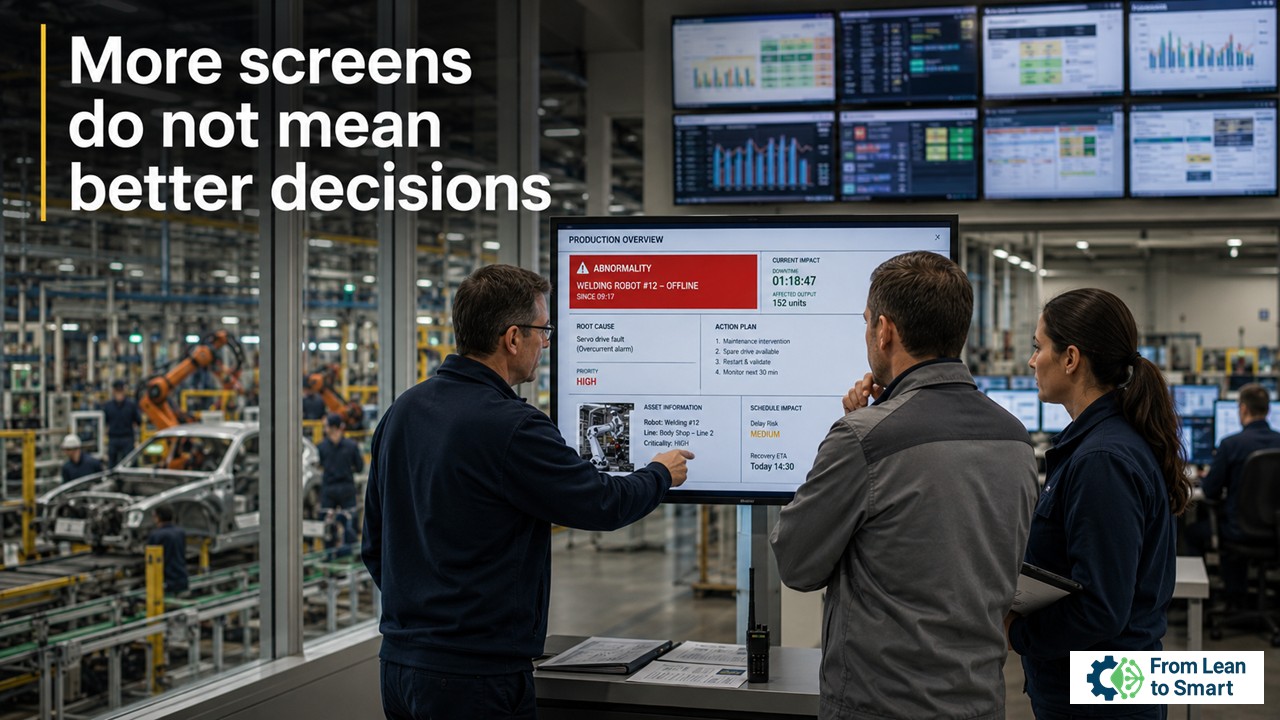
A factory can have more dashboards than decisions.
This is one of the most common contradictions in MES implementation. The project connects machines, collects downtime, calculates OEE, publishes production reports, creates alert rules, and provides different departments with access to “real-time information.”
Yet after the initial enthusiasm, many of the same operational problems remain.
Supervisors still ask what happened during the previous shift. Maintenance still disputes downtime reasons. Quality still detects deviations too late. Production meetings still review numbers without understanding causes. Operators still receive information that does not help them act.
The problem is not that the MES failed to report information.
The problem is that the information did not reach the right person, at the right moment, in the right operational form, with a clear expectation of response.
MES information is not communication by default. It becomes communication only when it is connected to decision-making, accountability, and execution.
Information Is Not the Same as Operational Control
A report is not communication.
A dashboard is not alignment.
An alert is not action.
MES information creates value only when it changes how people decide, escalate, correct, learn, or prevent recurrence.
This distinction matters because many plants still treat information delivery as a technical output. They ask:
Can the system display this KPI?
Can we send an alert when this condition occurs?
Can we build a dashboard for this department?
These are valid technical questions, but they are incomplete. The more important operational questions are different:
Who needs to know?
When do they need to know?
What decision should the information support?
What action is expected?
Who owns the response?
What happens if nobody reacts?
How will we know that the information changed the operational outcome?
Without these questions, MES becomes another visibility layer. It may show more of the factory, but it does not necessarily improve how the factory is managed.
Reports Explain the Past, Dashboards Manage the Present, Alerts Interrupt the Flow
Reports, dashboards, and alerts are often treated as interchangeable outputs. They are not.
Reports are useful for structured review. They help teams understand what happened, compare shifts, analyze losses, review quality performance, validate production quantities, and support daily or weekly management routines.
Dashboards are useful for situational awareness. They help operators, team leaders, and supervisors understand current status, performance gaps, abnormalities, and trends while the process is still active.
Alerts are different. An alert is an interruption. It exists because the system has detected a condition that requires attention now, not during the next meeting.
The mistake is using all three as if they served the same purpose.
A daily production report should not behave like a live control screen. A dashboard should not become a repository for every KPI in the factory. An alert should not be used for information that nobody is expected to act on immediately.
When everything is visible, nothing is truly managed.
Where This Fits in MES/MOM Architecture
In a mature MES/MOM environment, information delivery sits between operational events and human decision-making.
At the lower levels, PLCs, SCADA systems, historians, sensors, and machine interfaces generate signals. MES gives those signals operational meaning by connecting them with context: order, product, operation, equipment, material, operator, reason code, quality status, recipe, shift, and standard.
ERP provides planning and business context. CMMS or EAM systems may provide asset, maintenance, and work-order context. QMS or LIMS platforms may provide quality context. BI tools may support deeper analysis and cross-functional reporting.
But the MES layer has a specific responsibility: it must translate shopfloor events into operational information that people can use while the process is still controllable.
This is why MES dashboards and alerts should not be designed only by IT or reporting teams. They must be designed around operating routines: shift handover, hourly production control, abnormality response, quality containment, maintenance escalation, daily management, and performance review.
The architecture matters. But the operating rhythm matters more.
The Main Failure: Reporting Everything While Changing No Decisions
Many MES projects overproduce information.
Every machine has a dashboard. Every KPI has a chart. Every department asks for its own report. Every abnormal condition becomes an email. Every manager wants real-time visibility.
At first, this appears to be progress.
Then the organization starts suffering from information fatigue.
Operators ignore screens because they do not support immediate work. Supervisors receive too many notifications. Managers still request Excel extracts despite having dashboards. Engineers spend time reconciling data instead of improving processes. Alerts become background noise.
The system becomes technically informative but operationally weak.
The problem is not the volume of data alone. The deeper problem is information without decision ownership.
If nobody owns the response, the information has no operational authority. If nobody reviews the quality of the data, the reports lose credibility. If nobody removes obsolete screens or ineffective alerts, the MES becomes harder to use over time.
Information design must therefore include governance. Each report, dashboard, and alert should have a purpose, an owner, a routine, and a decision attached to it.
A Practical Example: Downtime Alerts That Do Not Reduce Downtime
Consider a production line where the MES sends an alert every time a machine stop exceeds ten minutes.
The logic seems reasonable. A long stop should trigger attention.
But after a few weeks, the response is inconsistent. Some alerts occur during planned micro-stops. Some are linked to incorrect reason codes. Some are sent to people who cannot influence the issue. Some arrive too late. Some generate conflict because production and maintenance do not agree on the cause.
The alert exists, but downtime does not improve.
A better design would begin not with the notification, but with the operational decision:
When a stop exceeds a defined threshold, who confirms the reason?
At what point should maintenance be called?
What information must be visible before escalation?
How should the event appear in the shift meeting?
Which repeated stops should trigger root-cause analysis?
How does the system distinguish between observation, warning, and required action?
Only after answering these questions should the alert be configured.
The value is not the notification. The value is the response model behind it.
Dashboards Should Reveal Abnormality, Not Decorate Walls
A good MES dashboard is not the one with the most graphics. It is the one that helps people see abnormality quickly and act with confidence.
For an operator, the useful view may include the current order, target versus actual, quality status, next changeover, machine state, and immediate loss reason.
For a team leader, it may include line performance, active downtime, short-interval control, staffing constraints, scrap trend, and escalation status.
For a production manager, it may include plan adherence, bottleneck status, major losses, quality risk, and recovery options.
For maintenance, it may include asset state, recurring downtime, technical interventions, open work orders, and production impact.
The same data may feed different views, but the view must respect the role.
A dashboard that does not understand the user’s decision context becomes digital decoration. It may look modern, but it does not improve control.
Reports Still Matter, but They Must Support Learning
Real-time visibility is important, but not every operational question should be answered in real time.
Some questions require structured review.
Why did the shift lose performance after the second changeover?
Which downtime reasons are increasing over time?
Are certain products associated with more scrap?
Is the same asset repeatedly causing minor stops?
Are manual reason codes reliable enough to support improvement?
Is the bottleneck really where the team assumes it is?
This is where MES reports can support Operational Excellence.
But the report must connect numbers with process discipline. A Pareto chart is useful only if the organization reviews it, challenges the reason codes, selects the right problem, assigns ownership, follows actions, and verifies impact.
Otherwise, reporting becomes a recurring ritual: the organization looks at losses without changing the system that creates them.
Alerts Should Be Designed with Restraint
The most dangerous alert is the one that trains people to ignore alerts.
This happens when alerts are too frequent, too generic, badly timed, or sent to the wrong role. It also happens when alerts identify a condition but do not clarify what action is expected.
In industrial operations, interruption has a cost. Pulling attention away from the process must be justified.
An MES alert should normally meet three conditions:
There is a meaningful abnormal condition.
Someone has the responsibility and capability to act.
The expected response is clear enough to avoid confusion.
If these conditions are not met, the system is probably creating noise instead of control.
Alert design should therefore include thresholds, ownership, escalation logic, timing, acknowledgement rules, and follow-up. It should also include deletion. Alerts that do not lead to action should be redesigned or removed.
Before Building the Next Report, Dashboard, or Alert
Before implementing another MES information object, the organization should answer a few basic operational questions.
Which decisions must MES information support at operator, supervisor, manager, maintenance, and quality levels?
Which routines will use the information: shift handover, hourly review, daily management, escalation, root-cause analysis, or performance review?
Which data must be real time, and which data is better reviewed after the event?
Who owns each alert, and what response is expected?
Which dashboards are role-based, and which exist mainly for management visibility?
Are reason codes, machine states, and production events reliable enough to support action?
How will teams distinguish normal variation from abnormality?
What will be removed if the information does not support a decision?
This last question is essential.
MES design is not only about adding information. It is also about protecting people from useless information.
The Key Takeaway
MES does not create value because it reports what happened.
It creates value when information reaches the right person in a form that supports the next operational decision.
Reports should support learning.
Dashboards should reveal abnormality.
Alerts should trigger disciplined response.
If these three elements are not connected to operating routines, MES becomes a sophisticated visibility layer with limited operational impact.
The factory does not need more screens. It needs a better information flow between reality, people, and decisions.
Every MES screen should justify its existence through a decision. If nobody can explain what action becomes better because the information exists, the screen is probably adding visibility without value.
In many factories, the weak point is not detection. MES can show the abnormality. The harder question is whether the organization has the discipline to respond: who reacts, when, how, with what evidence, and through which escalation path.
That is where MES information becomes operational control.
#MES #ManufacturingOperationsManagement #SmartFactory #OperationalExcellence #IndustrialMaintenance #LeanManufacturing #IndustrialAI #BPM #ProcessMining #ManufacturingExcellence #AssetManagement #Reliability #ContinuousImprovement #DigitalTransformation