Many factories are full of systems, but still struggle to answer a simple question:
What is really happening in production right now, and what does it mean for the business?
The PLC knows a motor is running. The SCADA knows a line is stopped. The historian knows a temperature changed. The ERP knows what should have been produced.
But none of these systems, by themselves, necessarily explains the full operational story.
That is where MES/MOM becomes important.
Not because it is “the brain of the factory” in a magical sense. And not because it should replace ERP, SCADA, maintenance, quality or analytics systems.
MES creates value when it sits in the right place in the industrial architecture: between the physical reality of the shopfloor and the planning, financial and supply chain logic of the business.
The core idea
The role of MES is to connect planned production with actual execution.
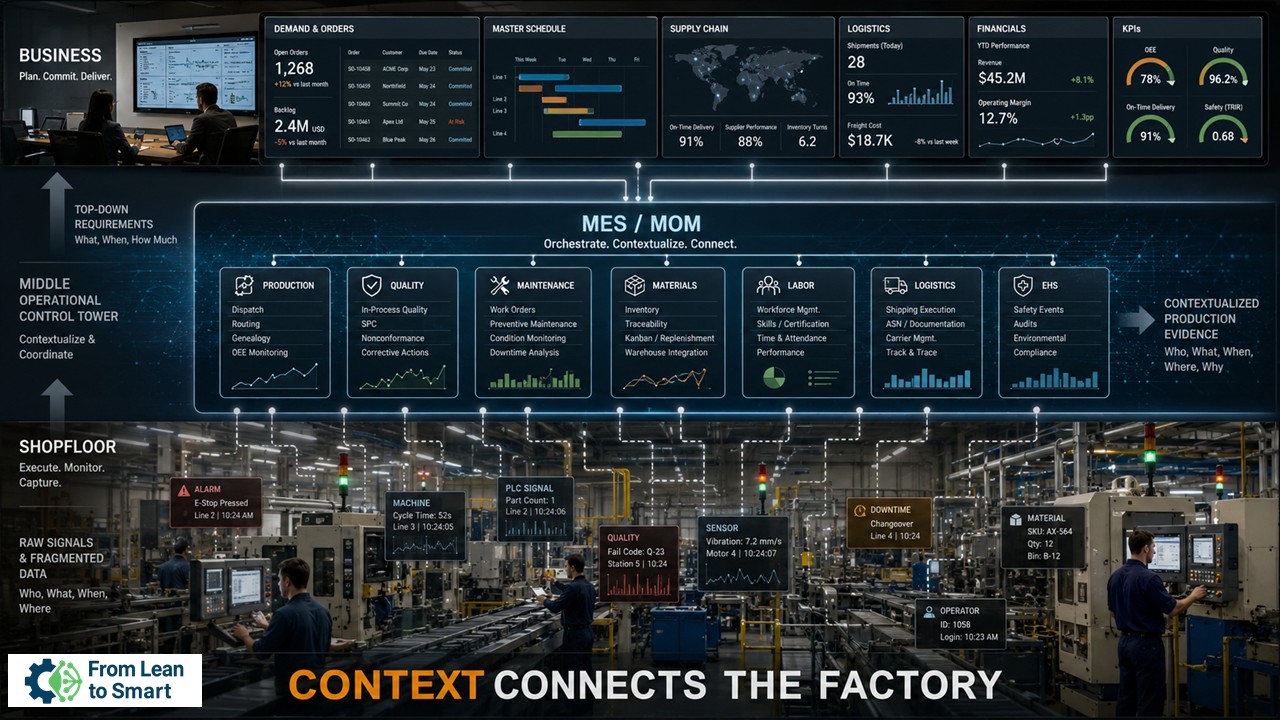
At the top of the organization, business systems deal with demand, orders, inventory, purchasing, finance, planning and customer commitments.
At the bottom, machines, lines, PLCs, sensors, instruments and operators generate the real events of production.
MES/MOM sits in the middle.
Its job is not only to collect data. Its job is to contextualize execution.
That means connecting signals, events and human inputs with:
orders, products, batches, materials, equipment, shifts, quality results, downtime causes, performance losses and traceability.
Without that context, factories can accumulate millions of data points and still not know what to do next.
A machine stopped for 18 minutes is a fact.
But knowing that the stop happened during a high-priority order, on a constrained line, because of a repeated material feeding issue, affecting delivery promise and creating overtime risk — that is operational information.
The difference matters.
The concept explained in plain English
A simple way to understand industrial architecture is to think in layers.
At the physical level, the factory transforms material into product. Machines run, operators intervene, sensors measure, motors move, valves open, robots position parts, batches are mixed, products are inspected and pallets are moved.
At the control level, PLCs, DCS, SCADA and HMI systems supervise and control the process. They are close to the machine. Their priorities are speed, safety, control logic, alarms, states and real-time operation.
At the business level, ERP and related enterprise systems manage the commercial and administrative view of the company. They handle orders, purchases, sales, finance, inventory, planning, costing and customer commitments.
MES/MOM belongs between those worlds.
It translates business intent into executable manufacturing work and returns reliable evidence of what actually happened.
A typical flow looks like this:
ERP sends the production plan, order, product, quantity, date, material requirements and priorities.
MES/MOM turns that into plant execution: line assignment, sequence, instructions, material validation, quality checks, recipe parameters, labor context, downtime tracking and production reporting.
SCADA, PLCs, operators and equipment execute or report the physical events.
MES/MOM captures the execution record and sends back production confirmations, consumed materials, quality status, losses, times, scrap, rework and traceability.
ERP, BI, supply chain, finance and management then use that evidence to update inventory, cost, delivery promises, performance reports and decisions.
In plain English:
ERP says what should happen. The shopfloor shows what is happening. MES explains what really happened and why it matters.
Where it fits in the MES/MOM architecture
MES/MOM should not be seen as one more software application sitting somewhere in IT.
It is an operational layer in the architecture.
It normally connects with several systems:
ERP provides demand, orders, master data, planning, inventory logic, costing and business priorities.
SCADA/HMI provides process supervision, alarms, machine states and operator interaction with the equipment.
PLC/DCS systems execute control logic and collect real-time signals from the physical process.
Historians store time-series process data such as temperature, pressure, speed, torque, flow, vibration or energy consumption.
CMMS/EAM systems manage assets, maintenance plans, work orders, spare parts and reliability information.
QMS/LIMS systems manage inspections, quality results, lab tests, specifications, deviations and releases.
WMS or logistics systems manage storage, movements, staging, picking and material availability.
BI and analytics platforms consume contextualized information for reporting, improvement and management decisions.
Edge, OPC UA, MQTT, APIs and integration layers support connectivity, but they do not replace operational architecture.
The key point is responsibility.
A PLC should not contain business rules about customer priority. An ERP should not try to control machine-level execution. A SCADA should not become a hidden MES. A historian should not be expected to understand product genealogy on its own. A dashboard should not be confused with operational control.
Good architecture respects what each system is good at.
MES/MOM is the layer that coordinates manufacturing execution and gives operational meaning to plant data.
Why it matters for Operational Excellence
Operational Excellence depends on the ability to see problems, understand them, prioritize them and act on them with discipline.
MES/MOM supports that discipline when it connects data to decisions.
For OEE, it provides the structure to calculate availability, performance and quality by line, product, order, shift, equipment or loss category.
For downtime, it helps classify losses with reason codes, duration, frequency, impact and recurrence.
For quality, it connects defects, inspections, scrap, rework and deviations with the actual conditions of production.
For traceability, it links materials, lots, batches, serial numbers, operations, equipment, parameters and quality results.
For maintenance, it connects equipment states, runtime, stops, failure patterns and operational impact with CMMS/EAM workflows.
For cost, it helps move from abstract averages to a more realistic view of cost per unit, waste, capacity loss and overtime risk.
For Lean and TPM, MES does not replace gemba, standards, problem solving or leadership routines. It can support them by making losses visible, structured and comparable.
That is the important distinction.
MES does not improve a factory because it displays numbers.
It improves a factory only when those numbers are trusted, contextualized and used in the daily management system.
A good MES/MOM architecture helps the organization move from opinion-based discussions to evidence-based operational routines.
Typical mistakes and anti-patterns
One common mistake is treating MES as a dashboard project.
Dashboards may be useful, but visibility is not the same as control. A plant can have beautiful screens and still lack reliable reason codes, standard workflows, data ownership or escalation routines.
Another mistake is asking the ERP to manage detailed shopfloor execution.
ERP is essential, but it is usually not designed for the rhythm, granularity and volatility of production execution. It can define what should be produced, but it should not be overloaded with every machine event, microstop or operator interaction.
A third mistake is stretching SCADA into a pseudo-MES.
SCADA is excellent for supervision and process interaction, but production execution requires orders, materials, quality, genealogy, shifts, performance, traceability and business context.
When SCADA becomes the unofficial MES, the architecture often becomes difficult to scale and govern.
Another anti-pattern is collecting plant data without an operational model.
If machine tags, alarms and historian signals are not related to products, orders, lots, equipment hierarchy, shifts and loss categories, the factory may have data but not intelligence.
There is also the problem of point-to-point integration.
When every system talks directly to every other system without clear ownership, interfaces become fragile. A change in ERP, SCADA, WMS or quality can break the chain.
Integration should follow a model, not improvisation.
Finally, many projects start with technology before understanding the process.
The question should not be:
“Which MES should we buy?”
The better question is:
“Which operational decisions are weak today because execution data is missing, late, unreliable or disconnected?”
Practical industrial example
Imagine an automotive assembly line producing several product variants.
The ERP defines customer demand, production orders, variant sequence and required delivery dates. It knows the business commitment.
The MES receives the order and turns it into executable work. It assigns the order to a line, validates the variant, checks the required materials, confirms that the right components are available, provides work instructions, records torque results, links serial numbers and captures quality checks.
The PLCs and automation systems control stations, tools, sensors, conveyors, scanners and machine cycles.
The SCADA/HMI gives operators visibility into equipment states, alarms and process conditions.
A historian stores key process values, such as torque curves, cycle times, temperatures or pressures.
The QMS records inspections and nonconformities.
The CMMS/EAM receives repeated stop patterns or equipment issues that require maintenance attention.
The WMS confirms whether the correct components are staged at the line.
At the end, MES sends back the as-built evidence:
what was produced, when, with which components, on which equipment, under which conditions, with which quality results and with which losses.
This is not just “data integration.”
It is the difference between saying:
“We produced 980 units.”
And knowing whether those 980 units were produced correctly, efficiently, traceably and in a way that supports delivery, quality and cost decisions.
Implementation checklist
Before implementing this capability, check whether…
The business problem is clear: downtime, traceability, quality, scheduling, material availability, cost, compliance or performance.
The boundary between systems is understood: ERP, MES/MOM, SCADA, PLC, historian, QMS, WMS and CMMS/EAM should each have a clear role.
The production model is stable enough to represent sites, areas, lines, equipment, storage locations, products, orders and resources.
The organization knows which system owns each master data object.
Operators, supervisors, maintenance, quality, logistics and planning agree on the workflows that will change.
The integration flows are defined: what goes down from business to plant, what comes up from plant to business and what flows horizontally between operational systems.
The first use case is narrow enough to deliver learning and value without creating a multi-year architecture program with no visible benefit.
Cybersecurity, access control, availability and recovery have been considered from the beginning, not added as an afterthought.
The data collected will support a decision, action or improvement routine.
Key takeaway
MES is not the bridge between shopfloor and top floor because it connects systems.
It is the bridge because it turns production reality into operational evidence that people can use to run and improve the factory.
Reflection questions
-
Is your factory architecture helping people understand execution, or just moving data between systems?
-
Where does your organization currently blur responsibilities between ERP, MES, SCADA, PLC, historian, quality and maintenance systems?
-
What is the most important decision in your plant today that would improve if execution data had better context?
#MES #MOM #Manufacturing #OperationalExcellence #SmartManufacturing #Industry40 #DigitalTransformation #IndustrialAutomation #ITOT #DataDrivenManufacturing #LeanManufacturing #OEE #ProcessImprovement #ManufacturingExecutionSystem #ManufacturingOperationsManagement