A changeover rarely takes too long because somebody is turning a bolt too slowly.
Yet many SMED initiatives begin precisely there.
We film the machine.
We observe motion.
We separate internal and external activities.
We redesign clamps.
We organise tools.
We reduce walking.
All of this can generate real improvement.
But repeated observation of industrial changeovers reveals a broader pattern:
A significant proportion of changeover loss is often created before the operator touches the machine.
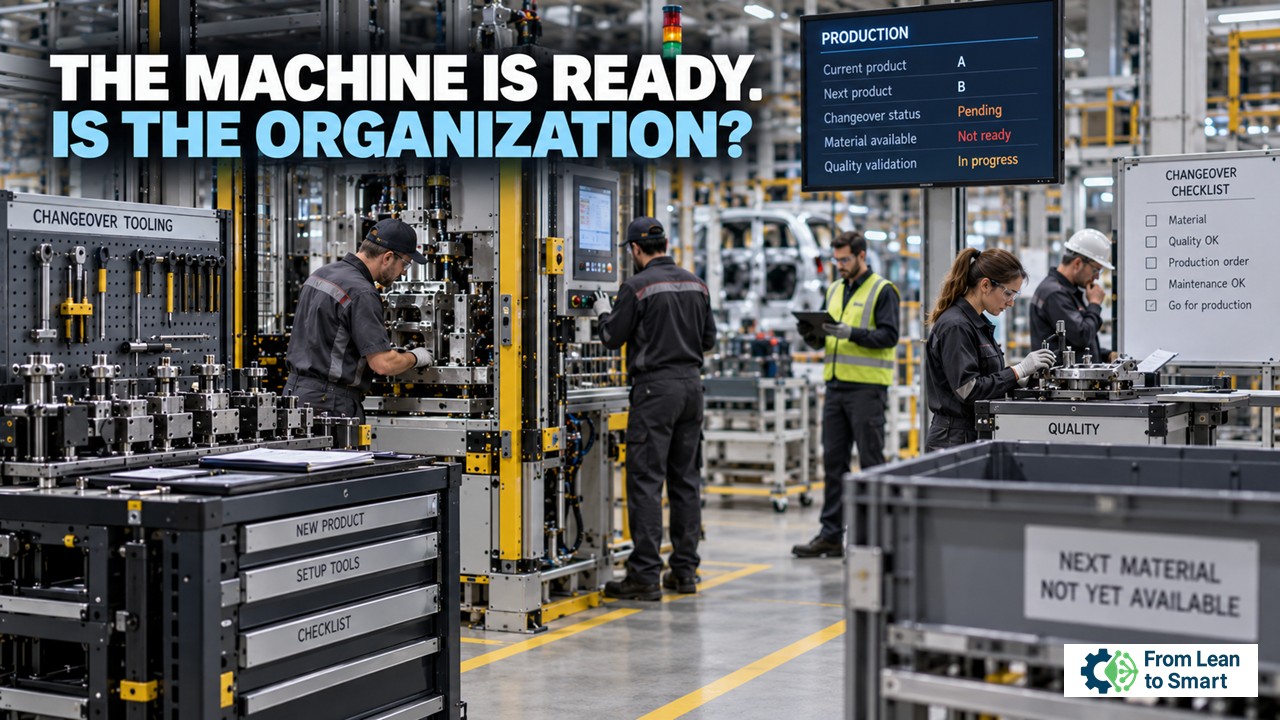
The next material is not ready.
The correct tooling has not arrived.
The setup sheet contains an obsolete parameter.
Quality is not prepared for first-piece verification.
Maintenance is called because a fixture is damaged.
The previous order ends later than planned.
Nobody available has authority to release the new recipe.
Logistics delivers the wrong container.
The machine may be technically ready for change.
The organisation is not.
This is why SMED should not be interpreted only as a tool-change technique.
At its best, SMED exposes the organisational conditions that make change either controlled and repeatable or slow and unstable.
That distinction matters because the true objective is not merely to shorten the mechanical intervention.
It is to reduce the complete transition between two stable production conditions.
Mechanical Changeover and Operational Changeover Are Not the Same
Consider a press line with a technically mature die-change process.
The physical sequence has been improved over several years.
The existing die can be removed, the new die installed, services connected and positioning completed in twelve minutes.
On paper, the changeover takes twelve minutes.
On the shopfloor, however, the interval from the last stable good part of Product A to stable good production of Product B is thirty-eight minutes.
Where did the remaining time go?
Seven minutes waiting for the next die.
Four minutes because material for the new reference is not at the point of use.
Three minutes confirming which parameter set should be loaded.
Five minutes waiting for the required measurement equipment.
Four minutes resolving an interpretation of the specification with Quality.
Three minutes recovering from a minor startup issue.
None of these losses belongs to the mechanical die-change sequence itself.
All of them belong to the production transition.
For the production system, the more meaningful question is therefore:
When did the last stable good output of Product A finish, and when did stable good output of Product B begin?
That is the operational changeover.
And it is usually broader than the physical intervention on the machine.
SMED Converts Uncertainty into Preparation
The traditional SMED distinction between internal and external activities remains fundamental.
Activities that can be performed while equipment is running should not wait until the machine stops.
But that principle extends beyond tools and fixtures.
Before the last unit of the current batch is completed, the organisation should already know as much as possible about the next operating condition.
Which product runs next?
Is the sequence sufficiently stable to prepare for it?
Is the required material available?
Is the tooling complete, identified and in acceptable condition?
Are gauges and measurement devices ready?
Is the correct recipe or parameter set approved?
Are current work instructions available?
Are the required operators qualified?
Are any maintenance concerns still open?
Does Quality know which startup characteristics require verification?
Is an engineering deviation changing the normal setup?
Did the previous use of the tooling leave an unresolved problem?
Every unanswered question creates the possibility of converting external preparation into internal downtime.
In that sense:
poor preparation converts organisational uncertainty into machine unavailability.
That is a much larger Lean problem than the speed of the physical tool change.
Watch What the Machine Is Waiting For
A useful SMED observation is to record not only what people are doing, but also what the machine is waiting for.
That changes the diagnosis immediately.
Is it waiting for:
-
tooling;
-
material;
-
information;
-
inspection;
-
maintenance;
-
authorisation;
-
cleaning;
-
programming;
-
an operator;
-
a forklift;
-
or a decision?
These are different loss mechanisms.
Each points towards a different management problem.
If tooling is repeatedly late, the issue may lie in logistics or preparation discipline.
If operators wait for release, decision rights may be unclear.
If first-piece verification dominates the transition, the startup-quality process needs examination.
If parameters frequently require correction, engineering discipline or master-data governance may be weak.
If maintenance is called during every third setup, equipment or fixture reliability may be the real constraint.
The value of SMED is therefore not simply that it reduces elapsed time.
It makes the causes of transition loss visible.
Faster Hands Do Not Create a Better System
There is a weak form of SMED in which improvement focuses aggressively on operator motion while leaving systemic instability untouched.
Tools are moved closer.
Steps are counted.
Movements are compressed.
The operator is expected to work faster.
Meanwhile, the production sequence still changes late.
Material readiness remains unreliable.
Fixtures arrive damaged.
Documents conflict.
First-piece approval still depends on locating the correct person.
The mechanical sequence may improve slightly.
But the system remains unstable.
Worse, the implicit message to the operator becomes:
“The organisation can remain unreliable; you must compensate more efficiently.”
That is not a mature Lean approach.
Lean should reduce the burden imposed on people by poor process design.
Respect for people includes creating conditions in which the correct work can be performed predictably, with less searching, waiting, improvisation and rework.
Variation Should Be Investigated Before the Average
Before chasing seconds, examine variation.
Suppose the same nominal changeover takes:
18 minutes on Monday,
27 minutes on Tuesday,
16 minutes on Wednesday,
42 minutes on Thursday,
and 21 minutes on Friday.
The average matters.
The variation may tell us more.
What changed?
Different operator?
Different tooling condition?
Different product sequence?
Missing material?
Quality approval delay?
Machine adjustment?
Engineering deviation?
Cleaning requirement?
Late planning change?
The variation reveals which parts of the process are not under control.
A highly variable changeover is difficult to optimise sustainably because the team is not repeatedly executing one stable process.
It is responding to a different combination of conditions each time.
Standard work becomes truly useful only when enough instability has been removed to create a repeatable baseline.
This is why SMED connects naturally with a broader Lean principle:
stability before optimisation.
Changeover Performance Begins in Planning
Production planning has a greater influence on SMED than many improvement programmes acknowledge.
A technically excellent changeover process cannot compensate indefinitely for an unstable sequence.
If the next order changes thirty minutes before the current run finishes, much of the external preparation becomes invalid.
The team that prepared Tool B now needs Tool D.
Material already staged must be moved.
Instructions may change.
Quality requirements may change.
The operator may have prepared mentally and physically for the wrong setup.
The factory then records a long changeover.
But the loss began upstream.
This is why changeover improvement should examine planning behaviour.
How frequently does the sequence change?
Who can change it?
How close to execution?
Under which conditions?
Are frozen horizons respected?
Do urgent orders automatically override preparation discipline?
Who evaluates the operational cost of that change?
External preparation depends on one important condition:
the organisation must know, with sufficient confidence, what it is preparing for.
Sometimes the largest SMED opportunity is not beside the machine.
It is in the governance of the production plan.
Maintenance Reliability Is Part of Changeover Capability
Equipment and tooling condition are often hidden inside setup losses.
A fixture fails to clamp correctly.
A connector is damaged.
A sensor needs adjustment.
A locating pin is worn.
A pneumatic coupling leaks.
A temporary repair fails during setup.
Maintenance is called.
The changeover timer continues.
The event may later be classified as “setup loss.”
But its underlying cause is reliability.
This is where SMED and TPM should reinforce one another.
If a fixture repeatedly requires adjustment during restart, that adjustment should not automatically be accepted as normal setup work.
It may represent an equipment-condition problem.
If a die repeatedly arrives dirty or damaged, the issue belongs to tooling management between production runs.
If connectors fail frequently, setup design itself may need improvement.
If maintenance interventions are common during changeovers, they should be analysed as a distinct recurring loss rather than absorbed into average setup duration.
A mature SMED review therefore asks:
What equipment-related problems are we carrying from one setup into the next?
Quality Can Become the Invisible Constraint
Another common pattern is a fast physical change followed by a slow production release.
The machine is ready.
The operator produces the first part.
Then the process waits.
Measurement.
Inspection.
Adjustment.
Another part.
Another measurement.
Approval.
Some of this may be necessary.
But it deserves the same Lean scrutiny as the mechanical intervention.
Can measurement equipment be prepared externally?
Can critical characteristics be checked closer to the point of use?
Can the process be set more repeatably so that startup begins closer to target?
Can gauges or measurement systems reduce handling and waiting?
Can automated or in-process verification remove unnecessary delay while preserving control?
Can clearly defined release criteria reduce dependence on individual interpretation?
The objective is not to weaken quality controls in pursuit of shorter setup time.
It is to design startup assurance so that quality is built into a rapid, controlled restart rather than added as a waiting stage afterwards.
The First Good Part Is Not Necessarily the End of the Changeover
Another measurement problem appears when a factory declares the changeover complete as soon as the first acceptable unit is produced.
The process may still be unstable.
Speed fluctuates.
Operators continue making adjustments.
Minor stops occur.
Scrap remains elevated.
The station requires unusually close attention.
The reported setup may be complete.
The production system has not yet reached stable flow.
This matters because local optimisation can otherwise improve the SMED metric while moving loss elsewhere.
Setup time falls.
Startup scrap rises.
Micro-stops increase.
Reduced-speed loss increases.
Quality holds increase.
The dashboard shows improvement.
The value stream does not.
A more demanding question is therefore:
How long does the process take to move from stable good production of one product to stable good production of the next?
This measure exposes losses that conventional setup timing can hide.
It also aligns the metric more closely with operational reality.
Handoffs Should Be Challenged, Not Automatically Eliminated
Every handoff creates the possibility of waiting.
Production to logistics.
Logistics to the setup team.
Setup team to operator.
Operator to maintenance.
Production to Quality.
Quality to engineering.
Engineering back to production.
Some of these handoffs are necessary.
They may provide specialised knowledge, segregation of duties, technical control or risk protection.
Others exist mainly because responsibilities and criteria were never redesigned.
For every handoff, ask:
Why is another function required?
Does it contribute expertise or necessary control?
Or does it merely provide approval?
Could the relevant information be available earlier?
Could the task be completed through standard work by the person already at the process?
Could decision criteria be established in advance?
Could automatic verification replace manual confirmation?
Could escalation occur only when conditions fall outside predefined limits?
The objective is not to eliminate functional boundaries indiscriminately.
It is to remove handoffs that add delay and variation without adding equivalent operational value.
Digitalisation Can Support SMED—or Automate the Friction
Digital tools can support changeover readiness effectively.
MES can identify the next order.
Electronic work instructions can provide controlled setup procedures.
Tool-management systems can confirm availability.
Recipe-management systems can control approved parameters.
Digital checklists can make readiness visible.
Workflow systems can escalate missing conditions.
Analytics can expose recurring startup losses.
These capabilities can be useful.
But digitalisation must follow the Lean problem.
If nobody owns tooling readiness, a dashboard showing that tooling is late does not make the tooling ready.
If recipe governance is weak, automated recipe transfer may scale configuration errors.
If schedule volatility is unmanaged, digital notifications merely communicate instability more rapidly.
If the preparation process itself is unclear, digitising it can create a faster method of requesting information that should already have been available.
A poor changeover process does not become Lean because it has a digital interface.
The sequence should remain disciplined:
understand the loss;
stabilise the process;
clarify ownership;
simplify the work;
standardise what can be standardised;
then apply technology where it improves execution, visibility or decision-making.
A Changeover Review Should Follow the Entire Transition
A serious SMED review should not begin when the machine stops and end when the first part is produced.
It should follow the entire transition.
Start before the current order finishes.
Was the next job confirmed?
Were material and tooling prepared?
Was equipment condition known?
Was Quality ready?
Were instructions, recipes and parameters current?
Then observe the machine stop.
Which tasks genuinely require the equipment to be unavailable?
Which can be externalised?
Which tasks contain adjustment rather than true replacement?
Which depend unnecessarily on specialist knowledge?
Where does the machine wait?
Then follow the restart.
How quickly does the process reach nominal speed?
How much scrap occurs?
How many adjustments are required?
Which abnormalities appear?
Does another function need to approve release?
Are problems documented?
Finally, observe what happens after the transition.
Is removed tooling restored correctly?
Are defects repaired before the next use?
Are abnormal conditions transferred into maintenance work?
Is learning incorporated into standard work?
Or does the organisation simply prepare to encounter the same friction again?
This end-to-end view transforms SMED from a stopwatch exercise into system-level process improvement.
The Strategic Target Is Flexibility
Why does changeover reduction matter?
Not because a shorter setup looks impressive on a Lean board.
It matters because long and unstable transitions force the production system into compensating behaviours.
Larger batches.
More WIP.
More inventory.
More buffers.
Less responsiveness.
Greater schedule rigidity.
Longer recovery cycles.
More hidden quality exposure.
When changeovers become shorter and more predictable, the system gains options.
Smaller economic batch sizes become possible.
Production can respond more effectively to changing demand.
Inventory can be reduced.
Flow becomes easier to manage.
Capacity previously consumed by transition loss becomes available.
The strategic value of SMED is therefore larger than the minutes removed from the setup itself.
The real target is a more flexible and controllable production system.
Eventually, the Stopwatch Should Point Upstream
A stopwatch remains a useful Lean tool.
But a mature SMED exercise eventually directs attention beyond the operator.
When the machine is waiting for tooling, follow the tooling process.
When it is waiting for information, follow the information.
When it is waiting for approval, examine the decision rights.
When it is waiting for material, examine planning and logistics.
When startup is unstable, investigate the technical causes.
When the sequence changes late, examine the governance behind scheduling decisions.
That is where some of the most consequential improvement opportunities appear.
SMED may begin at the machine.
It should not end there.
A changeover is not merely the moment when one tool replaces another.
It is the point at which the entire operating system must move from one controlled production condition to another.
When that transition is slow or unstable, the constraint is often not the speed of the people performing the setup.
It is the organisation surrounding them.
Three Questions Worth Taking Back to the Gemba
-
When a changeover takes too long, how much of the loss comes from physical setup—and how much from waiting for the organisation to become ready?
-
Are we genuinely reducing the transition to stable production, or merely moving losses into startup scrap, adjustment, reduced speed, micro-stops and quality waiting?
-
If the next production order changed thirty minutes before the current one ended, would our external preparation remain effective—or would the SMED process collapse?
#SMED #LeanManufacturing #OperationalExcellence #TPM #ManufacturingExcellence #ContinuousImprovement #ProductionPlanning #IndustrialMaintenance #QualityManagement #SmartFactory