
Takt time is often introduced as a simple formula:
Available production time divided by customer demand.
The calculation is useful. It connects customer demand with the required production rhythm. But in many factories, the real problem begins after the number has been calculated.
Takt time is not merely a numerical target. It is a test of how the organisation manages flow, variation, standards, capacity, priorities, escalation, and operational discipline under pressure.
A plant can calculate takt time correctly and still operate far from it. The line may depend on hidden buffers, unstable cycle times, missing materials, repeated quality checks, maintenance interruptions, operator overburden, poor line balancing, and supervisors constantly firefighting. The spreadsheet may show a clean rhythm. The shopfloor may show a very different reality.
That gap is where Lean becomes real.
The Risk of Treating Takt as Just a Target
When takt time is treated only as a target, it quickly becomes another number to defend in a meeting.
Production explains demand variation. Planning explains product mix instability. Maintenance explains lower-than-expected equipment availability. Logistics explains material shortages. Quality explains inspection delays. Supervisors explain absenteeism, rework, and operator rotation constraints.
Many of these explanations may be valid.
But the more important question is this:
What does the management system do with the gap between takt and actual performance?
If takt time only creates pressure, it will drive the wrong behaviours. Operators will be pushed to compensate for system instability. Team leaders will chase output instead of understanding losses. Buffers will grow quietly. Minor stops will be normalised. Problems will be hidden to keep the line moving.
That is not Lean flow. It is stress disguised as productivity.
A mature use of takt time does not begin by blaming the people closest to the work. It begins by making instability visible and manageable.
Takt Exposes the Quality of the Operating System
Takt time is powerful because it forces the factory to confront uncomfortable operational questions:
Can the process repeat reliably?
Is standard work realistic under current conditions?
Are cycle times stable, or are averages hiding variation?
Can materials arrive at the required rhythm?
Can maintenance support the constraint points of the flow?
Can quality be built into the process instead of inspected afterwards?
Can leaders respond quickly when abnormality appears?
These are not theoretical Lean questions. They are operating questions.
Imagine an assembly line with a calculated takt time of 58 seconds. On paper, the line appears balanced. In reality, one station sometimes completes the work in 50 seconds and sometimes in 75. Another station depends on parts delivered in batches. A quality check is repeated because the previous process is not trusted. A small equipment stop occurs several times per shift, but it is not recorded properly because the team considers it “normal.”
The takt calculation did not fail.
The operating system failed to respond to what takt was revealing.
Many Takt Problems Are Management Problems
When a line misses takt, factories often look first for technical explanations.
Sometimes that is correct. A machine may lack capacity. A fixture may be poorly designed. A changeover may be too long. A workstation may have poor ergonomics. A process may require engineering support.
But many takt problems are not purely technical. They are management problems.
They are caused by weak escalation routines, poor loss visibility, unstable planning, unclear ownership, disconnected maintenance priorities, unreliable standards, or daily meetings that review performance without removing recurring causes.
This is why takt time must be connected to daily management.
Not as a punishment mechanism.
As a learning mechanism.
When the line cannot follow takt, leaders should not only ask:
“Why did we miss the target?”
They should ask:
What abnormality did we detect?
How quickly did we react?
Was the standard clear and realistic?
Did the team have the required conditions to follow it?
Did the same problem repeat?
Who owns the countermeasure?
What did we learn about the system?
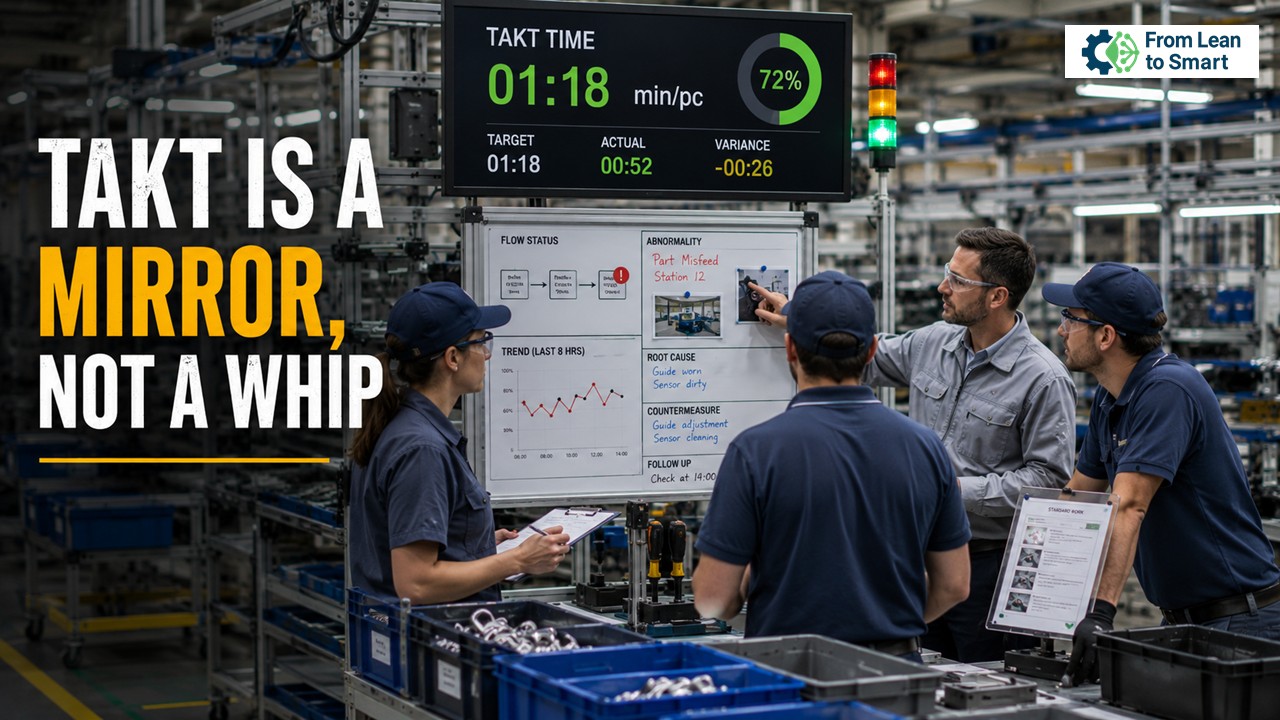
Without that discipline, takt becomes a number on a board. With that discipline, takt becomes a mirror of operational capability.
Takt Without Stability Creates Frustration
One common mistake in Lean transformation is trying to impose flow before building basic stability.
The team calculates takt. Workstations are rebalanced. Visual boards are updated. Performance is reviewed more frequently.
But the process remains unstable.
Materials do not arrive reliably. Equipment downtime is treated as background noise. Quality defects interrupt the rhythm. Engineering changes arrive late. Operators are rotated without sufficient training. The standard exists on paper, but the real work still depends on experience, improvisation, and informal workarounds.
In that environment, takt time becomes a source of frustration.
Not because takt is wrong, but because the organisation is asking people to follow a rhythm that the system cannot yet support.
This is where leadership discipline matters.
A leader who understands Lean does not use takt to demand impossible performance. A leader uses takt to identify which constraints must be removed so that people can work in a stable, safe, and repeatable way.
Respect for people includes not asking them to compensate permanently for broken processes.
Before Using Takt as a Strong Management Reference
Before takt time becomes a central operational reference, the organisation should be honest about its level of readiness.
This does not mean waiting for perfect conditions. It means understanding the gap between the calculated takt and the actual capability of the system.
Several questions are worth taking seriously:
Is the demand signal understood, or is it being blindly averaged?
Has the product mix been considered, including changeovers and sequence variation?
Have cycle times been observed at the gemba, or are they taken only from standards and routings?
Are losses visible by cause, or hidden inside generic downtime categories?
Can material flow support the required rhythm without creating shortages or excess buffers?
Are maintenance priorities aligned with the points that most affect flow?
Are quality checks designed to prevent defects, or mainly to detect them late?
Do team leaders have a real escalation process when abnormality appears?
These questions are not bureaucratic. They define whether takt can become a serious management reference or whether it will become another unrealistic expectation imposed on the shopfloor.
The Real Value of Takt Time
The real value of takt time is not that it tells people how fast they should work.
Its real value is that it reveals whether the factory is capable of creating value at the pace required by the customer without hiding problems, overburdening people, or building unnecessary buffers.
Takt time translates market demand into operational truth.
But it only works when leaders are willing to look at what the number reveals.
If takt is used only to push output, it creates tension and defensive behaviour.
If takt is used to expose instability, improve flow, strengthen standards, align support functions, and accelerate problem-solving, it becomes a serious Lean management tool.
The difference is not mathematical.
The difference is managerial.
A useful gemba question is therefore not simply, “Are we meeting takt?”
The better question is:
What does our gap to takt reveal about the way we manage the system?
Because in the end, takt time does not only measure production rhythm. It exposes the maturity of the organisation’s ability to manage reality.
#OperationalExcellence #LeanManufacturing #ManufacturingExcellence #IndustrialMaintenance #Reliability #AssetManagement #SmartFactory #MES #ContinuousImprovement #OperationalDiscipline