Process mining can be brutally useful.
It can reveal that the process an organization believes it follows is not the process people actually execute. It can expose loops, delays, skipped steps, uncontrolled variants, waiting time, rework, hidden handovers, and informal paths that were never visible in traditional process documentation.
For many organizations, this is the first time operational reality becomes visible through evidence rather than opinion.
But there is a serious risk.
The risk is assuming that the process mining output explains the process by itself.
It does not.
An event log is not the process. A generated process model is not the same as the work taking place in the plant, the warehouse, the maintenance area, the quality lab, the planning meeting, or the supplier escalation call. It is a digital footprint of what was recorded, when it was recorded, and according to the logic of the systems involved.
That footprint can be extremely valuable.
But without operational context, it can also be dangerously misleading.
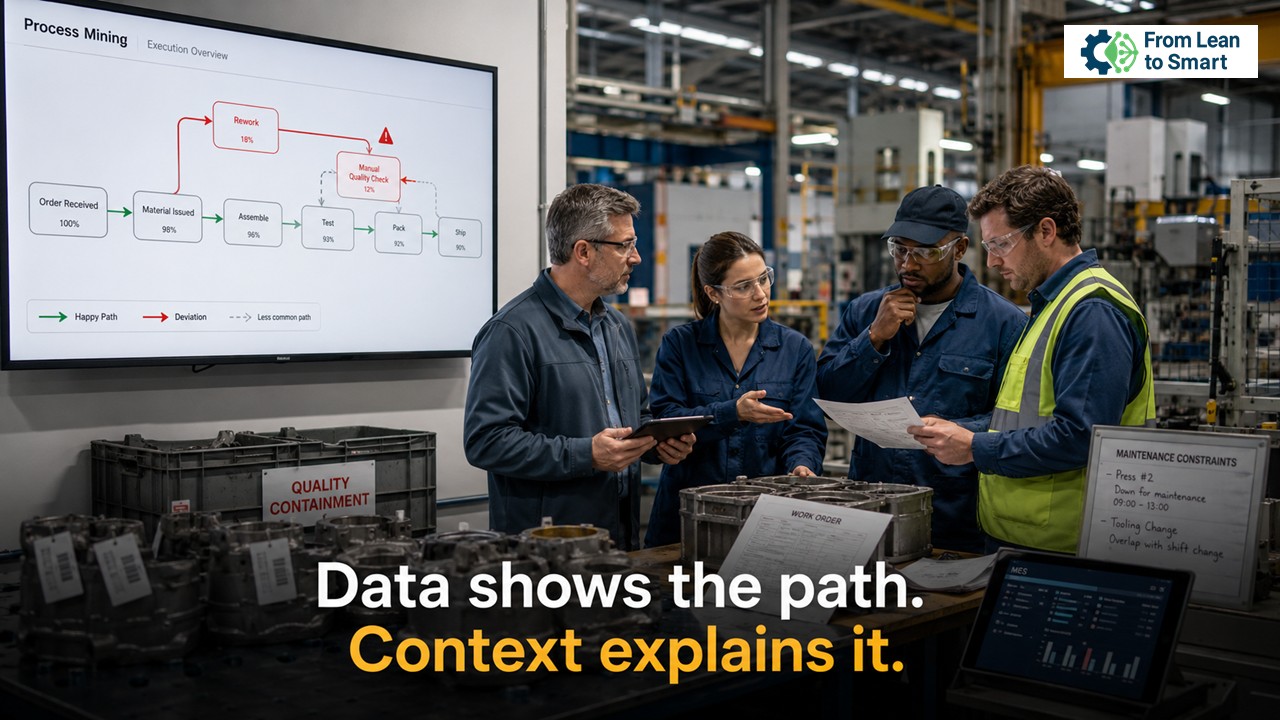
A process mining model may show a deviation. On the shopfloor, that deviation may be a necessary containment action. It may show a delay. In reality, that delay may reflect a production window, a missing spare part, a pending quality decision, a customer approval, or an engineering change. It may show rework. In practice, that rework may be the visible consequence of a problem created much earlier in planning, master data, maintenance, supplier quality, or process design.
The tool shows movement.
The factory explains meaning.
When the Map Looks More Objective Than It Really Is
One of the most common mistakes in digital transformation is confusing data visibility with operational understanding.
A process mining dashboard can look highly authoritative. Clean diagrams, frequencies, variants, lead times, bottlenecks, percentages, red paths, and green paths all create a strong impression of objectivity.
But industrial operations are full of conditions that do not appear clearly in an event log.
Product mix changes. Material shortages. Temporary quality containment. Maintenance access restrictions. Shift experience. Launch maturity. Engineering concessions. Supplier instability. Planning instability. Equipment behavior. Informal escalation routines. Local workarounds. Manual decisions made under pressure.
If these conditions are not connected to the analysis, the organization may start optimizing symptoms instead of causes.
A late maintenance closure may be interpreted as poor execution discipline when the real issue is that production did not release the asset. A repeated quality loop may look like bureaucracy when it is actually protecting the customer during an unstable process. A purchasing deviation may be judged as non-compliance when it was triggered by an urgent production recovery decision.
Of course, the opposite can also be true.
Sometimes the deviation is poor discipline. Sometimes waiting time hides weak ownership. Sometimes a workaround has become normalized waste. Sometimes the “exception” is no longer an exception but the real process.
That is precisely why context matters.
The purpose of process mining is not to let the software declare guilt. Its purpose is to create better questions.
The Factory Does Not Run on Event Logs Alone
In manufacturing environments, many important decisions happen across systems.
ERP may capture the order. MES may capture execution. CMMS may capture maintenance work. QMS may capture deviations. WMS may capture material movement. Spreadsheets may still coordinate exceptions. Supervisors may resolve conflicts in daily production meetings. Operators may make small adjustments that never become structured data.
Therefore, when process mining reconstructs a process from one system, or even from several systems, it is still reconstructing only what those systems can see.
This is especially important in industrial BPM.
Traditional BPM often assumes that a process can be designed, standardized, automated, and controlled as a predictable sequence. Real operations behave differently. They are affected by constraints, variability, priorities, risk, asset condition, material availability, engineering maturity, and customer pressure. They require judgment. They depend on timing. They are shaped by what happens when the standard path no longer fits reality.
In this environment, process mining is powerful because it challenges the official version of the process.
But it becomes weak when interpreted far away from operations.
A process mining finding should not remain in a conference room with process owners, analysts, and transformation teams. It should be taken back to the people who understand why decisions were made at the time.
The question is not only:
“Why did the process deviate?”
The better question is:
“What condition made this path necessary, acceptable, invisible, or repeated?”
That question changes the quality of the conversation.
A Realistic Industrial Example
Consider a process mining analysis of a quality deviation process.
The model shows that many cases move from inspection to containment, then back to engineering review, then to re-inspection, and again to containment. The dashboard highlights this as a high-rework variant with excessive lead time.
The first conclusion may appear obvious: the quality process is inefficient.
But after going to the plant, the story becomes more precise.
Some cases are linked to a supplier batch under temporary containment. Some require engineering judgment because the product is in launch phase and tolerances are still being stabilized. Some wait because production must continue while the quality team prioritizes customer-risk issues. Some are delayed because disposition rules are unclear. Others move backward because the MES record, the quality defect code, and the physical label do not always match.
Now the process mining insight becomes useful.
Not because it showed a red path, but because it helped separate several realities that were previously mixed together:
- legitimate containment under operational risk;
- unclear decision rights;
- poor master data alignment;
- weak defect coding;
- unstable launch conditions;
- inconsistent system integration between MES and QMS;
- and genuine process discipline issues.
The improvement action is no longer simply “reduce rework in the quality process.”
That is too generic.
The real improvement may involve clarifying disposition authority, improving the defect taxonomy, aligning MES and QMS data, defining escalation rules for launch cases, separating customer-risk containment from administrative loops, and assigning ownership for recurring exceptions.
Same process mining output.
Completely different operational interpretation.
Process Mining Needs Process Ownership
Another danger is treating process mining as an analytics project rather than a management discipline.
The tool can reveal variants, but it cannot decide which variants are acceptable. It can show waiting time, but it cannot determine whether the wait is justified. It can expose rework, but it cannot decide whether the root cause belongs to planning, maintenance, engineering, quality, supplier management, or production execution.
That requires ownership.
Without process ownership, process mining becomes another reporting layer. People admire the visualization, debate the numbers, and continue working in the same way.
Good process mining governance should force uncomfortable but necessary questions:
Who owns the end-to-end process?
Who owns the decision rules?
Who can approve exceptions?
Which variants are legitimate?
Which variants are symptoms of weak discipline?
Which system is the source of truth?
Which data fields are operationally meaningful?
Which improvement actions will actually change daily decisions?
This is where BPM becomes real.
Not in the diagram.
In the accountability behind the diagram.
Operational Context Is Not an Excuse
There is also a trap on the other side.
Some organizations use context to defend every deviation. Every delay has an explanation. Every workaround has a history. Every exception is described as necessary. Every local habit is protected because “that is how the plant works.”
That is not operational maturity.
Context should not be used to justify chaos. It should be used to understand reality accurately enough to improve it.
A mature organization does not blindly accept every process mining finding. But it also does not dismiss uncomfortable evidence because “the tool does not understand operations.”
The right posture is more demanding.
Use process mining to make reality visible. Use operational knowledge to interpret it. Use BPM discipline to decide what must change. Use Lean thinking to remove waste and stabilize flow. Use MES, ERP, CMMS, WMS, and QMS integration to improve data quality and execution discipline. Use governance to ensure that decisions do not disappear after the workshop.
This is where process mining becomes more than analysis.
It becomes a bridge between process evidence and operational improvement.
From Finding Deviations to Improving Decisions
The most valuable question is not whether the mined process perfectly matches the designed process.
The most valuable question is whether the organization can make better decisions because of what it has learned.
Can planners identify which exceptions are caused by unstable master data?
Can maintenance and production distinguish justified waiting time from poor execution?
Can quality teams separate true rework from risk-based containment?
Can process owners identify which deviations require standardization and which require adaptive case management?
Can leaders decide which problems deserve structural improvement instead of another dashboard?
Process mining should not become a digital mirror that the organization looks at once and then forgets.
It should become part of the operating rhythm.
Not every day. Not for every process. Not as another layer of KPI theatre. But as a disciplined way to connect system evidence with operational reality, process ownership, and management action.
Because the real promise of process mining is not discovering that the process is messy.
Most people in operations already know that.
The real promise is helping the organization understand which part of the mess is necessary complexity, which part is avoidable waste, and which part is a leadership problem that has been hidden inside systems for too long.
#ProcessMining #BPM #OperationalExcellence #SmartFactory #MES #ManufacturingExcellence #LeanManufacturing #IndustrialAI #AssetManagement #ContinuousImprovement