There is a version of Lean that looks convincing during visits.
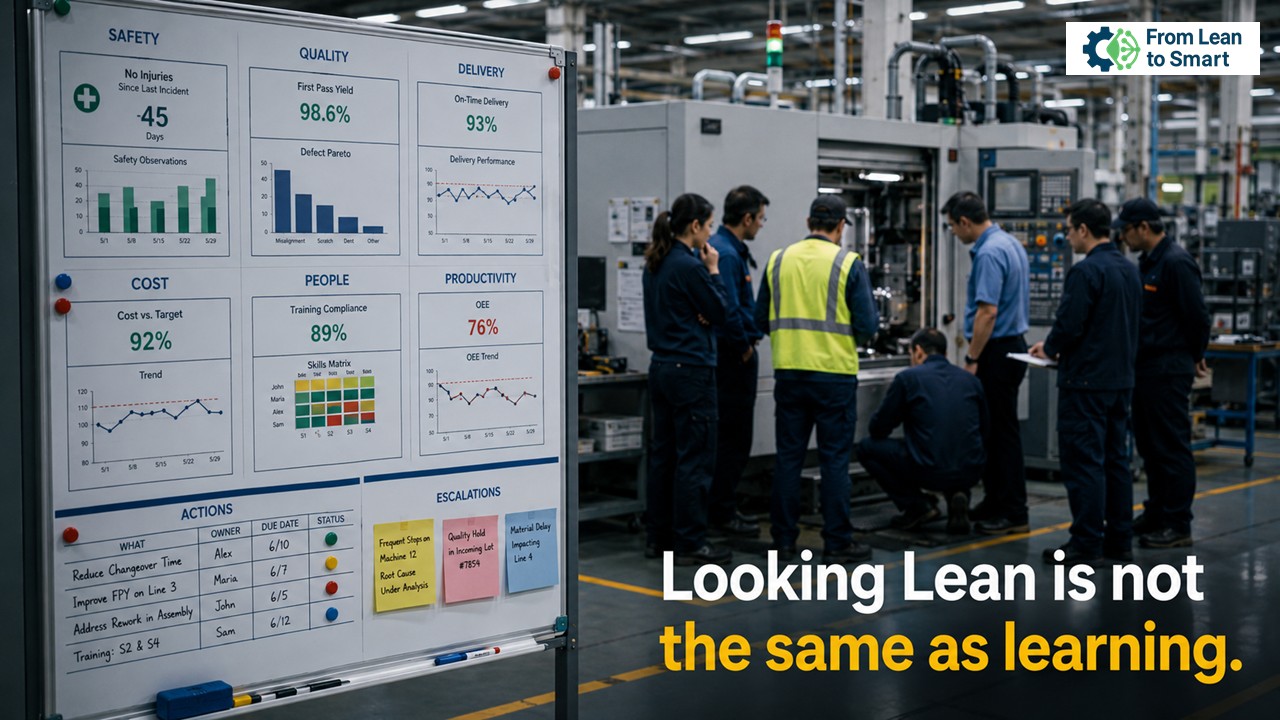
The 5S boards are updated. The floor markings are fresh. The performance board contains charts, colours, and action lists. The kaizen newspaper is full. The area displays slogans about continuous improvement, ownership, and discipline.
But when the line stops, the real management system becomes visible.
Operators bypass the standard because the standard no longer reflects the actual condition of the process. Supervisors chase output because the daily meeting did not remove yesterday’s causes. Maintenance is called too late because an abnormality was visible but not escalated. Quality defects repeat because containment was faster than learning. Operators know the workarounds, but the organization has learned not to ask too deeply.
That is the hidden cost of cosmetic Lean.
It does not simply waste time. It creates the impression of operational maturity while leaving the underlying operating system largely unchanged.
When Lean Becomes Visual Instead of Operational
Visual management is not the problem. 5S is not the problem. Standard work is not the problem. Audits are not the problem.
The problem begins when these practices become disconnected from decision-making.
A board that displays problems but does not trigger decisions becomes decoration. A 5S audit that checks labels but ignores recurring abnormalities becomes housekeeping. A standard that is posted but not used for training, coaching, and problem-solving becomes bureaucracy. A kaizen event that produces slides but not sustained behavioural change becomes theatre.
Cosmetic Lean is dangerous because it is not always obvious from a distance. It can pass audits. It can look disciplined. It can generate activity. It can even create short-term enthusiasm.
But it does not change how the factory learns.
And Lean, at its core, is not about looking organized. It is about learning faster from operational reality.
The Real Cost Is Not the Wasted Time
The visible cost of cosmetic Lean is easy to identify: hours spent preparing boards, cleaning for visits, updating templates, and chasing audit scores.
The deeper cost is more serious.
Cosmetic Lean teaches the organization to confuse appearance with capability.
It tells teams that the purpose of Lean is to look organized, not to expose problems. It tells supervisors that compliance matters more than understanding. It tells managers that a green dashboard means the system is under control. It tells operators that improvement is something done around them, not with them.
Over time, the factory becomes skilled at performing Lean and weak at practising it.
The language remains.
The rituals remain.
The posters remain.
But the operational truth becomes harder to see.
A Clean Area Can Still Be Unstable
One of the most common misunderstandings in Lean is the belief that order equals stability.
A clean workplace is valuable. It reduces search time, improves safety, and makes abnormalities easier to detect. But a clean area does not automatically mean that the process is capable, stable, or controlled.
A workstation may look perfect and still suffer from missing materials, unstable cycle times, recurring quality defects, unclear escalation rules, or equipment micro-stoppages. A visual board may be complete and still fail to explain why yesterday’s losses occurred. A standard may be laminated and still be impossible to follow because process conditions change every hour.
In real factories, the question is not only:
Does the area look organized?
The more important question is:
Does the organization react differently when reality deviates from the standard?
That is where cosmetic Lean and operational Lean separate.
The Audit Trap
Many Lean systems become cosmetic through audit logic.
Audits are useful when they test whether the management system is alive. They become harmful when the organization starts optimizing for the checklist instead of the behaviour the checklist was supposed to protect.
I have seen areas prepare for audits with impressive discipline: cleaning, updating boards, printing action plans, aligning materials, correcting labels, and rehearsing explanations. The score improves. The visit goes well. The area receives positive feedback.
Then, the following week, the same recurring problems return.
Not because people are careless. More often, people are adapting to a system that has not removed the causes.
The audit saw the surface.
The process kept the pain.
A more useful audit would ask harder questions:
- Did yesterday’s abnormality lead to action?
- Was the root cause understood at the right level?
- Did leadership remove a barrier, or simply ask the team to try harder?
- Did the standard change because learning occurred?
- Did the same problem reappear under a different name?
- Were decision rights clear when escalation was required?
These questions are less comfortable. But they are closer to Lean because they test the effectiveness of the management system, not merely the appearance of compliance.
Cosmetic Lean Protects Leaders from Reality
One uncomfortable truth is that cosmetic Lean often survives because it protects leadership from difficult conversations.
A colourful board is easier to accept than a serious discussion about unstable planning, poor maintenance windows, weak training, unrealistic takt, supplier variability, or engineering changes introduced without proper shopfloor validation.
A clean audit score is easier to present than a recurring conflict between production pressure and quality discipline.
A kaizen report is easier to celebrate than the fact that supervisors have no time to coach because they are absorbed by firefighting.
Cosmetic Lean allows organizations to say, “We are doing Lean,” without changing how decisions are made.
But real Lean does not protect leaders from reality. It brings reality closer to leadership.
That is why a genuine gemba walk is not a tour to verify whether people are following the program. It is a disciplined way to test whether management assumptions survive contact with the process.
From Compliance to Learning
The antidote to cosmetic Lean is not to abandon the tools. It is to restore their purpose.
5S should make abnormalities visible.
Standard work should create a baseline for learning.
Visual management should trigger decisions.
Daily management should connect performance to causes.
Kaizen should change conditions, not only generate activity.
Leader standard work should protect the rhythm of observation, coaching, and escalation.
When these practices are connected, Lean becomes an operating discipline. When they are disconnected, Lean becomes a visual identity.
The difference is not philosophical. It is practical.
In one factory, a daily board shows downtime by category. The supervisor reports the number. Everyone nods. The meeting ends. The same loss appears again the following week.
In another factory, the same downtime triggers a clear escalation. The team checks the actual condition at the machine, confirms whether the reason code reflects reality, separates symptoms from causes, assigns ownership, verifies the countermeasure, and updates the standard if learning is confirmed.
Both factories may have boards.
Only one is using Lean to manage reality.
The Role of Digitalization
Cosmetic Lean becomes even more dangerous when digital tools amplify it.
A weak visual board can become a weak dashboard. Poor reason-code discipline can become unreliable analytics. A superficial action log can become a digital workflow full of overdue actions that nobody truly owns. A process that was not understood can be automated faster than it was improved.
Digitalization does not automatically make Lean more mature.
It often reveals whether Lean was mature in the first place.
Before digitalizing daily management, OEE, problem-solving, escalation, or standard work, leaders should ask whether the analogue system already changes decisions. If it does not, the digital version may only make the illusion more scalable.
An MES, a dashboard, or a Smart Factory platform cannot compensate for weak process discipline, unclear accountability, poor data quality, or absent management routines. Digital tools can improve visibility, but visibility without ownership does not create operational control.
Smart Factory requires Lean thinking, not Lean decoration.
What Mature Lean Looks Like
Mature Lean is often less theatrical than cosmetic Lean.
It may not look perfect during a visit. There may be open problems on the board. There may be red indicators. There may be standards under revision. There may be difficult conversations taking place in front of the process.
That should not be interpreted as weakness.
A factory that exposes problems honestly is often more mature than one that hides instability behind green charts.
The objective is not to celebrate disorder. The objective is to create a system where problems are visible, understood, owned, and solved.
That requires leadership discipline. It requires time for problem-solving. It requires supervisors who are not left alone between output pressure and improvement expectations. It requires managers who ask better questions. It requires respect for people in its most practical form: making problems solvable instead of making them look acceptable.
Cosmetic Lean asks:
Does it look Lean?
Operational Lean asks:
Are we learning from reality and improving the system?
That difference is expensive.
Questions Worth Taking to the Gemba
A serious Lean system should be tested by the decisions it changes.
Where are we creating visibility without changing escalation, ownership, or problem-solving behaviour?
Which abnormalities have become so familiar that we no longer treat them as problems?
What would our Lean system reveal if we stopped preparing for audits and started observing normal operating conditions?
The real maturity of Lean appears when the process is under pressure, when the standard is difficult to follow, and when leaders must choose between short-term output and disciplined learning.
That is where cosmetic Lean reaches its limit.
And that is where operational Lean begins.
#LeanManufacturing #OperationalExcellence #ManufacturingExcellence #IndustrialMaintenance #SmartFactory #MES #AssetManagement #Reliability #ContinuousImprovement #ProcessImprovement #DigitalTransformation