Many Smart Factory strategies look convincing at executive level.
They include roadmaps, platforms, connectivity layers, dashboards, data lakes, MES/MOM initiatives, AI pilots, digital twins and integration programmes. The architecture is often coherent. The language is ambitious. The expected value is clear on paper.
But then Monday morning arrives.
A production line has quality deviations. Maintenance is negotiating a narrow intervention window with production. A supervisor is trying to recover output after a pattern of micro-stoppages that nobody fully understands. Logistics is managing material shortages. Engineering is waiting for feedback on the latest process change. The daily meeting reviews yesterday’s numbers, but the conversation remains too superficial to change today’s decisions.
This is where many digital strategies lose power.
Not because the technology is necessarily wrong. Not because people naturally resist change. Not because the factory is simply “not ready”.
The real gap is often more specific: digital ambition is not connected to the operating rhythm of daily management.
A Smart Factory is not built only by connecting machines, deploying dashboards or increasing data availability. It becomes real when information changes how people see problems, interpret abnormalities, prioritise action, escalate issues, learn from deviations and make decisions closer to operational reality.
Strategy does not transform operations by itself
Digital strategy usually speaks the language of capabilities: visibility, traceability, prediction, integration, automation and intelligence.
Daily management speaks the language of operational pressure: safety, quality, delivery, cost, downtime, scrap, staffing, changeovers, maintenance windows, urgent customer requirements and equipment instability.
The problem appears when these two languages are not connected.
A plant may have a dashboard showing OEE losses almost in real time, while the daily meeting still discusses only whether the target was missed. A MES may capture downtime reason codes, while nobody challenges whether those codes are accurate enough to support root cause analysis. A predictive quality model may detect a risk pattern, while the escalation path remains unclear. A digital Andon may generate alerts, while nobody owns the response standard.
In these cases, the factory has more information, but not necessarily better management.
Digital tools expose reality faster. They do not automatically create process discipline, decision quality or accountability.
The daily meeting is where digital value becomes visible
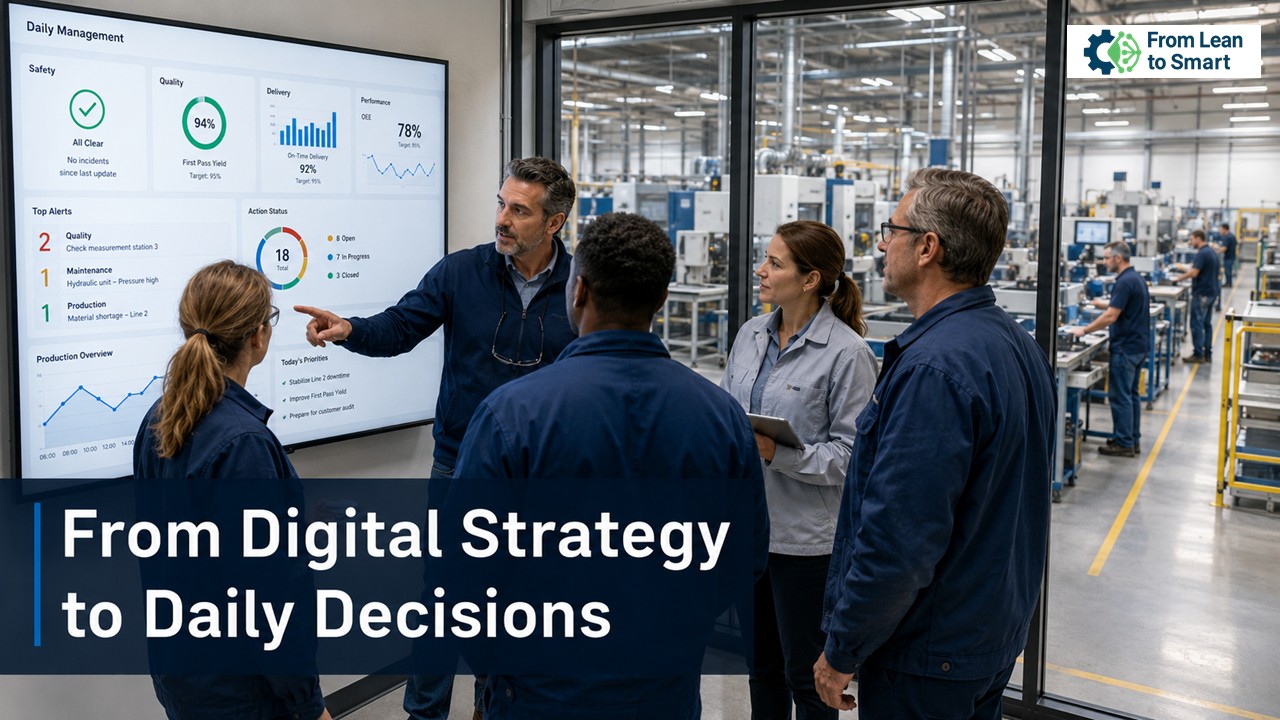
One of the best tests of a Smart Factory initiative is not the dashboard itself. It is the quality of the conversation that happens around it.
Does the meeting move from performance numbers to causes?
Does the team distinguish normal variation from abnormal conditions?
Does the information trigger decisions, or only explanations?
Are actions assigned with ownership, timing and follow-up?
Are recurring problems escalated structurally, or simply accepted as part of factory life?
This is where the hidden gap becomes visible.
A digital system can show that a line lost 42 minutes because of short stops. But daily management must ask better questions: Why are those stops recurring? Is the operating standard clear? Are production and maintenance interpreting the loss in the same way? Is the machine condition stable? Is the issue related to operation, maintenance, material, process parameters or product mix? Should it be solved locally, or escalated to a cross-functional team?
Without this discipline, the dashboard becomes a faster way to admire the problem.
Smart Factory needs a management system, not only a technology stack
In many factories, the technology stack is better designed than the management system around it.
There is an integration architecture, but no clear decision architecture.
There are KPIs, but weak abnormality rules.
There are alerts, but unclear escalation paths.
There is data capture, but poor ownership of master data, reason codes and operational definitions.
There are pilots, but no structured mechanism to absorb successful solutions into daily routines.
This is why Smart Factory should be understood as a socio-technical transformation. Systems matter. Connectivity matters. Data matters. Analytics matter. But the decisive question is operational:
How will this information change the way the factory is managed every day?
If the answer is vague, the initiative is not yet mature.
A serious digital strategy should define not only what will be connected, but also which decisions will improve, who will make them, under which rules, with what evidence, and through which management routines.
This requires more than dashboards. It requires clear decision rights, escalation logic, response standards, data ownership and follow-up discipline.
The factory does not need more signals. It needs better operational judgement.
Modern factories already generate enormous quantities of data. PLC signals, SCADA events, historian trends, MES records, quality results, maintenance work orders, ERP transactions and manual inputs all describe different fragments of the same operational reality.
The difficulty is not only collecting data. The difficulty is turning fragmented signals into usable context.
A downtime event means little without product, equipment state, operator condition, maintenance history, material batch, process parameters and production plan.
A quality deviation means little without recipe, changeover history, environmental conditions, inspection method, process capability and previous corrective actions.
A maintenance alert means little without asset criticality, failure history, spare parts availability, production constraints and risk to service level.
Daily management needs context, not noise.
This is why MES/MOM, IT/OT integration, master data, process governance and Lean routines must be connected. Lean helps clarify what problem must be solved. MES/MOM can structure execution and evidence. Analytics can reveal patterns. AI can support prediction and recommendation. But management discipline is what turns insight into action.
Without that discipline, Smart Factory becomes a reporting layer over unchanged operating habits.
The risk of digitalising weak routines
One of the most common mistakes is to digitalise daily management before improving it.
A weak paper board becomes a weak digital board.
A superficial meeting becomes a superficial meeting with better graphics.
An unclear escalation process becomes an unclear workflow.
A poor downtime classification becomes a colourful Pareto chart that misleads improvement priorities.
Technology does not remove the need for standards. It makes the absence of standards more visible.
Before digitalising daily management, leaders should clarify what “good” looks like in operational terms:
What is the standard agenda for each management level?
Which KPIs are reviewed daily, weekly and monthly?
What defines an abnormal condition?
Which problems must be solved locally?
Which problems require escalation?
Who owns the response when an alert is triggered?
What evidence is required before closing an action?
How are recurring issues detected?
How does the system prevent the same problem from being discussed every week without structural action?
These questions are not glamorous. But they determine whether digital transformation reaches the shopfloor or remains an executive presentation.
Closing the gap
The bridge between digital strategy and daily management is built through routines.
Not routines as bureaucracy, but routines as disciplined learning.
A mature Smart Factory connects real-time visibility with daily accountability. It links abnormality detection with escalation. It connects operational data with root cause analysis. It uses digital systems to strengthen standards, not bypass them. It gives supervisors, engineers, maintenance teams and managers a shared operational truth.
This is where Digital Operational Excellence becomes concrete.
Not when every machine is connected.
Not when every KPI is visualised.
Not when an AI pilot identifies an interesting pattern.
It becomes concrete when the factory makes better decisions every day because people, processes, data and systems are aligned around operational reality.
The hidden gap is not primarily technological.
It is managerial.
And the factories that close it will not necessarily be those with the most impressive dashboards. They will be those where digital information changes the quality of daily decisions: how losses are prioritised, how abnormalities are escalated, how maintenance windows are negotiated, how quality risks are contained, and how recurring problems are removed.
That is the real test of a Smart Factory strategy.
Does it change what people do on Monday morning?
#OperationalExcellence #SmartFactory #MES #IndustrialMaintenance #LeanManufacturing #IndustrialAI #BPM #ProcessMining #ManufacturingExcellence #AssetManagement #Reliability #DigitalTransformation