One of the most expensive mistakes in continuous improvement is not failing during execution. It is starting to improve before understanding what is really happening.
This is why tools such as Value Stream Mapping, BPMN and Process Mining are so powerful. They are not the same thing. They do not answer the same question. They do not work at the same level of detail. But when used together, they can give a much richer understanding of a process than any of them could provide alone.
VSM helps us understand the flow of value.
BPMN helps us understand the operational logic of the process.
Process Mining helps us understand what actually happens in reality, using data from information systems.
Three different lenses. One common purpose: to stop improving blindly.
1. Value Stream Mapping: seeing the flow of value
Value Stream Mapping, or VSM, is one of the most practical tools in Lean Management. Its purpose is to represent the complete flow of materials and information required to deliver value to the customer.
Although the logic behind VSM comes from the Toyota Production System and its focus on flow, waste and customer value, the tool was strongly popularised in the Lean community through Learning to See by Mike Rother and John Shook, published by the Lean Enterprise Institute in 1999. The method was based on Toyota’s material and information flow mapping practices and helped many organisations move from looking at isolated operations to looking at the whole value stream.
A good VSM normally shows process steps, material flow, information flow, inventories, waiting times, cycle times, changeover times, quality levels and lead time. Its strength is that it makes the system visible. It shows that the real problem is often not the individual activity, but the waiting, disconnection and lack of synchronisation between activities.
What VSM is especially good at
VSM is excellent for identifying where value is created and where time is lost. It makes visible the difference between processing time and total lead time. In many organisations, this is a painful discovery: the actual work may take hours, while the customer waits days or weeks.
It is also very useful for aligning teams. A VSM workshop forces people from different areas to look at the same system together. Sales, planning, production, logistics, quality and finance may each have their own partial truth. The VSM puts those partial truths on the same wall.
Limitations of VSM
VSM is powerful, but it also has limits.
It is usually a simplified representation of reality. It often reflects what people believe happens, not always what actually happens. It is very good at showing the main flow, but less effective at representing exceptions, alternative paths, decision rules, rework loops and complex interactions between departments or systems.
That does not make it weak. It simply means that VSM is not designed to explain every detail of process behaviour. Its job is to reveal the value stream.
2. BPMN: understanding the operational logic
BPMN stands for Business Process Model and Notation. Strictly speaking, BPMN is not the same as BPM. BPM, or Business Process Management, is the broader management discipline. BPMN is a modelling notation often used within BPM initiatives.
BPMN was originally developed by the Business Process Management Initiative and has been maintained by the Object Management Group since 2005. BPMN 2.0 became a formal OMG specification in 2011 and is intended to be understandable by business users while also being precise enough for technical implementation and process automation.
Where VSM asks, “How does value flow?”, BPMN asks, “How does the process actually work?”
A BPMN diagram can show activities, events, decisions, roles, responsibilities, handoffs, message flows, exceptions and alternative paths. It can represent the difference between a normal order, an incomplete order, a rejected order, a blocked order, an urgent order or an order requiring special approval.
What BPMN is especially good at
BPMN is excellent for clarifying who does what, when, under which conditions and with which exceptions.
It is particularly useful when a process crosses several departments or systems. In these cases, the real problem is often not just time or waste, but ambiguity: unclear ownership, unnecessary approvals, missing information, duplicated checks, uncontrolled exceptions or decisions made outside the standard process.
A well-built BPMN model makes these elements visible. It can show, for example, that an order is not delayed because warehouse people are slow, but because the order enters the warehouse without credit approval, with missing delivery data or after several manual corrections between Sales and Finance.
Limitations of BPMN
BPMN can become too detailed if it is not managed properly. A diagram that tries to show everything may become unreadable. Another risk is confusing the official process with the real process. A BPMN diagram may describe how the process should work, but not necessarily how it actually works every day.
BPMN is strong in logic, roles and sequence. But unless it is enriched with data, it does not automatically tell us how often each path occurs, how long each activity really takes, or where the biggest statistical bottleneck is.
That is where Process Mining enters the picture.
3. Process Mining: discovering reality from data
Process Mining is a more recent discipline that connects process analysis with event data. Instead of asking people how the process works, Process Mining starts from the digital traces left in information systems: ERP, CRM, MES, WMS, ticketing systems, workflow tools or other transactional platforms.
The IEEE Process Mining Manifesto describes process mining as a set of techniques that extract knowledge from event logs commonly available in information systems, supporting process discovery, monitoring and improvement. It also highlights two major drivers behind its growth: the increasing availability of event data and the need to improve processes in competitive and fast-changing environments.
In simple terms, Process Mining asks: “What really happened?”
To work properly, it needs at least three basic elements: a case ID, an activity name and a timestamp. For example, in an order-to-cash process, the case ID could be the sales order number. The activities could be “order received”, “credit checked”, “order released”, “goods picked”, “shipment created” and “invoice issued”. The timestamps show when each event happened.
With this data, Process Mining can reconstruct the real process flow, identify variants, detect bottlenecks, measure waiting times, compare reality against the standard process and reveal compliance deviations.
What Process Mining is especially good at
Process Mining is excellent for evidence-based process diagnosis.
It can show that the process has not one path, but dozens or hundreds of variants. It can identify which variants are frequent and which are rare. It can quantify waiting times, rework loops and deviations. It can reveal that the official process says one thing, while the system data shows another.
It is especially powerful when the process is high-volume, transactional and digitally recorded: order-to-cash, purchase-to-pay, incident management, claims management, maintenance work orders, customer onboarding, production orders or logistics flows.
Limitations of Process Mining
Process Mining depends heavily on data quality. If the event logs are incomplete, inconsistent or poorly structured, the analysis may be misleading.
It also does not replace business judgement. A tool can show that an activity takes too long, but people still need to understand why. Is it a system issue? A policy issue? A capacity problem? A training gap? A deliberate control point? A regulatory requirement?
Process Mining shows patterns. It does not automatically provide wisdom.
A practical case: Order-to-Cash
Let us take a simple order-to-cash process.
A customer sends an order. Sales receives it and checks whether the information is complete. Credit and collections verify whether the customer has credit approval. Warehouse prepares and packs the order. Logistics ships it. Finance issues the invoice.
On paper, this looks simple.
But customers are complaining because deliveries are slow. Internal teams blame each other. Sales says warehouse is slow. Warehouse says orders arrive incomplete. Finance says invoices are blocked because shipment data is missing. Management wants to improve the process, but the organisation does not yet understand the system.
This is exactly the kind of situation where the three tools can work together.
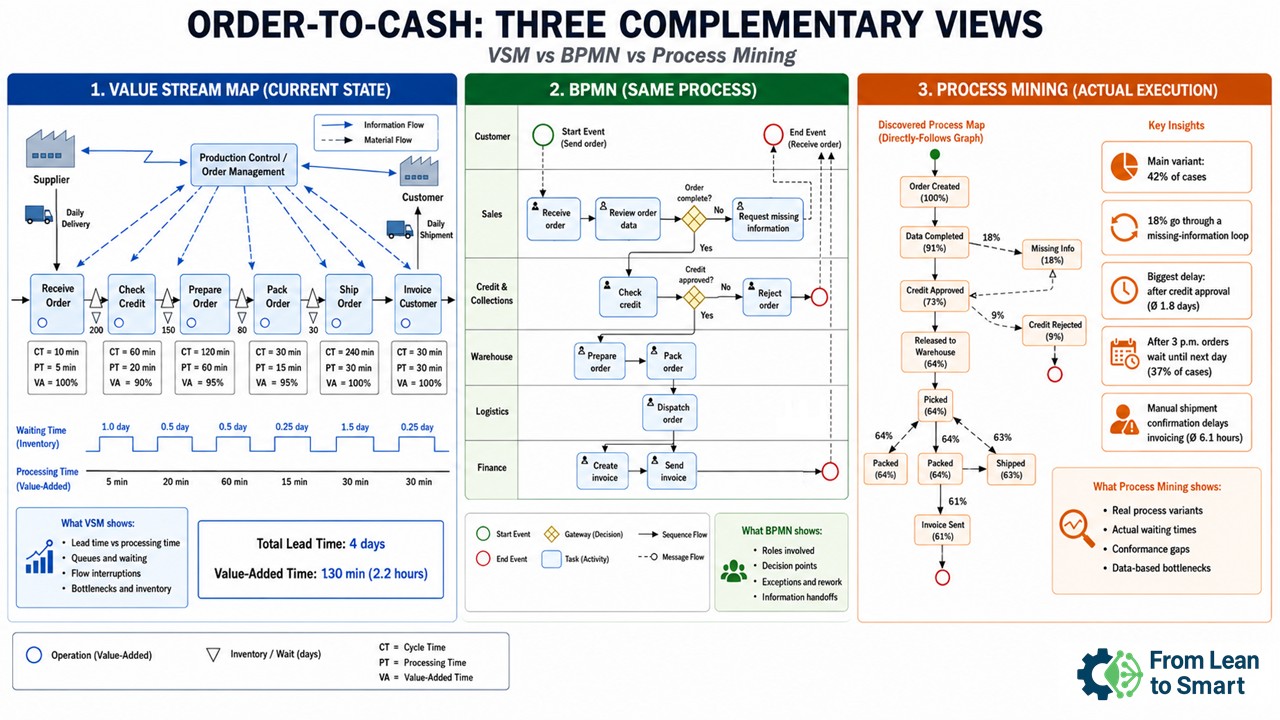
Step 1: Analysing the process with VSM
The first step is to map the current state with VSM.
We represent the main process steps:
- Order reception
- Credit verification
- Order preparation
- Packing
- Shipping
- Invoicing
Then we add data: cycle time, effective processing time, waiting time, inventory or queue size, quality at first pass and information flows between customer, sales, planning, warehouse and finance.
What do we discover?
The VSM may show that the total lead time is four days, while the real value-added processing time is only two hours. This immediately changes the conversation.
The problem is not that every department is inefficient. The problem is that the order spends most of its life waiting.
Waiting before credit approval.
Waiting before warehouse release.
Waiting before shipment confirmation.
Waiting before invoicing.
The VSM also reveals whether the flow is pushed or pulled, whether information arrives late, whether planning is disconnected from execution and whether orders accumulate before specific process steps.
What VSM gives us in this case
VSM gives us a systemic diagnosis.
It shows the gap between customer lead time and real processing time. It identifies where flow is interrupted. It helps the organisation stop blaming isolated departments and start seeing the process as an end-to-end value stream.
The main contribution of VSM is this: it tells us where the system loses time and value.
But it does not fully explain the internal logic behind those losses.
That is why we now use BPMN.
Step 2: Analysing the same process with BPMN
Now we model the same order-to-cash process using BPMN.
This time, we create lanes for each participant:
- Customer
- Sales
- Credit and Collections
- Warehouse
- Logistics
- Finance
The process starts when the customer sends the order. Sales receives it and checks whether the information is complete. If the order is incomplete, Sales must request missing information from the customer. If the order is complete, Credit verifies the customer status. If credit is rejected, the order is blocked or cancelled. If credit is approved, Warehouse prepares and packs the order. Logistics ships it. Finance generates and sends the invoice.
This view gives us something VSM does not show with the same precision: the decision logic.
We can now see the gateways, exceptions and handoffs. We can identify where the process branches. We can see whether Finance receives the necessary information automatically or manually. We can see whether Logistics confirms shipment before invoicing starts. We can see whether Sales is reworking orders because customer master data is incomplete.
What BPMN gives us extra
BPMN reveals the mechanics of the process.
It shows who acts, who waits, who decides and who receives information from whom. It exposes hidden complexity: approvals, rework loops, exception paths, missing data, manual handoffs and unclear responsibilities.
In our example, BPMN may reveal that many delays are caused by incomplete orders returning to Sales, credit checks being performed too late, or shipment confirmations not being sent automatically to Finance.
The main contribution of BPMN is this: it tells us how the process is structured and where its operational logic creates friction.
But even BPMN has a weakness: it may still represent the process as people think it works.
So now we go one step further.
Step 3: Analysing the process with Process Mining
For Process Mining, we extract event logs from the systems involved: CRM, ERP, warehouse management system, transport system and invoicing platform.
For each order, we collect events such as:
- Order created
- Order completed
- Credit check started
- Credit approved
- Order released to warehouse
- Picking started
- Picking completed
- Shipment created
- Goods dispatched
- Invoice created
- Invoice sent
Now the process is no longer a workshop hypothesis. It is reconstructed from data.
The Process Mining analysis may reveal something like this:
The standard process represents only 42% of cases.
18% of orders go through at least one missing-information loop.
New customers wait much longer for credit approval than existing customers.
Orders received after 3 p.m. usually wait until the next day before warehouse release.
Packing is not the main bottleneck, although people assumed it was.
The biggest delay is between credit approval and warehouse release.
Some urgent orders bypass the standard approval path.
Invoices are delayed when the shipment confirmation is entered manually instead of automatically.
These findings are very difficult to obtain with VSM or BPMN alone.
What Process Mining gives us extra
Process Mining gives us reality at scale.
It tells us not only what can happen, but what actually happens, how often it happens, how long it takes and where deviations occur.
It can validate or challenge the VSM. It can confirm or correct the BPMN model. It can reveal variants that nobody mentioned in the workshop because they were considered “exceptions”, even if they happen every day.
The main contribution of Process Mining is this: it tells us what the process really does in practice, based on evidence.
What happens when we combine the three?
Used separately, each tool is valuable.
Used together, they become much more powerful.
VSM gives the strategic Lean view of the value stream. BPMN gives the operational view of the process logic. Process Mining gives the empirical view of actual execution.
The three tools answer different but complementary questions:
| Tool | Main question | Best at | Main risk |
|---|---|---|---|
| VSM | Where is value created or lost in the end-to-end flow? | Lead time, waiting, waste, flow, current/future state | Oversimplifying exceptions and variability |
| BPMN | How does the process work across roles, decisions and handoffs? | Responsibilities, gateways, exceptions, message flows, automation design | Modelling the official process instead of the real one |
| Process Mining | What actually happens according to system data? | Variants, bottlenecks, conformance, frequency, real waiting times | Poor conclusions if event data quality is weak |
In the order-to-cash example, VSM helps us see that the customer waits four days for only two hours of real work. BPMN helps us understand that delays are linked to incomplete orders, credit decisions, manual handoffs and unclear responsibilities. Process Mining helps us quantify which variants dominate, where time is really lost and whether the official process is being followed.
That is the real power: not choosing one tool against another, but knowing what each one is designed to reveal.
A practical improvement sequence
A sensible improvement approach could look like this:
First, use VSM to build a shared end-to-end diagnosis. This creates alignment around the value stream and helps the organisation understand where time and value are lost.
Second, use BPMN to model the process logic in more detail. This clarifies roles, decisions, exceptions, handoffs and possible automation points.
Third, use Process Mining to validate the model against reality. This shows actual variants, bottlenecks, deviations and performance patterns.
Fourth, redesign the future state. The future-state VSM defines the target flow. The to-be BPMN defines the new operating logic. Process Mining then becomes a monitoring mechanism to check whether the redesigned process is actually working.
This is where continuous improvement becomes much more mature.
Not just a workshop.
Not just a diagram.
Not just a dashboard.
A real connection between process understanding, process design and process evidence.
Final reflection
VSM, BPMN and Process Mining are not interchangeable.
VSM comes from Lean thinking and teaches us to see the flow of value.
BPMN comes from the world of process modelling and helps us describe how work is coordinated across people, systems and decisions.
Process Mining comes from the intersection of data and process analysis and allows us to discover how the process really behaves in execution.
The mistake is to ask one tool to do everything.
The opportunity is to combine them intelligently.
If we only use VSM, we may understand the flow but miss the operational complexity.
If we only use BPMN, we may understand the logic but miss the real performance.
If we only use Process Mining, we may see the data but miss the Lean interpretation of value and waste.
Together, they help us move from opinion to evidence, from local optimisation to systemic improvement, and from process documentation to real operational transformation.
Because the objective is not to draw better diagrams.
The objective is to understand the system well enough to improve it without making it worse.