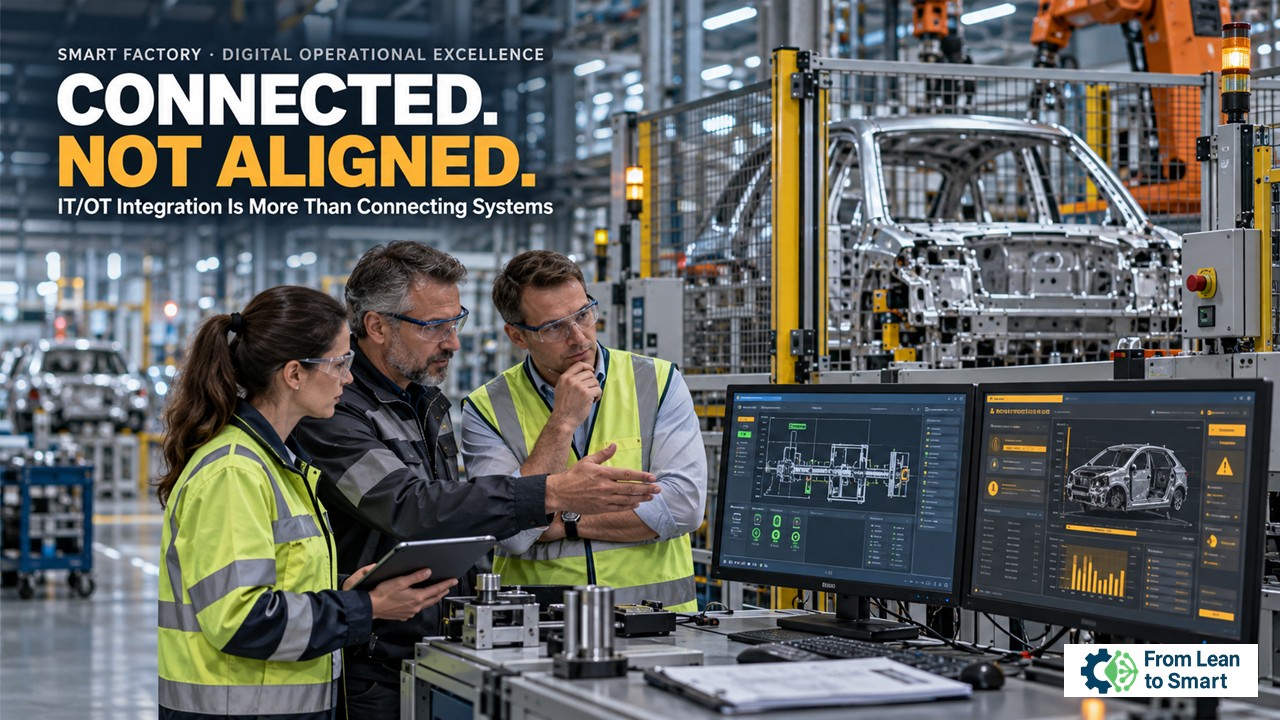
A factory can have ERP connected to MES, MES connected to SCADA, SCADA connected to PLCs, and maintenance information flowing into analytical platforms.
Every interface may be functioning correctly.
Every dashboard may be receiving data.
Yet when something unexpected happens on the shopfloor, the organization may still struggle to answer a fundamental question:
What does this event mean for the operation, and who is responsible for deciding what happens next?
This is one of the persistent challenges of industrial digitalization.
Connectivity is frequently presented as evidence of integration. But connecting systems does not necessarily align processes, responsibilities, information, or decisions.
A technically successful IT/OT implementation can coexist with fragmented operational management.
In some cases, greater connectivity simply makes existing inconsistencies more visible without providing the mechanisms required to resolve them.
The real challenge of IT/OT integration is not only enabling communication between systems. It is ensuring that information crossing technical boundaries supports coherent, accountable operational decisions.
When Connected Systems Tell Different Stories
Consider an automated assembly station in an automotive manufacturing plant.
During production, the station detects an abnormal condition and stops the affected operation.
The equipment controller identifies the fault.
SCADA captures the event.
MES records the production interruption and associates it with the active manufacturing order.
Maintenance investigates the equipment, corrects the identified technical problem, and documents the intervention in the CMMS.
After the required checks, the equipment is technically ready to operate again.
From an integration perspective, the sequence appears successful.
The event was detected, transmitted, recorded, and made visible to the relevant systems.
However, the operational situation may remain unresolved.
Quality may need to determine whether products manufactured before the interruption require additional verification.
Maintenance may have restored the equipment while establishing temporary operating restrictions.
Production may need to reassess resource availability and decide how to recover the manufacturing sequence.
The ERP production plan may still reflect the original assumptions rather than the constraints identified during the interruption.
Each system contains a different part of the operational context.
The PLC determines whether its configured technical conditions permit equipment operation.
MES provides execution context and production history.
CMMS records maintenance interventions and restrictions.
The quality system supports product conformity assessment and disposition.
ERP maintains the broader planning requirements.
These perspectives are complementary, but they are not interchangeable.
Equipment readiness does not automatically establish production authorization, and neither necessarily establishes product conformity or release.
The return-to-production decision depends on the applicable operational rules, the status of required verifications, and the authority assigned to the relevant functions.
This is where IT/OT integration becomes more than a technical interface problem.
Connectivity, Interoperability, and Operational Integration
Three concepts deserve to be distinguished.
Connectivity establishes the technical ability of systems to exchange information.
Interoperability enables systems to exchange and interpret information through agreed interfaces, structures, and semantics.
Operational integration ensures that the exchanged information contributes to coordinated processes, appropriate decisions, and controlled execution.
These capabilities are related, but achieving one does not guarantee the others.
A machine can publish thousands of signals without the organization knowing which conditions require action.
MES can receive production quantities without having access to the information needed to distinguish produced units from accepted units.
An analytical platform can identify recurring equipment interruptions without knowing whether maintenance has an authorized opportunity to intervene.
A CMMS can show that a corrective work order has been completed while production continues operating under an unresolved restriction.
These situations do not necessarily indicate communication failures.
They may reflect missing operational definitions, incomplete information relationships, or unclear responsibilities.
A useful IT/OT program should therefore begin with the situations in which better coordination is required.
Where does operational information become fragmented?
Which decisions are delayed because essential context is unavailable?
Where do production, maintenance, and quality interpret the same event differently?
Which handovers depend on informal communication?
Which recurring losses remain unresolved despite the availability of increasingly detailed data?
These questions connect IT/OT integration with Business Process Management (BPM), maintenance, production management, Lean Manufacturing, and Operational Excellence.
They help establish why integration is necessary before determining how it should be implemented.
The Problem of Meaning: When the Same Data Represents Different Realities
One of the most underestimated IT/OT challenges is semantic consistency.
Industrial systems serve different purposes and therefore represent operational reality from different perspectives.
A PLC implements equipment-control logic.
SCADA supports supervision and visibility.
MES/MOM coordinates manufacturing execution and associated operational activities.
ERP supports enterprise planning and business transactions.
CMMS/EAM manages maintenance processes and asset information.
These systems do not necessarily use the same definitions of operational states.
Consider equipment availability.
An automation system may report that a machine is ready because its technical permissives are satisfied.
Production may consider the equipment unavailable because the required material or qualified personnel is missing.
Maintenance may have imposed a temporary operating restriction.
Quality may prohibit production until a defined verification has been completed.
These conditions can coexist without any system being technically incorrect.
The problem appears when the integration architecture treats them as equivalent.
If a machine-ready signal is interpreted as general production availability, dispatching or execution decisions may rely on incomplete information.
The consequences become more serious when automated workflows use these indicators to authorize downstream actions.
A technically ready machine is not necessarily an authorized manufacturing resource.
The architecture must distinguish technical equipment states from operational readiness, applicable restrictions, execution authorization, and product disposition.
This does not require every system to maintain identical information.
It requires the relevant information models to define what each state means, how it relates to other states, and which operational decisions it may support.
The difference between machine ready, production authorized, and product released is not a minor terminology issue.
It reflects different controls, risks, and decision authorities.
Master Data and Operational Context: The Invisible Architecture
IT/OT integration depends on information that often receives less attention than physical connectivity.
Asset hierarchies.
Equipment identifiers.
Production-order references.
Product and recipe revisions.
Material definitions.
Process parameters.
Failure classifications.
Production calendars.
Maintenance restrictions.
Quality states.
These elements provide the context required to interpret industrial events.
Consider an equipment controller reporting an abnormal condition through a local machine identifier.
The event reaches the analytical platform successfully.
However, the CMMS uses a different asset hierarchy.
MES associates production losses with a workstation rather than the specific physical component.
Maintenance records the intervention against another equipment reference.
The same physical event now appears in several systems without a reliable relationship between its records.
The organization may struggle to associate the event with the affected production order, relevant maintenance history, or potential quality consequences.
Adding interfaces does not necessarily resolve the problem.
The information relationships must be governed.
ISA-95 provides useful conceptual models for manufacturing activities and information exchange. However, applying a standard does not eliminate the need to define plant-specific entities, identifiers, authoritative sources, and ownership responsibilities.
The organization must determine what each identifier represents, how relationships are maintained, who authorizes changes, and how inconsistencies are resolved.
For example, associating a maintenance intervention with a manufacturing event may require reliable equipment identification, event timestamps, production context, and sufficiently precise failure classifications.
If these foundations are incomplete, the resulting analysis may be misleading even when all interfaces function correctly.
Without reliable operational context, connectivity can become an efficient mechanism for distributing ambiguity.
This is particularly relevant to process mining, predictive analytics, digital twins, and Industrial AI.
Their effectiveness depends not only on data availability but also on the integrity of the operational meaning associated with that data.
The Missing Connection: Decision Ownership
A connected factory should not merely record what happened.
It should support the decisions required to respond appropriately.
Return to the automated assembly station.
After maintenance restores the equipment, several questions remain.
Who confirms that the equipment is technically ready?
Who determines whether the maintenance restriction can be removed?
Who evaluates the potentially affected products?
Who authorizes the required quality disposition?
Who decides whether production can resume?
Who adjusts the production plan if the original sequence is no longer feasible?
These decisions may belong to different functions and require distinct approvals.
Technical connectivity does not establish those responsibilities.
They must be defined within the operating model.
BPM can contribute by clarifying responsibilities, process handovers, exception paths, escalation criteria, and decision rights.
MES/MOM can support the execution and traceability of relevant operational decisions.
Maintenance and quality systems provide specialized evidence, records, and controls.
However, the applications must implement agreed responsibilities rather than independently establish competing rules.
Not every equipment abnormality requires a complete cross-functional approval process.
Responses should remain proportionate to the operational context and associated risk.
An equipment fault with no potential impact on product conformity may require a different response from an event affecting process parameters, traceability, or safety-related conditions.
The architectural requirement is to make those distinctions explicit.
Integration becomes operationally meaningful when information crosses system boundaries without accountability disappearing between departments.
IT/OT Integration Must Respect Industrial Control Requirements
Not all industrial systems operate under the same technical constraints.
Enterprise applications typically emphasize business transactions, planning, reporting, and information management.
Operational technology may require predictable response times, local availability, deterministic behavior, and direct interaction with physical equipment.
Safety-related functions must remain within their appropriately engineered and validated control arrangements.
These distinctions cannot be ignored simply to create a more centralized architecture.
A reporting dashboard does not require direct control authority over equipment.
An enterprise application should not become an unnecessary dependency for a critical machine-control function.
Cloud platforms should not be assumed to provide the response characteristics required by every industrial process.
The architecture must allocate functions according to their operational requirements and risk characteristics.
Some decisions must remain local and immediate.
Others can be coordinated through MES/MOM.
Enterprise systems may manage broader planning, business constraints, and optimization requirements.
The objective is not to centralize every decision.
It is to ensure that responsibilities are allocated appropriately and remain consistent across the industrial operating environment.
This principle also applies when systems become unavailable.
Networks fail.
Messages arrive late or out of sequence.
Applications may be temporarily inaccessible.
Different systems may operate with different synchronization cycles.
A production event generated at equipment level may reach another application after subsequent events have already occurred.
Without appropriate event identification, timestamps, sequencing, and reconciliation rules, the reconstructed operational history may become unreliable.
A resilient architecture must therefore address explicit operating conditions.
Which functions can continue locally?
What information must be retained during communication interruptions?
Which operations may proceed under an approved degraded operating mode?
How will missing or delayed transactions be reconciled?
Which conditions require production to stop rather than continue with incomplete information?
These are not merely technical recovery questions.
They determine whether operational control can be preserved when the integration infrastructure is degraded.
Cybersecurity and Change Management Are Part of Operational Integration
Connecting IT and OT introduces dependencies that must be understood and governed.
Interfaces expand communication paths.
Remote access requires controlled authentication and authorization.
Software updates may affect operating conditions that have already been validated.
Changes in master data, integration logic, or system configurations can influence production behavior even when the physical equipment remains unchanged.
Cybersecurity, network segmentation, access management, change control, and recovery procedures must therefore be treated as architectural requirements rather than activities added after deployment.
Established industrial cybersecurity frameworks, such as the IEC 62443 series, provide relevant principles for managing security across industrial automation and control environments.
However, applying security controls requires consideration of operational consequences.
A poorly coordinated update may interrupt production.
An incorrectly configured access restriction may prevent authorized maintenance intervention.
An uncontrolled remote connection may create unacceptable exposure.
An effective governance model must balance security, operational continuity, and maintainability.
IT contributes expertise in platforms, information management, integration, and cybersecurity.
OT contributes knowledge of equipment behavior, automation, physical processes, and control requirements.
Production, quality, and maintenance define the operational implications of the information and decisions involved.
IT/OT convergence does not require IT and OT to become identical disciplines. It requires their different responsibilities to operate within a coherent and governed industrial architecture.
The Danger of Integrating a Process Nobody Has Clarified
A common mistake in industrial digitalization is assuming that existing operational practices are sufficiently defined simply because they have been followed for years.
A factory may depend on informal communication to coordinate maintenance interventions.
Equipment-status definitions may differ between departments.
Downtime classifications may be inconsistent.
Production scheduling may require repeated manual adjustments.
Quality decisions may be formally recorded in one application while their operational consequences are communicated through emails, telephone calls, or local spreadsheets.
When such practices are digitalized without examination, their weaknesses may become embedded in interfaces and application logic.
The resulting system can reproduce the same ambiguity at greater speed.
It may also become more difficult to modify because informal practices have been converted into technical dependencies.
This is where Lean thinking and process discipline should influence integration design.
Before automating an information exchange, the organization should understand the process that exchange supports.
What event triggers the process?
What operational outcome is required?
What information is needed?
Who has the authority to decide?
What happens when the expected conditions are not satisfied?
How is the resulting action recorded and verified?
This does not mean that every operational process must be perfected before digitalization begins.
That would be neither realistic nor necessary.
It means that integration design should expose unresolved operational assumptions instead of silently incorporating them into software.
Automating an unclear handover does not establish accountability. It may simply make an unclear handover occur faster.
Measuring Integration by Operational Outcomes
IT/OT integration programs are frequently evaluated through technical delivery indicators.
Number of connected assets.
Number of deployed interfaces.
Volume of collected data.
Availability of dashboards.
Integration-service performance.
These indicators are useful for measuring technical implementation and service reliability.
They do not, however, demonstrate that manufacturing operations have improved.
A stronger evaluation examines the operational consequences of integration.
Can equipment abnormalities be identified and escalated with sufficient production context?
Can maintenance and production coordinate interventions using consistent information about asset condition and operational constraints?
Are quality restrictions reliably reflected in manufacturing execution?
Can the organization reconstruct relevant production incidents more accurately?
Are operational records sufficiently consistent to support investigation and decision-making?
Has the time required to resolve cross-functional information discrepancies decreased?
Can the organization demonstrate that improved information has contributed to better decisions without weakening safety, quality, or governance?
Not every improvement can be attributed directly to a particular interface.
Verification should therefore distinguish system performance from changes in operational processes and outcomes.
This is especially important when multiple technical and organizational improvements are implemented simultaneously.
A relatively small integration may provide significant operational value when it closes a critical information gap or makes an important decision more reliable.
Conversely, a sophisticated connectivity platform may offer limited benefit if departments continue operating through disconnected decision routines.
The appropriate measure of value depends on the operational problem the integration was intended to address.
From Connected Assets to Connected Operations
Industrial digitalization increasingly incorporates advanced analytics, digital twins, predictive models, and Industrial AI.
These technologies can strengthen the ability to detect abnormalities, interpret patterns, and support decisions.
However, their usefulness depends on the reliability of the underlying information and the maturity of the operational processes through which their findings are acted upon.
An AI model may identify evidence of developing equipment deterioration.
An effective response still requires knowledge of asset criticality, production constraints, maintenance capacity, available spare parts, and intervention authority.
A digital twin may simulate process behavior.
Its conclusions depend on the adequacy of its model and the validity of the operating conditions and data used.
An analytical platform may identify a recurring production loss.
The organization still needs an accountable mechanism for investigating its causes and implementing appropriate improvements.
The common requirement is operational coordination.
Connected assets provide information.
Connected operations require that information to retain its meaning, reach the appropriate decision-makers, and support controlled action.
This does not necessarily require a single centralized platform.
It requires a coherent combination of information architecture, functional responsibilities, technical integration, and governance.
The next level of IT/OT maturity is not simply greater data availability. It is greater consistency between operational events, contextual information, decisions, and execution.
The Real Meaning of IT/OT Convergence
IT/OT integration is an important enabler of Smart Factory capabilities.
But connectivity alone is not an industrial transformation strategy.
A genuinely integrated manufacturing environment requires consistent operational definitions, clear system boundaries, trustworthy data, explicit decision authority, resilient technical mechanisms, and disciplined cross-functional coordination.
It also requires the willingness to question existing operating practices before reproducing them digitally.
The most consequential integration may not be the interface between two applications.
It may be the connection between an equipment event, its production and quality implications, the responsible functions, and the authorized decision that follows.
The architecture must support that connection under normal operating conditions and preserve essential controls when conditions become abnormal.
The real measure of IT/OT integration is not how successfully systems exchange data, but how reliably that exchange supports the decisions and actions required to operate the factory.
That is the distinction between a technically connected factory and an operationally integrated one.
And it is where connectivity begins to contribute to sustainable industrial performance.
Questions for Further Reflection
- Are we measuring IT/OT integration through technical connectivity, or through evidence that operational decisions have become more reliable and better coordinated?
- How many of our integration problems originate in unclear responsibilities, inconsistent operational definitions, or inadequate information governance rather than interface technology?
- When an abnormal production event occurs, can our connected systems preserve operational context, support the appropriate decision authorities, and coordinate a controlled response without requiring teams to reconstruct the situation manually?
#ITOTConvergence #SmartFactory #MES #MOM #OperationalExcellence #ManufacturingExcellence #IndustrialAutomation #BPM #IndustrialAI #DigitalTransformation