The future of BPM is not less structure. It is structure that can move.
Traditional BPM was built on an important idea:
Organizations perform better when work is understood, standardized, governed and improved.
That idea is still valid.
Factories need standards.
Operations need discipline.
People need clarity.
Systems need structure.
Leaders need visibility.
Without process thinking, industrial organizations become dependent on informal knowledge, personal routines, heroic intervention and local improvisation.
That is not operational excellence.
But there is a problem.
Many traditional BPM approaches still assume that processes are relatively stable, repeatable and predictable. They are modeled as flows. They are documented as sequences. They are governed through ownership structures. They are automated through predefined rules.
This works well when the process behaves as expected.
But modern operations increasingly do not.
The issue is not that BPM is obsolete.
The issue is that too much BPM is still designed for a level of stability that operations no longer have.
Industrial environments have always been complex. But today the pressure is different.
Product mix changes faster. Supply chains are less predictable. Customer requirements are more volatile. Maintenance strategies are more data-driven but also more dependent on system integration. Quality decisions involve more traceability, regulation and risk evaluation. Production planning must react to material shortages, capacity constraints, engineering changes and urgent priorities.
The factory is no longer just executing a plan.
It is constantly adjusting.
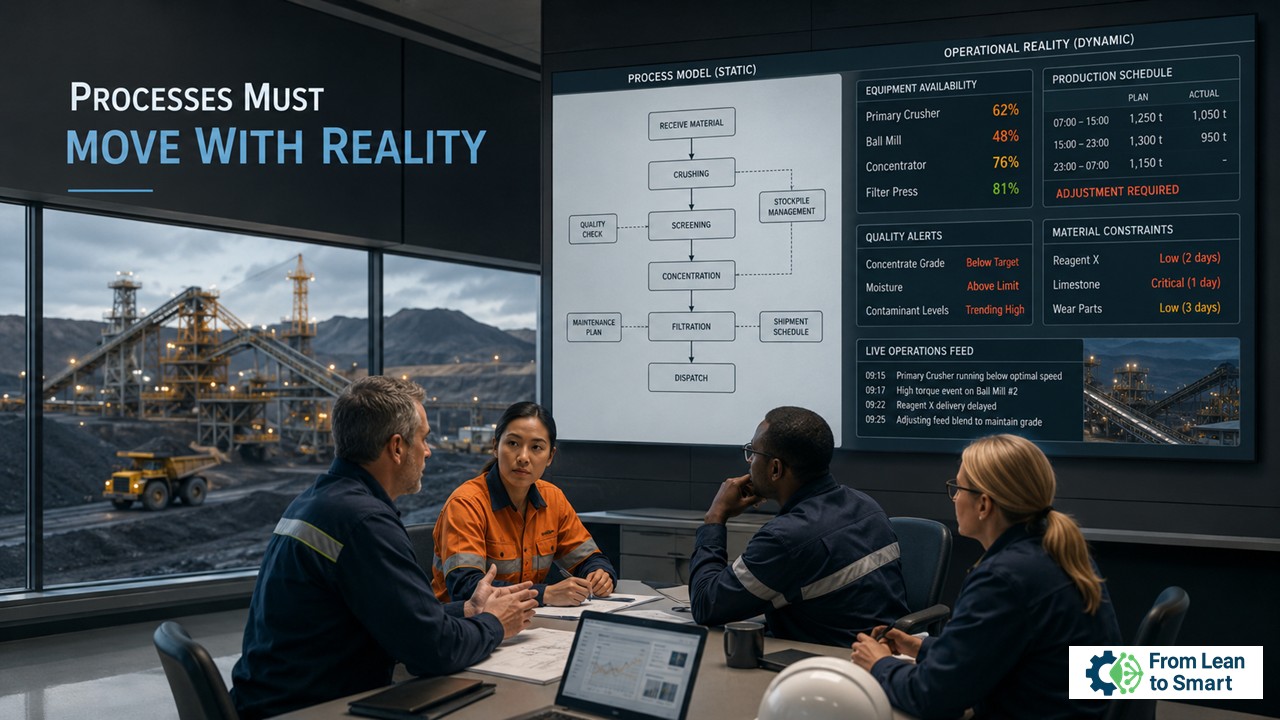
And that adjustment does not fit neatly into static process diagrams.
When the workflow stops behaving like a workflow
A traditional BPM view might describe the production planning process as a structured flow:
Demand review. Capacity check. Material availability. Scheduling. Release. Execution. Monitoring. Adjustment.
That is useful.
But anyone who has worked close to operations knows that the real process is much more dynamic.
A supplier delay changes the sequence.
A quality hold blocks a batch.
A critical machine becomes unavailable.
A customer order is reprioritized.
A maintenance intervention is postponed.
A planner needs to split, merge, freeze or rebuild the schedule.
A supervisor must decide whether to protect efficiency, delivery, changeover time or recovery.
The process does not disappear.
But it stops behaving like a clean workflow.
It becomes a living negotiation between constraints.
That is where traditional BPM becomes too static.
It describes the intended path, but often fails to support the adaptive work required when the intended path is no longer enough.
This is not a small weakness.
It is a structural limitation.
In many organizations, process models are updated after reality changes. They are reviewed periodically. They are governed through change requests. They represent an agreed version of how work should be done.
But operations move faster than that.
The shopfloor does not wait for the next process governance cycle.
Maintenance does not wait for a revised workflow when a critical asset fails.
Quality does not wait for a perfect decision tree when a customer risk is emerging.
Planning does not wait for the process owner when material availability changes at 6:00 a.m.
People act.
They must.
And this is where the real operating model often moves outside the official BPM layer.
It lives in daily meetings, escalation calls, shift handovers, planner experience, maintenance judgment, quality risk discussions and informal coordination between functions.
That should make us reflect.
If the most critical decisions happen outside the process model, then the process model is not governing the real process.
It is only describing part of it.
The next level is adaptive process governance
Traditional BPM often focuses on standardization.
That is necessary.
But it is no longer sufficient.
The more volatile the environment becomes, the more organizations need to manage not only the standard flow, but also the controlled deviation from that flow.
This is where static BPM struggles.
It can tell people what should happen.
It is weaker at helping them decide what should happen next when conditions change.
In industrial operations, that difference matters.
A maintenance process can define how to create, plan, execute and close a work order.
But what happens when the technician finds a secondary failure that was not included in the original scope?
What happens when production refuses the downtime window?
What happens when the spare part is available, but the quality risk of continuing operation is unclear?
A quality process can define how to manage nonconformities.
But what happens when production needs to continue while the analysis is incomplete?
Who decides the containment level?
Who accepts the risk?
How is the decision documented?
How does the organization learn from the case?
A production process can define how to execute orders.
But what happens when the optimal sequence from a planning perspective conflicts with cleaning requirements, customer priority, maintenance availability and operator skill coverage?
These are not rare exceptions.
They are daily operational reality.
And this is why the future of BPM cannot be only about better process maps.
It must be about better operational decision structures.
The process is no longer just a flow of activities.
It is a combination of:
Activities.
Rules.
Roles.
Context.
Exceptions.
Decisions.
Evidence.
Accountability.
That is a much richer object than a traditional workflow.
Not every operational process is a workflow
A workflow assumes that the next step can be determined in advance.
Many times, it can.
Purchase approvals, basic master data changes, standard maintenance requests, routine inspections and repetitive administrative tasks can often be structured effectively.
But not every operational situation behaves like that.
Some situations are not simple workflows.
They are cases.
They evolve.
They require diagnosis.
They involve uncertainty.
They depend on context.
They need human judgment.
They cross functional boundaries.
They may require several possible paths before closure.
This is especially visible in industrial environments.
A recurring equipment failure is not just a maintenance workflow.
It may become a technical case involving production, maintenance, engineering, spare parts, reliability, safety and quality.
A supplier quality issue is not just a nonconformity process.
It may become a risk case involving purchasing, logistics, incoming inspection, production planning, customer service and engineering.
A production instability issue is not just a performance loss.
It may become an operational case involving process parameters, operator routines, material variability, equipment condition and scheduling pressure.
Trying to force all of this into static workflows creates frustration.
The system becomes rigid where operations need guided flexibility.
But this does not mean “anything goes.”
Adaptive operations do not mean uncontrolled operations.
Flexibility without governance becomes chaos.
But governance without adaptability becomes bureaucracy.
The challenge is to combine both.
What BPM must become
The next generation of process thinking in industrial environments should not abandon standards.
It should separate what must be standardized from what must be guided.
Some steps must be mandatory.
Some decisions must be controlled.
Some information must be captured.
Some risks must be escalated.
Some paths must remain flexible.
Some cases must allow expert judgment within clear boundaries.
This is a more mature view of process management.
It recognizes that operational excellence is not achieved by pretending every situation can be predefined.
It is achieved by building the capability to respond consistently when situations are not predefined.
That is a different level of discipline.
A more adaptive BPM model should help organizations do four things:
1. Standardize what must be stable
Some activities need strict standardization.
Safety steps.
Quality gates.
Regulatory controls.
Critical approvals.
Master data rules.
Traceability requirements.
Maintenance execution standards.
These are not optional.
They create reliability, compliance and control.
2. Guide what must remain flexible
Some situations cannot be fully predefined.
They require judgment.
But judgment should not mean improvisation.
It should be guided by principles, risk criteria, escalation rules, decision rights and evidence requirements.
3. Govern the exceptions
Traditional BPM often treats exceptions as deviations from the process.
But in many industrial environments, exceptions are where the real process complexity lives.
If exceptions consume a large portion of management attention, they should not be treated as noise.
They should be designed for.
This does not mean documenting every possible scenario.
That is impossible and usually counterproductive.
It means defining who decides, when to escalate, what evidence is required, which options are acceptable and what must never be bypassed.
4. Learn from execution
Processes should not only be documented.
They should be observed.
This is where Process Mining, MES/MOM data, operational analytics and structured feedback loops can create value.
Not as decorative dashboards.
But as mechanisms to understand how work really happens, where decisions break down and where the operating model needs to evolve.
From static process control to adaptive process governance
A static BPM model asks:
What is the correct sequence?
An adaptive operational model also asks:
What is the current context?
What has changed?
What risk is involved?
Who needs to decide?
What evidence is required?
Which options are acceptable?
What must be learned after closure?
These questions are much closer to how real operations work.
They are also closer to where AI, Process Mining, MES/MOM and decision orchestration can become valuable.
But only if the foundation is clear.
AI cannot compensate for unclear accountability.
Process Mining cannot fix poor governance.
MES cannot resolve every operational trade-off.
Automation cannot save a process that does not understand exceptions.
Technology can support adaptive operations.
But the organization must first accept that not all processes are simple workflows.
This is an important shift.
For years, many companies pushed BPM toward standardization and automation.
That made sense.
There was waste to remove, inconsistency to reduce and manual work to eliminate.
But the next performance frontier is different.
It is not only about executing the standard path faster.
It is about managing variability better.
The real risk of static BPM
Factories that succeed in the coming years will not be the ones with the most beautiful process architecture.
They will be the ones that know which processes should be stable, which should be flexible and which require structured case management.
That distinction will become critical.
Because the more dynamic the operating environment becomes, the more dangerous it is to manage everything with static logic.
A static process can provide control.
But a static process can also hide reality.
It can make leaders believe the organization is governed because the workflow is documented.
It can make systems look compliant while people solve the real problems elsewhere.
That is not transformation.
That is separation between design and execution.
BPM still has a central role in industrial transformation.
But it must move closer to the operational moment.
It must stop acting only as a documentation and standardization discipline.
It must become a discipline for managing work, decisions, exceptions and accountability in motion.
The future is not process without structure.
The future is structure that can operate under uncertainty.
That is why traditional BPM is becoming too static.
Not because processes no longer matter.
But because real operations are asking for something more demanding than a fixed map.
They are asking for process thinking that can move.
The future of BPM is not less structure.
It is structure that can move.
Hashtags
#BPM #OperationalExcellence #AdaptiveOperations #ProcessMining #SmartFactory #ManufacturingOperations #IndustrialTransformation