In Operational Excellence, we are very good at looking at the visible mechanics of the system.
We map processes.
We calculate cycle time.
We analyse material flow.
We define standard work.
We measure process capability.
We monitor OEE, quality, productivity and delivery performance.
All of that matters.
A process map, a Value Stream Map, a standard operating procedure or a dashboard can reveal many important things about how work is supposed to happen.
But there is one reality we often forget:
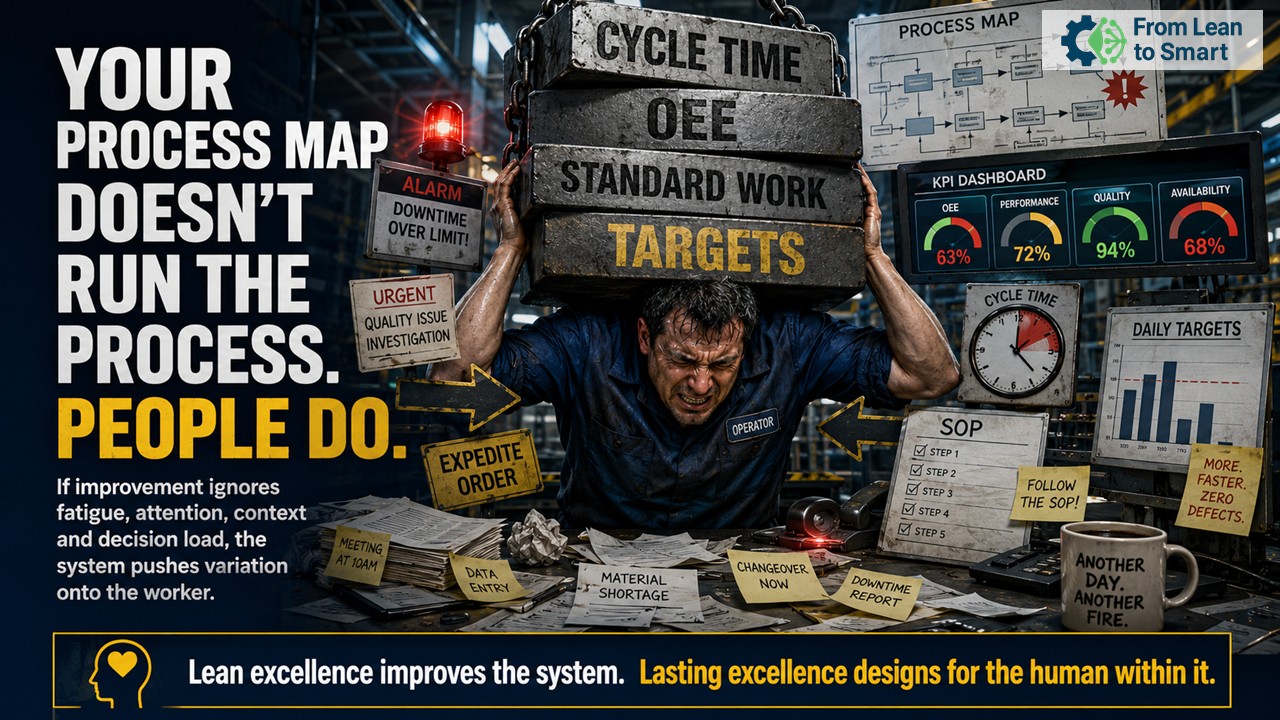
The process is not executed by the map. It is executed by a person.
And that person does not work inside a clean diagram.
They work in a real environment, with interruptions, fatigue, unclear signals, time pressure, awkward movements, changing priorities, incomplete information and decisions that often need to be made in seconds.
That is where many improvement initiatives start to break.
When the process looks right, but does not hold
I have seen many processes that looked technically correct on paper but failed to remain stable in daily operation.
The standard existed.
The work instruction was documented.
The KPI was defined.
The visual board was in place.
The process flow was clear.
But in reality, people were still using shortcuts, workarounds and personal adaptations to make the process work.
The usual reaction is to think that the problem is discipline.
“People are not following the standard.”
“We need more training.”
“We need more audits.”
“We need to reinforce compliance.”
Sometimes that is true.
But often, it is not enough.
When people constantly need to compensate for weak signals, missing information, poor ergonomics, unstable inputs or conflicting priorities, the problem is not only behaviour.
It is system design.
If the signal is unclear, people interpret.
If the material arrives late, people improvise.
If the standard does not fit reality, people adapt.
If there are too many interruptions, people prioritize under pressure.
If the process requires permanent attention, sooner or later mistakes will appear.
Then we blame the operator for variation that the system itself has pushed onto them.
Human Factors are part of the system
In Lean and Operational Excellence, we often talk about flow, stability, standards and waste reduction.
But we should also talk more seriously about Human Factors.
Not as a soft topic.
Not as an HR topic.
Not as something separate from process improvement.
Human Factors are part of operational performance.
Attention matters.
Fatigue matters.
Ergonomics matters.
Cognitive load matters.
Interruptions matter.
Stress matters.
Context matters.
The quality of information matters.
A process can have a perfectly calculated cycle time and still be fragile if it requires people to maintain an unrealistic level of attention during the whole shift.
A process can have a logical flow and still fail if operators are forced to make too many micro-decisions under pressure.
A process can have visual instructions and still generate errors if those instructions are not available at the right moment, in the right place and in the right format.
Continuous improvement should not only ask:
How can we make the process more efficient?
It should also ask:
How can we make good performance easier to achieve?
Lean should not depend on heroes
One of the most powerful Lean principles is that problems are usually in the system, not in the people.
But this sentence is repeated more often than it is practiced.
If a process only works because an experienced operator knows how to compensate for its weaknesses, we do not have a robust process.
We have a system supported by heroes.
And heroes get tired.
Heroes make mistakes.
Heroes change shifts.
Heroes leave the organization.
Operational Excellence is not about designing processes that only work when the best person is present.
It is about designing systems where the right way of working is clear, practical, visible and sustainable.
That means working on several layers:
The standard must be clear, but also realistic.
The workplace must support the work, not make it harder.
The signals must make abnormalities visible before they become problems.
The process must prevent errors whenever possible.
Information must arrive with context.
Leaders must observe real work, not only review reports.
This is where Gemba Walks, visual management, standard work, poka-yoke, root cause analysis and ergonomic design stop being isolated tools and become part of a coherent improvement system.
Digital transformation does not remove the human reality
This point is especially important today, as we talk more and more about AI, automation, MES, dashboards, sensors and digital twins.
Technology can help a lot.
It can capture data, detect patterns, anticipate failures, visualize deviations and accelerate decision-making.
But technology does not eliminate the human reality of work.
In some cases, if it is poorly designed, it can even increase the burden.
More alerts do not always mean more control.
More dashboards do not always mean better decisions.
More data does not always mean more clarity.
More automation does not always mean less cognitive load.
If technology adds signals without prioritization, reports without context, or recommendations without ownership, the system does not become smarter.
It becomes noisier.
From my perspective, industrial digital transformation must connect three dimensions:
The technical process: how work flows, which resources are involved, which constraints exist and which outcomes are expected.
The human reality: how people perceive, decide, move, adapt and recover during daily work.
The decision system: how information becomes priorities, actions, learning and sustainable improvement.
When these three dimensions are disconnected, improvement remains fragile.
Designing for people is not lowering standards
Designing processes around people does not mean reducing ambition.
It means creating the conditions for high performance to be sustainable.
A good system does not ask people to pay attention to everything all the time.
It designs clear signals.
It does not ask people to remember every critical detail.
It designs visual standards.
It does not ask people to compensate for unstable inputs.
It designs robust flow.
It does not ask people to detect defects too late.
It designs prevention.
It does not ask people to fight the same fires every day.
It designs learning and root cause elimination.
The demand for performance does not disappear.
It moves from “try harder” to “design better”.
And that is a very different way of managing improvement.
Conclusion
A process does not improve just because we draw it better.
It improves when we understand how it is really executed.
It improves when we observe work at the Gemba.
It improves when we listen to the people who keep the process running every day.
It improves when we turn their difficulties into system redesign.
It improves when we use data, standards and technology to make better decisions easier.
Operational Excellence is not about asking people to compensate for weak processes.
It is about designing processes that respect how real people work.
Because, at the end of the day:
Your process map does not run the process. A person does.
And good process design does not ask people to be heroes.
It makes good performance easier to achieve.
#OperationalExcellence #LeanManufacturing #ContinuousImprovement #HumanFactors #ProcessImprovement #LeanThinking #Gemba #StandardWork #VisualManagement #SmartFactory #DigitalTransformation #IndustrialExcellence #Leadership #Manufacturing #ProcessDesign