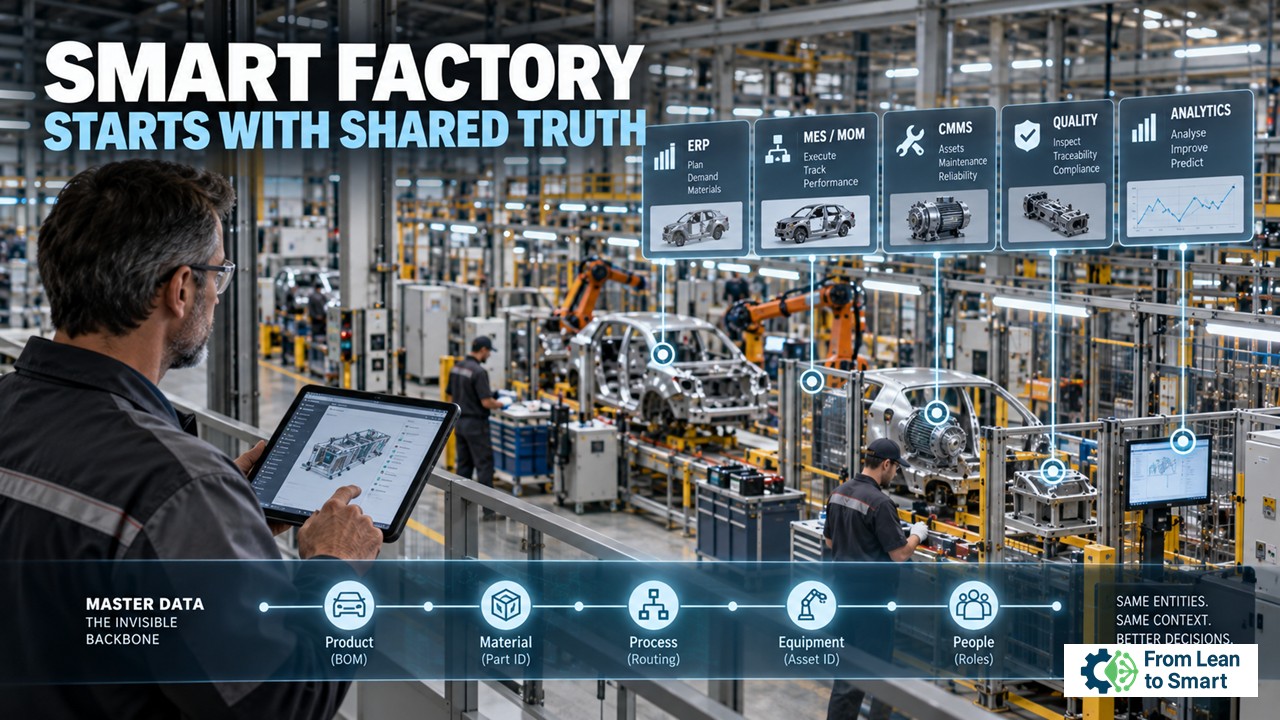
A factory can be highly connected and still have a weak digital foundation.
Machines generate signals.
MES captures execution.
ERP manages orders and materials.
CMMS/EAM stores asset records.
Quality systems maintain specifications and inspection results.
Historians retain process data.
Dashboards calculate KPIs.
Process Mining reconstructs flows.
AI models begin identifying patterns.
Everything appears ready for the Smart Factory.
Then someone asks a deceptively simple question:
“Are all these systems actually referring to the same machine, material, operation and production condition?”
That is where many digital architectures become uncomfortable.
The problem is rarely the absence of data.
The problem is whether the organisation maintains a stable, governed and operationally meaningful representation of the entities behind that data.
This is the domain of master data.
Master data is the governed representation of relatively stable operational objects and classifications: equipment, materials, products, operations, recipes, hierarchies, reason codes, process segments and other entities used repeatedly across industrial systems.
It is not glamorous.
It rarely appears in transformation videos.
It does not generate the same excitement as AI, analytics or digital twins.
Yet master data is one of the infrastructures on which Smart Factory capability depends.
If that foundation is weak, digitalisation can connect systems while simultaneously multiplying ambiguity.
Smart Factory Depends on Shared Operational Meaning
Consider a production line.
ERP may represent it as one work centre.
MES may model it as several production resources.
SCADA identifies controllers and stations.
CMMS/EAM manages motors, robots, gearboxes and other maintainable assets.
Quality may associate characteristics with products, processes or operations.
The historian stores thousands of signals according to automation naming conventions.
None of these representations is necessarily incorrect.
They exist for different operational purposes.
The problem begins when the organisation has not defined how those representations relate to one another.
Then apparently simple questions become difficult:
Which downtime event belongs to which maintainable asset?
Which equipment produced a specific serial number?
Which maintenance intervention influenced an OEE loss?
Which recipe was active when a quality deviation occurred?
Which material lot passed through the process?
Which operation does a PLC signal represent?
The underlying technical data may exist.
The operational context may not.
This distinction is fundamental.
Smart Factory is not simply about making more data available. It is about making data interpretable within the context of real operations.
Master Data Is Not an IT Housekeeping Exercise
One reason master data receives insufficient attention is that organisations often treat it as a technical administration problem.
Duplicate codes.
Naming conventions.
Database maintenance.
Interface mappings.
Data cleansing.
These activities matter, but they address only part of the issue.
Manufacturing master data represents decisions about how the factory itself is understood.
What is the equipment hierarchy?
What qualifies as a production resource?
Where does one process segment end and another begin?
Which material identifier is authoritative?
What is the approved routing?
What constitutes a valid downtime reason?
Which recipe revision is active?
What is defined as a changeover?
Which assets are considered critical?
How are product families defined?
These are not purely technical questions.
Production, maintenance, quality, engineering, logistics and IT often view the same factory through different functional models.
Master-data governance therefore requires operational ownership of meaning, not merely system administration.
If nobody owns the definition, each system gradually develops its own interpretation.
Once several systems do this independently, reconciliation becomes part of daily operations.
The Hidden Cost of Digital Reconciliation
Imagine that a plant wants to analyse the relationship between recurring downtime and maintenance interventions.
At first, the use case appears straightforward.
MES contains downtime.
CMMS contains work orders.
The historian contains equipment signals.
Analytics combines the datasets.
Then the actual work begins.
MES records the station as:
Assembly_Line_2_Station_40
CMMS represents the maintainable asset as:
ST40_FASTENING_CELL
The historian uses namespaces inherited from the PLC architecture.
Some maintenance records reference the complete line.
Others reference individual components.
Downtime reason codes have changed over time.
Several assets were replaced without the equipment hierarchy being fully updated.
The analytics project becomes a mapping exercise.
Someone creates a spreadsheet.
A second mapping table follows.
A data engineer introduces transformation logic.
An experienced technician explains that two apparently unrelated identifiers refer to the same physical machine.
Eventually, the dashboard works.
But the organisation has not solved the underlying problem.
It has embedded master-data inconsistency inside the analytics layer.
This matters because every subsequent use case may require the same reconstruction.
OEE.
Predictive maintenance.
Process Mining.
Energy analytics.
Traceability.
Digital twins.
AI.
Each inherits the same ambiguity.
Bad Master Data Scales Faster Than Good Judgement
This is one of the paradoxes of industrial digitalisation.
Automation increases speed.
Integration increases reach.
Analytics increases visibility.
AI increases the ability to process large amounts of information.
But none of these capabilities automatically improves the meaning of the source data.
If a downtime reason code is applied incorrectly, automated reporting can distribute that interpretation faster.
If an equipment hierarchy is inconsistent, enterprise dashboards can aggregate losses against the wrong structure.
If routing information no longer represents the real process, Process Mining may faithfully reconstruct deviations from a process model that is itself obsolete.
If maintenance records refer inconsistently to assets, AI may retrieve technically similar but operationally irrelevant cases.
Digitalisation does not neutralise weak master data. It scales its consequences.
This is why governance should not be postponed until after a Smart Factory platform has been implemented.
By that point, ambiguity may already be embedded in interfaces, data models, reports, data lakes and operating routines.
The Shopfloor Must Remain the Reference Point
Master-data programmes become fragile when they attempt to repair the digital representation without validating the physical process.
A system may show twelve production operations.
The current line may contain eleven because two stations were merged.
ERP may still contain a legacy work centre.
MES may reflect the current execution structure.
Maintenance may have introduced a new asset hierarchy after a major rebuild.
Quality may still associate inspection points with the previous process definition.
Which representation is correct?
The answer cannot be determined from the databases alone.
It requires the gemba.
The digital model must be validated against physical and operational reality.
This becomes especially important during:
- equipment replacement;
- line balancing;
- capacity expansion;
- product launches;
- process relocation;
- automation upgrades;
- new inspection points;
- outsourcing or insourcing;
- routing changes;
- asset modifications.
Factories change continuously.
Master data that was correct at commissioning can become incorrect quietly.
For that reason, master-data quality is not a one-time cleansing problem.
It is a lifecycle-governance problem.
The Production Model Is Foundational
A mature Smart Factory requires a reliable representation of how production is structured.
Enterprise.
Site.
Area.
Line.
Cell.
Machine.
Operation.
Process segment.
Material.
Product.
Recipe.
Order.
Asset.
Shift.
Reason code.
Different organisations will model these concepts differently.
The objective is not to create the most sophisticated hierarchy possible.
The objective is to establish a production model that is:
operationally accurate, stable enough to govern and consistent enough to connect systems.
That model becomes a structural map of the factory.
Its real value lies not only in the objects themselves, but also in their relationships.
Which asset belongs to which production resource?
Which operation uses which equipment?
Which materials can be processed by which route?
Which quality characteristic belongs to which process step?
Which reason code contributes to which loss category?
Which equipment hierarchy should maintenance use for reliability analysis?
Once these relationships are governed, data from different systems can be interpreted within a common operating context.
A quality defect can be connected to the material and equipment involved.
A downtime event can be related to maintenance history.
A production order can be connected to actual equipment states.
Energy consumption can be allocated to meaningful production activity.
Process deviations can be interpreted within the correct production structure.
The data may already exist.
The production model gives it operational structure.
Reason Codes Are Master Data Too
Master-data discussions often focus on materials, assets and equipment while overlooking operational classifications.
Downtime reason codes are a good example.
Many factories accumulate hundreds of them.
Some overlap.
Some are ambiguous.
Some describe symptoms.
Others describe root causes.
Some mix production, logistics and maintenance responsibility.
Operators select the closest available category.
Supervisors subsequently recode events.
Different sites interpret similar codes differently.
Management then requests a global Pareto analysis.
The output can look numerically precise.
The semantics underneath it may be weak.
The same issue applies to:
- scrap classifications;
- defect codes;
- maintenance failure modes;
- work-order priorities;
- production states;
- changeover categories;
- hold reasons;
- deviation types.
These classifications shape how the organisation interprets losses and prioritises improvement.
If their definitions are unstable, analytics creates numerical confidence around inconsistent operational meaning.
Master-data governance must therefore ask more than:
“Does the code exist?”
It should ask:
“Can the organisation apply this classification consistently, and does it support a meaningful operational decision?”
Master Data Enables Context Integration
Modern Smart Factory architectures commonly combine:
ERP,
MES/MOM,
SCADA/HMI,
PLC,
historian,
CMMS/EAM,
QMS,
WMS,
analytics platforms,
edge infrastructure,
cloud services,
IIoT,
and increasingly AI capabilities.
Each performs a different function.
The value emerges when information can move across these boundaries without losing meaning.
A MES downtime event becomes more valuable when maintenance can associate it with the correct maintainable asset.
A CMMS work order becomes more valuable when its equipment context can be related to production performance.
A quality deviation becomes more useful when genealogy connects it to the correct material, recipe, operation, equipment and process conditions.
This is more than technical integration.
It is context integration.
And context integration depends heavily on governed master data and relationships.
Process Mining Is an Excellent Stress Test
Process Mining illustrates this particularly well.
Organisations sometimes assume that if event logs exist, the real process can simply be discovered from them.
But event logs depend on semantic discipline.
What identifies the case?
What defines the activity?
Which timestamp represents the event?
Which system is authoritative?
Are activities named consistently?
Do structural process changes appear in the data?
Can production orders, maintenance events and quality cases be related reliably?
Weak master data can produce Process Mining results that are technically correct but operationally misleading.
The algorithm may reconstruct exactly what the source systems recorded.
That does not guarantee the source records correctly represent the physical process.
Process Mining should therefore not replace gemba interpretation.
It should challenge and sharpen it.
The digital trace and operational reality should validate one another.
AI Raises the Stakes
The same issue becomes even more important with Industrial AI.
Suppose an AI assistant receives the question:
“Why is Line 3 losing availability?”
It retrieves MES downtime, CMMS history, condition-monitoring alerts, operator notes and quality events.
That sounds powerful.
But what if the systems disagree about asset identity?
What if an old machine and its replacement have been linked incorrectly?
What if downtime reason codes are inconsistently applied?
What if work-order descriptions contain weak failure information?
What if the production hierarchy changed last year but the analytics model did not?
The AI may still produce a fluent answer.
Fluency does not guarantee operational reliability.
This is an important principle for AI-enabled manufacturing:
AI increases the need for master-data governance because it amplifies the consequences of weak identity, hierarchy, classification and historical continuity.
AI quality is therefore constrained not only by model capability, but also by the quality of the operational structure surrounding the data.
If the underlying objects and relationships are unstable, the reasoning layer inherits that instability.
Ownership Matters More Than Cleansing
Organisations frequently launch master-data cleanup programmes.
Duplicates are removed.
Naming conventions are standardised.
Obsolete values are deleted.
Records are corrected.
This is useful.
But without clear ownership, deterioration begins again.
The deeper requirement is governance.
Who can create a new equipment record?
Who approves changes to the production hierarchy?
Who owns the definition of a material?
Who determines when a downtime code becomes obsolete?
Who updates routing information after an engineering change?
Who ensures MES and CMMS remain aligned after a machine modification?
Who validates the digital model following a line rebalance?
These responsibilities cannot remain implicit.
There is also an important distinction between administration and ownership.
IT may administer the database.
That does not necessarily mean IT should own the operational definition of an asset, process segment or failure classification.
Operational ownership must remain with the function capable of defining the meaning correctly.
Master data remains trustworthy only when maintaining it becomes part of normal operating discipline.
That means embedding master-data responsibilities into engineering change, maintenance modification, industrialisation, product launch, commissioning and operational-management processes.
Not running a cleanup exercise every two years.
A Practical Example: Replacing a Critical Machine
Suppose an assembly plant replaces a critical fastening station.
Mechanically, the project succeeds.
The machine is installed.
PLC logic is commissioned.
Cycle-time targets are achieved.
Production begins.
From a conventional project perspective, the job appears complete.
Digitally, however, several questions remain.
Has the production-resource hierarchy been updated?
Does MES represent the new station correctly?
Is the CMMS asset record connected to the appropriate maintainable components?
Have historian namespaces changed?
Are quality characteristics still associated with the correct operation?
Has the previous equipment been retired without destroying useful historical continuity?
Are the correct spare parts associated with the new asset?
Does the digital twin, if one exists, represent the current configuration?
Have OEE and reporting models inherited the correct relationships?
Can an AI maintenance assistant distinguish the failure history of the old machine from that of the replacement?
These are not secondary documentation questions.
They determine whether the digital operating model still represents the physical factory accurately.
The equipment change is therefore not fully complete when the machine begins producing.
It is complete when the physical change and the digital representation are aligned.
Smart Factory Requires a Data Operating Model
A mature Smart Factory programme should be able to answer five questions for every critical master-data domain.
What is the object?
Equipment, material, product, operation, recipe, reason code or another operational entity.
Who owns its operational meaning?
Not simply who administers the database.
Who is accountable for the definition?
Which system is authoritative?
And, where necessary, which system is authoritative for which attribute?
How is the object related across systems?
Which identifiers, hierarchies and mappings connect it across architecture layers?
How is change governed?
What happens when equipment, process, product or organisational reality changes?
These questions are less visible than deploying another analytics platform.
They are also more foundational.
Smart Factory Maturity Is Often Invisible
The most mature factory is not necessarily the one with the greatest number of screens.
It may be the one where a material definition remains consistent across planning, execution, quality and traceability.
Where an equipment change propagates correctly through MES, maintenance, analytics and reporting.
Where downtime classifications support reliable loss analysis.
Where digital process models reflect the current shopfloor.
Where ownership is explicit.
Where information can move between applications without constant manual interpretation.
Where AI can retrieve relevant operational context without first reconstructing the factory from inconsistent identifiers.
This maturity is largely invisible.
Until it is absent.
Then every digital initiative pays the price.
Master data should therefore not be treated as administrative plumbing beneath Smart Factory architecture.
It is part of the operating infrastructure that allows digital systems to describe the same physical reality consistently.
Machines generate signals.
Systems generate records.
Analytics generates insights.
AI may generate recommendations.
But all of them depend on the organisation agreeing on what its assets, materials, operations, classifications and relationships actually represent.
Without that agreement, the factory may be highly connected.
It is not necessarily digitally coherent.
And a Smart Factory built on connected ambiguity is not yet a mature Smart Factory.
Three Questions Worth Taking Back to the Factory
- If a critical machine were replaced tomorrow, which systems, hierarchies and relationships would need to change—and who would own that change end to end?
- How many of our current analytics or integration problems are actually master-data problems expressed through technology?
- Could an AI system interpret our factory correctly from existing data without relying on experienced people to explain what the identifiers, hierarchies and classifications really mean?
#SmartFactory #MasterData #DataGovernance #MES #AssetManagement #ProcessMining #IndustrialAI #OperationalExcellence #ManufacturingExcellence #DigitalManufacturing #IndustrialData