The idea of a fully autonomous factory is attractive.
Machines detect abnormalities.
AI predicts what may happen next.
Agents modify production plans.
Maintenance interventions are scheduled automatically.
Quality parameters are adjusted in real time.
Materials move to where they are required.
People become involved only when an exceptional condition appears.
Parts of this vision are technically plausible.
The more important industrial question, however, is not:
“How much of the factory can we automate?”
It is:
“Which decisions are we prepared to delegate, within which boundaries, and who remains accountable when reality moves beyond those boundaries?”
That question leads to a different vision of the future factory.
Not a factory without people.
Not a factory in which AI independently determines every consequential operational action.
But a governed industrial decision system in which automation, MES/MOM, analytical models, AI and accountable professionals operate within explicit decision rights and constraints.
This vision may sound less spectacular than complete autonomy.
It is also more consistent with the realities of serious industrial operations.
Industrial Decisions Rarely Exist in Isolation
Consider a predictive-maintenance scenario.
An analytical model detects increasing bearing degradation on a production bottleneck and recommends intervention within 24 hours.
The prediction may be technically sound.
But should the factory stop the asset?
The decision may depend on:
- whether the correct spare is physically available;
- whether the required maintenance competence is available;
- whether production has an alternative route;
- whether customer commitments can tolerate the interruption;
- whether the deterioration is accelerating;
- whether safety or product quality could be affected;
- whether a planned maintenance opportunity is approaching;
- and how much confidence the organisation has in the diagnosis.
The model contributes evidence.
It does not represent the complete decision.
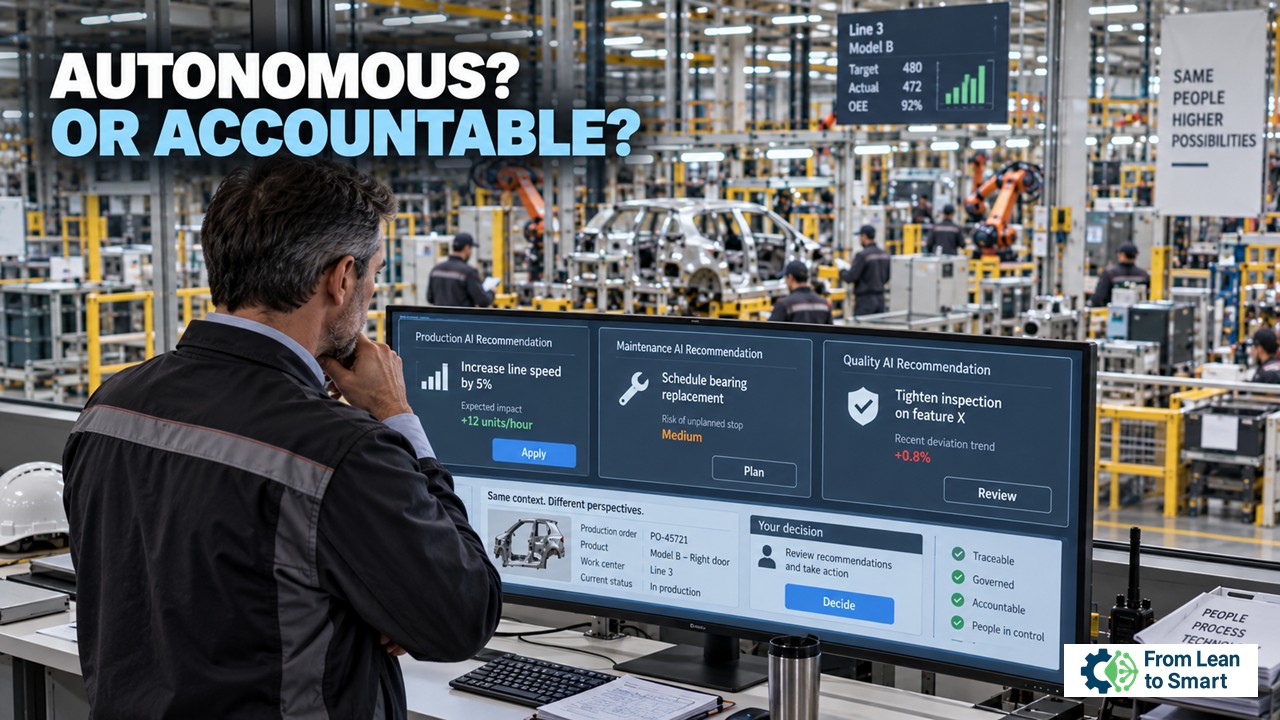
Now imagine that a production-planning agent evaluates the same condition from another perspective.
Its objective is schedule recovery, so it recommends continuing for another eight hours.
A maintenance agent recommends stopping.
A quality agent identifies no current product-conformity risk.
Three systems.
Three internally rational recommendations.
One physical factory.
Who arbitrates?
That is not primarily an AI-model problem.
It is a decision-governance problem.
And it becomes more important as intelligent systems acquire greater influence over execution.
Autonomy Is a Question of Decision Authority
Industrial autonomy should not be treated as a binary choice between manual and autonomous operation.
Authority can be delegated progressively.
A system may be permitted to:
Observe — collect and contextualise information automatically.
Classify — determine that a condition belongs to a predefined category.
Recommend — propose an action while leaving the decision to a person.
Prioritise — rank actions or problems according to defined criteria.
Prepare — create a work order, production alternative or parameter proposal.
Execute conditionally — perform an action automatically when explicit criteria are satisfied.
Execute autonomously within bounds — act without prior approval, provided defined limits and constraints remain satisfied.
These represent very different levels of authority.
An advanced control system may adjust a non-critical parameter automatically within a validated operating window.
A similar change outside that window may require engineering or quality approval.
A maintenance assistant may retrieve equipment history, identify comparable failures and propose a diagnostic sequence.
It should not therefore acquire authority to bypass an interlock.
A production agent may resequence orders automatically within pre-approved scheduling constraints.
It may need escalation when customer priority, maintenance requirements and quality restrictions conflict.
The important design question is therefore not simply:
“Can the AI perform this action?”
It is:
“What authority should this system have for this decision, under these operating conditions?”
Control and Decision-Making Are Not the Same Problem
Factories have used autonomous control for decades.
PLCs execute logic without requesting human approval.
Control loops regulate process variables continuously.
Interlocks stop equipment when defined conditions are violated.
Automated systems sequence machines, move materials and coordinate equipment.
There is nothing inherently new about machines acting without direct human intervention.
The governance challenge becomes more complex when intelligent systems begin influencing decisions that involve:
- uncertain diagnoses;
- conflicting operational objectives;
- incomplete information;
- economic trade-offs;
- quality consequences;
- maintenance risk;
- customer commitments;
- or actions whose consequences extend across multiple functions.
A deterministic control rule operates inside explicitly defined logic.
An AI-supported operational decision may involve interpretation and uncertainty.
Those situations should not automatically receive the same level of delegated authority.
The appropriate level of autonomy depends not only on technical capability, but also on consequence, uncertainty, constraints and reversibility.
Governance Must Reach the Point of Execution
AI governance is often discussed at policy level.
Corporate standards.
AI committees.
Approval procedures.
Restricted-use lists.
Validation requirements.
These mechanisms can be necessary.
But industrial governance ultimately has to reach the moment when a recommendation becomes an operational action.
For every consequential AI-supported decision, the factory should be clear about several elements.
Decision ownership. Who remains accountable for the operational outcome?
Delegated authority. What can the system decide or change without further approval?
Hard constraints. Which safety, quality, engineering or maintenance conditions cannot be violated?
Evidence. Which information supports the recommendation?
Uncertainty. What is known, what remains uncertain and how should that uncertainty affect the permitted action?
Operational consequence. What happens if the recommendation is wrong?
Reversibility. Can the action be corrected easily, or does it create lasting exposure?
Escalation. Under which conditions must a person or another function become involved?
Traceability. Can the organisation later reconstruct the evidence, recommendation, decision and action?
Override. Can authorised personnel challenge, modify or stop the action?
Learning. Does the organisation subsequently compare the expected and actual outcome?
Without these mechanisms, governance remains detached from shopfloor execution.
Constraints Should Not Become Suggestions
One of the most important principles in an AI-enabled factory is that not everything should be subject to optimisation.
Some requirements exist precisely to limit operational discretion.
If a safety condition is violated, an engineered interlock may be more appropriate than a probabilistic recommendation.
If product release requires mandatory traceability evidence, the requirement should be enforced.
If maintenance work requires defined isolation conditions, an AI-generated estimate of low risk should not make those conditions optional.
If a validated process window defines permissible operating parameters, automated optimisation should remain bounded by that window unless a controlled process exists for changing it.
These are hard constraints.
They define the permitted decision space.
AI may optimise within that space.
It should not silently redefine the space itself.
This distinction becomes particularly important as organisations introduce agents capable of taking action across systems.
MES/MOM Can Provide Critical Execution Context
If AI is expected to influence manufacturing decisions, raw data is insufficient.
The system needs operational context.
What product is currently running?
Which production order is active?
Which recipe or specification version applies?
Which equipment is executing the operation?
Which material lots are being consumed?
Is the asset in production, setup, maintenance, trial or another state?
Which quality holds or restrictions are active?
What downtime condition exists?
Which actions have already been taken?
MES/MOM can provide an important part of this execution context.
It sits close to manufacturing operations and often connects production requirements with resources, materials, genealogy, operating states, procedures and actual performance.
This makes MES/MOM a potentially important component of an industrial AI governance architecture.
Not because MES should become the AI system.
Nor because every relevant decision must be controlled by MES.
But because AI recommendations affecting manufacturing execution must be grounded in the current state of manufacturing execution.
A technically sophisticated model working from incomplete context can still produce an operationally poor recommendation.
Lean Becomes More Important, Not Less
AI is sometimes presented as though it makes established Operational Excellence practices obsolete.
The opposite may be closer to reality.
The more intelligence introduced into industrial operations, the more important it becomes to understand what normal, abnormal and controlled operating conditions actually mean.
Lean provides important foundations:
standards,
visual management,
problem-solving,
flow,
clear abnormalities,
process ownership,
gemba validation,
and disciplined learning.
AI depends on many of the same foundations.
If the process has no stable baseline, what exactly should the system optimise?
If abnormal conditions are poorly defined, what should trigger escalation?
If process ownership is unclear, who receives and evaluates the recommendation?
If recurring causes are never eliminated, will AI improve the process—or simply accelerate firefighting?
If standards are routinely bypassed under pressure, which operating reality should the system learn from?
AI does not remove the need for process discipline. It increases the consequences of weak process discipline.
A Smart Factory cannot compensate indefinitely for an operating model that is poorly standardised, weakly governed or dependent on undocumented workarounds.
Human-in-the-Loop Must Mean More Than Human Approval
There is also a weak form of human-in-the-loop design.
The AI generates a recommendation.
A person clicks Approve.
The organisation declares the process governed.
That is insufficient.
If people retain accountability, they need the ability to exercise meaningful judgement.
They need to understand:
why the recommendation exists;
which evidence supports it;
what uncertainty remains;
which alternatives were considered;
which constraints apply;
and what consequences may follow from accepting or rejecting the action.
Otherwise, the person becomes a ceremonial approval layer.
That creates a problematic asymmetry:
the system performs the effective reasoning while the human retains formal responsibility.
Good human-in-the-loop design should therefore increase human decision quality.
The person must be able to interrogate the evidence, challenge assumptions, request additional information, reject the recommendation and understand the consequences of doing so.
If meaningful challenge is impossible, the organisation has not created strong human oversight.
It has merely inserted a confirmation step.
Not Every Industrial Decision Needs AI
A mature factory should use the simplest decision mechanism capable of governing the situation reliably.
Sometimes that mechanism is hard automation.
Sometimes a deterministic rule.
Sometimes a workflow.
Sometimes an advanced control algorithm.
Sometimes optimisation.
Sometimes a predictive model.
Sometimes an AI assistant or agent.
Sometimes professional judgement.
The objective should not be to maximise the number of decisions made by AI.
The objective should be to select the appropriate decision mechanism for the operational problem.
AI is particularly valuable where context, ambiguity or multiple competing signals make purely deterministic logic insufficient.
Where conditions are stable, consequences are well understood and valid rules already exist, deterministic automation may remain the better engineering solution.
Knowing where not to use AI is therefore part of industrial AI maturity.
The Future Factory May Need an Explicit Decision Capability
As AI expands across industrial operations, factories may discover a structural gap in their architecture.
ERP manages enterprise planning.
MES/MOM manages manufacturing execution.
SCADA and PLCs manage equipment supervision and control.
CMMS/EAM manages maintenance work.
QMS governs quality activities.
Analytics explains performance.
AI begins producing recommendations across all of them.
But what happens when those recommendations conflict?
Who manages the decision itself?
This suggests the need for an increasingly explicit governed operational decision capability.
Not necessarily another software platform.
The more important requirement is an operating model that makes visible:
the decision to be made;
the current operational context;
the relevant evidence;
the competing objectives;
the permitted actions;
the hard constraints;
the authority boundaries;
the recommendation;
the final decision;
the action taken;
and the observed outcome.
This is where Decision Intelligence becomes practically relevant to industrial operations.
Its value is not in creating another analytical layer.
It is in connecting analysis to explicit, accountable operational decisions.
A good prediction is useful.
A good decision requires more.
A Quality Example Shows the Difference
Imagine an AI system detects a pattern suggesting that a process parameter is moving towards conditions historically associated with defects.
The current product remains within specification.
What should happen?
One option is to adjust the parameter immediately.
But several additional conditions may matter.
Perhaps the parameter is restricted by validated process limits.
Perhaps the recipe is formally controlled.
Perhaps the observed relationship is influenced by a particular material batch.
Perhaps maintenance recently changed a component.
Perhaps the current production order is part of a controlled engineering trial.
A system that optimises one variable without recognising this context can produce a locally rational but operationally inappropriate action.
A governed response could instead:
identify the abnormal pattern;
relate it to current material, equipment and recipe context;
evaluate the likely quality consequence;
determine whether an approved autonomous adjustment exists;
recommend an action when authority limits are reached;
record the resulting decision;
and monitor whether the intervention produced the expected effect.
This approach may be less autonomous.
It is more operationally controlled.
Cross-Agent Conflict Requires Decision Rights
The problem becomes even more interesting when several intelligent agents operate simultaneously.
A production agent may optimise schedule attainment.
A maintenance agent may minimise asset-risk exposure.
A quality agent may protect process capability and conformity.
A logistics agent may optimise material availability.
Each can behave rationally according to its own objective function.
The factory can still receive contradictory recommendations.
This means multi-agent industrial systems require more than technically capable agents.
They require rules for arbitration.
Which constraints are absolute?
Which objectives have priority under specific abnormal conditions?
Who owns the cross-functional decision?
When can one agent override another?
When must the conflict be escalated to people?
How is the final decision recorded?
Without this layer, greater distributed intelligence can produce greater operational conflict.
Local optimisation does not become global optimisation simply because every function has an intelligent agent.
The Goal Is Better Allocation of Human Attention
There are many areas where greater autonomy makes industrial sense.
Highly repeatable corrections.
Closed-loop process adjustment.
Automated material movement.
Scheduling within constrained boundaries.
Automated inspection.
Condition-based triggers.
Routine administrative decisions.
The deeper objective, however, should not be removing people from every operational decision.
It should be reducing the amount of human attention consumed by decisions that machines can execute safely and consistently.
This allows experienced people to focus on what remains difficult:
ambiguity,
risk,
exceptions,
cross-functional trade-offs,
continuous improvement,
and changes to the operating system itself.
A strong future operating model may therefore assign different forms of work to different decision mechanisms:
automation handles what is deterministic;
AI helps interpret patterns and complex context;
people retain judgement where uncertainty, consequence and conflicting objectives require accountable reasoning.
That is not resistance to technology.
It is sound industrial design.
The Real Maturity Test Appears When the Recommendation Is Wrong
AI demonstrations are most convincing when the recommendation is correct.
Governance becomes visible when it is not.
What happens when the model assigns the wrong maintenance priority?
When a scheduling agent creates a material problem?
When a quality recommendation misses an important interaction?
When two agents issue incompatible actions?
When the operating context changes faster than the model recognises?
Can the factory reconstruct what happened?
Can it identify which data, rules and assumptions influenced the recommendation?
Can authorised people challenge the system?
Can the action be reversed where necessary?
Does decision ownership remain clear?
Is the error converted into improved rules, models or operating procedures?
These questions determine whether AI becomes a trusted industrial capability or another technology layer that experienced people gradually learn to work around.
Governance is therefore not only about preventing bad decisions.
It is also about ensuring that bad decisions become traceable learning rather than unexplained operational noise.
Autonomy Without Accountability Is Not Industrial Maturity
The industrial future will undoubtedly contain more automation and more AI.
Some areas may become highly autonomous.
That does not mean the most advanced factory will necessarily be the one with the fewest human decisions.
A more meaningful sign of maturity may be that the organisation knows precisely:
which decisions are automated;
which are AI-assisted;
which require professional judgement;
which constraints cannot be violated;
where decision authority begins and ends;
how conflicting recommendations are resolved;
how important actions are traced;
and how outcomes are converted into learning.
That is more demanding than simply pursuing autonomous manufacturing.
It requires reliable operational context.
Process discipline.
Master data.
MES/MOM and system integration.
Clear ownership.
Decision rights.
Technical competence.
And governance designed into execution rather than added afterwards.
The competitive advantage will not come simply from deploying AI across the factory.
It will come from designing a better industrial decision system around it.
The future factory will almost certainly become more intelligent.
In many areas, it will also become more autonomous.
But autonomy should expand where the evidence, constraints and consequences justify delegation—not where technology merely makes delegation possible.
The defining characteristic of a mature future factory will therefore be something more demanding than autonomy:
it will know what may decide, what may act, under which conditions, within which limits, and who remains accountable for the outcome.
Three Questions Worth Taking Back to the Factory
- Which operational decisions would we genuinely delegate to AI without prior human approval today—and what makes those decisions suitable for that level of authority?
- If production, maintenance and quality agents recommended incompatible actions, what decision rights and arbitration rules would determine the final response?
- Are our human-in-the-loop systems giving people enough evidence and authority to exercise real judgement—or merely asking them to approve recommendations they cannot meaningfully challenge?
#IndustrialAI #SmartFactory #OperationalExcellence #MES #MOM #DecisionIntelligence #ManufacturingExcellence #AIgovernance #AssetManagement #DigitalManufacturing #OperationalGovernance