There are professional stages that, when you look back years later, you realize were not simply a beginning. They were an entry point. A way of seeing the world. A way of starting to build the person and the professional you would eventually become.
For me, my trainee period at SEAT was exactly that.
I joined the company through a talent attraction program aimed at young graduates. Throughout the year, candidates were selected based on a certain professional fit with the company, and some aspects were especially valued, including language skills such as German, which made perfect sense within the Volkswagen Group environment.
The program lasted twelve months. During that period, you rotated through different areas of the company that were, to a greater or lesser extent, related to your final destination. In addition, part of the experience took place in another Volkswagen Group company. In my case, I had the opportunity to spend time at Audi in Ingolstadt.
Described like that, it almost sounds like the formal description of a corporate program. But living it from the inside was something completely different.
I had come almost straight from university, from the academic and research world. Suddenly, I found myself inside a major car factory, part of an iconic Spanish brand and a huge industrial group. For a young engineer, it was a mixture of vertigo, excitement, and technological fascination.
I still remember the first time I entered Workshop 10.
It was around 2003, during the launch period of the SEAT Altea. I saw the station where the powertrain and body were assembled, the precision of the robots, the fixtures holding the body, the transfers between the electric overhead conveyor and the station, and the coordination between machines, tooling, people, and product.
It made a huge impression on me.
Until then, engineering had been something I studied, calculated, modeled, or analyzed. There, I discovered another dimension: engineering operating in real time, with real consequences, real pressure, and thousands of details that had to fit together every single day.
And perhaps one of the first things that unsettled me, or rather, that put me in my place, was the immediacy of the factory.
In a car factory, it is not only the cars that move to takt time. Decisions, problems, frustrations, joys, and lessons also move to takt time. Everything happens quickly. Everything has an impact. Everything seems urgent, and very often it is. You cannot afford to drift too much, because the line keeps moving, issues appear, priorities change, and reality does not wait for you to fully understand it.
For someone coming from a more academic environment, that was a brutal lesson.
I was, in principle, a production trainee. Since I had been selected by Assembly, it seemed logical to think that my final role would be there. But I did not know until almost the end that I would eventually join Assembly Maintenance. Looking back, I think that was an enormous stroke of luck.
During that year, I had the opportunity to get to know many areas: production, quality, logistics, engineering, and the technical center. And for someone fresh out of university, that meant opening a window into a universe you cannot even imagine until you see it from the inside.
From the outside, one might think that a factory is simply production. But within production there are entire worlds. And within quality, many more. The same is true of logistics, engineering, maintenance, and the technical center. Each area has its own language, priorities, tensions, indicators, and problems.
That was one of the great gifts of the program: building a mental map of the company.
You did not become an expert in anything, because that was impossible. But you did begin to understand how the pieces connected. Who did what. Where the problems were. Which areas needed to talk to each other. Why a technical decision could affect production, quality, maintenance, logistics, or cost.
And that cross-functional knowledge, although still immature, was very powerful.
Over time, I realized that many experienced people had a much deeper view of their own area, but also a much more specific one. By contrast, those of us who went through the trainee program had a broader, more panoramic, more connected view. That could be an advantage, provided you used it with humility.
Because that was one of the keys: knowing how to make use of that broader perspective without forgetting that you had only just arrived.
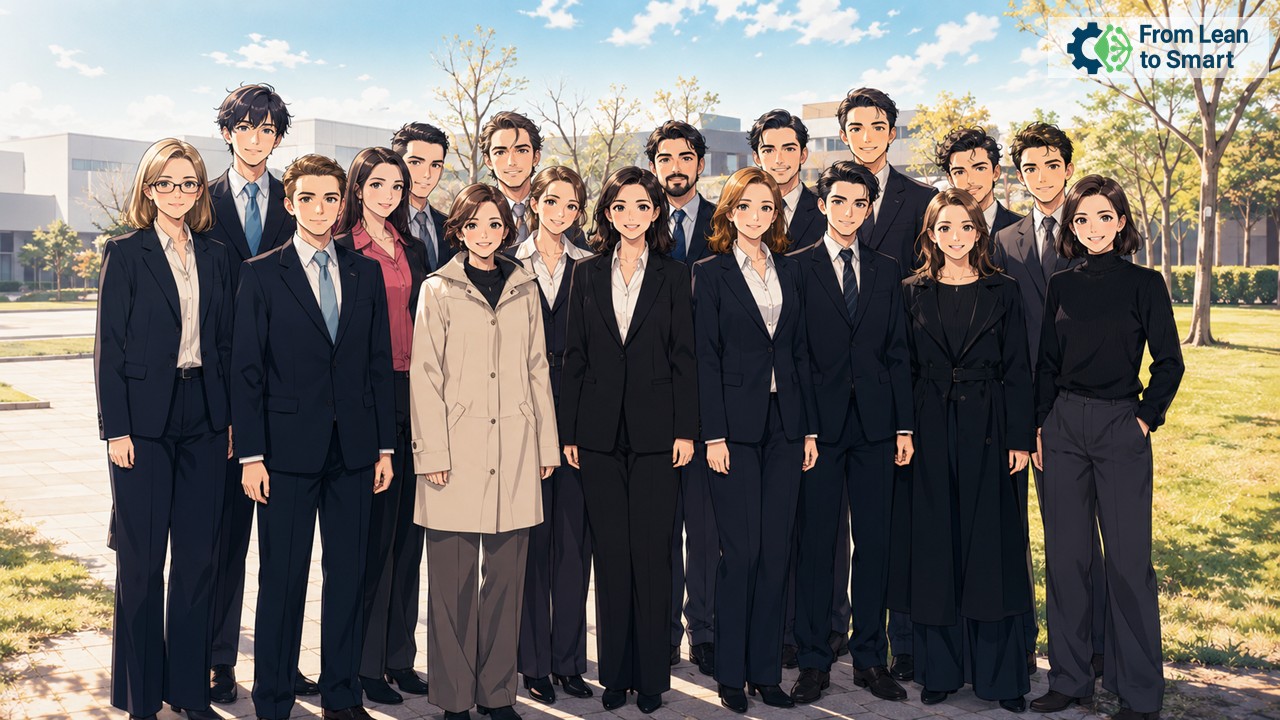
During the program, you also met other trainees. Some were more senior and helped you understand how to move around, what to expect, who to ask, and how to interpret certain dynamics. There was a strong sense of camaraderie. It was almost like a small Erasmus inside the factory: meetings, activities, talks, conversations, and the feeling of belonging to a group going through something similar.
And that camaraderie also became international.
My time at Audi in Ingolstadt was very interesting precisely for that reason. There, I was able to see the differences between countries, cultures, and brands. Different ways of expressing things, different codes, another language, another way of experiencing the organization. But at the same time, the great similarities were obvious.
In the end, many of the problems were the same. The same discussions, the same challenges, the same tensions between areas, the same balances between production, quality, logistics, engineering, and maintenance. Only in another language and with another cultural accent.
That was a very powerful lesson: industry changes country, brand, and language, but many of its deeper dynamics are universal.
There were trainees there too. And that reinforced a very special feeling: being part of a young generation entering a huge industrial group, trying to learn quickly, understand the codes, and find its place.
Of course, not everything was perfect. No program is. Sometimes you could feel slightly underused. There were areas where they perhaps did not quite know what to do with you. But in most cases, if you showed interest, respect, and proactivity, the reward appeared.
I especially remember my time at the Technical Center. There, I developed a small Visual Basic program that organized the result logs from the algorithms used in engine control unit testing. It was a simple tool, but it saved repetitive work when searching for results inside those files.
Years later, I learned that it was still being used.
It may seem like a minor anecdote, but for a trainee it meant a lot. It was proof that, even as a newcomer, even without having a definitive role yet, you could contribute something useful if you observed carefully, asked questions, and looked for a practical way to help.
Another experience I remember with particular affection, and also with great respect, was the two weeks I spent on the assembly line working like any other operator.
Anyone who wants to understand a factory should experience that.
Spending eight hours assembling the same part, repeating the same operation again and again, following the rhythm of the line, understanding fatigue, ergonomics, time pressure, the small recurring problems, and the real difficulties of the workstation changes your perspective.
From a technical office, from engineering, or from maintenance, it is very easy to have an opinion about the process. But when you are there, on the line, you understand much better why certain things matter so much. You understand why a small design issue can become an irritation repeated hundreds of times. You understand why poor accessibility is not a detail. You understand why a stoppage, a poorly presented part, or an uncomfortable tool has a real impact.
Those two weeks toughened me up.
And they also made me respect much more the work of the people who keep the factory running every day.
Over the years, I have often thought that entering maintenance and a major company in that way was almost like coming in on a red carpet. Not because it was easy, but because the program gave you an extraordinary opportunity: to learn, meet people, ask questions, move around, make mistakes, observe, and build relationships before taking on a specific responsibility.
I am immensely grateful to those who selected me and to those who welcomed me.
I know not all trainees will have the same opinion. Some will have had more difficult experiences. Others, surely, will have made even better use of the opportunity than I did and may have an even more enthusiastic view. Every experience has its rough edges, and every program can be improved.
But I also believe that a fundamental part of being a trainee is precisely learning to navigate what is there.
To find your own way.
To ask.
To listen.
To propose.
Not to expect everything to arrive perfectly packaged.
Because that is probably one of the great lessons of any professional career: opportunities rarely come fully organized. Often, you have to know how to recognize them, work on them, and turn them into something valuable.
In my case, I believe the keys were enthusiasm, humility to learn, willingness to listen, and courage to ask and propose. And yes, also luck. The luck of finding good mentors, good colleagues, and generous people who took the time to explain how that enormous industrial system worked.
My trainee period taught me more than many courses, more than many manuals, and probably more than any master’s degree could have taught me at that moment.
It taught me that a company cannot be understood from an organization chart.
You understand it by walking through it.
You understand it by listening to people.
You understand it by seeing how things are manufactured, how problems are solved, how areas coordinate with each other, and how every decision creates a chain of effects.
It taught me that technology is impressive, but people are the ones who truly make everything work.
And it taught me something that I still consider essential today: to grow professionally, you need to combine ambition with humility. You need the desire to contribute, but also respect for those who had been sustaining the system long before you arrived.
To today’s trainees, I would say that I envy them a lot. But not because I want to go back. That would make no sense. Every stage has its moment.
I envy them because I would like to feel things again with that same intensity.
To walk into a factory again and be amazed by everything.
To discover a new area every few weeks.
To listen to experienced people explain problems that you do not yet even know how to formulate.
To feel that every conversation, every visit, every placement, and every small project opens a new door.
It is not that nothing excites me anymore. That is not the point.
It is that that level of wonder, that way of experiencing everything as if you were inside something immense, does not happen many times in a professional life. And it is fascinating to work under that spell.
Few things are more motivating than feeling that you are learning at full speed inside a place that still feels much bigger than you.
That trainee year was not just my entry into SEAT.
It was my real entry into industry.
And, in many ways, it became the first major foundation for everything that came afterwards.