Over the years, I have seen many 5S implementations in industrial environments, offices, workshops, maintenance areas, and production zones.
And the more time passes, the clearer one thing becomes to me:
the problem with 5S is not that people do not understand them.
The problem is that many organizations think they have understood them too quickly.
Reducing 5S to “order and cleanliness” is one of the fastest ways to destroy their real potential.
Because 5S are not about having a nice-looking area for a management visit.
They are not about painting lines on the floor.
They are not about buying tool shadow boards.
They are not about running a monthly audit to put a score into an Excel file.
5S are about creating stable, visible, and repeatable working conditions.
They are about reducing wasted time.
They are about making abnormalities visible.
They are about making daily work easier.
They are about improving safety.
They are about eliminating unnecessary improvisation.
They are about building operational discipline.
And that is where the problems begin.
1. They are implemented as a campaign, not as a system
Many companies launch 5S as if they were a one-off activity.
An intensive workshop is organized.
Areas are cleaned.
Unnecessary items are removed.
Before-and-after pictures are taken.
The initiative is communicated internally as a success.
And for a few days, everything seems to work.
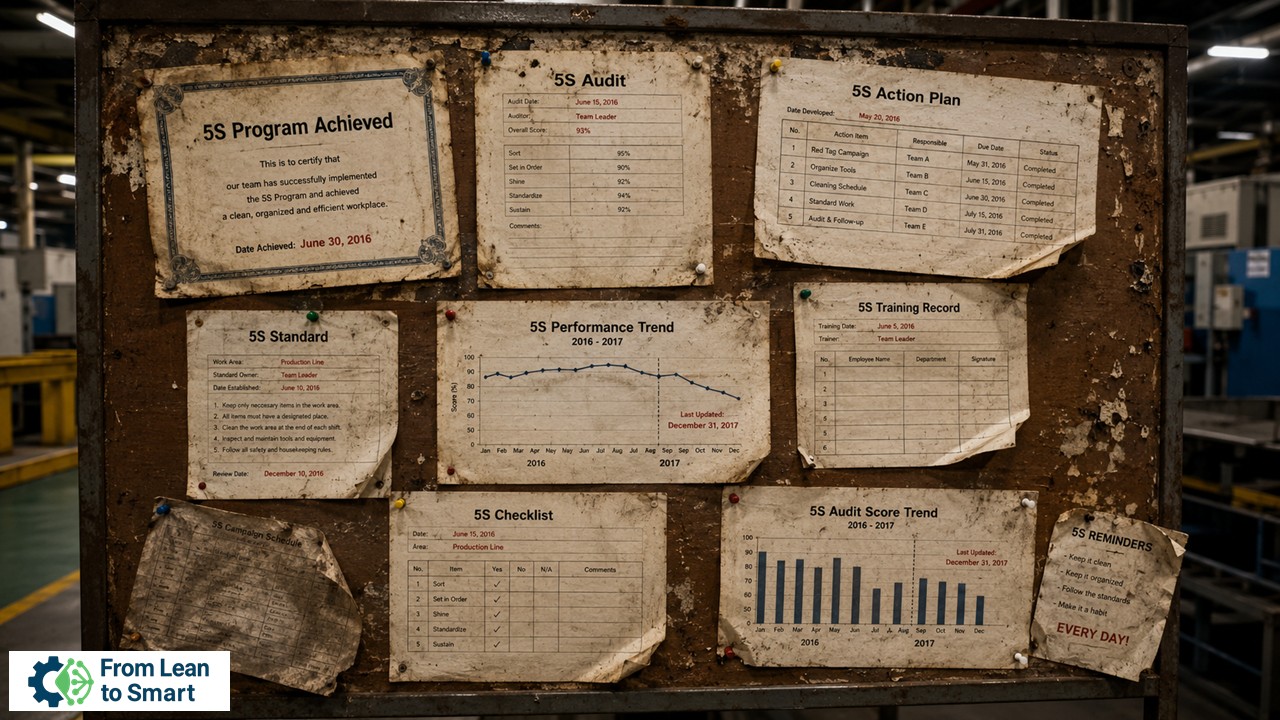
The problem appears three weeks later, when the area gradually returns to its previous state. Not because people are naturally disorganized, but because the system that created the disorder has not changed.
If the causes are still alive, the chaos comes back.
2. Cleaning is confused with improvement
Cleaning is important, but it is not enough.
A clean area can still be inefficient.
A labelled tool can still be badly located.
An organized cabinet can still contain unnecessary material.
A visually perfect area can still hide problems related to flow, safety, quality, or maintenance.
Cleaning is only one part of the method.
The right question is not:
“Is it clean?”
The right question is:
“Does this environment help people work better, detect problems earlier, and avoid mistakes?”
That change of question completely changes the implementation.
3. The people who work in the area are not truly involved
Another common mistake is designing 5S from the outside.
A continuous improvement, engineering, production, or consulting team arrives. They define locations, labels, standards, boards, and layouts. Everything seems logical on paper.
But then the person who works eight hours a day in that area has to live with a solution that does not always reflect the reality of the process.
5S cannot be imposed as corporate decoration.
They must be built with the people who use the space, understand the real difficulties, and know where time is actually lost.
Participation is not a nice gesture.
It is a technical condition for making the system work.
4. They are not connected to real performance indicators
5S should not be measured only through an audit score.
An audit can help, but it cannot become the objective.
What really matters is connecting 5S with operational results:
time spent searching for tools,
reduction of unnecessary movements,
improved safety,
fewer incidents caused by misplaced material,
fewer waiting times,
fewer errors,
higher equipment availability,
better quality of work.
If 5S do not improve daily work, they end up being perceived as an aesthetic obligation.
And when something is perceived as bureaucracy, the organization may comply with it for a while, but it rarely integrates it.
5. Discipline is demanded without creating the conditions to sustain it
The fifth S, Shitsuke, is usually translated as discipline.
But it is often misunderstood.
Discipline does not mean asking people to make heroic efforts every day to maintain the system.
Discipline means designing an environment where doing the right thing is the easiest, most natural, and most visible option.
If everything has its place, if missing items are visible, if the standard is clear, if responsibilities are defined, and if follow-up is part of the routine, then discipline no longer depends only on goodwill.
Discipline does not appear by decree.
It is designed.
6. Management supports it, but does not sustain it
Almost every 5S implementation starts with management support.
The problem is that support is not the same as sustained commitment.
Support means approving the initiative.
Commitment means asking about it when it is no longer new.
Support means attending the launch.
Commitment means reviewing the standards three months later.
Support means asking for before-and-after pictures.
Commitment means removing obstacles when the team says it cannot maintain what was defined.
5S need visible leadership, but above all, they need consistent leadership.
7. Compliance is audited, but non-compliance is not used for learning
When an area does not comply, the usual reaction is to correct the deviation.
But the more powerful question is different:
“Why did the system allow this to happen again?”
A 5S deviation may be telling us many things:
that the standard is not realistic,
that the location does not work,
that material is missing,
that production pressure is being badly managed,
that nobody is reviewing the area,
that ownership is unclear,
that the process has changed and the standard has not been updated.
5S should not be used to look for someone to blame.
They should be used to discover causes.
8. We forget that 5S are basic operational culture
Sometimes organizations talk about Lean, Six Sigma, digitalization, artificial intelligence, process mining, or advanced automation while their basic working environment remains unstable.
And that is a huge contradiction.
It makes little sense to want a smart factory if we still do not know where a critical tool is, which material is unnecessary, which standard is valid, or which abnormality is repeated every week.
5S are not the most sophisticated part of continuous improvement.
But that is precisely why they are so revealing.
Because they show whether an organization truly has the discipline to sustain the basics.
And without the basics, the advanced usually becomes technological make-up.
Conclusion
5S seem simple because they are easy to explain.
Sort.
Set in order.
Shine.
Standardize.
Sustain.
But implementing them properly requires something much deeper: leadership, participation, method, follow-up, learning, and coherence.
5S do not fail because they are a weak tool.
They fail when we treat them as a general cleaning exercise with a Japanese name.
When implemented well, they become a school of daily management.
When implemented poorly, they are just a nice picture before returning to the same disorder as always.
And that difference, as almost always in continuous improvement, is not in the tool.
It is in how the organization decides to use it.