Why maintenance must be managed as a flow of decisions, knowledge, resources and risk
Every factory has a visible production system.
Machines. Lines. Operators. Takt time. Quality checks. Buffers. Schedules. Output targets.
This factory is easy to see.
Easy to measure.
Easy to discuss in daily meetings.
But inside every industrial plant, there is another factory operating in parallel.
Less visible.
Less structured.
Often less understood.
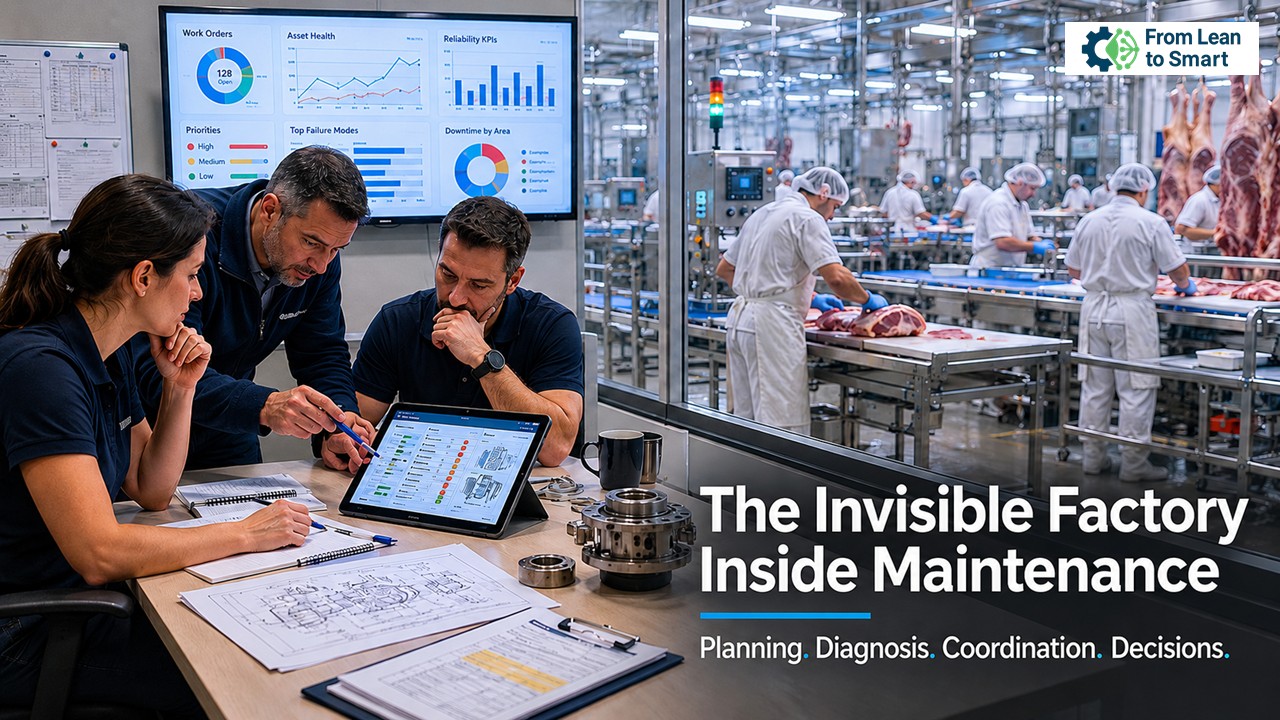
It is the factory inside maintenance.
A factory made of work orders, urgent calls, inspections, troubleshooting, spare parts searches, shutdown preparation, contractor coordination, temporary fixes, repeated failures, missing information and decisions made under pressure.
This invisible factory does not produce parts.
It produces operational continuity.
And when it does not work well, the visible factory eventually pays the price.
Maintenance Is Not Just a Support Function
Maintenance is often described as a support function.
That description is too small.
In reality, maintenance has its own internal production flow.
Demand enters the system through breakdowns, preventive tasks, inspections, safety findings, audits, improvement requests, modifications, operator reports, reliability actions and engineering projects.
Then that demand must be filtered, prioritized, planned, scheduled, resourced, executed, documented, analyzed and converted into learning.
That is a value stream.
But many organizations do not manage maintenance like a value stream.
They manage it as a list of tasks.
Or worse, as a sequence of interruptions.
In production, we would never accept a process where demand arrives randomly, priorities change every hour, materials are uncertain, instructions are incomplete, capacity is constantly interrupted and decisions depend on who happens to be available.
But in maintenance, this is often considered normal.
A technician starts a planned job.
Then a critical line stops.
The planned job is abandoned.
A spare part is needed.
The part exists in the system, but not in the expected physical location.
Production asks when the machine will run again.
A supervisor asks for an update.
Another line calls for support.
The technician makes a temporary repair to recover production.
The work order is closed later with minimal information.
The next shift inherits the same unresolved condition.
This is not just maintenance work.
This is a poorly controlled internal production system.
The Hidden Flow Problems in Maintenance
The visible factory has flow problems.
The invisible maintenance factory has flow problems too.
Waiting for spare parts.
Waiting for access to equipment.
Waiting for production release.
Waiting for technical information.
Waiting for contractor availability.
Waiting for engineering support.
Waiting for approval to stop the asset.
Waiting for someone to make a decision.
These waiting times rarely appear clearly in standard maintenance KPIs.
But they consume capacity every day.
They reduce wrench time.
They weaken planning.
They create frustration.
They extend downtime.
They turn simple jobs into complex coordination problems.
And they often make maintenance look inefficient when the real issue is systemic friction.
This is why maintenance productivity is so often misunderstood.
A technician may spend little time physically replacing a component, but a large amount of time navigating the system around the repair.
Finding the right drawing.
Checking the failure history.
Looking for the spare part.
Confirming whether the machine can be stopped.
Understanding what the previous shift already tried.
Explaining the risk to production.
Escalating a decision.
Waiting for isolation.
Testing the asset after intervention.
Capturing what was found.
From the outside, this can look like delay.
From the inside, it is the real work required to make a safe and correct decision.
The problem is that much of this work is invisible.
And invisible work is easy to underestimate.
Maintenance Waste Is Real, but Harder to See
Lean thinking taught factories to see waste in production.
Waiting.
Overprocessing.
Excess movement.
Defects.
Inventory.
Transport.
Unused knowledge.
But maintenance has its own forms of waste.
And they are often harder to detect.
A technician searching for a missing spare part.
A planner rescheduling the same task three times.
A supervisor negotiating the same maintenance window every week.
A reliability engineer analyzing poor-quality work order data.
A team repeating diagnosis because the previous intervention was not properly documented.
A preventive task executed for years without detecting anything useful.
A shutdown plan changed at the last minute because priorities were not aligned early enough.
These are not isolated inefficiencies.
They are symptoms of an invisible factory that has not been designed properly.
Not All Maintenance Demand Is the Same
The invisible maintenance factory has demand variability.
Some demand is predictable:
Preventive maintenance.
Inspections.
Calibrations.
Statutory tasks.
Planned replacements.
Some demand is partially predictable:
Recurring failures.
Known weak components.
Seasonal issues.
Degradation patterns.
Chronic microstops.
Some demand is unpredictable:
Sudden breakdowns.
Safety incidents.
Hidden failures.
Quality-related equipment problems.
The mistake is trying to manage all this demand with the same logic.
A statutory inspection is not the same as a chronic intermittent fault.
A lubrication route is not the same as a difficult troubleshooting case.
A planned replacement is not the same as an investigation into repeated failures.
Yet many systems reduce all of this complexity to a work order.
That simplification may help administration.
But it often weakens operational understanding.
A Work Order Is Not Just a Task
A work order is not only proof that something was done.
It should be a container of operational knowledge.
It should capture:
What was requested.
What was observed.
What was suspected.
What was done.
What was found.
What was changed.
What remains uncertain.
What should happen next.
In many plants, work orders are treated mainly as administrative records.
Opened.
Assigned.
Completed.
Closed.
But the maintenance system needs more than closure.
It needs learning.
Without learning, the same problems re-enter the system again and again under different descriptions.
Sensor fault.
Line stop.
No cycle.
Intermittent failure.
Machine reset.
Adjustment required.
Different words.
Same underlying weakness.
This is where maintenance data often loses value.
Not because the CMMS is useless.
Not because technicians do not care.
But because the system around data capture was not designed for operational intelligence.
Technicians are asked to document after the urgency has passed.
Failure codes are too generic.
Descriptions are too short.
The priority is to restart production, not to build organizational memory.
The same asset may have dozens of work orders but no coherent failure story.
The factory has data.
But it has weak memory.
And a factory with weak memory repeats the same problems.
The Bottleneck Is Often Not the Technician
The invisible maintenance factory also has bottlenecks.
Sometimes the bottleneck is technical skill.
But very often it is something else.
Planning quality.
Spare parts readiness.
Access to the asset.
Unclear prioritization.
Decision authority.
Production windows.
Engineering support.
Escalation routines.
Quality of information.
Many maintenance teams are judged on execution performance while their real constraints sit outside execution.
A technician cannot execute a high-quality job if the part is missing.
A planner cannot create a stable schedule if production windows are constantly cancelled.
A supervisor cannot reduce emergency work if every request is treated as urgent.
A reliability engineer cannot eliminate chronic losses if the organization only allows time for restoration.
The bottleneck is often not effort.
It is system design.
This is why blaming maintenance teams is usually the least useful response.
Most maintenance people already work under pressure.
They adapt.
They improvise.
They absorb uncertainty.
They protect production even when the system around them is incomplete.
But adaptation has a cost.
When people constantly compensate for weak processes, the organization stops seeing the weakness.
The technician who knows where the undocumented spare part is stored becomes the process.
The supervisor who can negotiate with production becomes the escalation system.
The planner who remembers historical constraints becomes the database.
The senior technician who recognizes the sound of a failure becomes the diagnostic model.
That experience is valuable.
But when the system depends too much on individual memory, it becomes fragile.
Tribal Knowledge Is Powerful, but Risky
Many plants run on tribal knowledge.
Who knows the machine.
Who knows the supplier.
Who knows the workaround.
Who knows which alarm is serious.
Who knows which component fails every summer.
Who knows which production area will accept a stop.
Who knows what the CMMS does not show.
Tribal knowledge is powerful.
But it is also vulnerable.
People retire.
People change shifts.
People move to other plants.
Contractors leave.
New technicians arrive.
And suddenly, the factory discovers that part of its maintenance capability was never really institutionalized.
It lived in people’s heads.
A mature maintenance organization does not try to eliminate human expertise.
That would be unrealistic and undesirable.
It tries to convert critical experience into shared operational capability.
Better work order narratives.
Better failure classification.
Better troubleshooting histories.
Better standard jobs where standardization makes sense.
Better case handling where uncertainty remains high.
Better technician feedback loops.
Better visibility of constraints before execution.
Better integration between planning, spare parts, production and engineering.
This is how the invisible factory becomes manageable.
Not by creating more bureaucracy.
But by making the real flow of maintenance work visible enough to improve.
Planning Is a Control Point, Not Administration
Maintenance planning is often treated as an administrative function.
It is not.
Planning is one of the most important control points in the maintenance system.
A good plan does not simply assign a task.
It reduces uncertainty before execution.
It clarifies scope.
It checks safety requirements.
It confirms parts.
It estimates resources.
It anticipates access constraints.
It coordinates with production.
It identifies special tools.
It protects technician time.
It separates what is ready from what is only requested.
Weak planning pushes uncertainty downstream.
And when uncertainty reaches the technician at the machine, it becomes delay, improvisation or risk.
Scheduling has the same problem.
Many plants have schedules that look good at the beginning of the week and collapse by Monday afternoon.
Emergency work enters.
Production changes priorities.
Materials are missing.
Assets are not released.
Technicians are reassigned.
Contractors are delayed.
The schedule becomes a suggestion rather than a commitment.
When this happens repeatedly, people stop trusting the schedule.
And when people stop trusting the schedule, planned maintenance loses authority.
Then emergency work dominates again.
The invisible factory returns to reaction.
Digital Tools Can Help, but Only If They Improve the Decision Flow
Digital tools can create real value in maintenance.
A CMMS can improve control.
Mobile maintenance can improve data capture.
Condition monitoring can create earlier signals.
Process Mining can reveal flow delays.
Dashboards can expose recurring patterns.
AI can support troubleshooting and knowledge retrieval.
But technology will not automatically fix the invisible factory.
If priorities are unclear, digital tools will accelerate unclear priorities.
If work orders are poor, analytics will analyze poor context.
If planning is weak, mobile execution will only make weak planning more visible.
If failure codes are generic, AI will learn from weak signals.
If production and maintenance do not share decision criteria, alerts will create more conflict.
Digitalization is useful when it improves the maintenance decision flow.
Not when it simply digitizes disorder.
The question is not:
Do we have more maintenance data?
The better question is:
Can this data help us make better operational decisions before risk turns into downtime?
That is the difference between digital activity and digital maturity.
Better Questions Create Better Maintenance Systems
The future of maintenance maturity depends on making this invisible factory visible.
Not to overload technicians with administration.
Not to create more dashboards.
Not to produce more reports.
But to understand how maintenance work really moves through the organization.
Where risk enters.
Where knowledge is lost.
Where decisions wait.
Where recurring issues are normalized.
Where planning fails.
Where spare parts strategy creates exposure.
Where production pressure silently reshapes the maintenance plan.
Where technical problems become organizational patterns.
That visibility changes leadership conversations.
Instead of asking:
“Why was the repair late?”
Leaders can ask:
“Where did the system create delay before the repair started?”
Instead of asking:
“Why is backlog high?”
They can ask:
“What kind of demand is entering maintenance, and which part of it represents real operational risk?”
Instead of asking:
“Why did the technician not complete the task?”
They can ask:
“Was the task actually ready to execute?”
Instead of asking:
“Why do we have repeated failures?”
They can ask:
“Why does the organization allow the same failure pattern to re-enter the system?”
These are better questions.
Because they address the system, not only the symptom.
Seeing the Factory Inside Maintenance
Every plant has an invisible maintenance factory.
In some organizations, it is fragmented, reactive and dependent on individual heroics.
In others, it is visible, disciplined and continuously improving.
The difference is not only technical competence.
The difference is whether maintenance work is understood as a flow of decisions, knowledge, resources and risk.
When this invisible factory is ignored, maintenance becomes a permanent struggle between urgency and planning.
When it is understood, maintenance becomes a source of operational stability.
That is the shift.
Maintenance is not only what happens when a machine stops.
It is the system that determines whether the machine should have stopped, could have been protected, or should have been managed differently long before the failure.
The visible factory produces output.
The invisible maintenance factory protects the conditions that make output possible.
And any serious operational transformation must learn to see both.
#Maintenance #ReliabilityEngineering #AssetManagement #TPM #LeanMaintenance #OperationalExcellence #SmartFactory #IndustrialMaintenance #ManufacturingLeadership #MaintenancePlanning #OperationalDecisionMaking #ProcessIntelligence #ProcessMining #MaintenanceExcellence