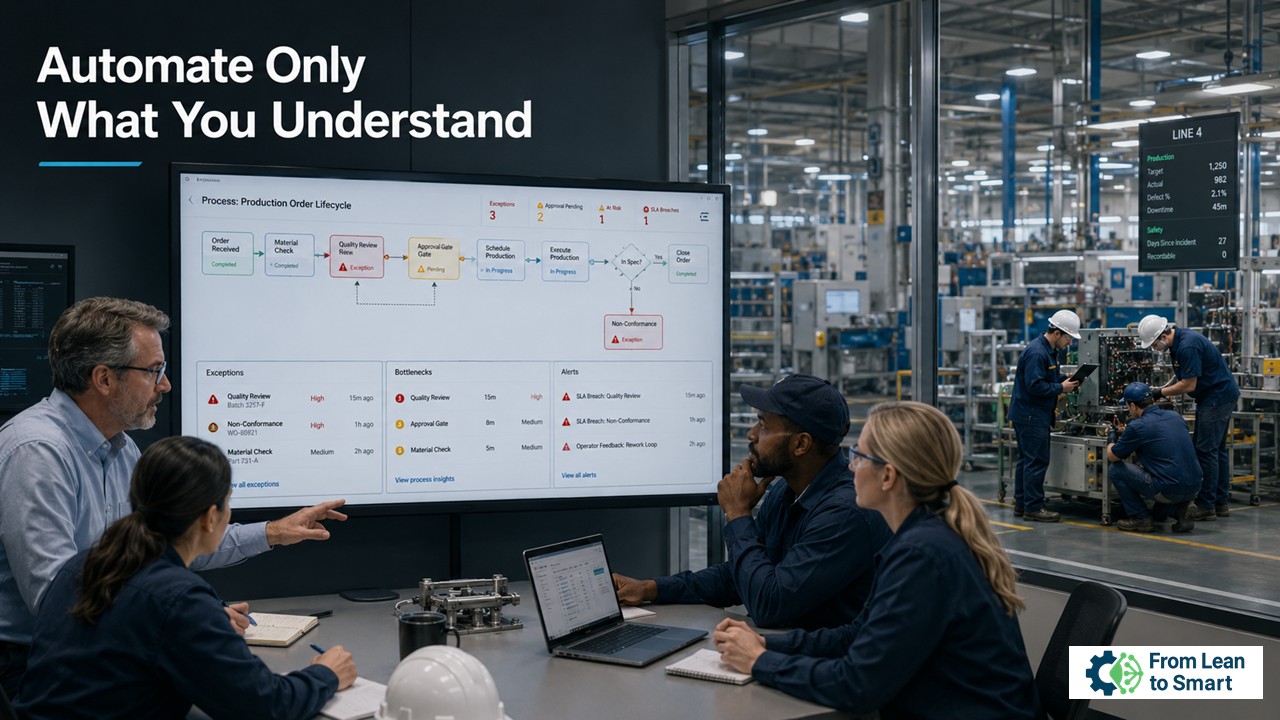
Before automating a process, we should understand what kind of work it really is.
Automation is attractive.
It promises speed, consistency, control and efficiency.
It removes manual work.
It reduces waiting time.
It eliminates repetitive tasks.
It gives leaders the feeling that the organization is becoming more mature, more digital and more scalable.
And in many cases, automation is exactly the right answer.
A repetitive approval with clear rules should probably be automated.
A standard data transfer between systems should not depend on manual re-entry.
A routine notification should not require someone to remember sending an email.
A simple validation should not wait for a meeting.
There is real value in automating predictable work.
But there is also a trap.
Many organizations assume that if a process is painful, it should be automated.
That assumption is dangerous.
Because some processes are not painful because they are manual.
They are painful because they are unclear, unstable, cross-functional, poorly governed or full of exceptions.
Automating that kind of process does not create excellence.
It creates faster dysfunction.
Not every process wants to be automated.
Some processes first need to be understood, stabilized, governed or redesigned.
The problem is not automation. The problem is automating too early.
This is especially true in industrial operations.
Factories are full of processes that look repetitive from a distance, but become highly contextual when seen from the shopfloor.
A maintenance intervention may look like a work order workflow.
But once the technician reaches the machine, reality may change.
The symptom may not match the initial report.
The failure may be intermittent.
The required spare part may not be available.
Production may be pushing to restart.
Quality may be concerned about product already produced.
Engineering may need to be involved.
At that point, the process is no longer just a workflow.
It is a case.
A quality deviation may look like a nonconformity process.
But the real work begins when people must decide whether to block stock, continue production, perform additional checks, inform the customer, request engineering judgment or accept a controlled deviation.
Again, this is not only a sequence of steps.
It is a decision under uncertainty.
A production rescheduling process may look like a planning adjustment.
But the planner may be balancing material availability, changeover losses, customer priority, machine capacity, operator skill, maintenance windows and supplier constraints.
That is not simple workflow automation.
That is operational negotiation.
The problem is not automation itself.
The problem is automating work before understanding what kind of work it is.
Different work needs different management logic
Not all work behaves the same way.
Some work is transactional.
Some work is procedural.
Some work is collaborative.
Some work is diagnostic.
Some work is exception-driven.
Some work is judgment-based.
Each type of work requires a different management logic.
When we treat all work as workflow, we force reality into the wrong shape.
This is where many digital transformation programs struggle.
They begin with the right ambition: reduce manual effort, improve visibility, standardize execution and increase control.
But they move too quickly from process pain to automation requirements.
The workshop question becomes:
“How can we automate this?”
Sometimes the better question is:
“Why does this process behave this way?”
That question is less exciting.
But it is much more useful.
A process may be slow because nobody owns the decision.
It may be inconsistent because the standard is unrealistic.
It may depend on emails because the system does not support exceptions.
It may require manual corrections because master data is poor.
It may generate rework because upstream quality is unstable.
It may involve too many approvals because risk ownership is unclear.
If those issues are not addressed, automation becomes a digital layer over an immature operating model.
The process becomes faster.
But not better.
In some cases, it becomes worse.
Bad automation removes flexibility without adding better logic
Before automation, experienced people often compensate for process weakness.
They interpret context.
They know when to escalate.
They understand which exception matters.
They call the right person.
They protect the operation from bad rules.
After automation, the system may remove that flexibility without replacing it with better decision logic.
The result is predictable.
People bypass the tool.
Exceptions move outside the workflow.
Approvals become mechanical.
Data quality deteriorates.
Supervisors lose trust in the system.
Operations creates a parallel process to get work done.
Then leaders call it resistance to change.
Often, it is not resistance.
It is the organization defending itself from badly automated assumptions.
This is why automation should not be treated as a universal sign of maturity.
A mature organization does not automate everything.
A mature organization knows what should be automated, what should be standardized, what should be guided and what should remain under human judgment.
That distinction is becoming more important.
Industrial operations are increasingly dynamic.
Product mix changes faster.
Supply chains create more variability.
Maintenance decisions depend on asset condition and production priorities.
Quality events require risk-based thinking.
MES/MOM systems expose more real-time deviations.
Process Mining reveals more variants.
AI introduces new possibilities for decision support.
In this environment, the most valuable capability is not simply automation.
It is adaptability with control.
Some processes need orchestration, not automation
We need to move beyond the idea that the future of operations is a fully automated end-to-end workflow.
Some processes will benefit from that.
Many will not.
The future factory will still need judgment.
Not because people are better than systems at everything.
They are not.
But because many operational situations involve ambiguity, trade-offs, incomplete information and accountability.
And accountability cannot be delegated blindly to automation.
This is where the distinction between automation and orchestration matters.
Automation executes predefined steps with minimal human intervention.
Orchestration coordinates people, systems, information, rules and decisions around a situation that may evolve.
In stable processes, automation is powerful.
In complex operational cases, orchestration is often more appropriate.
A standard inspection can be automated.
A complex quality investigation must be orchestrated.
A routine preventive maintenance task can be automated.
A recurring failure with unclear root cause must be orchestrated.
A basic material movement can be automated.
A critical shortage affecting production priorities must be orchestrated.
A simple purchase approval can be automated.
A supplier disruption affecting customer delivery must be orchestrated.
The mistake is using the same logic for all of them.
When everything becomes a workflow, exceptions become failures of the workflow.
But in real operations, exceptions are often the work.
Automation should begin with process truth
Traditional BPM asks us to define the process.
That remains useful.
But operational reality asks us to also define how the process behaves when the case does not follow the standard path.
Who is involved?
What context matters?
What options are available?
Which risks require escalation?
What evidence is needed?
Which decisions must be recorded?
What should the system learn from the outcome?
These questions are not anti-automation.
They make automation safer.
Because the goal is not to keep work manual.
The goal is to avoid automating ignorance.
A good automation strategy should begin with a simple test:
Is the process stable enough?
Are the rules clear enough?
Is the data reliable enough?
Are exceptions understood?
Are decision rights defined?
Are roles accountable?
Does the process create value, or does it only move tasks?
When the answer is yes, automate with confidence.
When the answer is no, be careful.
The process may need standardization first.
Or simplification.
Or better master data.
Or clearer ownership.
Or redesigned escalation logic.
Or a case management approach instead of a workflow.
Lean still matters before digitalization
This is where Lean thinking remains essential.
Before automating, we should still ask:
What is value-added?
What is waste?
What creates waiting?
What causes rework?
What hides problems?
What prevents flow?
Digital tools do not remove the need for operational discipline.
They amplify the consequences of its absence.
Automating waste does not make it value.
Automating ambiguity does not make it clarity.
Automating escalation does not make it accountability.
Automating rework does not make it improvement.
It only makes the organization move faster around the same problem.
There is also a human dimension.
When organizations automate without understanding the work, they often remove the visible task but keep the invisible burden.
People no longer perform the old manual step.
But they now spend time correcting exceptions, explaining system behavior, recovering blocked cases or creating parallel controls.
The burden changes shape.
It does not disappear.
Frontline experience is process intelligence
This is why frontline involvement is critical.
Operators, supervisors, planners, maintenance coordinators, quality engineers and logistics teams know where the process breaks.
They know which fields are meaningless.
They know which approvals are symbolic.
They know which workarounds are dangerous.
They know which exceptions happen every week.
Their experience is not noise.
It is process intelligence.
Ignoring it leads to elegant automation that fails in practice.
A serious automation program should respect operational knowledge enough to challenge it and learn from it.
Not every workaround should be preserved.
Some must be eliminated.
But every recurring workaround should be understood before it is automated away.
Because sometimes the workaround is the only honest signal that the official process does not work.
This is also where Process Mining can help.
It can reveal variants, loops, waiting time, rework and paths that were never designed.
But the purpose is not simply to identify automation candidates.
The purpose is to understand process behavior.
A high-volume repetitive path may be a good candidate for automation.
A high-variation path may be telling a different story.
It may indicate poor standardization, unclear decisions, unstable inputs or legitimate operational complexity.
The solution may not be automation.
It may be better governance.
Digital maturity is not measured by the number of automated workflows
This is an important message for leaders.
Digital maturity is not measured by how many workflows have been automated.
It is measured by whether the organization can manage work with clarity, discipline and adaptability.
Sometimes that requires automation.
Sometimes it requires better standards.
Sometimes it requires stronger ownership.
Sometimes it requires case management.
Sometimes it requires human-in-the-loop decision support.
Sometimes it requires stopping the process and redesigning it from the beginning.
The most mature decision is not always to automate.
Sometimes the most mature decision is to wait.
Not because the organization is afraid of technology.
But because it understands the cost of scaling bad process logic.
Once a broken process is automated, it becomes harder to challenge.
The system gives it legitimacy.
People adapt around it.
Reports are built on it.
Compliance is measured against it.
Deviations are blamed on users instead of design.
Bad automation becomes institutionalized.
That is why automation requires humility.
The question should not be only:
“Can we automate this process?”
In many cases, the answer will be technically yes.
The better question is:
“Does this process deserve to be automated in its current condition?”
That question changes everything.
It forces the organization to look at stability, accountability, exceptions, risk, data and operational judgment.
It prevents the organization from confusing speed with maturity.
It reminds us that the purpose of transformation is not to remove humans from every process.
The purpose is to make operations perform better.
The real capability is knowing the difference
Some processes are ready for automation.
Some need redesign.
Some need orchestration.
Some need decision support.
Some need to remain human-led, but better governed.
Understanding the difference is becoming one of the most important capabilities in industrial transformation.
Because not every process wants to be automated.
Some processes are asking for something more intelligent:
Clarity before speed.
Governance before digitalization.
Adaptability before rigidity.
Accountability before automation.
The future of industrial transformation is not automation everywhere.
It is automation where the process is ready, orchestration where the work is complex and governance where accountability matters.
Because the real question is not whether a process can be automated.
The real question is whether it deserves to be automated.
#BPM #OperationalExcellence #SmartFactory #Automation #AdaptiveOperations #CaseManagement #MES #MOM #ProcessMining #IndustrialTransformation #ManufacturingOperations #DecisionOrchestration