Why manufacturing execution systems should be treated as operating model design, not only system implementation
For many years, BPM and MES/MOM have lived in different conversations.
BPM was discussed in process offices, transformation programs, quality systems, shared services and enterprise architecture.
MES and MOM were discussed in factories, production meetings, automation programs, manufacturing IT and operational excellence initiatives.
One language was about process models, workflows, ownership, governance and improvement.
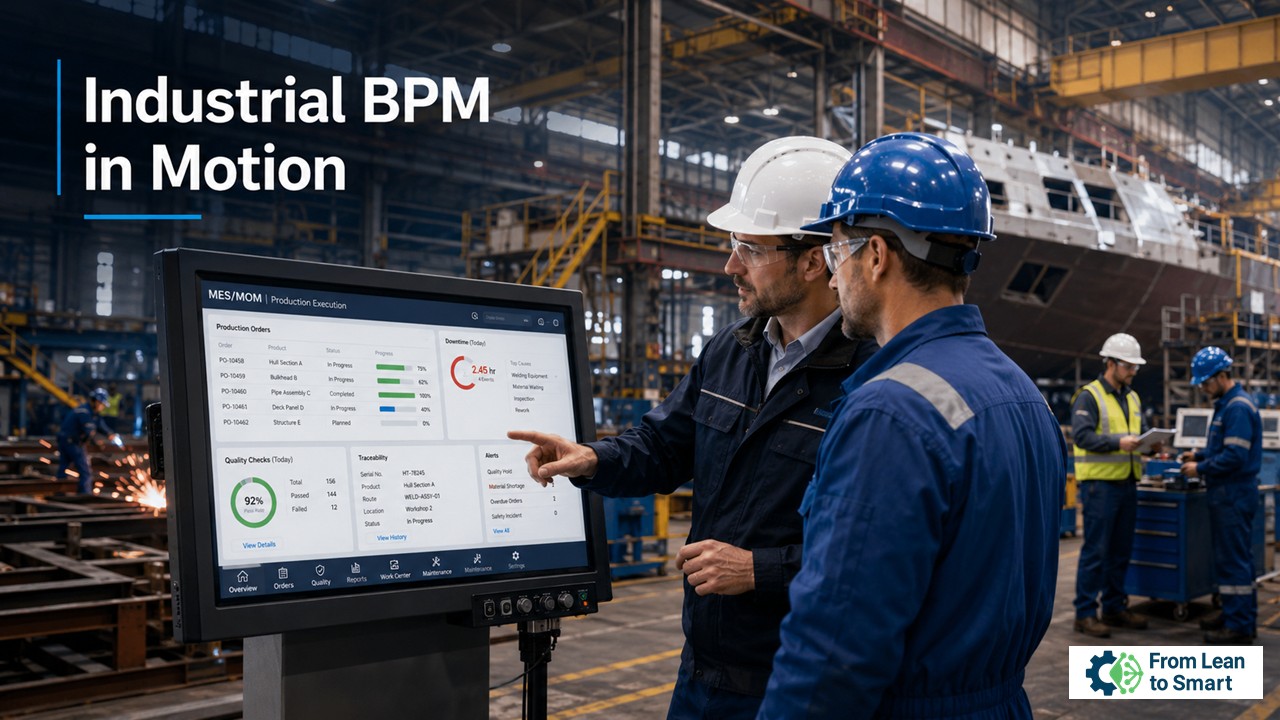
The other was about production orders, work instructions, traceability, machine status, quality checks, downtime, material consumption, labor reporting and operational execution.
But in industrial environments, this separation is becoming harder to justify.
Because when MES/MOM is implemented seriously, it is not just a manufacturing system.
It becomes the operational process layer of the factory.
MES/MOM is often the closest thing industry has to real BPM on the shopfloor.
Not BPM as documentation.
Not BPM as a repository.
Not BPM as a workshop output.
But BPM as the daily execution of work, standards, controls, deviations, decisions and accountability inside the plant.
MES/MOM is industrial BPM in motion.
That distinction matters.
MES/MOM is not only a technical implementation
Many organizations still treat MES/MOM as a technology deployment.
They define interfaces, screens, transactions, master data, terminals, equipment connections and integration with ERP or automation systems.
All of that is necessary.
But it is not enough.
A weak MES/MOM implementation does not fail only because of technology.
It often fails because the organization did not understand that it was redesigning how the factory works.
A production order is not just a system object.
It is a commitment to execute work under specific constraints.
A work instruction is not just a digital document.
It is a standard made visible at the point of execution.
A quality check is not just a data entry field.
It is a control point that protects the customer and the process.
A downtime code is not just a reporting category.
It is the beginning of a reliability conversation.
A deviation workflow is not just an approval path.
It is a decision structure for risk, containment and accountability.
When viewed this way, MES/MOM becomes much more than software.
It becomes a process management layer embedded in daily operations.
And that changes the implementation question.
The question is not only:
“What should the system do?”
The better question is:
“How should the factory operate when this system becomes part of daily work?”
That is an operating model question.
Not only an IT question.
The process becomes real at the point of execution
Traditional BPM often struggles to reach the shopfloor because it remains too far from execution.
It describes how work should happen, but it does not always participate in the moment where work actually happens.
MES/MOM is different.
It operates inside production reality.
It knows whether the order has started.
It knows which machine is running.
It knows which operator is assigned.
It knows whether the material is available.
It knows whether the quality check was completed.
It knows whether the line is stopped.
It knows whether the process is deviating from standard.
That proximity gives MES/MOM a level of operational relevance that traditional BPM often lacks.
But proximity alone does not create value.
Many MES/MOM programs digitize transactions without improving the process logic behind them.
They replace paper with screens.
They add data capture.
They automate reporting.
They connect machines.
They improve visibility.
Yet the operational behaviors remain the same.
Supervisors still chase missing information.
Maintenance still receives incomplete downtime context.
Quality still intervenes late.
Planning still releases unrealistic schedules.
Operators still bypass screens that do not help them.
Managers still debate whose numbers are correct.
The system is digital.
But the process is still fragmented.
This is why MES/MOM should not be approached only as a system implementation.
It should be approached as a process transformation program with industrial consequences.
MES/MOM should make the factory more executable
A serious MES/MOM implementation should make the factory more executable, not just more visible.
That means the system must support the real rhythm of operations:
The start of shift.
The release of work.
The confirmation of material.
The execution of operations.
The detection of deviations.
The escalation of problems.
The containment of quality risk.
The recording of downtime.
The management of rework.
The handover between shifts.
The learning after recurring issues.
These are not just transactions.
They are process moments.
And each process moment has consequences.
If the operator cannot trust the work instruction, the process weakens.
If downtime coding is ambiguous, reliability analysis weakens.
If quality checks are disconnected from production flow, containment weakens.
If material consumption is recorded late, inventory accuracy weakens.
If deviations are approved without context, governance weakens.
If supervisors use the system only after the fact, operational control weakens.
MES/MOM exposes whether the process is truly operational.
It also exposes whether the organization is ready for discipline.
That can be uncomfortable.
Before MES/MOM, many factories survive on informal coordination.
Experienced people know what to do.
Supervisors know who to call.
Operators know which machine behaves badly.
Maintenance knows which failure is likely to repeat.
Quality knows where risk usually appears.
Planning knows which schedule will not survive the first shift.
This knowledge is valuable.
But if it remains informal, the factory becomes dependent on memory, relationships and heroics.
MES/MOM forces a choice.
Either the organization converts operational knowledge into executable standards, or the system becomes an administrative burden.
There is no middle ground.
A poorly designed MES/MOM asks people to feed the system.
A well-designed MES/MOM helps people run the operation.
That difference is enormous.
The system must help at the point of need
Operators should not experience MES/MOM as an obstacle between them and production.
Supervisors should not experience it as another reporting layer.
Maintenance should not receive downtime data that is too generic to be useful.
Quality should not discover deviations after the process has already moved forward.
Planning should not release work into a system that does not reflect real constraints.
The system must help at the point of need.
This is where BPM thinking becomes essential.
BPM asks:
How does work flow?
Who owns it?
Where is control required?
How are exceptions managed?
How are decisions made visible?
How does improvement happen?
Those are exactly the questions MES/MOM projects should ask.
But too often, MES/MOM projects are driven mainly by functional requirements.
The result is predictable.
The system technically works, but the factory does not feel transformed.
Screens exist, but decisions remain unclear.
Data exists, but accountability remains weak.
Dashboards exist, but daily management does not change.
Workflows exist, but exceptions are still handled outside the system.
This is not a technology failure.
It is an operating model failure.
A plant can implement MES and still have poor process maturity.
It can capture production data and still lack ownership.
It can digitize work instructions and still tolerate outdated standards.
It can record downtime and still avoid the reliability decisions that the data demands.
MES/MOM does not automatically create operational excellence.
But it makes the gap between aspiration and reality harder to ignore.
That is useful — if leaders are prepared to act.
Downtime management is not only data capture
Consider downtime management.
In many factories, downtime is recorded because the system requires it.
Operators select a code, sometimes under pressure, sometimes after the event, sometimes with limited precision.
Reports are generated.
Pareto charts are reviewed.
Actions are discussed.
But the same losses return.
Why?
Because downtime management is not only a data capture process.
It is a cross-functional accountability process.
The system should help answer:
Was the failure detected correctly?
Was the response time visible?
Was maintenance called at the right moment?
Was the root cause understood?
Was the temporary fix documented?
Was production pressure influencing the repair decision?
Was the issue repeated?
Who owns recurrence prevention?
If MES/MOM captures only the downtime event but not the decision logic around it, the process remains incomplete.
The same applies to quality.
A digital quality check can confirm that an inspection was performed.
But the real process begins when the result is abnormal.
What happens next?
Who decides containment?
Can production continue?
Is the batch blocked?
Is engineering required?
Is the customer at risk?
Is rework allowed?
What evidence is needed?
This is not just a quality workflow.
It is operational case management emerging inside MES/MOM.
That is an important signal.
The closer MES/MOM gets to real operations, the more it must manage not only standard execution, but also exceptions, deviations, investigations and decisions under uncertainty.
This is where the boundary between MES/MOM and BPM becomes less clear.
And perhaps that is a good thing.
MES/MOM sits at the center of the industrial operating system
Industrial companies do not need separate conceptual worlds.
They need a coherent operating system where strategy, process, execution, data and decisions are connected.
ERP may define the business plan.
MES/MOM translates that plan into operational execution.
BPM provides governance and process logic.
Lean provides discipline and improvement habits.
Process Mining reveals how work actually behaves.
AI may eventually support decisions — but only if the process foundation is mature.
MES/MOM sits at the center of this reality.
It is where the planned process meets physical execution.
That makes it one of the most strategic platforms in industrial transformation.
But only if it is treated that way.
If MES/MOM is treated as a production reporting tool, its value will be limited.
If it is treated as a compliance system, people will feed it because they must.
If it is treated as an automation project, it may digitize bad assumptions.
But if MES/MOM is treated as industrial BPM, the conversation changes.
Implementation is no longer only about screens and interfaces.
It becomes about how the factory should operate.
What is the standard?
Where must the system enforce it?
Where must people retain judgment?
What deviations require escalation?
Which decisions must be documented?
What data is needed for daily management?
How does the process learn from execution?
Who owns the end-to-end outcome?
These are not only system design questions.
They are leadership questions.
MES/MOM design is operating model design
MES/MOM programs require strong operational ownership.
They cannot be delegated entirely to IT, automation or external implementation teams.
Those teams are essential.
But they cannot define the operating model alone.
The people who understand production pressure, maintenance constraints, quality risk, planning instability and shopfloor behavior must be deeply involved.
Otherwise, the system will reflect a simplified version of the factory.
And simplified factories do not exist.
The strongest MES/MOM implementations are not the ones with the most functionality.
They are the ones where the digital process matches the real operating discipline the organization wants to build.
That requires choices.
Do we want operators to confirm every step, or only critical steps?
Do we want supervisors to manage exceptions in real time, or review them later?
Do we want quality holds to stop production automatically, or trigger controlled decision-making?
Do we want maintenance integration to capture every failure, or only meaningful reliability events?
Do we want dashboards for visibility, or for action?
There is no universal answer.
The right answer depends on operational maturity, risk profile, product complexity, regulatory requirements, culture and leadership discipline.
But the questions must be asked.
Because MES/MOM will shape behavior.
Every mandatory field, every workflow, every screen, every alert, every integration and every exception rule teaches people how the organization expects work to be done.
That is why MES/MOM design is process design.
And process design is management design.
From digital transactions to governed execution
The future of MES/MOM will increasingly move beyond transaction execution.
Factories will need systems that help manage ambiguity, not just record activity.
They will need guided exceptions, contextual escalation, decision support, integrated performance learning and stronger links between process execution and operational governance.
Not fully autonomous factories.
Not science fiction.
Just better support for the reality that operations already live every day.
The factory of the future will not run only on workflows.
It will run on a combination of:
Standards.
Cases.
Decisions.
Data.
Human judgment.
Governed intelligence.
MES/MOM can become the backbone of that evolution.
But only if we stop seeing it as just a system.
It is the place where industrial process management becomes real.
The process is not real because it is documented.
It is real because it is executed.
It is real because deviations are controlled.
It is real because decisions are visible.
It is real because accountability exists where the work happens.
That is the promise of MES/MOM as industrial BPM.
Not more digital bureaucracy.
Not more screens for the shopfloor.
But a more disciplined, visible and adaptive way to run operations.
Because in manufacturing, BPM does not truly arrive when the process is approved.
It becomes real when the process can guide the next shift.
#MES #MOM #BPM #OperationalExcellence #SmartFactory #ManufacturingOperations #IndustrialTransformation #ProcessGovernance #ProcessMining #DigitalManufacturing