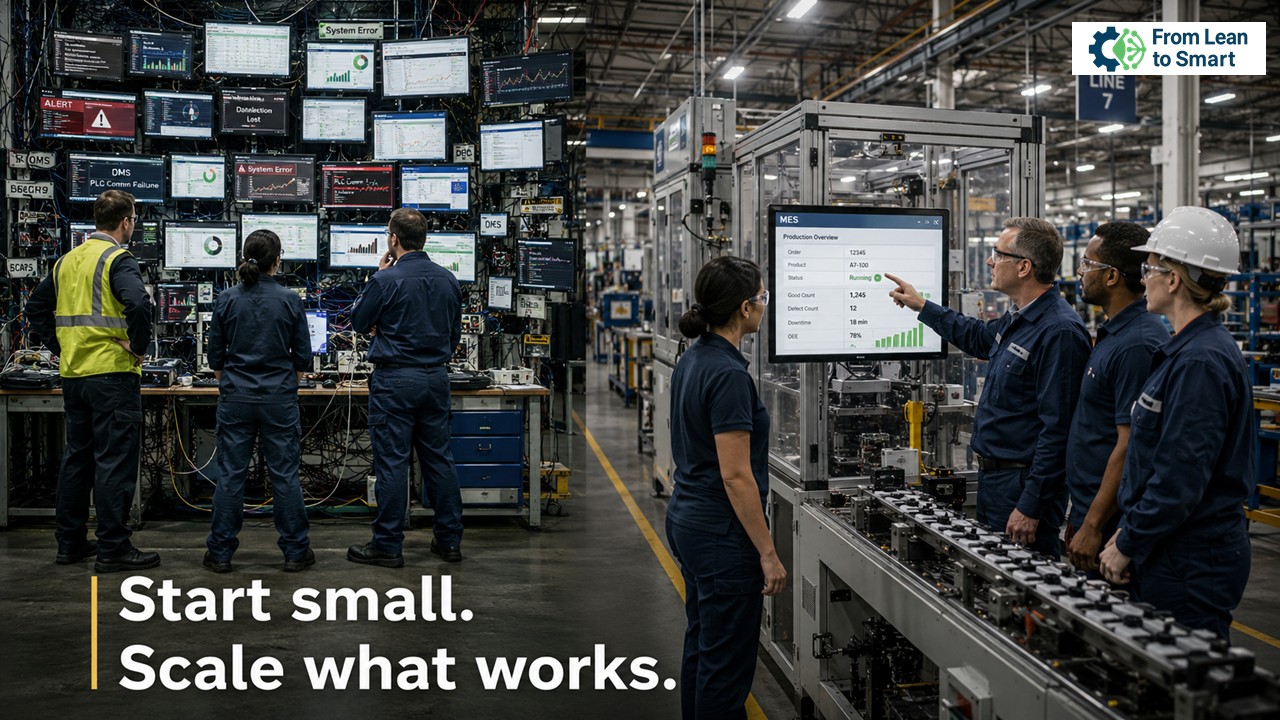
Start small does not mean think small. It means scale what has already proven value on the shopfloor.
Many MES/MOM projects fail not because the technology is weak.
They fail because the ambition becomes too broad, too early.
A factory wants visibility, traceability, OEE, electronic work instructions, quality checks, ERP integration, alerts, dashboards, maintenance links and real-time performance management.
All of that may be reasonable.
But when everything becomes the first phase, nothing is really the first priority.
This is where progressive MES implementation becomes powerful.
Not as a way to reduce ambition.
Not as a way to avoid complexity.
But as a way to build operational credibility before scaling digital complexity.
A progressive MES implementation starts with a limited but meaningful operational scope. It tests whether people, processes, data and systems can work together in real production conditions.
The goal is not to start small forever.
The goal is to scale something that has already proven it can work.
MES value is proven on the shopfloor
MES and MOM are often discussed as enterprise platforms.
That makes sense.
Manufacturing companies want standardization, integration and governance across plants. They want common templates, reliable data, scalable architecture and consistent execution.
But MES value is not created at corporate level first.
It is proven on the shopfloor.
With operators.
With supervisors.
With planners.
With quality teams.
With maintenance teams.
With production managers.
With real orders, real constraints and real decisions.
Starting small usually wins because it forces the organization to answer practical questions before the architecture becomes too large:
Which production event really matters?
Who owns the reason code?
Which master data is reliable enough?
Which signal from the machine can be trusted?
Which decision will change when the information becomes visible?
Which daily routine will use the data?
These questions are not secondary.
They are the foundation of MES value.
A progressive MES implementation does not mean installing a small tool and hoping it grows.
It means implementing a controlled slice of capability that connects people, process, data and systems in a way that can be tested, stabilized and repeated.
The mistake many companies make is to confuse small scope with small value.
A well-designed first MES use case can expose the real condition of the factory better than a large implementation roadmap that only exists in PowerPoint.
What progressive MES implementation really means
A progressive MES implementation is a staged deployment approach.
Instead of trying to digitize the entire factory at once, the organization selects a limited but meaningful operational scope.
That scope could be:
One production line.
One production area.
One product family.
One plant.
One critical use case.
For example:
Downtime capture.
Production confirmation.
Quality checks.
Electronic batch records.
Material traceability.
OEE and shift performance review.
But the first step must be complete enough to create a real operational loop.
It should not be only a dashboard.
It should not be only machine connectivity.
It should not be only data collection.
It should not be only an IT pilot.
A useful first MES scope normally includes four elements:
1. A real production process
The scope must be connected to actual work, not only to system functionality.
2. A clear operating routine
People must know how the information will be used during the shift, in daily meetings and in follow-up actions.
3. A minimum viable integration
ERP, MES, automation and reporting do not need to be fully integrated from day one, but they must be connected enough to test the real process.
4. A decision-making mechanism
The data must change something: what supervisors review, what maintenance investigates, what quality escalates or what production improves.
For example, collecting downtime automatically is useful only if the team reviews the losses, corrects wrong reason codes, acts on recurring issues and connects improvement actions to the production meeting.
Otherwise, the company has not implemented operational intelligence.
It has implemented digital decoration.
The vertical slice: small scope, serious architecture
MES sits between enterprise planning and shopfloor execution.
At the top, ERP provides production plans, orders, materials, batches, routings, cost structures and inventory context.
At the bottom, PLCs, SCADA, HMI systems, historians, sensors and machines provide signals about actual execution.
MES/MOM connects these two worlds and adds operational meaning:
What was produced.
When it was produced.
By whom.
With which material.
Under which conditions.
With which quality result.
With which deviations.
A progressive MES implementation should avoid two extremes.
The first extreme is the isolated shopfloor pilot.
A local team connects machines, builds screens and collects useful data, but the solution has no real relationship with ERP, master data, production orders or standard reporting.
It creates enthusiasm.
But it cannot scale.
The second extreme is the enterprise architecture program that spends months designing interfaces, templates and governance without proving whether the shopfloor process can actually use the system.
It creates structure.
But it may remain disconnected from execution.
The practical path is usually a vertical slice.
A vertical slice connects a limited part of the architecture end to end.
For example:
ERP sends production orders to MES.
MES manages execution on one line.
Machine signals capture counts and stops.
Operators confirm reason codes.
Quality records key checks.
MES sends production and consumption confirmations back to ERP.
Supervisors review shift performance using a standard routine.
This is small in scope.
But it is not superficial.
It tests the real architecture.
Depending on the use case, the first implementation may also touch CMMS/EAM for maintenance-related losses, QMS or LIMS for quality decisions, WMS for material staging, BI tools for management reporting, edge systems for connectivity or cloud platforms for broader analytics.
But the principle remains the same:
Integrate only what is needed to close the operational loop, and design it in a way that can scale later.
MES should change behavior, not only improve visibility
Operational Excellence is not improved by visibility alone.
It improves when visibility changes behavior.
A progressive MES implementation helps because it brings digital capability closer to daily management.
The first value is often not advanced analytics.
It is basic operational discipline becoming visible.
Are production orders started and closed correctly?
Are downtime reasons captured consistently?
Are quality checks performed at the right moment?
Are scrap and rework visible by process step?
Are material movements aligned with actual consumption?
Are supervisors and operators looking at the same version of performance?
Are improvement teams working from evidence rather than opinion?
This matters for OEE, downtime reduction, cost per unit, quality losses, traceability, standard work and maintenance coordination.
But it also matters for trust.
When operators see that MES data is used only for control or blame, the system becomes a reporting burden.
When they see that it helps remove recurring problems, improve changeovers, reduce firefighting or clarify priorities, adoption becomes more realistic.
Starting small allows the organization to build that trust.
It gives time to adjust reason codes, train supervisors, fix master data, tune machine signals, clarify ownership and align production meetings around the new information.
This also helps avoid a common failure mode:
A company has a powerful MES platform, but weak operational routines.
The system collects data accurately.
But the factory still makes decisions as before.
That is not transformation.
That is digital reporting without operational change.
Common MES implementation mistakes
1. The big-bang program
The company tries to implement multiple modules, plants, integrations and reporting layers at once.
The project becomes heavy, slow and politically exposed.
When issues appear, it becomes difficult to know whether the problem is technical, organizational, process-related or master-data-related.
2. The first use case is too easy to matter
A screen showing real-time production counts may look good.
But if no one uses it to manage the shift, it will not change performance.
A first scope should be manageable, but it must also be important enough to create real operational learning.
3. Treating the first phase as a technical pilot
MES is not validated only when the interface works.
It is validated when the process works with the interface.
That means the first deployment should test routines, roles, decisions, data ownership and follow-up mechanisms.
4. Copying ERP structures directly into MES
ERP may define routings, work centers and materials at a planning level.
MES often needs more execution detail:
Equipment hierarchy.
Stations.
Operations.
Reason codes.
Inspection points.
Labor roles.
Machine states.
Process parameters.
If this difference is ignored, the system may be technically integrated but operationally weak.
5. Connecting everything too early
More tags, more machines, more dashboards and more alerts do not automatically create more value.
Early MES value often comes from better context, not more data volume.
A few reliable events with clear ownership can be more useful than thousands of signals nobody trusts.
6. Underestimating change management
Operators may be trained on screens, but supervisors may not be trained on how to run better meetings.
Engineers may get reports, but no one defines how improvement actions will be tracked.
Planners may receive confirmations, but exceptions may still be handled manually.
The system goes live.
But the management routine does not.
And without the routine, the value does not stick.
A practical example: one packaging line before the whole plant
Consider a food packaging plant with several high-speed lines.
The company wants a full MES program:
OEE.
Downtime.
Material traceability.
Quality checks.
ERP integration.
Management dashboards.
Instead of starting with the entire plant, the team selects one packaging line with high volume, frequent stops and visible business impact.
The first scope is deliberately focused:
Production order execution.
Automatic good count capture.
Downtime event detection.
Operator reason-code assignment.
Basic scrap capture.
Shift performance review.
ERP sends the production order and product information to MES.
The line PLC provides running, stopped and count signals.
MES detects downtime events and asks the operator to confirm the reason when the stop exceeds a defined threshold.
The supervisor reviews the top losses at the end of each shift.
Maintenance is involved when repeated technical stops appear.
Process engineers review changeover losses.
Quality reviews scrap and hold events.
The first weeks are not perfect.
Some machine signals are noisy.
Operators use “Other” too often.
Some reason codes are unclear.
The equipment hierarchy does not match how the line team talks about the process.
The production meeting initially focuses on whether the numbers are right instead of what actions should be taken.
This is exactly why starting small helps.
The team corrects the signal logic.
They reduce and clarify the reason-code list.
They agree on ownership for top losses.
They adjust the shift review routine.
They define which events require maintenance follow-up and which are process-related.
They align ERP confirmations with real production completion.
After stabilization, the plant has more than a working MES screen.
It has a tested operating pattern.
When the second line is deployed, the team brings better reason codes, clearer training material, stronger master data and a more realistic integration model.
The value was not created by the first line alone.
It was created by learning how to scale without multiplying confusion.
What “stable enough to scale” should mean
Progressive implementation only works if the organization is honest about readiness.
Before scaling, the first scope should prove more than technical functionality.
It should prove that the operating model is stable enough to repeat.
A useful scale-readiness check should include:
The first scope is small enough to manage, but important enough to matter.
The selected use case has a clear operational decision behind it.
The shopfloor process has been observed directly, not only described in workshops.
ERP, MES and automation data structures are aligned at the minimum required level.
Machine signals are reliable enough for the intended purpose.
Reason codes, equipment hierarchy and production states have clear owners.
Operators and supervisors understand how the information will be used.
Daily management routines have changed after go-live.
The first deployment can become a repeatable pattern, not a local exception.
The team has defined what “stable enough to scale” really means.
This last point is critical.
Without a clear definition of scale readiness, companies often scale too early.
They multiply screens.
They multiply interfaces.
They multiply reports.
But they also multiply unclear ownership, weak routines, poor master data and unresolved process logic.
That is how digital complexity grows faster than operational maturity.
Start small, but do not think small
Progressive MES implementation is not about lowering ambition.
It is about sequencing ambition intelligently.
The question is not:
“How much MES functionality can we deploy in phase one?”
The better question is:
“What operational capability must we prove before scaling?”
That question changes the project.
It shifts attention from modules to decisions.
From screens to routines.
From interfaces to ownership.
From data capture to operational learning.
From rollout speed to scale quality.
This is the mindset industrial companies need.
Because MES/MOM implementation is not only a software journey.
It is a transformation of how the factory sees, decides, acts and improves.
The first MES scope should behave like a business experiment, not only like a technical pilot.
The question is not whether the system can collect data.
The question is whether the organization can use that data to manage production differently.
That is why starting small usually wins.
Not because the final ambition is small.
But because the organization learns how to scale the right thing.
Start small does not mean stay small.
It means scale only what has proven it can work.
Reflection questions
Is your first MES scope designed to prove software functionality, or to prove a better way of managing operations?
Which operational decision should change after the first MES implementation goes live?
Are you scaling a validated operating model, or just multiplying screens, interfaces and reports?
#MES #MOM #Manufacturing #OperationalExcellence #SmartManufacturing #DigitalTransformation #ITOT #OEE #Industry40