Why the real challenge is not prediction, but governed operational decision-making
Industrial AI often enters the factory with a powerful promise:
Predict earlier. React faster. Automate decisions. Reduce downtime. Improve quality. Make operations more intelligent.
The ambition is valid.
AI can clearly improve industrial performance when it is connected to real operational needs. Predictive maintenance, quality analytics, process optimization, computer vision and AI agents can all create value.
But there is a dangerous assumption behind many industrial AI initiatives:
That AI can compensate for weak operational thinking.
It cannot.
If a factory does not understand how decisions are made today, AI will not magically create better decisions tomorrow.
It may create more alerts.
More dashboards.
More recommendations.
More meetings.
But not necessarily better outcomes.
The real challenge is not only whether the algorithm works.
The more important question is:
Is the organization ready to act on what the algorithm says?
Prediction is not the same as operational intelligence
Imagine an AI model that predicts a potential bearing failure on a critical asset.
Technically, the model may be accurate.
But the real operational decision is not simply:
“The model says there is a risk, so replace the bearing.”
In a real factory, that decision depends on many factors:
Asset criticality.
Safety exposure.
Production plan.
Maintenance window.
Spare parts availability.
Quality risk.
Backlog.
Customer commitments.
Credibility of the signal.
Consequences of acting too early or too late.
This is where many industrial AI initiatives become fragile.
They focus heavily on prediction quality, while the real factory problem is often decision quality.
A prediction only creates value when the organization can interpret it, prioritize it, challenge it, act on it and learn from the result.
Without that discipline, AI becomes another layer of operational noise.
Broken operations do not become intelligent by adding algorithms
Many factories already show warning signs before any AI project starts.
Daily meetings discuss KPI deviations, but not root causes.
Maintenance and production argue about priorities without shared decision criteria.
Quality teams detect repeated issues, but corrective actions lose momentum.
Dashboards show losses, but nobody owns the decision logic behind the next action.
Supervisors rely on personal experience because systems do not reflect shopfloor reality.
Master data is treated as an IT problem, while operations continue surviving through informal workarounds.
In that environment, AI does not enter a clean system.
It enters a system full of exceptions, pressure, compromises and undocumented knowledge.
That is normal in real industrial environments.
But it also means that AI must be designed around operational reality, not around an ideal process diagram.
Before asking:
“What can we predict?”
A better question is:
“What decision are we trying to improve?”
If that question is not clear, the AI use case is already weak.
The missing layer is governance
Industrial AI needs more than data, models and dashboards.
It needs governance.
Not governance as bureaucracy.
Governance as operational clarity.
That means answering practical questions:
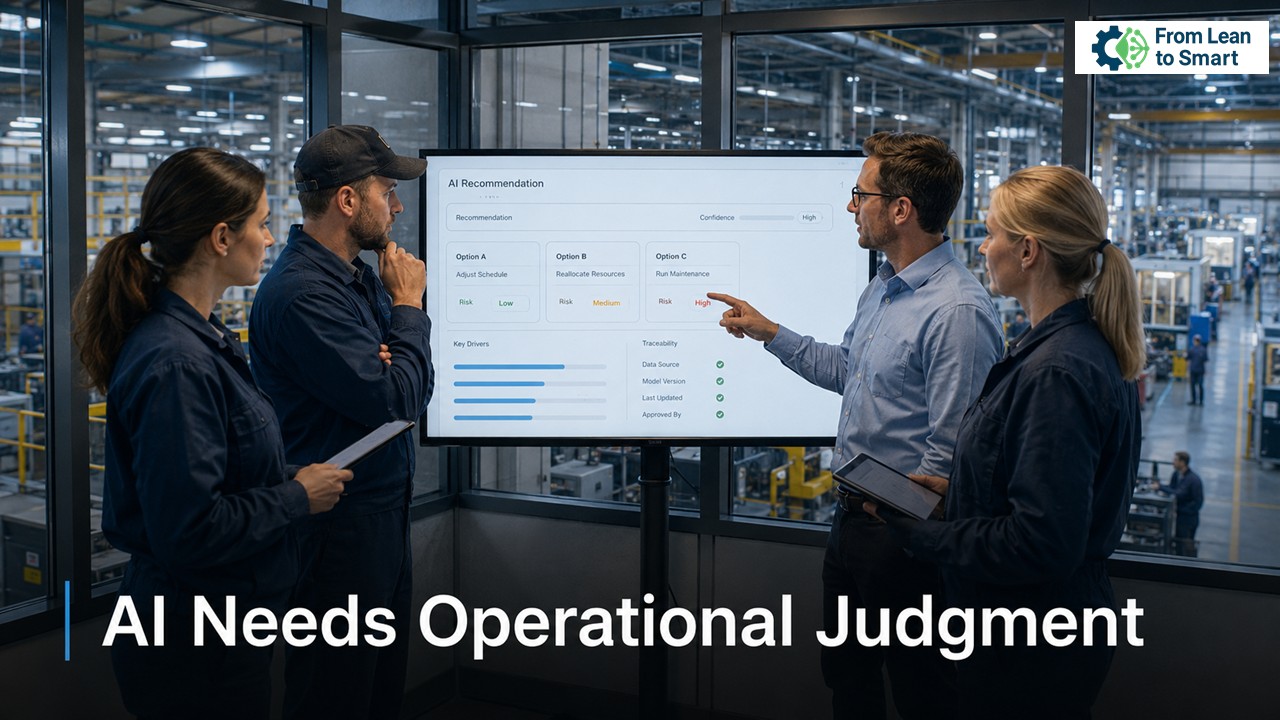
Who owns the decision influenced by AI?
Who validates the recommendation?
Who can override it?
What constraints must never be violated?
What evidence must be recorded?
How is the outcome reviewed?
How does the organization learn when the recommendation was wrong, incomplete or ignored?
These are not administrative details.
They are the difference between an impressive pilot and a real operational capability.
In manufacturing, decisions affect safety, quality, delivery, cost, asset life and customer trust.
They cannot be delegated blindly to a model.
But they also should not remain trapped in informal judgment, personal influence or undocumented experience.
The right ambition is not simply a fully autonomous factory.
The right ambition is:
Governed operational intelligence
AI needs Lean, BPM, MES/MOM and Reliability more than many people think
Industrial AI becomes stronger when it is connected to operational disciplines that already exist — or should exist.
Lean helps clarify standards, flow, abnormalities and problem-solving routines.
BPM helps define process ownership, exceptions, escalation paths and decision logic.
MES/MOM provides execution context, traceability and shopfloor evidence.
Maintenance and Reliability bring asset criticality, failure modes, intervention logic and lifecycle thinking.
Quality systems bring containment rules, genealogy, release criteria and corrective action discipline.
AI does not replace these disciplines.
It depends on them.
A model without process discipline is fragile.
A recommendation without operational context is incomplete.
An AI agent without ownership is risky.
A dashboard without decision rules is decoration.
The factories that succeed with AI will not be the ones that simply install the most algorithms.
They will be the ones that govern how AI influences operational decisions.
Start with decision maturity
A practical way to evaluate an AI opportunity is to describe it in decision language.
Not:
“We need AI for maintenance.”
Better:
“We need better prioritization of maintenance interventions under production pressure.”
Not:
“We need AI for quality.”
Better:
“We need faster interpretation of defect patterns connected to process parameters, material batches, recipes and containment actions.”
Not:
“We need AI agents.”
Better:
“We need role-based decision support that respects escalation rules, approved procedures, operational risks and human accountability.”
This shift matters.
It moves the conversation from technology capability to operational impact.
It forces the organization to clarify the decision, the owner, the context, the constraints and the learning loop.
Only then can AI become more than an impressive pilot.
Only then can it become part of the operating system of the factory.
The uncomfortable truth
Industrial AI will often expose weak operational thinking before it improves performance.
It will expose:
Poor master data.
Unclear ownership.
Unstable standards.
Disconnected systems.
Weak escalation logic.
Informal decision-making.
Lack of traceability.
Gaps between procedures and shopfloor reality.
That exposure should not be treated as resistance.
It should be treated as learning.
Because the future factory will not be intelligent simply because every process has an algorithm attached to it.
It will be intelligent because people, processes, systems and AI work together inside a governed decision system.
The competitive advantage will not come from having AI in the factory.
It will come from knowing how AI changes operational judgment.
And governing that change with discipline.
Questions for reflection
Which operational decisions in our factory are still driven more by urgency, habit or informal influence than by clear decision logic?
Are our AI initiatives improving real decisions, or are they mainly producing more predictions, alerts and dashboards?
Who is accountable when AI influences a production, maintenance or quality decision?
Do our systems reflect how the factory really works, or only how we wish it worked?
Are we building artificial intelligence on top of operational maturity, or using it to hide the lack of it?
#IndustrialAI #SmartFactory #OperationalExcellence #DecisionIntelligence #AIInManufacturing #DataGovernance #Manufacturing #Reliability #AssetManagement #LeanManufacturing #MES #MOM #PredictiveMaintenance #IndustrialTransformation #FactoryOfTheFuture