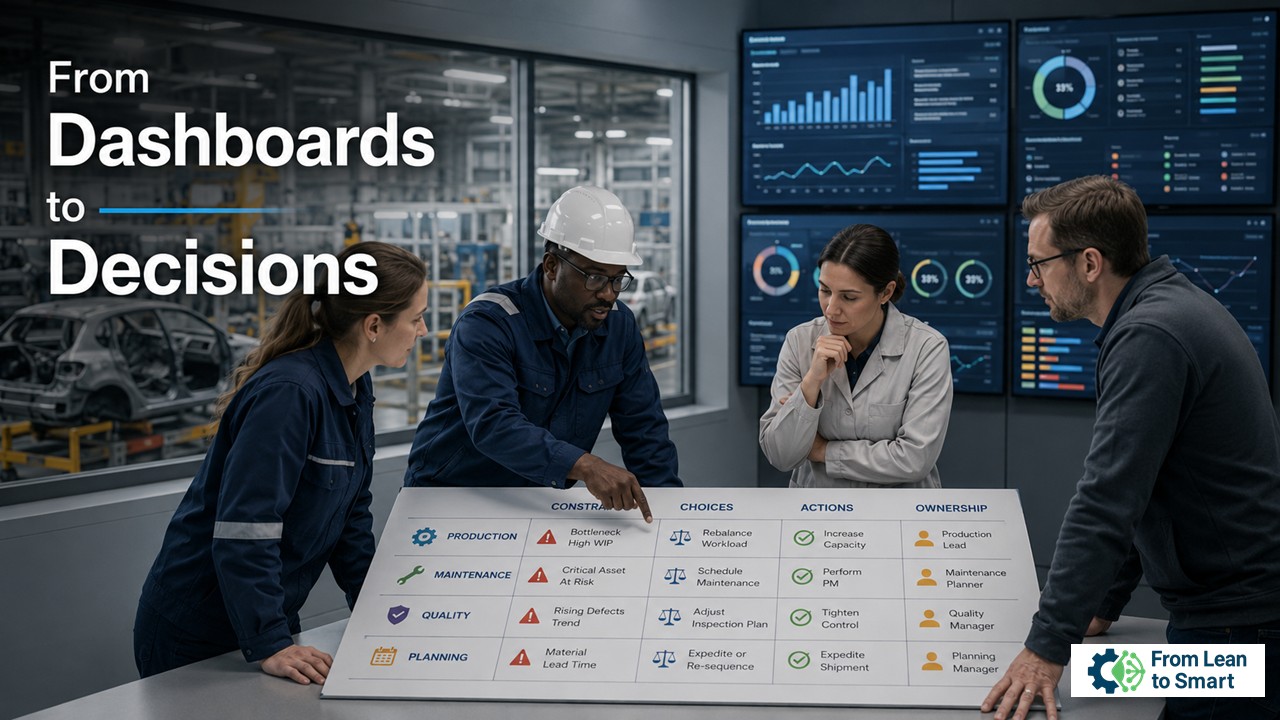
Many factories already have more dashboards than decisions.
Production teams monitor OEE. Maintenance teams review CMMS reports. Quality teams analyse defect trends. Planning teams follow schedule adherence. Engineering teams examine process capability data. Management teams review Power BI screens, daily KPIs, and monthly performance reports.
And yet, many operational meetings still end with the same unresolved question:
“So, what are we going to do?”
This is where the real problem becomes visible. Visibility is not the same as decision-making. A dashboard can show that performance is deteriorating. It can highlight downtime, scrap, backlog, deviations, energy consumption, or schedule instability. But it does not automatically clarify the trade-off, identify the decision owner, evaluate constraints, define the escalation path, or trigger a disciplined response.
Factories rarely struggle because they lack indicators. More often, they struggle because the organisation has not designed how decisions should be made when operational reality becomes complex.
Dashboards tell us what happened. Operations need to know what matters now, who must act, under which constraints, and with what level of risk.
A dashboard is usually built around data availability. Decision intelligence must be built around operational consequences.
That difference matters.
The Real Problem Is Not the Stoppage. It Is the Decision
Consider a line stoppage during the night shift.
The dashboard shows downtime. The Pareto chart shows a recurring failure mode. Maintenance receives an alert. Production sees the impact on output. Quality is concerned about restart conditions and potential rework. Planning sees customer risk. Finance sees cost.
Everyone sees part of the truth.
But the real decision is not simply: “The machine stopped.”
The real decision is more complex:
Should the team continue with a temporary fix until the next planned maintenance window? Should the line stop now? Should production be resequenced? Should safety stock be consumed? Should the issue be escalated? Should output be quarantined? Should the factory accept a short-term delivery loss to protect long-term reliability, quality, or safety?
That is not a dashboard problem.
It is a decision architecture problem.
The Factory Is a Decision System Under Pressure
In real operations, decisions are rarely made in ideal conditions. They are made with incomplete information, limited time, conflicting priorities, and people who are already managing multiple disturbances.
A production supervisor may know that a workaround is technically risky, but the shipment is late. A maintenance planner may know that an asset needs intervention, but the spare part is unavailable. A quality engineer may detect a recurring pattern, but the relevant process parameters, material batch, recipe, and operator conditions are distributed across different systems.
More dashboards will not solve this. Industrial AI will not solve it automatically either.
The missing capability is the ability to connect data, context, rules, constraints, ownership, escalation logic, and learning into a decision process that people can trust and use.
That is the practical meaning of decision intelligence in industry.
Decision Intelligence Is Not Another Reporting Layer
Decision intelligence is often misunderstood as advanced analytics, AI recommendations, or executive dashboards. These elements can be useful, but they are not the core.
In a factory, decision intelligence means designing how operational decisions are framed, supported, challenged, executed, and reviewed.
It asks questions that many dashboards avoid:
Who owns this decision?
What evidence is required before action?
What are the approved options?
Which constraints must be checked?
Which risk level requires escalation?
How is the decision recorded?
How do we know whether the decision worked?
This is where AI can become useful, but only after the operational logic is clear. AI can prioritise alerts, detect patterns, suggest probable causes, retrieve historical cases, or simulate scenarios. But if the organisation lacks decision discipline, AI does not create control. It accelerates confusion.
The Risk of Beautiful Visibility
A visually impressive dashboard can create a dangerous illusion of control.
Many factories can explain performance losses with increasing precision, but still struggle to convert that visibility into better execution. Teams may spend twenty minutes explaining why the numbers look bad and only two minutes deciding what will change before the next shift.
An OEE board may show accurate losses but weak ownership of corrective actions. A maintenance alert may be technically valid but operationally ignored because nobody trusts the prioritisation logic. A quality trend may be reviewed repeatedly without being connected to material batches, process parameters, recipes, containment rules, or release decisions.
In these cases, the dashboard is not necessarily wrong.
It is incomplete.
It provides information, but it does not structure action.
This is one of the most common traps in industrial digitalisation: confusing access to data with improved operational capability.
From KPI Monitoring to Decision Design
A mature factory does not only ask, “What should we measure?”
It also asks, “Which decisions must this information improve?”
That question changes the work.
Instead of building a generic downtime dashboard, the team designs the decision flow around abnormality management:
When does a stoppage become visible?
Who validates the reason code?
When does the issue move from operator response to maintenance escalation?
What separates a normal disturbance from a recurring reliability problem?
Which losses require structured root cause analysis?
When can production accept short-term instability, and when must it stop to protect safety, quality, or asset reliability?
This is not bureaucracy. It is operational clarity.
The same logic applies to quality, maintenance, logistics, energy, planning, and industrial engineering. The objective is not to create more reports. The objective is to reduce the gap between signal and action.
Industrial AI Needs Decision Context
Industrial AI initiatives often begin with data: sensor data, historian data, MES data, CMMS data, quality records, ERP transactions, and maintenance logs.
This is necessary, but not sufficient.
A model may predict a likely bearing failure. But the value of that prediction depends on operational context: asset criticality, production schedule, available spare parts, safety implications, maintenance capacity, customer demand, alternative routing, and planned shutdown opportunities.
Without that context, the model creates an alert.
With that context, the organisation can make a better decision.
This distinction is critical. The competitive advantage will not come from simply having AI in the factory. It will come from governing how AI influences operational decisions.
An AI recommendation should not become another unmanaged signal in an already overloaded system. It should be embedded into clear decision rights, escalation rules, evidence requirements, and feedback loops. Otherwise, predictive analytics becomes a more sophisticated version of the same old problem: more visibility without better execution.
The Role of People Does Not Disappear
Some digital narratives suggest that the future factory will progressively remove human judgment from operations. That may sound attractive in presentations, but it does not reflect industrial reality.
Factories are socio-technical systems. Machines, materials, people, procedures, suppliers, constraints, and unexpected events interact continuously. Good operational decisions often require experience, local knowledge, and judgment that cannot be reduced to a single metric or automated recommendation.
Decision intelligence does not eliminate people. It gives people better support, clearer context, and stronger governance.
A good system should help a supervisor understand the operational consequence of a deviation. It should help maintenance prioritise the right intervention. It should help quality connect defects with process conditions. It should help management understand whether decisions are improving stability or merely transferring problems from one area to another.
The human role becomes more important, not less. But it must be supported by better information architecture, clearer accountability, and disciplined execution routines.
What Industrial Leaders Should Do Differently
The practical starting point is not to buy another dashboard tool.
The starting point is to identify the critical operational decisions that most affect safety, quality, delivery, cost, reliability, and customer trust.
For each decision, leaders should clarify:
What information is required?
Where does that information come from?
Who validates it?
What are the decision rules?
Which exceptions require escalation?
How is the decision recorded?
How is learning fed back into standards, maintenance plans, quality controls, production routines, or training?
This is where Lean, BPM, MES/MOM, Smart Factory, and Industrial AI begin to converge.
Lean exposes abnormalities and disciplines the response. BPM clarifies ownership, flow, and accountability. MES/MOM provides operational context and execution evidence. AI supports pattern recognition, recommendations, and scenario evaluation. Governance ensures that decisions remain auditable, consistent, and accountable.
None of these elements is sufficient alone.
Together, they can help the factory move from reporting performance to improving decisions.
The Real Measure of an Intelligent Factory
The next maturity level for industrial organisations is not simply becoming “more digital.”
It is becoming more disciplined, contextual, and governed in the way decisions are made.
Dashboards still matter. KPIs still matter. Data still matters. But they must serve a higher purpose: helping people make better operational decisions under real constraints.
A factory does not become intelligent because it displays more information.
It becomes intelligent when it develops the capability to decide better, act faster, learn systematically, and prevent the same problems from returning under a different name.
That is the real test of decision intelligence in industry.
#OperationalExcellence #IndustrialMaintenance #SmartFactory #MES #LeanManufacturing #IndustrialAI #BPM #ProcessMining #ManufacturingExcellence #AssetManagement #Reliability #DigitalTransformation