
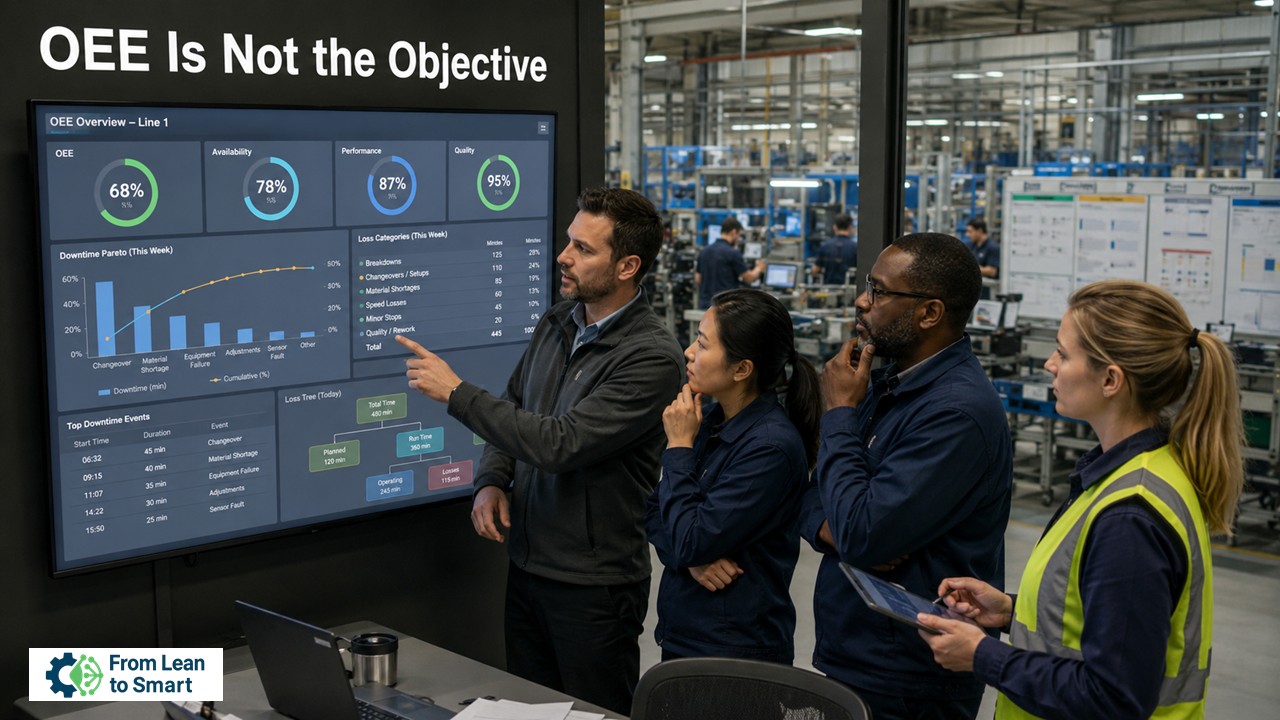
OEE is often the first use case selected when a factory begins its MES journey.
The choice is understandable. Availability, performance, and quality are familiar concepts. Managers want visibility. Production teams want to understand losses. Continuous improvement teams want Pareto analysis. Finance wants a clearer view of productivity impact. MES vendors can also demonstrate OEE dashboards relatively quickly.
However, this apparent simplicity creates a risk.
OEE can become one of the most useful starting points for MES implementation. It can also become a dangerous operational religion.
It is useful when it helps the factory understand losses, improve decisions, and connect shopfloor reality with disciplined execution. It becomes dangerous when the percentage becomes more important than the operational truth behind it.
OEE is not the objective. Better operational decisions are the objective.
OEE only has value when it helps the organization see real losses, assign ownership, and act with consistency.
Why OEE Is Attractive as a First MES Use Case
OEE gives structure to production losses by separating the discussion into three basic questions:
Are we running when we should be running?
Are we running at the expected speed?
Are we producing good parts?
This structure is powerful because many factories still discuss performance in imprecise terms:
“The line was bad yesterday.”
“We had many stops.”
“The machine was slow.”
“Quality affected output.”
“Maintenance delayed the shift.”
OEE forces a more disciplined conversation:
What was the planned production time?
What stopped the equipment?
How long did the stop last?
Was the standard cycle time realistic?
Which losses came from scrap or rework?
Which reason codes explain the greatest impact?
This is where MES can create real value. It can collect downtime events, production counts, scrap information, shift context, work order data, machine states, and reason codes. It can transform scattered shopfloor signals into structured operational evidence.
But this only works if the data has meaning.
A visually impressive OEE dashboard based on poor reason codes, unclear standards, or incorrect cycle times is not intelligence. It is decorated confusion.
Where OEE Fits in MES/MOM Architecture
In a MES/MOM architecture, OEE normally sits between execution management, performance management, and operational improvement.
ERP defines what needs to be produced. MES manages the execution context: work orders, operations, equipment, materials, personnel, confirmations, and production events. SCADA, PLCs, and historians may provide machine states, counters, and process signals. Quality systems may provide scrap, rework, and inspection results. CMMS or EAM systems may provide maintenance events and asset context.
OEE becomes meaningful only when these layers are connected through a reliable operational model.
The MES must know which equipment is producing which product, under which order, at which standard rate, with which shift, with which material, and under which operating condition. Without that context, OEE is only arithmetic.
The calculation is rarely the hardest part.
The hard part is agreeing what the calculation means in the real factory.
Anti-Pattern 1: Chasing the Percentage
The most common mistake is turning OEE into a score that must be defended.
Once the number appears on dashboards, management reviews, and performance meetings, people naturally try to improve it. That can be positive. But in a weak operational culture, the organization starts managing the number instead of managing the losses.
Planned stops are reclassified.
Reason codes become too generic.
Micro-stoppages disappear.
Scrap is recorded later or in another system.
Cycle times are adjusted without real process validation.
Teams debate definitions instead of root causes.
Production pressure turns OEE into a performance weapon.
At that point, OEE stops being a learning tool. It becomes a negotiation tool.
The factory may report a better percentage while still living with the same bottlenecks, recurring stops, quality escapes, and maintenance conflicts.
A high OEE number that nobody trusts is worse than a low OEE number that reveals the truth.
Anti-Pattern 2: Collecting Losses Nobody Will Act On
MES can generate enormous detail.
Every stop. Every reason. Every minute. Every line. Every shift. Every product. Every operator. Every machine state.
But more data does not automatically create better decisions.
Many factories implement OEE and quickly drown in loss categories. The Pareto chart shows many small reasons. Supervisors spend time correcting events. Operators feel monitored rather than supported. Maintenance receives long lists without priority. Improvement teams launch actions that do not survive production pressure.
The problem is not the MES.
The problem is the absence of decision discipline.
Before collecting a loss, the organization should know who will use the information, how it will be reviewed, what decision it supports, and what escalation it triggers. If a downtime reason code does not help someone decide, prioritize, escalate, or improve, it may be noise.
OEE should simplify the path from loss visibility to operational action. It should not make the factory administratively heavier.
Anti-Pattern 3: OEE Without Standards
OEE depends on standards.
If planned time is unclear, availability becomes questionable.
If ideal cycle time is wrong, performance becomes misleading.
If scrap definitions vary, quality becomes inconsistent.
If micro-stoppage thresholds are arbitrary, losses become distorted.
If reason codes are not governed, Pareto analysis becomes weak.
This is why OEE is not only a digital use case. It is a process discipline use case.
MES can calculate automatically, but the organization must define and govern the operational truth behind the calculation.
What is planned downtime?
What is unplanned downtime?
Who can modify reason codes?
How are minor stops captured?
What is the approved ideal cycle time?
How is rework treated?
When does a quality loss become visible?
How are changeovers classified?
How do production and maintenance agree on downtime ownership?
These are not technical details. They determine whether the OEE number can be trusted.
A Practical Example: When “Other” Becomes the Largest Loss
Consider a machining line where MES is introduced to capture OEE automatically.
Before MES, supervisors estimated downtime at the end of the shift. The plant knew the line was a bottleneck, but loss discussions were vague. Maintenance blamed poor operation. Production blamed equipment reliability. Quality blamed unstable process conditions. Planning blamed lack of capacity.
After connecting machine signals to MES, the first dashboard shows that availability losses are the dominant issue.
At first, leadership celebrates. The factory finally has visibility.
Then the first Pareto chart shows “Other” as the largest downtime reason.
This is a critical moment in the implementation.
The immature response is to add more reason codes and demand better discipline from operators.
The mature response is to go to the gemba and understand why “Other” is appearing.
Perhaps operators do not have enough time to classify stops correctly. Perhaps the reason-code tree does not reflect real failure modes. Perhaps machine states are detected incorrectly. Perhaps changeover losses are mixed with technical stoppages. Perhaps maintenance response time is not separated from repair time. Perhaps material feeding problems are being recorded as machine downtime.
The value of MES is not the first OEE number.
The value is the operational conversation that the number makes possible.
Before Implementing OEE in MES
Before implementing OEE as a first MES use case, the factory should test its readiness in several areas.
First, definitions must be clear. Planned time, downtime, speed loss, scrap, rework, changeover, and minor stops need agreed meanings across production, maintenance, quality, and engineering.
Second, standards must be validated at the shopfloor. Ideal cycle times should not be copied blindly from ERP master data or engineering assumptions. They must reflect the actual operating condition under which the process is expected to run.
Third, reason codes must be usable. They should be simple enough to apply under production pressure, but precise enough to support action. A reason-code structure that looks perfect in a conference room may fail immediately during a difficult shift.
Fourth, ownership must be explicit. If the top losses are visible but nobody owns them, OEE becomes reporting without accountability.
Fifth, daily management routines must use OEE to trigger problem-solving, not just presentation. The number should lead to Pareto reviews, A3 thinking, maintenance prioritization, standard work updates, engineering actions, and escalation when recurring losses are not being reduced.
Finally, leaders must be prepared to accept uncomfortable data.
If the organization only wants better numbers, it is not ready for real OEE.
OEE as a Starting Point, Not a Destination
OEE can be a strong first MES use case because it connects digital visibility with operational excellence. It helps the factory move from opinions to evidence. It shows where time, speed, and quality are being lost. It creates a common language between production, maintenance, quality, engineering, and continuous improvement.
But OEE should not become the center of the operating system.
The factory does not improve because the OEE dashboard exists. It improves when the losses behind OEE are understood, owned, and reduced.
The key question is not:
“What is our OEE?”
The better question is:
“What did OEE help us decide differently today?”
That is where MES becomes more than a screen.
OEE is a useful MES use case when it exposes operational truth and improves decisions. It becomes dangerous when the number is defended, manipulated, or disconnected from real loss reduction.
The goal is not to worship OEE. The goal is to build an operating system where data, standards, routines, and accountability help the factory see losses clearly and act on them with discipline.
#MES #MOM #OEE #OperationalExcellence #SmartFactory #LeanManufacturing #IndustrialMaintenance #Reliability #AssetManagement #ManufacturingExcellence #ContinuousImprovement #IndustrialData #ShopfloorManagement