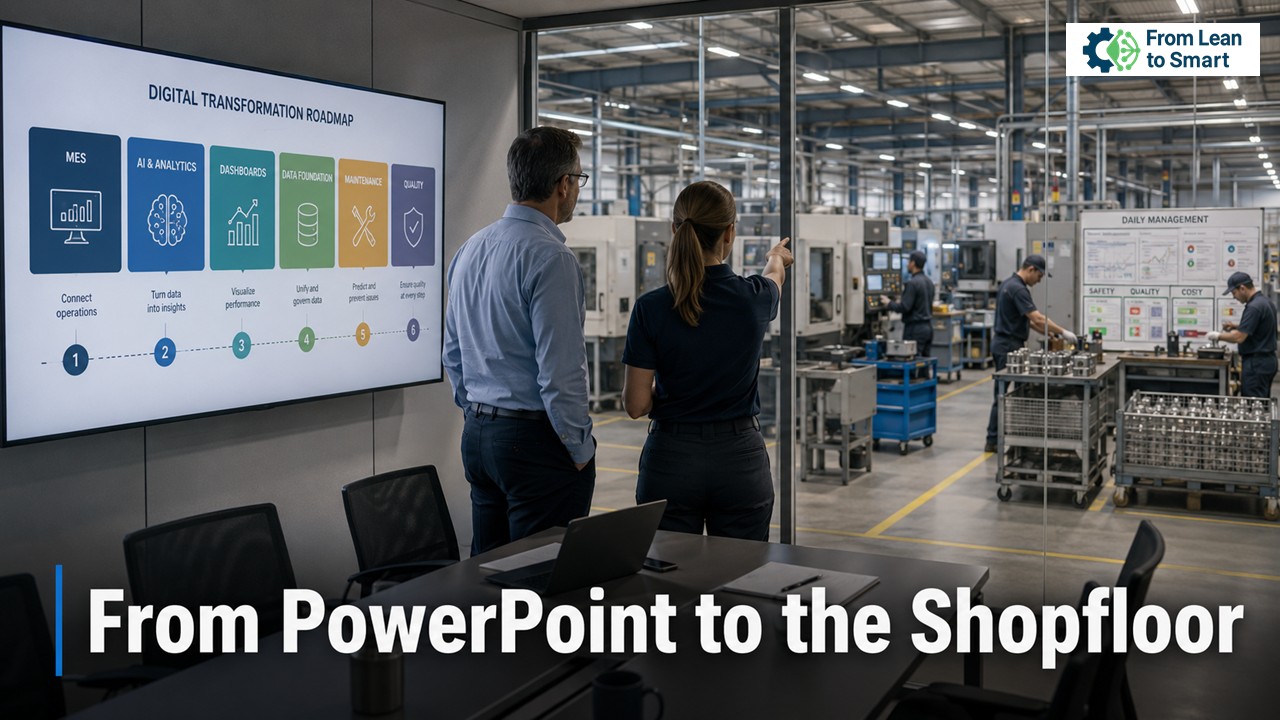
Digital transformation rarely fails in the presentation.
On slides, the logic is clean. The roadmap is structured. The architecture looks coherent. The benefits appear measurable. The future state feels almost inevitable.
Dashboards will improve visibility.
MES and MOM will connect execution.
AI will anticipate deviations.
Digital twins will simulate decisions.
Operators will receive better guidance.
Leaders will have real-time information.
Then the project reaches the shopfloor.
And reality becomes less elegant.
The machine signal is not reliable. The downtime reason codes do not reflect actual events. Master data is incomplete. Operators do not trust the interface. Supervisors already manage too many screens. Maintenance receives alerts that are not actionable. Quality needs context that is not available in the system. IT and OT disagree about ownership. Production pressure pushes people back to manual workarounds.
This is where many digital transformations fail.
Not because the technology is necessarily poor, but because the transformation was designed around a future-state image rather than around the operational system required to make that future real.
The gap between PowerPoint and the shopfloor is not mainly a communication gap. It is a gap in process discipline, ownership, data governance, escalation logic, and decision-making capability.
Technology Does Not Remove Operational Reality
A factory is not a software environment with machines attached.
It is a socio-technical system where people, assets, materials, methods, data, routines, constraints, and decisions interact under pressure. That pressure matters.
A supervisor does not reject a dashboard because they dislike data. They reject it when it does not help them decide what to do during the shift.
An operator does not bypass a digital instruction because they resist change. They bypass it when the instruction does not reflect the real condition of the station.
A maintenance technician does not ignore an alert because they are old-fashioned. They ignore it when the alert cannot distinguish between noise and a required intervention.
A quality engineer does not ask for another spreadsheet because they prefer manual work. They ask for it when the system does not connect genealogy, inspection evidence, containment status, and process conditions.
Digital transformation fails when it underestimates this reality.
Technology can support better operations. It can improve visibility, accelerate analysis, standardise workflows, and strengthen control. But it cannot replace operational understanding.
The First Failure: Starting with the Solution
Many digital initiatives begin with the tool.
A platform is selected. A pilot is launched. A use case is adapted to available functionality. The team searches for data. A dashboard is configured. A demo is prepared.
The project moves.
But the operational problem has not been properly understood.
The essential questions are often weak or absent:
What decision are we trying to improve?
Who makes that decision today?
What information is missing?
What delay creates the loss?
What behaviour must change?
What process instability must be addressed first?
What will happen differently when the system goes live?
When these questions are not answered with discipline, the solution may still look impressive, but the value will be fragile.
A dashboard that visualises downtime does not improve availability unless it changes how losses are reviewed, owned, escalated, and reduced.
An AI model that predicts defects does not improve quality unless the organisation can contain, investigate, and correct the process faster.
A digital work instruction does not improve standard work if the physical process is unstable, the station design is inadequate, or supervisors do not protect the standard.
The starting point should not be the technology.
The starting point should be the operational decision that must improve.
The Second Failure: Confusing Visibility with Transformation
Visibility is useful. Many factories need more of it.
They need to know where losses occur, which machines are unstable, which orders are delayed, which quality issues are repeated, and which constraints are blocking flow.
But visibility is not transformation.
A screen does not create accountability.
A dashboard does not remove a root cause.
A KPI does not align production and maintenance.
A real-time alert does not guarantee response.
A connected machine does not create process discipline.
The question is not whether people can see the problem.
The question is whether the operating system reacts differently when the problem becomes visible.
Who reviews the information?
When is it reviewed?
What decision does it trigger?
Who owns the action?
How is escalation managed?
How is learning captured?
How does the standard change?
Without these mechanisms, digital visibility becomes another layer of reporting. The factory knows more, but it does not necessarily act better.
This is one of the most common weaknesses in Smart Factory programmes: they improve the availability of information without redesigning the routines, accountabilities, and decision rights required to use that information.
The Third Failure: Weak Ownership
Digital projects often expose ownership gaps that already existed.
Who owns downtime reason-code quality?
Who owns master-data accuracy?
Who defines an abnormal condition?
Who owns escalation rules?
Who arbitrates when ERP, MES, SCADA, and CMMS do not agree?
Who decides when production, maintenance, and quality priorities conflict?
If nobody owns these questions clearly, the digital system will inherit the ambiguity.
This is especially visible in industrial environments where responsibility is fragmented. IT may own the platform. OT may own connectivity. Operations may own performance. Engineering may own process standards. Quality may own control plans. Maintenance may own asset condition. Continuous improvement may own the methodology.
But digital value appears across the boundaries.
When ownership remains purely functional, the transformation becomes a collection of local tools instead of an integrated operating capability.
A Smart Factory is not built by connecting systems alone.
It is built by connecting ownership, routines, standards, and decisions.
The Fourth Failure: Poor Data Without Operational Context
Industrial data is not useful simply because it is available.
A machine signal needs meaning.
A downtime event needs classification.
A production count needs product, order, shift, and equipment context.
A quality result needs specification, batch, process condition, and containment status.
A maintenance alert needs asset criticality, work history, spare-part availability, and production impact.
Without context, data becomes noise.
This is why many digital initiatives struggle after the first pilot. The demo works because the scope is controlled. Scaling requires master data, standard definitions, integration rules, governance, and disciplined execution.
That work is less attractive than discussing AI, digital twins, or advanced analytics. But it is the backbone.
A factory cannot build reliable operational intelligence on weak master data, inconsistent definitions, unclear ownership, and informal workarounds.
If the foundation is weak, digital transformation becomes a sophisticated way of amplifying confusion.
The Fifth Failure: Pilots That Never Change the Management System
Pilots are useful for learning.
But a pilot is not value.
A pilot becomes valuable only when it changes the way the organisation works.
Many factories have successful pilots that never scale because the pilot was protected from reality. It had dedicated attention, selected users, manual data preparation, external support, and a narrow scope.
Then the plant tries to industrialise it.
Suddenly, shift patterns matter. Training matters. Support matters. Data quality matters. Cybersecurity matters. Interfaces matter. Maintenance of the solution matters. Change management matters. Governance matters. Ownership matters.
The pilot was a technical proof.
The factory needs an operational capability.
This is the difference between digital experimentation and digital transformation.
A Practical Example: The OEE Dashboard
Consider a plant that implements a real-time performance dashboard for a critical production line.
The dashboard shows OEE, downtime, speed losses, and scrap. It is visually clear. Managers like it. The first meetings are positive.
After a few weeks, the problems begin.
Operators classify many stops as “Other” because the reason-code tree does not reflect real events. Supervisors correct data at the end of the shift to make reports usable. Maintenance argues that downtime is assigned to equipment even when the actual cause is material feeding. Quality losses appear late because inspection results are entered in another system. Engineering discovers that the standard cycle time was copied from old master data and no longer reflects the current product mix.
The dashboard did not fail.
It revealed that the operating system was not ready.
The real transformation begins only when the team returns to the process: simplifying reason codes, validating standards at the gemba, defining ownership, connecting quality data, aligning production and maintenance routines, and using the information in daily management to trigger action.
The value was not the screen.
The value was the discipline created around the screen.
Digital Transformation Must Reach Daily Management
If digital transformation does not change daily management, it usually remains superficial.
The real test is simple: what happens differently on Monday morning?
Does the shift meeting discuss causes, not only numbers?
Does the supervisor know which abnormalities require escalation?
Does maintenance receive better prioritisation based on asset criticality and production impact?
Does quality see risks earlier?
Does planning understand real capacity constraints?
Do operators receive clearer and more reliable instructions?
Do leaders remove obstacles faster?
Does the organisation learn from deviations?
Digital transformation must enter the operating rhythm of the factory.
Otherwise, it remains in project reviews, steering committees, and dashboards that are admired but not used.
A Smart Factory is not only a technology architecture. It is a management system supported by technology.
The Leadership Responsibility
Leaders often ask why digital adoption is slow.
A better question is whether the organisation has created the conditions for adoption to make sense.
People adopt tools that help them do real work better. They resist tools that add administrative burden, expose problems without support, duplicate existing routines, or ignore the constraints they face every day.
If leaders want digital transformation to survive beyond PowerPoint, they must protect operational truth.
That means going to the gemba before defining the solution.
It means asking which decision must improve.
It means clarifying ownership before automating workflows.
It means fixing master data before scaling analytics.
It means designing escalation before launching alerts.
It means ensuring that new visibility leads to action.
It means resisting the temptation to call a pilot a transformation.
The factory does not need more digital theatre.
It needs digital operational excellence.
The Real Bridge Between PowerPoint and the Shopfloor
The bridge between PowerPoint and the shopfloor is built with process discipline, data governance, ownership, standards, routines, and leadership behaviour.
Technology is essential, but it is not the bridge by itself.
MES, MOM, AI, digital twins, process mining, predictive analytics, and connected devices can create significant value when they are pulled by real operational problems and embedded into the way decisions are made.
They fail when they are pushed as independent solutions into an organisation that is not ready to use them.
The future factory will not be the one with the most impressive digital roadmap. It will be the one that converts digital capability into better decisions, faster learning, stronger reliability, and more disciplined execution.
That work does not happen on the slide.
It happens where the process, the people, the data, the machines, and the pressure meet.
It happens on the shopfloor.
#SmartFactory #DigitalTransformation #DigitalOperationalExcellence #OperationalExcellence #ManufacturingExcellence #MES #MOM #LeanManufacturing #IndustrialAI #ITOT #DataGovernance #ShopfloorManagement #ProcessDiscipline #AssetManagement #Reliability