Poor maintenance decisions rarely look irrational at the moment they are made.
They often look reasonable.
A preventive task is postponed because production needs the line. A temporary repair is accepted because the equipment is running again. A spare part is replaced because there is no time for deeper diagnosis. A recurring failure is closed as “solved” because the work order has been completed. A technician senses that the problem has not been properly understood, but the shift pressure does not allow a controlled stop.
None of these decisions necessarily appears negligent. The plant has a production schedule to protect. Customers are waiting. Supervisors need output. Operators need stability. Maintenance is expected to keep the factory moving.
The difficulty is that the real cost of maintenance decisions is often paid later, in places where the accounting system does not clearly show the original cause.
It appears as repeated downtime, unstable quality, overtime, emergency purchasing, frustrated operators, blocked improvement time, excess inventory, rework, missed maintenance windows, accelerated asset degradation, and recurring meetings where the same problems return under different names.
The visible maintenance cost is only the surface.
The deeper cost is the deterioration of decision quality.
Maintenance Is a Decision System Under Pressure
Maintenance is not only a technical function. It is a decision system operating under constraint.
Every day, maintenance and production make trade-offs between availability, reliability, safety, quality, cost, and long-term asset value. These trade-offs are rarely neutral. When a planned intervention is deferred, time is not simply being saved; risk may be transferred into the future. When a temporary fix is accepted without follow-up, pragmatism may become an informal standard. When a failure is closed without understanding the cause, the organization may be normalizing recurrence.
This is why maintenance cost cannot be understood only through labour hours, spare parts, contractor invoices, or budget variance. Those measures matter, but they do not capture the cost of weak prioritization, incomplete diagnosis, poor planning, unclear asset criticality, or decisions made without sufficient operational context.
A maintenance decision can look inexpensive on the work order and become expensive for the factory.
The Work Order Does Not Tell the Whole Story
One of the most common traps in maintenance management is assuming that the work order contains the full cost of the intervention.
It rarely does.
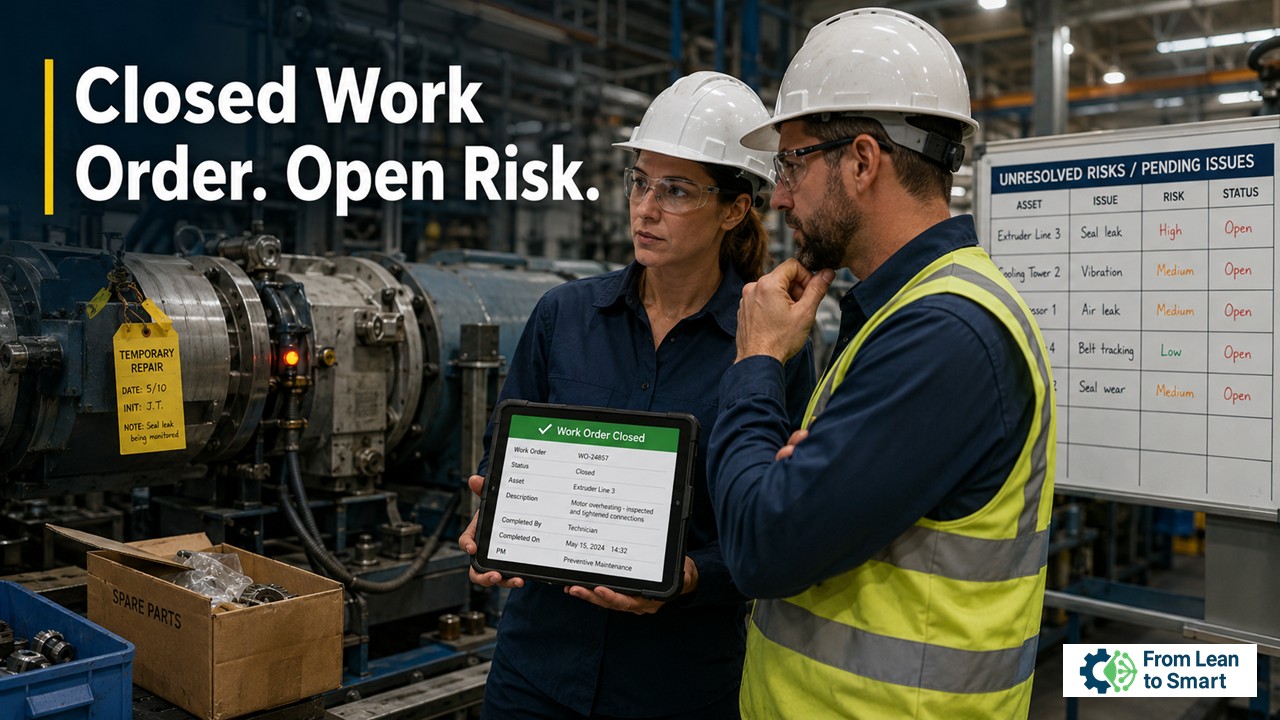
A work order may record that a sensor was replaced, a belt was adjusted, or a bearing was changed. It may include the technician, duration, spare parts consumed, and final status. From a transactional perspective, the job is complete.
But the real operational questions are different.
Did the same failure return two weeks later? Was the replaced component the cause or only a symptom? Did the line continue running at a lower speed? Did the intervention introduce a quality deviation? Did production lose confidence in the equipment and start building buffers? Was the maintenance window rescheduled several times before the job was finally executed? Was the technician who understood the failure available when the problem returned?
At that point, the cost is no longer contained in one work order. It is distributed across operations.
This is why CMMS or EAM data can be technically complete and still operationally insufficient. The system may record what was done, but not what was considered. It may capture closure, but not whether the risk was reduced. It may show activity, but not the quality of the decision that generated the activity.
A maintenance organization can close thousands of work orders and still accumulate reliability debt.
Reliability Debt Is Built Through Small Decisions
Reliability debt is the accumulation of short-term maintenance decisions that make future performance more fragile, more expensive, or less predictable.
It is created when temporary repairs are not tracked as temporary. It grows when repeated failures are treated as normal. It increases when maintenance plans are copied from history without challenging failure modes. It becomes dangerous when asset criticality is unclear. It becomes cultural when firefighting is rewarded more visibly than prevention.
The issue is not that factories make urgent decisions. Real factories will always operate with emergencies, constraints, incomplete information, and competing priorities. The problem begins when urgency becomes the default management system.
In that environment, decisions are evaluated mainly by whether the equipment restarted. That is understandable, but it is incomplete.
Restarting the machine is not the same as restoring reliability. Closing the work order is not the same as eliminating risk. Completing the intervention is not the same as organizational learning.
When this distinction is lost, maintenance activity increases while reliability remains unstable.
Weak Prioritization Changes the Factory’s Risk Profile
Many maintenance teams do not suffer from lack of work. They suffer from too many competing priorities and too little decision clarity.
Everything is urgent. Every production area has a legitimate argument. Every stopped asset appears critical. Every planner is negotiating. Every supervisor is trying to protect today’s output.
Without a clear prioritization logic, maintenance decisions begin to follow pressure, hierarchy, habit, or emotion. The loudest problem wins. The most visible breakdown wins. The strongest escalation wins. The failure that stopped the line today wins, even if another asset is quietly creating a larger risk for tomorrow.
This is where maintenance cost becomes strategic. Poor prioritization does not only consume resources; it changes the risk profile of the plant.
A factory may spend heavily on maintenance and still spend on the wrong problems. It may have capable technicians, modern systems, and serious intentions, but if decisions are not connected to asset criticality, failure consequence, production constraints, spare parts readiness, safety exposure, and failure history, effort will not reliably translate into performance.
Activity is not the same as value.
Production Pressure Is Real, but It Cannot Be the Only Logic
It is too simplistic to say that production should simply “respect maintenance.” Production pressure is real. Customer commitments are real. Schedule recovery is real. The cost of stopping a line can be significant. Maintenance cannot behave as if reliability exists outside business reality.
But the opposite mistake is equally dangerous: allowing every short-term production need to override maintenance judgement.
When that happens, the factory becomes efficient only on paper. The schedule is protected today by increasing instability tomorrow. Preventive work is deferred until it becomes corrective work. Small defects become chronic losses. Maintenance windows disappear. Trust between production and maintenance deteriorates.
The mature discussion is not “production versus maintenance.”
The mature discussion is: what operational risk are we accepting, who owns that decision, and when will the risk be removed?
This question changes the nature of the conversation. It makes trade-offs visible. It moves decisions from personal conflict to governed accountability. It forces the organization to distinguish between an informed risk and an unmanaged gamble.
Better Decisions Require Better Context
A good maintenance decision is rarely based on a single data point.
A vibration alert is not enough. A downtime Pareto is not enough. A technician’s intuition is not enough. A spare part cost is not enough. An availability KPI is not enough.
The decision requires context.
What is the asset criticality? Which failure mode is involved? What is the consequence of failure? Is safety exposed? Is the risk increasing? Are spare parts available? Is there a realistic maintenance window? Has the failure repeated? Was the previous repair temporary? Do we understand the root cause? Who has the authority to accept the risk? Who is accountable for removing it?
This is where maintenance, reliability engineering, TPM, asset management, and digital systems should converge.
Not around more dashboards, but around better decisions.
A dashboard that displays alerts without prioritization may only create more noise. Predictive maintenance that identifies risk without a defined action path may create frustration. A CMMS that captures work orders without decision ownership may create administrative completeness while leaving operational weakness untouched.
Technology helps when it improves the speed, quality, and traceability of decisions. It fails when it only makes poor decisions more visible.
What Leaders Should Examine
Senior leaders should not only ask, “How much did maintenance spend?”
They should also ask where the organization is repeatedly paying for the same failure. Which temporary fixes have become invisible standards? Which preventive tasks are regularly deferred, and what risk is being accepted? Which assets consume attention without improving reliability? Which KPIs encourage short-term availability while damaging long-term asset health? Where are work orders being closed without causes being closed?
These questions are uncomfortable because they reveal that maintenance performance is not only a maintenance issue. It is a management system issue.
Reliability is shaped by engineering decisions, production planning, purchasing policies, spare parts strategy, operator care, maintenance discipline, data quality, leadership behaviour, and financial pressure. When maintenance decisions are poor, the cost does not remain inside the maintenance department.
The whole factory pays.
From Cost Control to Decision Quality
Cost control is necessary. No maintenance leader can ignore budgets, productivity, spare parts consumption, or contractor spend.
But cost control without decision quality can become dangerous. It may reduce visible expense while increasing hidden risk. It may delay interventions that protect asset health. It may reward short-term savings that create long-term instability. It may push teams to close work orders faster without solving problems better.
The stronger question is not only: how do we reduce maintenance cost?
The stronger question is: how do we improve the decisions that generate maintenance cost?
That shift matters.
It moves the discussion from budget reduction to operational intelligence. It connects maintenance with reliability, production, quality, safety, and asset lifecycle value. It recognizes that the cheapest intervention is not always the best decision, and that the most expensive failure is not always the one with the highest repair invoice.
The real cost of poor maintenance decisions is not only what the factory spends.
It is the risk it normalizes, the instability it accepts, the learning it prevents, and the future reliability it sacrifices to survive the day.
#OperationalExcellence #IndustrialMaintenance #AssetManagement #Reliability #ManufacturingExcellence #LeanManufacturing #SmartFactory #MES #ContinuousImprovement #DigitalTransformation