For many years, industrial AI in maintenance has been presented as if its main contribution were simple: predict the failure before it happens.
That ambition is understandable. No plant wants unplanned downtime. No maintenance team wants a critical asset to stop during peak production pressure. No operations manager wants the emergency call at 2:00 a.m., when the line is down, the spare part is unavailable, and the production plan is already compromised.
But in real factories, prediction is not the same as decision-making.
A model may detect an abnormal vibration pattern. A condition monitoring system may estimate bearing degradation. An algorithm may classify an asset as likely to fail within a certain time window. These outputs can be useful, but they do not answer the operational question that matters most:
What should we do now, given the constraints we have?
That question is harder than prediction.
The right decision depends on production schedule, asset criticality, spare parts availability, maintenance capacity, safety exposure, product mix, customer commitments, quality risk, changeover opportunities, and the practical relationship between production and maintenance.
A prediction without decision context becomes just another alert.
And many factories already have too many alerts.
The maintenance problem is rarely only technical
In many industrial environments, maintenance teams are not suffering from a complete lack of information. They are suffering from fragmented, inconsistent, and poorly connected information.
There is data in the CMMS or EAM. There are alarms in SCADA. There are inspection sheets, operator comments, emails about recurring failures, spare parts constraints, and production priorities discussed in meetings but not always reflected in the systems. There are also temporary fixes that everyone knows about, but nobody has formally converted into a reliability improvement action.
Then an AI model arrives and says: risk detected.
Useful? Potentially.
Sufficient? No.
The real value begins when the organization can connect that risk signal to a disciplined decision pathway:
Should the asset be stopped now, or can it continue until the next planned window?
Should the response be inspection, replacement, lubrication, adjustment, monitoring, derating, or escalation?
Is the spare part available and technically correct?
Is the asset critical for today’s production plan, or only critical in general?
Has this failure mode occurred before?
Was the previous corrective action effective?
What is the risk of doing nothing?
Who owns the final decision?
This is where many predictive maintenance initiatives become disappointing. The model may be technically valid, but the operational system around it is not mature enough to act on the recommendation.
From prediction to decision support
A mature approach to AI in maintenance does not begin with the fantasy of autonomous repair decisions.
It begins with decision support.
This means AI should help maintenance, reliability, and operations teams interpret signals, prioritize work, compare options, assess risk, and document the reasoning behind decisions.
That is a different ambition.
It is not: the algorithm tells us what to do.
It is: the algorithm helps us make a better maintenance decision, faster, with more context and traceability.
Consider a motor driving a bottleneck process. An AI model detects early degradation and estimates an increasing probability of failure. On its own, that prediction is incomplete.
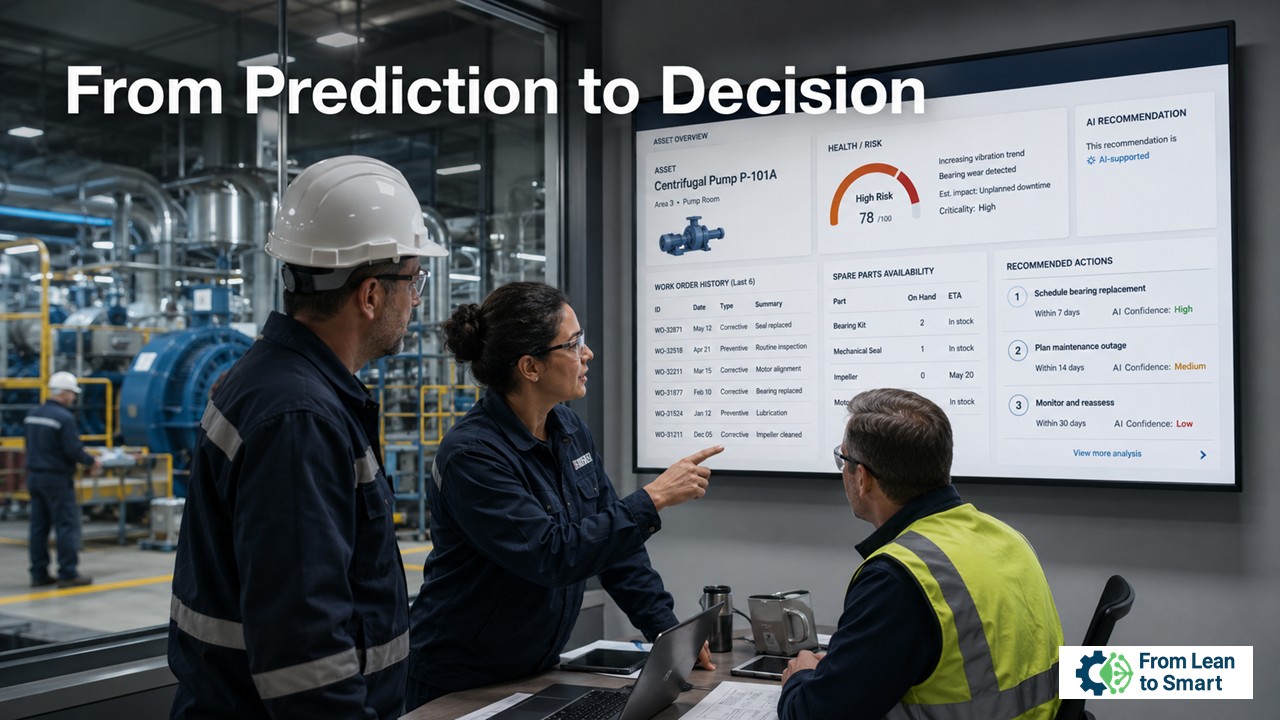
A decision-support approach would connect the signal with asset criticality, current production campaign, maintenance backlog, spare parts status, recent work order history, similar historical failures, safety and quality implications, available shutdown windows, and recommended intervention options.
The output should not be a visually attractive dashboard that nobody acts on. It should be a practical recommendation that clarifies:
- the evidence behind the risk;
- the confidence and limitations of the model;
- the operational constraints considered;
- the proposed action options;
- the escalation logic;
- the responsible decision owner.
In other words, the question is not only what the model sees. The more important question is what the organization should consider before acting.
AI cannot compensate for weak maintenance discipline
There is a dangerous assumption in some digital programs: that AI will solve what preventive maintenance, reliability engineering, TPM, planning discipline, and CMMS governance have not solved.
It will not.
If asset hierarchies are inconsistent, failure codes are meaningless, work orders are closed with vague comments, spare parts data is unreliable, and preventive maintenance plans are not reviewed against actual failure behaviour, AI will inherit those weaknesses.
It may still produce outputs. But outputs are not the same as operational value.
Maintenance AI needs industrial context. It needs sufficiently reliable asset structures, credible work history, meaningful failure modes, consistent execution routines, and people capable of challenging the recommendation.
The objective is not to make maintenance look digital.
The objective is to improve the quality of maintenance decisions.
That distinction matters. A factory may have sensors, dashboards, machine learning models, and mobile applications while still making the same short-term decisions that create long-term reliability problems.
Digital maturity without maintenance discipline is only a more sophisticated way of exposing the same weaknesses.
The missing layer: governed recommendations
The future of AI in maintenance is not simply predictive analytics. It is governed recommendation.
A governed recommendation does not merely state: “replace this component.”
It explains why the recommendation exists, what evidence supports it, what assumptions are being made, what operational constraints were considered, and who has the authority to approve, defer, or reject the action.
This matters because maintenance decisions affect safety, availability, cost, quality, and asset life. They cannot be treated as casual suggestions generated by a black box.
A useful AI recommendation should be auditable. It should respect technical standards and approved maintenance strategies. It should identify uncertainty. It should trigger escalation when risk exceeds local authority. It should leave a trace of the human decision.
In industrial maintenance, human-in-the-loop is not a weakness.
It is governance.
The purpose of AI is not to remove accountability from maintenance and reliability professionals. It is to support accountability with better evidence, better context, and better decision traceability.
Reliability is an organizational capability
A bearing does not fail simply because the AI model was weak.
A gearbox does not fail simply because a dashboard was missing.
Many reliability problems persist because organizations tolerate weak feedback loops. The same failure returns. The same temporary fix is repeated. The same spare part is urgently requested. The same production-maintenance conflict reappears. The same root cause analysis remains incomplete because there is no time, no ownership, or no follow-up discipline.
AI can help, but only if it strengthens the feedback loop.
It should help detect patterns across work orders. It should retrieve similar previous cases. It should connect symptoms with probable causes. It should highlight repeated corrective actions that did not eliminate the root cause. It should support planners in prioritizing backlog based on risk, not only age. It should help reliability engineers move from incident response to failure mode learning.
That is a more valuable use of AI than simply producing another risk score.
The question maintenance leaders should ask is not only whether the model predicts failure.
They should ask whether predictive signals are actually changing prioritization, planning, intervention timing, and reliability learning.
If the answer is no, the system is not yet decision support. It is only detection.
The best AI maintenance systems will not replace judgment
Experienced maintenance professionals know that industrial reality is full of nuance.
The same vibration trend may mean different things depending on operating mode. The same temperature alarm may be acceptable under one product mix and dangerous under another. The same failure probability may require immediate action on a critical bottleneck and continued monitoring on a redundant auxiliary asset.
AI can process more data than a human team can manually review. But humans understand context, consequences, trade-offs, technical responsibility, and plant priorities.
The best systems will combine both.
AI should contribute memory, pattern recognition, retrieval, simulation, prioritization, and structured recommendations. Maintenance and reliability teams should contribute field knowledge, safety awareness, engineering judgment, and accountability.
That collaboration is where the value is created.
Not in replacing maintenance expertise, but in making it easier to apply that expertise at the right moment.
From maintenance data to maintenance decisions
The industrial challenge is not to predict every failure.
The challenge is to make better decisions before failure becomes unavoidable.
That requires more than algorithms. It requires disciplined maintenance processes, credible asset data, meaningful failure history, spare parts governance, production-maintenance coordination, escalation rules, and leadership commitment to reliability.
AI in maintenance will create value when it moves from isolated prediction to operational decision support.
From alerts to actions.
From risk scores to governed recommendations.
From model outputs to accountable decisions.
From reactive firefighting to organizational learning.
The future of maintenance will not be fully autonomous. That is not the most realistic or useful ambition.
The more important future is maintenance that is more contextual, more traceable, more disciplined, and more capable of learning from its own decisions.
That is where industrial AI can make a serious contribution.
#IndustrialMaintenance #Reliability #AssetManagement #OperationalExcellence #SmartFactory #IndustrialAI #MaintenanceStrategy #ManufacturingExcellence #DigitalTransformation