
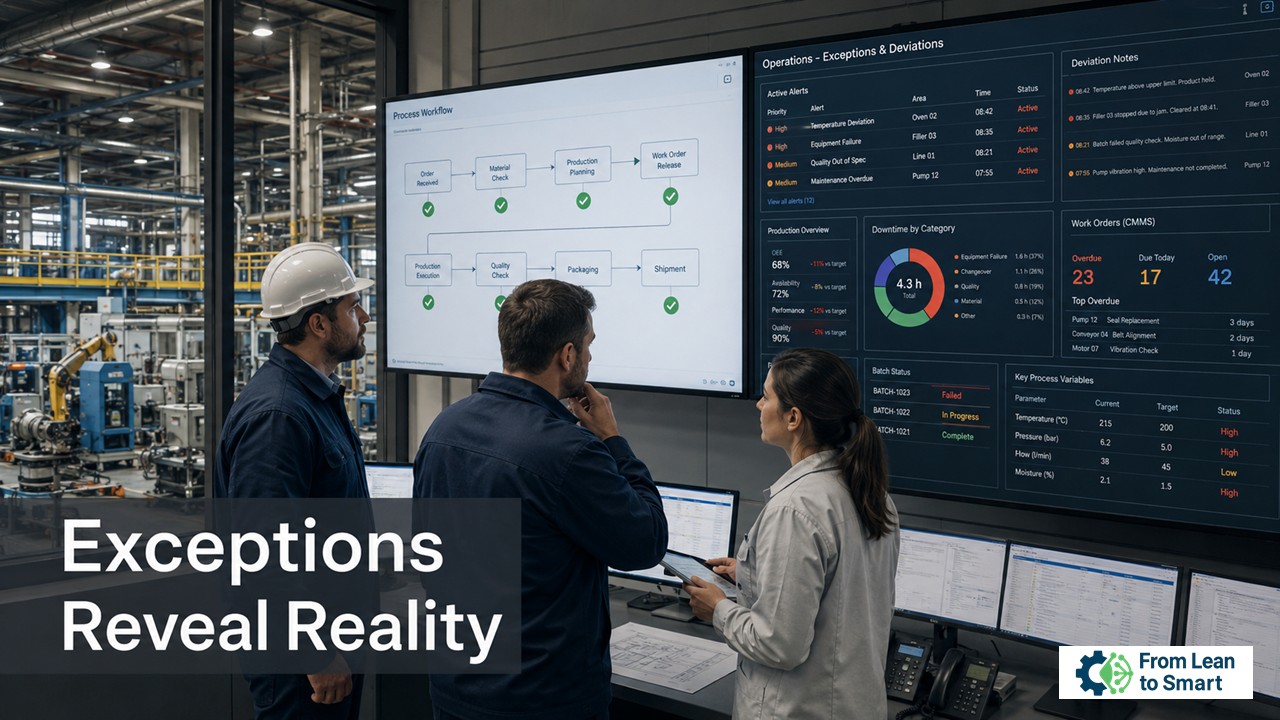
In many organizations, exceptions are treated as defects in the process model.
The workflow is designed. Approval levels are defined. System logic is configured. Escalation routes are documented. The process appears complete.
Then real operations begin.
A customer changes priority after the production plan has already been frozen. A machine remains technically within tolerance but starts generating quality instability. A maintenance intervention cannot follow the standard sequence because the required spare part is unavailable. A batch is blocked by quality, while production needs capacity on the same line. The MES indicates one status, the ERP shows another, and the supervisor must decide before the next shift loses productive time.
Traditional process thinking often treats these cases as noise.
In industrial operations, they are not noise. They are evidence.
They show where the formal process meets operational reality. They reveal whether a process is merely documented, or whether it is capable of supporting execution under pressure, uncertainty, and constraint.
The Process Map Is Usually Too Clean
A process model is useful because it creates a shared understanding. It clarifies roles, inputs, outputs, decisions, dependencies, and expected sequences of work.
But the model is not the operation.
The real operation includes incomplete information, shifting priorities, degraded assets, material variability, informal knowledge, system limitations, unclear ownership, and decisions made under time pressure.
This is why many BPM initiatives look convincing in workshops but weak on the shopfloor. They describe the standard path with precision, but they do not explain what happens when the standard path breaks.
And in manufacturing, it breaks frequently.
Not because people are careless. Not because operators resist change. Not because supervisors prefer firefighting. It breaks because industrial operations are dynamic socio-technical systems. Machines degrade. Materials vary. People rotate. Systems are imperfect. Priorities change. Constraints collide.
A process that only works when everything behaves as expected is not robust. It is an optimistic drawing.
Exceptions Reveal the Operating System Behind the Process
When exceptions are studied seriously, the hidden operating system of the factory becomes visible.
Who really decides when production and quality disagree?
What happens when maintenance identifies an asset risk, but no production window is available?
Who owns the correction when a deviation sits between planning, logistics, maintenance, quality, and operations?
Which workarounds exist because the official system does not support the actual sequence of work?
Where are experienced people compensating for poor master data, weak integration, unclear standards, or missing decision rules?
These questions are uncomfortable, but they are valuable.
Exceptions expose the gap between formal design and operational capability. They show where accountability is ambiguous, where data is not trusted, where workflow logic is too rigid, and where people create local solutions to protect output, quality, or delivery.
This does not mean that every exception is acceptable.
Some exceptions are pure waste. Some create safety, quality, or compliance risk. Some hide weak discipline. Some normalize poor execution. Others, however, reveal that the process model is incomplete, the system design is unrealistic, or the organization has not defined how decisions should be made under abnormal conditions.
The mature question is not:
How do we eliminate all exceptions?
The better question is:
What are repeated exceptions teaching us about how work actually happens?
The Risk of Automating Only the Ideal Process
One of the most common errors in digital transformation is to automate the clean version of the process while ignoring the messy version of the work.
A workflow tool can route approvals. An ERP can enforce transactions. An MES can guide execution. A CMMS can structure maintenance work orders. A QMS can manage non-conformities.
But when exception logic is weak, the organization creates parallel processes.
People use spreadsheets. They send messages outside the system. They bypass fields because the mandatory data is unavailable or irrelevant. They close work orders with generic codes. They create unofficial escalation channels because the official one is too slow or too disconnected from operational urgency.
Then leaders review the dashboard and believe the process is under control.
It is not.
The system is only showing the part of the process that fits the system. The real operational intelligence may be hidden in comments, manual adjustments, waiting times, rework loops, informal coordination, and unresolved deviations.
This is where BPM must evolve.
In industrial environments, BPM cannot remain only a discipline of process maps and workflow automation. It must become a discipline of operational decision design.
That means defining not only the standard sequence of work, but also the logic for abnormal situations: who decides, based on what evidence, within which limits, using which system, and with what feedback into standards.
Exceptions Need Ownership, Not Improvisation
A factory does not need unlimited flexibility. It needs governed adaptability.
There is a critical difference.
Improvisation means that every exception depends on who is present, how much pressure exists, and which manager answers the phone first.
Governed adaptability means that the organization has designed how to respond when reality does not follow the standard path.
This requires clear ownership of abnormal situations, reliable escalation criteria, explicit decision rights, contextual data, system integration, documented learning, and feedback into process improvement.
Consider a quality deviation during production.
A weak process says: “Block the material and notify Quality.”
That may be necessary, but it is not sufficient.
The operational questions are more demanding:
Can production continue under controlled conditions?
Who has the authority to release, rework, downgrade, scrap, or stop?
What evidence is required?
Is the deviation linked to machine condition, material batch, operator method, recipe parameter, environmental condition, tooling, or a recent maintenance intervention?
Has the same deviation appeared in previous shifts, products, batches, or lines?
What must be updated in the standard, control plan, inspection rule, master data, maintenance plan, or system workflow?
Without this logic, the process becomes a theatre of compliance. People follow visible steps, but the organization does not improve its capability to decide, execute, and learn.
Process Mining Helps, But It Does Not Replace Operational Interpretation
Process mining can be highly useful because it reveals how processes actually flow through systems. It can expose rework, waiting time, loops, variants, deviations, and handover failures that are invisible in the official process map.
But process mining does not automatically explain operational reality.
A deviation in the system may represent waste. It may also represent a necessary adaptation to a constraint that the process design ignored.
A long waiting time may indicate poor discipline. It may also reflect a missing decision owner, unavailable material, quality hold, maintenance dependency, engineering review, or planning conflict.
A high number of variants may indicate process chaos. It may also reveal that the organization is forcing different operational cases into the same workflow.
This is why BPM, Lean, process mining, MES/MOM knowledge, and shopfloor experience must work together.
Data can show where the process deviates. People who understand the operation can explain why it deviates. Leadership must decide what to standardize, what to redesign, what to govern, and what to escalate.
Without this connection, process mining becomes another dashboard: technically impressive, visually persuasive, and operationally weak.
Mature BPM Treats Exceptions as Design Input
Mature organizations do not design processes only around the ideal path. They design around the reality of variation.
They ask:
Which exceptions appear repeatedly?
Which exceptions are acceptable adaptations, and which are dangerous deviations?
Which situations require human judgment?
Which cases can be standardized?
Which cases require escalation?
Which exceptions reveal poor master data, weak integration, unclear ownership, or unrealistic system logic?
Which recurring deviations should become structured improvement opportunities?
This is where adaptive operations begin.
Not by allowing everyone to do whatever they want, but by recognizing that real operations need disciplined ways to handle uncertainty.
The future of BPM in industrial environments will not be defined by more elegant diagrams. It will be defined by stronger connections between process ownership, execution systems, operational data, decision rights, escalation logic, and continuous improvement.
MES/MOM, ERP, CMMS, QMS, process mining, and AI can support this evolution. But they create value only when the organization has the discipline to ask a more fundamental question:
Which operational decisions must become better, faster, more visible, and more reliable?
The Real Test of a Process
The strength of a process is not proven when everything goes according to plan.
It is proven when the plan meets reality.
When a supplier issue threatens production. When a machine starts behaving abnormally. When quality risk conflicts with delivery pressure. When the system blocks a transaction but the truck is already at the dock. When maintenance needs time and production needs output.
That is where operational maturity becomes visible.
A weak organization hides exceptions, normalizes workarounds, and calls it experience.
A mature organization makes exceptions visible, governs the response, distinguishes useful adaptation from risky improvisation, and learns from recurring patterns.
The real issue is not the existence of exceptions. Industrial operations will always contain variability, uncertainty, and constraint.
The real issue is whether exceptions remain invisible, personal, and improvised — or whether they become part of a disciplined system of operational learning.
In that sense, exceptions are not the enemy of process management.
Unhandled exceptions are.
#OperationalExcellence #BPM #ProcessMining #SmartFactory #MES #IndustrialMaintenance #ManufacturingExcellence #AssetManagement #Reliability #ContinuousImprovement