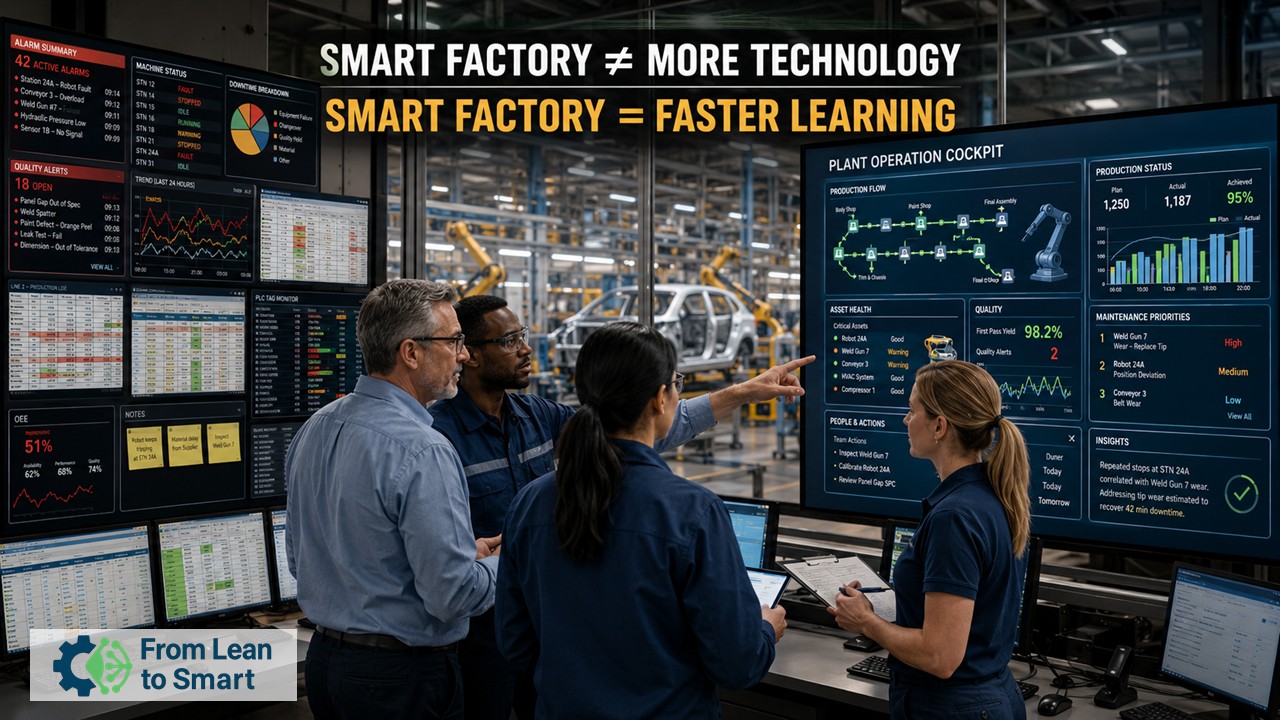
Many factories are becoming more digital.
But not necessarily smarter.
Over the last few years, the industrial conversation has moved from automation, sensors and dashboards to digital twins, MES/MOM, process mining, predictive analytics, generative AI and industrial copilots.
The vocabulary has evolved quickly. The ambition has grown. The available technology is clearly more powerful than before.
But one uncomfortable question remains:
Are we really improving the way factories make decisions?
Because a factory does not become smart because it has more screens. It does not become smart because it has more data. It does not become smart because it launches AI pilots or connects machines to a platform.
A Smart Factory is not defined by the amount of technology it deploys.
It is defined by its ability to detect problems earlier, understand causes faster, decide better and learn systematically from what happens in the operation.
That distinction matters.
When technology becomes the starting point
In many organizations, Smart Factory initiatives start with technology.
A new dashboard. A new platform. A new data lake. A new AI use case. A new automation project. A new digital twin. A new control tower.
None of these things are wrong.
The problem appears when they become the starting point.
When transformation starts from the tool, the organization often skips the most important questions:
What operational problem are we trying to solve? Who owns the process? Which decision needs to improve? What data is really needed? What standard is missing? What risk are we creating if we automate too early? How will the learning be captured and scaled?
These questions are less attractive than a technology demo.
But they are much more important.
The factory does not need digital decoration. It needs better operational capability.
The shopfloor does not follow the roadmap
On the shopfloor, reality is rarely as clean as it looks in a transformation roadmap.
A production line may have real-time data, but asset master data may be incomplete.
A quality dashboard may show defects, but the root cause analysis may still depend on informal conversations and individual experience.
A maintenance team may receive predictive alerts, but if planning, spare parts, work order discipline and prioritization are weak, the alert does not automatically become value.
The same happens in industrial projects.
A launch program may involve hundreds of people, many product variants, thousands of operations, several suppliers and multiple systems. But critical decisions may still move through emails, spreadsheets and meetings without enough traceability.
In that context, adding another platform will not solve the problem if the governance model remains unclear.
This is where many digital transformations lose strength.
They connect systems, but not decisions. They create dashboards, but not ownership. They automate tasks, but not accountability. They collect data, but do not improve the management routine. They launch pilots, but do not build a learning system.
Then, after some time, people say:
“The tool did not work.”
Sometimes that is true. The tool may not be good enough.
But very often, the tool was never the real issue.
The issue was expecting technology to compensate for weak process discipline, poor data governance, unclear escalation rules or fragmented decision-making.
A complete dashboard does not mean a controlled process.
From Smart Factory to Digital Operational Excellence
This is why I believe Smart Factory should be approached from Digital Operational Excellence, not from technology alone.
Lean thinking is still essential because it helps clarify value, flow, waste, standards and problem-solving.
Process management is essential because it defines ownership, interfaces and routines.
MES/MOM is essential when we need execution discipline and a reliable connection between planning, production, quality and maintenance.
Asset Management is essential because industrial decisions must balance performance, cost, risk and lifecycle value.
Process mining can help reveal how processes really behave, instead of how we think they behave.
AI can help detect, predict, recommend and capture knowledge.
But the sequence matters.
First, understand the process. Then define the decision. Then understand the data. Then choose the technology. Then govern the learning.
This sounds simple, but in practice it is one of the biggest differences between digitalization and real transformation.
AI is not a shortcut around operational discipline
Take industrial AI as an example.
An AI assistant for maintenance, quality or production incidents should not be treated as a chatbot project.
It should be treated as a knowledge and decision-support system.
The important questions are not only technical. They are operational and organizational.
Which expert knowledge should be captured? Which historical incidents are reliable? Which standards should the system use? Who validates the recommendation? What happens when the answer is wrong? Who remains accountable for the final decision? How do we prevent the system from spreading bad practices at scale?
Without these questions, AI can become another layer of complexity.
With the right governance, however, it can become a powerful way to preserve expert knowledge, support less experienced teams, reduce repetition and improve problem-solving speed.
The same logic applies to predictive quality.
Detecting defects earlier through data is valuable. Predicting them is even more valuable. But the real industrial value appears only when prediction is connected with process control, reaction plans, engineering knowledge, maintenance response and continuous improvement.
Prediction without action is sophisticated reporting.
And reporting, by itself, does not change the factory.
A digital twin is not valuable because it looks impressive
A digital twin follows the same principle.
Its value is not in looking impressive. Its value is in helping teams validate scenarios earlier, reduce late changes, understand constraints, train people, simulate flows or make better engineering and operational decisions.
The Smart Factory should not become a showroom of isolated technologies.
It should become a learning system.
That means the organization needs to be very clear about what it wants to learn, from which data, through which process, with which people, under which governance and for which decision.
What this means for industrial leaders
For industrial leaders, this has some very practical implications.
The best digital use cases should come from real operational pain: quality losses, maintenance instability, logistics constraints, launch complexity, productivity gaps, safety risks, energy consumption or slow decision-making.
Unclear processes should not be digitalized blindly. If ownership and standards are weak, digital tools will expose the weakness, but they will not solve it alone.
Data must be treated as an industrial asset, not as an IT by-product. Context, quality, master data, timestamps, process definitions and governance are operational foundations.
AI must remain connected to human accountability. In industry, explainability, auditability and control are not optional details. They are part of responsible execution.
And above all, technology must be integrated into management routines.
A dashboard only matters if it changes the way the team reviews, escalates, decides and acts.
The real KPI of innovation is not the number of pilots.
It is the speed from problem to validated learning.
The real challenge
This is where the conversation about Smart Factory needs to mature.
The next stage of industrial transformation will not be won by the factories that install the most tools.
It will be won by the factories that learn faster from defects, breakdowns, deviations, launches, supplier issues, process instability, operator experience and failed experiments.
That is much harder than buying technology.
It requires discipline. Governance. Process ownership. Data quality. Cross-functional collaboration. A culture that can experiment without losing control. Leaders who understand that technology is not a substitute for management, but a way to strengthen better decisions.
A Smart Factory is not a digital layer placed on top of the old operating model.
It is a socio-technical system where people, processes, assets, data, suppliers, customers and governance are connected to improve the way the factory works and learns.
The challenge is not to make factories more digital.
The real challenge is to make them more capable of learning.
And that is where technology starts to become truly valuable.
#SmartFactory#DigitalOperationalExcellence#OperationalExcellence#DigitalTransformation#Manufacturing#Industry40#IndustrialAI#LeanManufacturing#MES#MOM#AssetManagement#ProcessMining#DigitalTwin#DataGovernance#PredictiveMaintenance#ContinuousImprovement#DecisionIntelligence#IndustrialTransformation