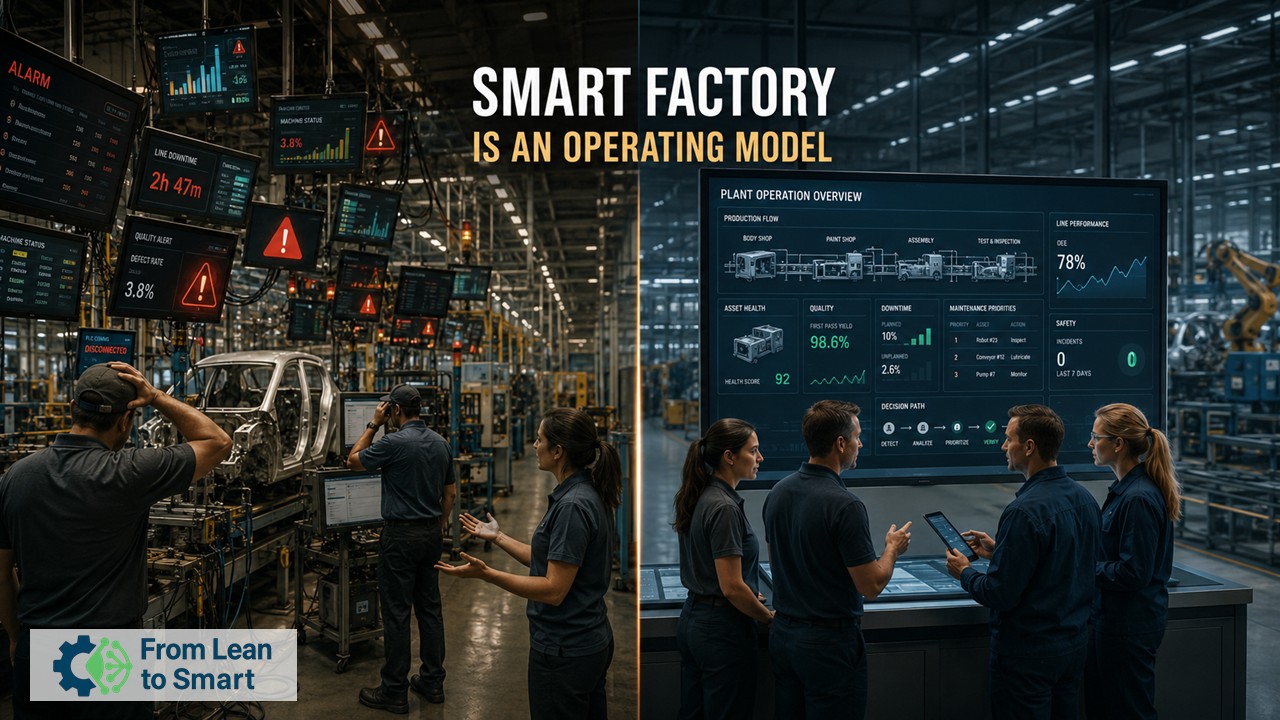
Many factories are becoming more digital.
But not necessarily smarter.
They have more dashboards, more sensors, more connected equipment, more automated reports, more pilots with artificial intelligence, and more conversations about digital twins.
And still, in many cases, the same operational questions remain difficult to answer:
Why did the deviation happen?
Who owns the corrective action?
Which process condition changed first?
Is the problem in the machine, the material, the method, the supplier, the planning sequence, or the standard itself?
What decision should be taken now, and who has the authority to take it?
This is where the Smart Factory discussion often becomes uncomfortable.
Because a factory does not become smart when it collects more data. It becomes smart when it makes better decisions faster, with discipline, context, and accountability.
That difference is not technological. It is operational.
When technology becomes the starting point
Many Smart Factory programs begin with a catalogue of solutions.
MES.
IoT.
AI.
Digital twin.
AGVs.
Vision systems.
Predictive maintenance.
Advanced analytics.
Real-time dashboards.
All of them can create value. None of them creates value automatically.
The mistake is not adopting technology. The mistake is assuming that technology can compensate for an unclear operating model.
If the process is unstable, digitalization may only make instability more visible.
If responsibilities are unclear, dashboards will show problems without ownership.
If master data is poor, analytics will produce elegant noise.
If standards are not followed, AI will learn from variation that nobody has governed.
If the escalation process is weak, real-time information will not create real-time action.
Very often, the issue is not that the tool failed.
The issue is that the organization expected the tool to fix a management problem.
The shopfloor does not follow the roadmap
On paper, digital transformation looks linear.
Define the roadmap.
Select the technologies.
Launch pilots.
Scale the successful cases.
Capture value.
On the shopfloor, reality is less obedient.
A production line does not stop because a roadmap is logical. A maintenance technician does not change decisions because a dashboard exists. A quality engineer does not trust a prediction model just because the algorithm is accurate in a presentation. A supervisor does not have more time because another system was added to the routine.
The industrial environment is already full of pressure: output, quality, safety, maintenance windows, material constraints, engineering changes, audits, absenteeism, urgent deviations, customer priorities, and cost targets.
When digital tools are introduced without redesigning how work is managed, they often become an additional layer.
Another screen.
Another workflow.
Another report.
Another source of data that does not fully match the previous one.
This is one of the reasons why many digital pilots look promising in isolation but struggle to scale. The pilot works because a small team protects it, explains it, adjusts it, and manually connects the gaps around it.
Scaling removes that protection.
Then the real question appears: Can the factory absorb this new capability into its daily operating system?
From Smart Factory to Digital Operational Excellence
A mature Smart Factory is not a showroom of technologies.
It is a factory where processes, systems, data, people, and governance are connected around operational decisions.
That is why the conversation should move from “Which technology should we implement?” to more difficult questions:
What operational problem are we trying to solve?
Which decision needs to improve?
What data is required to support that decision?
Where is the data created, validated, and maintained?
Who owns the process?
Who acts when the signal appears?
How do we know whether the decision improved performance?
This is where Digital Operational Excellence becomes essential.
Lean helps clarify the process.
Six Sigma helps understand variation.
BPM helps define process ownership and interfaces.
MES/MOM helps connect execution with operational standards.
Asset Management helps align technical decisions with lifecycle value.
AI can increase prediction, recommendation, and decision support.
But these disciplines must not live as separate corporate languages.
Lean without digital visibility can become too slow for today’s complexity. Digital without Lean discipline can scale chaos. AI without governance can automate confusion.
The real opportunity is not to replace operational excellence with technology. It is to upgrade operational excellence with better data, better integration, and better decision intelligence.
MES/MOM as an operational backbone, not just a system
In many factories, MES/MOM is still treated as an IT implementation.
That is a limited view.
A well-designed MES/MOM environment is not only a software layer between ERP and the shopfloor. It is a way to structure production execution, quality checks, traceability, material consumption, work instructions, deviations, performance monitoring, and operational feedback.
In practical terms, it can become the backbone of industrial control.
But only if the organization does the hard work behind it.
That means defining standards. Cleaning master data. Clarifying interfaces with ERP, SCADA, CMMS/EAM, quality systems, logistics, and analytics platforms. Agreeing ownership. Designing escalation rules. Training people not only to use screens, but to manage the process differently.
Without that foundation, MES can become a digital archive of what happened.
With that foundation, it becomes part of how the factory learns, reacts, and improves.
The difference is not in the software license.
The difference is in the operating model.
AI will not rescue poor process discipline
Generative AI and industrial AI assistants are opening a powerful new chapter for manufacturing.
They can help technicians search lessons learned, support root cause analysis, summarize incidents, recommend probable causes, compare process conditions, detect anomalies, and accelerate access to expert knowledge.
This is especially relevant in environments where experienced people are retiring, complexity is increasing, and decision cycles are becoming shorter.
But AI does not eliminate the need for industrial discipline.
An AI assistant trained on poor documentation will reproduce poor documentation faster. A prediction model fed by inconsistent data will create fragile confidence. A recommendation engine without clear accountability can blur the line between support and responsibility.
In industry, this matters.
Because a wrong recommendation is not just a wrong answer. It can affect quality, safety, downtime, cost, customer delivery, or asset integrity.
The future of AI in manufacturing should not be built around uncontrolled automation. It should be built around governed decision support.
That means explainability where needed, traceability of recommendations, human accountability, clear escalation, cybersecurity awareness, and alignment with operational standards.
The question is not whether AI can make the factory smarter. The question is whether the factory is mature enough to use AI responsibly.
What industrial leaders should look at differently
A serious Smart Factory agenda should be evaluated less by the number of technologies deployed and more by the quality of the operational system being created.
Some practical signals are worth observing.
Are digital initiatives clearly linked to business and operational problems?
Are pilots designed with scalability from the beginning, or are they isolated experiments?
Is data ownership defined, or is everyone consuming data that nobody really governs?
Do dashboards trigger action, or only visualization?
Are operators, technicians, engineers, supervisors, and managers involved in designing the new way of working?
Is the integration between OT and IT treated as a technical challenge only, or as an operational governance challenge?
Are digital tools reducing friction in daily work, or adding administrative weight?
These questions are less glamorous than a technology demo.
But they are closer to the truth.
Smart Factory is not about making the factory look advanced. It is about making the factory more capable: more stable, more adaptive, more transparent, more resilient, and more human in the way decisions are supported.
The real challenge
The most difficult part of Smart Factory transformation is not connecting machines.
It is connecting decisions.
Connecting strategy with execution.
Connecting engineering with production.
Connecting maintenance with asset value.
Connecting quality with process conditions.
Connecting suppliers with factory reality.
Connecting data with ownership.
Connecting people with the systems that are supposed to support them.
That is why the Smart Factory should not be managed only as a technology portfolio.
It should be managed as an evolution of the operating model.
Technology is still critical. Sensors, MES/MOM, analytics, digital twins, AI, automation, and advanced interfaces will continue to shape the future of industry.
But they should be pulled by real operational needs, not pushed as isolated solutions.
A factory becomes smarter when information improves action.
When standards become easier to follow.
When deviations are detected earlier.
When teams trust the data.
When decisions are faster but still accountable.
When technology reduces complexity instead of hiding it.
The Smart Factory is not the destination.
It is the result of building an organization capable of learning, deciding, and improving with discipline.
And that is why the real question is not:
“How digital is our factory?”
The better question is:
“How intelligently does our factory operate?”
#SmartFactory #DigitalOperationalExcellence #Industry40 #Industry50 #ManufacturingExcellence #OperationalExcellence #MES #MOM #IndustrialAI #DataGovernance #LeanManufacturing #ProcessDiscipline #OTITIntegration #DecisionIntelligence #DigitalTransformation #ManufacturingLeadership #AssetManagement #IndustrialTransformation